

In a major update for medical aspirants and healthcare institutions, the National Board of Examinations in Medical Sciences (NBEMS), under guidance from the Ministry of Health and Family Welfare, has reduced the qualifying NEET-PG 2025 cut-off after two rounds of counselling left tens of thousands of postgraduate medical seats vacant across India. The revised eligibility criteria now allow general and EWS category candidates to qualify at a much lower percentile than before, and reserved category candidates are eligible at a zero percentile – including those with markedly low or even negative scores – to participate in Round-3 counselling and mop-up rounds of the postgraduate admission process.
This shift has triggered intense debate among medical professionals, educators, and the public over its implications for healthcare quality and medical education standards.
Latest Updates:
- To read about NEET 2026 exam – Click Here
- NEET 2025 PG Cut-off – Check Here
Why Was the Cut-Off Lowered?
The official reason cited for the cut-off revision is: to utilise vacant postgraduate seats that remained unfilled even after the first two counselling rounds.
Reports show that over 18,000 MD/MS seats – spread across government and private colleges – were yet to be allotted, largely because many candidates with higher scores preferred certain specialities and institutions, leaving others unclaimed. Lowering the qualifying criterion expands the pool of eligible candidates for subsequent counselling rounds, thereby reducing the number of vacant seats at a time when the country is tackling shortages of medical professionals.
Officials emphasise that this move is a pragmatic response to recurring seat vacancies and is intended to ensure that education and healthcare delivery systems are not disrupted by unfilled postgraduate training positions.
Revision Does Not Dilute Academic Standards – How True Is It?
Government sources have maintained that the reduction in qualifying cut-off does not dilute academic standards, because every candidate eligible for NEET-PG has already completed an MBBS degree and internship, which itself is a rigorous academic and clinical training programme.
They argue that NEET-PG functions primarily as a ranking mechanism to allocate seats through centralised counselling rather than a subsequent competency test. According to this perspective, admitting more MBBS-qualified doctors into postgraduate training does not in itself lower the quality of future specialists, since admissions are still governed strictly by merit-based rank lists and preferences chosen by candidates.
However, medical bodies such as the Federation of All India Medical Associations (FAIMA) have countered this view, warning that repeatedly lowering cut-offs could gradually weaken expectations for postgraduate performance and long-term quality of medical training and patient care. Critics argue that while expanding eligibility brings more candidates into the counselling process, it does not address deeper issues of systemic shortages, uneven distribution of doctors, or the root causes behind seat vacancies.
Official Say Candidates Selected From Eligible Pool — Are Negative-Score Candidates Really Eligible?
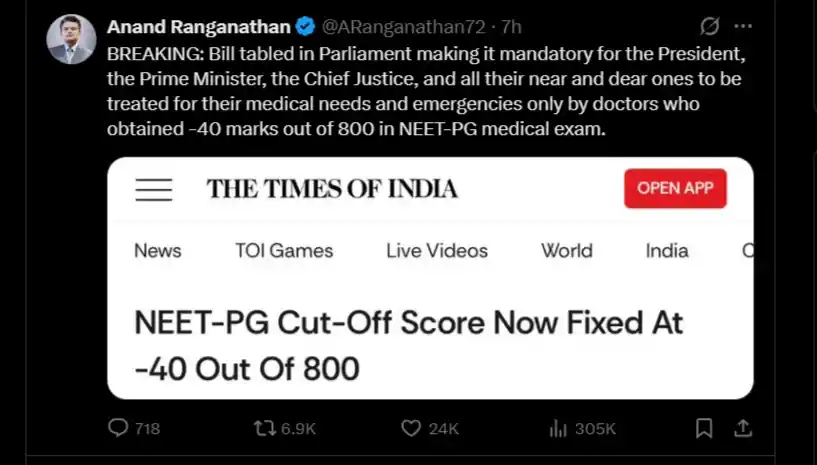
Under the revised criteria, candidates who scored as low as near-negative marks (reported around -40 out of 800) can now qualify for counselling, particularly in SC, ST, and OBC categories where the cut-off has been set at zero percentile. For general and EWS categories, the qualifying percentile was moved down to around the 7th percentile, equivalent to a much lower mark threshold than in previous years.
Officials clarify that this does not guarantee admission for these candidates; rather, it makes them eligible to participate in the counselling process. Actual seat allotment will continue to favour candidates with higher ranks once choices and preferences are submitted and processed. This distinction is critical: eligibility simply means a candidate’s name is present in the list from which seats are allotted, but rank and choice still determine whether a seat is actually offered.
Lowered Cut-Off Invites Social Media Backlash!
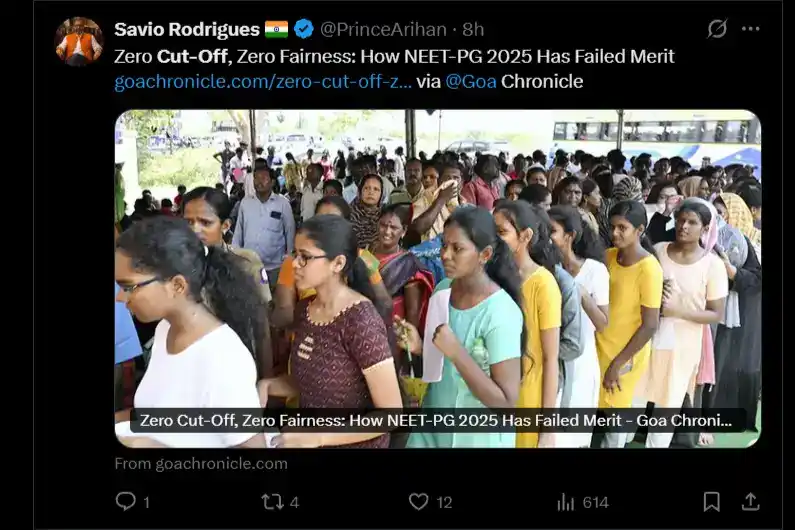
The cut-off change has sparked widespread reaction on social media and professional forums. Many voices – including students, doctors, and medical educators -have expressed outrage that the qualifying bar has been set so low, to the point that individuals with minimal or even negative scores can enter postgraduate counselling. Critics argue this undermines the competitive edge and reputation of India’s medical entrance processes, which are known for their high difficulty and rigorous standards.
Some commentators link the policy shift to mounting public frustration over long wait lists for specialist care and chronic shortages of trained doctors in rural and under-served regions. Others warn that frequent lowering of eligibility criteria could erode trust in medical education benchmarks and disadvantage future generations of students who invest years of intensive study to achieve higher ranks.
Reaction 1:
Reaction 2:
Reaction 3:

Reaction 4:

Is Cut-Off Reduction a Solution or a Symptom?
The debate over cut-off reduction is not just about whether it works to fill seats — it’s increasingly being seen as a symptom of deeper structural challenges facing postgraduate medical education in India. Persistent seat vacancies point to a mismatch between the number of MBBS graduates, specialty preferences, distribution of colleges, clinical exposure quality, and the attractiveness of certain specialities or regions. Simply lowering eligibility gives a short-term boost to counselling figures but may not address why seats go unclaimed in the first place.
Educational analysts and practitioners argue that unless factors such as workload pressures, resource constraints in smaller hospitals, and career incentives for postgraduate training are addressed, the mere expansion of the eligible pool may continue to be a cycle repeated each year.
Filling Seats at Any Cost: Is This the Underlying Objective?
The official stance is that lowering the cut-off is a pragmatic step to make the most of available educational infrastructure and ensure that healthcare systems are staffed adequately – especially in regions with acute shortages of specialists. However, sceptics contend that this expedient may signal a broader shift toward treating seat utilisation numbers as a policy objective in itself, rather than focusing on improving conditions that naturally attract high-quality aspirants to less popular courses and locations.
Some doctors worry that private colleges with poor infrastructure and limited clinical exposure benefit disproportionately from such policies, as seats that were avoided by top-ranked candidates suddenly become fillable without improving the underlying training environment. Others view frequent threshold changes as a reactive policy rather than part of a proactive strategy to strengthen medical education and bridge quantitative shortages with qualitative improvements. In summary, while the cut-off reduction has immediate practical utility in reducing vacant postgraduate medical seats and broadening the counselling pool, its implications for medical standards, healthcare delivery, and the future of medical education continue to fuel debate among policymakers, doctors, and students alike. Whether this measure serves as a one-off adjustment or heralds more systemic reforms remains a subject of ongoing discussion and scrutiny.