LATEST ARTICLES

How AI Search Is Changing Educational Content

0

For nearly two decades, the rules of content discovery remained largely unchanged. Users typed keywords into a search engine, scanned a list of blue links, clicked on a webpage, and hopefully found the information they were looking for.

Educational publishers built entire businesses around this model. Websites such as Shiksha, Careers360, Collegedunia, and CollegeDekho invested heavily in content creation, search engine optimization (SEO), and topical coverage to attract students searching for information on admissions, exams, colleges, scholarships, and careers.

However, the emergence of AI-powered search is beginning to alter this familiar journey.

Today, a student can ask ChatGPT, Gemini, Claude, or Perplexity a question in plain English and receive a direct answer within seconds. In many cases, the student may never visit the original website from which the information was sourced.

This shift raises an important question:

If AI systems increasingly become the primary gateway to information, how should educational content creators adapt?

The answer lies in a new discipline known as Generative Engine Optimization (GEO), which focuses on making content easier for AI systems to understand, retrieve, summarize, and cite.

Also Read:

What is GEO

GEO, or Generative Engine Optimization, is the process of optimizing content for AI-powered platforms such as ChatGPT, Perplexity, Gemini, Claude, and Google AI Overviews.

The rise of GEO is closely linked to the growing adoption of AI assistants. Unlike traditional search engines that provide a list of links, AI systems generate direct answers, often supported by citations and sources. Users can continue the conversation, ask follow-up questions, and explore a topic in depth without leaving the interface.

As a result, content creators are increasingly competing not only for search rankings but also for visibility within AI-generated responses. A strong GEO strategy makes content discoverable, understandable, trustworthy, and citation-worthy for AI systems.
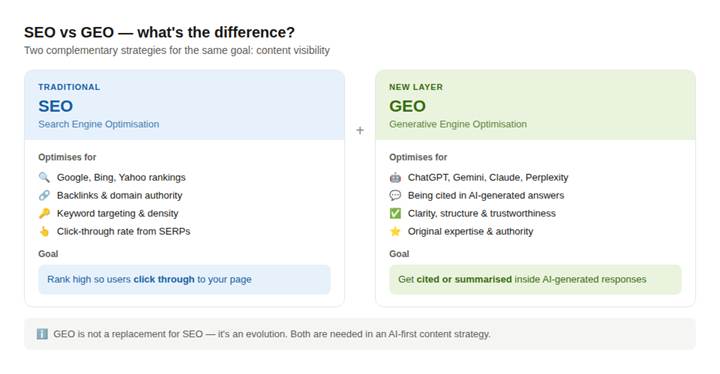
image 2

How AI Search Differs from Google Search

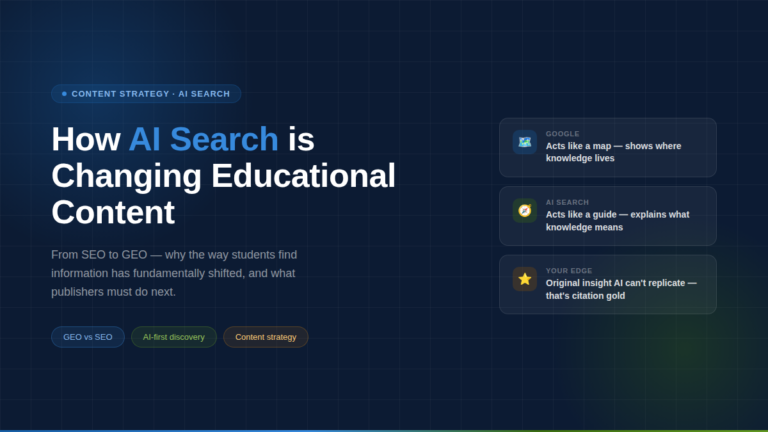
Google is like a map. It points users toward information and expects them to navigate the rest of the journey.

AI chatbots, on the other hand, act more like guides. They summarize information, explain concepts, compare options, and answer follow-up questions within the same conversation.

Put simply:

• Google says, “Here’s where knowledge lives.”
• AI chatbots say, “Here’s what that knowledge means.”

Both approaches have value, but conversational AI is increasingly becoming the preferred starting point for many information-seeking users.
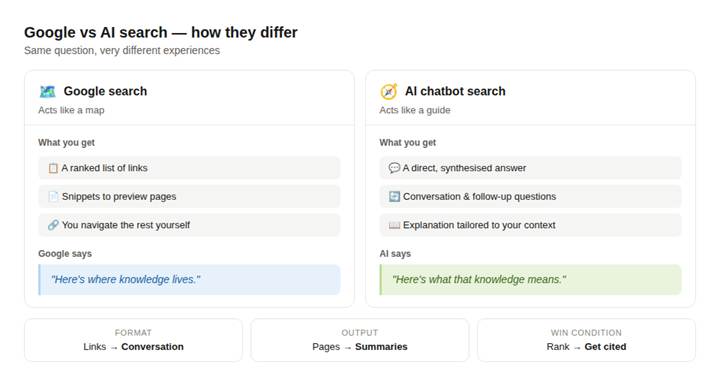
image 1

How AI Is Changing the Way Students Discover Information

Growing up in a small town in Assam during the late 1980s, access to information was largely limited to textbooks. If a concept was poorly explained, students often had to search for alternative books or rely on teachers and peers for clarification.

The internet changed that by making information widely accessible. Search engines connected students to millions of webpages, while platforms such as Wikipedia enabled deeper exploration through interconnected content.

Today, AI chatbots represent the next major shift. Students can ask complete questions, receive tailored explanations, and continue refining their understanding through conversation.

For example, a student struggling to understand the double-slit experiment can ask a chatbot specific questions, challenge the explanation, and seek alternative examples until the concept becomes clear.

AI gives students unprecedented access to explanations, examples, and personalized guidance that were previously difficult to obtain.

What This Shift Means for Education Content Creators

This shift has major implications for educational publishers and content creators. If students increasingly receive answers directly from AI systems, educational content can no longer rely solely on keyword rankings.

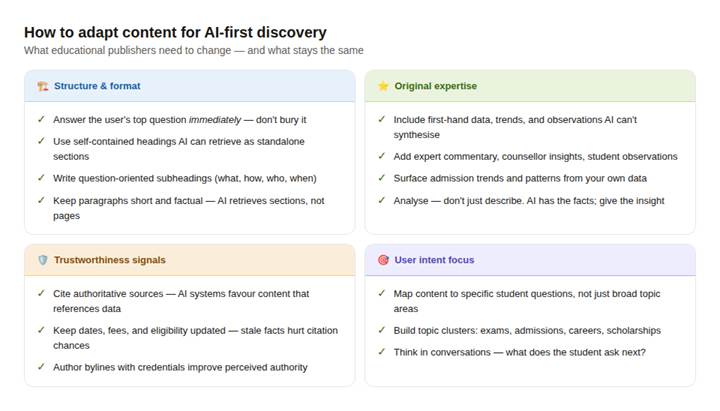
Content must be structured in ways that AI systems can easily understand, cite, and reference. At the same time, original insights, practical examples, first-hand observations, and subject expertise become increasingly valuable because they help content stand out from the vast amount of generic information already available online.

GEO is not simply about making content visible to AI systems. It is about making content understandable, trustworthy, and citation-worthy in an AI-first world.

How Content Creators Should Adapt

Until recently, content discovery strategies revolved around keywords and search rankings. While these remain important, AI-powered search is shifting the focus toward topical expertise and authority.

Educational publishers have been building topic clusters for years. Websites such as Shiksha, Careers360, Collegedunia, and CollegeDekho already organize content around exams, admissions, scholarships, placements, and careers.

The key change lies in how content is structured.

Educational content should answer user intent immediately. A page about applications should quickly address questions such as:

• Is the application window open?
• What is the fee?
• What are the important dates?
• Who is eligible?

AI systems often retrieve specific sections rather than entire pages. Therefore, content should use self-contained headings, direct answers, and question-oriented structures.

However, structure alone is not enough. Since AI can synthesize factual information from multiple sources, educational publishers must increasingly differentiate themselves through original analysis, expert commentary, admission trends, student insights, and data-backed observations.

The future belongs not to publishers who create the most content, but to those who create the most useful, trustworthy, and citation-worthy content.
image

Practical Examples

Example 1: CAT Exam Application Page

Pre-GEO Approach

Many education websites traditionally began with lengthy introductions similar to:

The Common Admission Test (CAT) is one of India’s most prestigious MBA entrance examinations conducted annually for admission to the Indian Institutes of Management (IIMs) and other leading business schools. Every year, lakhs of candidates appear for the examination hoping to secure admission to their dream MBA programme.

While factually correct, this introduction does not immediately answer the questions most students are searching for.

GEO-Friendly Approach

The article should begin by addressing the user’s primary intent.

Student QuestionDirect Answer
Is the CAT application form currently open?No. The application process closed on September 20, 2025.
Is there an application correction window?Yes. Registered candidates can edit specific fields during the correction period.
What is the CAT application fee?General category candidates must pay ₹X, while reserved category candidates pay ₹Y.

after answering these high-priority questions should the article move into detailed discussions about eligibility, important dates, exam pattern, registration steps, and preparation strategies.

The objective is not to eliminate detailed content but to surface the most useful information first. This improves user experience while also making the content easier for AI systems to retrieve, summarize, and cite.

Ultimately, GEO is not about abandoning traditional SEO principles. It is about creating content that answers questions clearly, demonstrates expertise, and is structured in a way that both humans and AI systems can easily understand, trust, and cite.

Instead of beginning with a lengthy description of the exam, answer the most important student questions first—application dates, fees, eligibility, and correction windows.

Example 2: College Admissions Content

Traditional Approach

“XYZ University is one of the leading universities in India offering a variety of undergraduate and postgraduate programmes.”

GEO-Friendly Approach

“XYZ University MBA admissions 2026 are expected to begin in October 2025. Candidates must have a bachelor’s degree with at least 50% marks and may be required to appear for CAT, XAT, or CMAT depending on the programme.”

The second version directly addresses user intent.

GEO Comparison

Evaluation CriteriaTraditional VersionGEO-Friendly Version
Answers user intent immediatelyNoYes
Provides actionable informationNoYes
Contains admission-specific factsNoYes
Easy for AI to cite or summarizeLimitedHigh
Useful to a prospective applicantLimitedHigh
Demonstrates topical relevanceGenericStrong

Example 3: Career Guidance Content

Traditional Approach

Many career-guidance articles begin with broad descriptions of a career path:

Data Science is one of the fastest-growing careers in the world. Data Scientists work with large datasets to identify patterns, generate insights, and support decision-making.

While informative, such content may not directly address the student’s actual concern.

GEO-Friendly Approach

Students often have specific questions in mind.

Student QuestionDirect Answer
Is Data Science a good career for students from a non-technical background?Yes, although additional training in statistics, programming, and data analysis may be required.
Does Data Science require coding?Most Data Science roles require some knowledge of programming, particularly Python or R.
What is the average starting salary in Data Science?Salaries vary by employer, location, and skill level, but entry-level professionals can expect competitive compensation.
Which undergraduate degrees can lead to a career in Data Science?Students from Engineering, Mathematics, Statistics, Computer Science, Economics, and related disciplines may pursue Data Science careers.

Once these questions are answered, the article can provide deeper information about skills, courses, career progression, and industry trends.

Example 4: Original Insights
Educational publishers can create value through content such as:

• Common mistakes students make during applications
• Emerging admission trends
• Student decision-making patterns
• Counsellor observations and expert analysis

Such content is harder to replicate and more likely to provide value beyond factual summaries.

Example 5: Frequently Asked Questions (FAQs)

Educational content should increasingly anticipate student questions.

For example, a CAT application page may include:

  • Can final-year students apply for CAT?
  • Can I edit my CAT application after submission?
  • Is there any age limit for CAT?
  • What documents are required during registration?

Each question can be answered in a concise, self-contained format, improving both usability and AI discoverability.
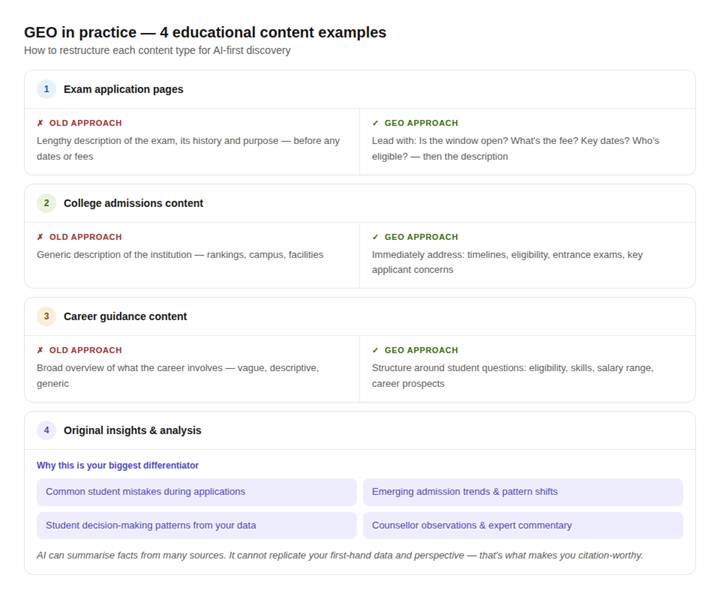
image 3

Conclusion

AI is changing not only how students search for information but also how educational content is discovered, consumed, and cited.

GEO should not be viewed as a replacement for SEO. Instead, it represents an evolution in how content is created and structured. Traditional SEO focuses on visibility and rankings, while GEO adds a new layer of optimization for AI understanding, retrieval, summarization, and citation.

As AI becomes an increasingly important gateway to information, educational publishers that prioritize clarity, expertise, trustworthiness, and user intent will be best positioned to remain visible and relevant.
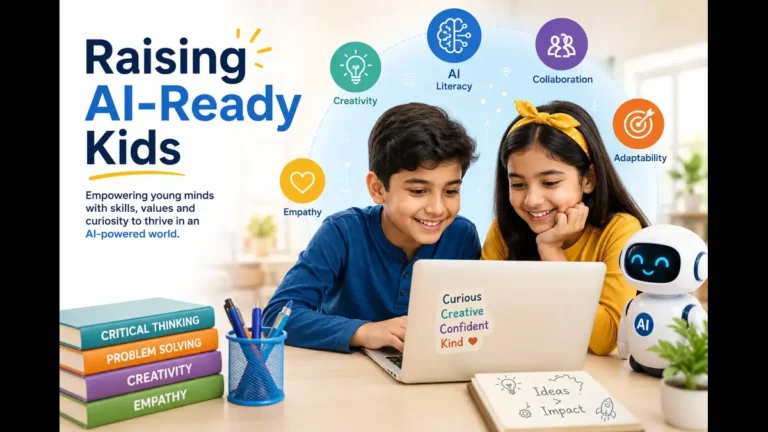
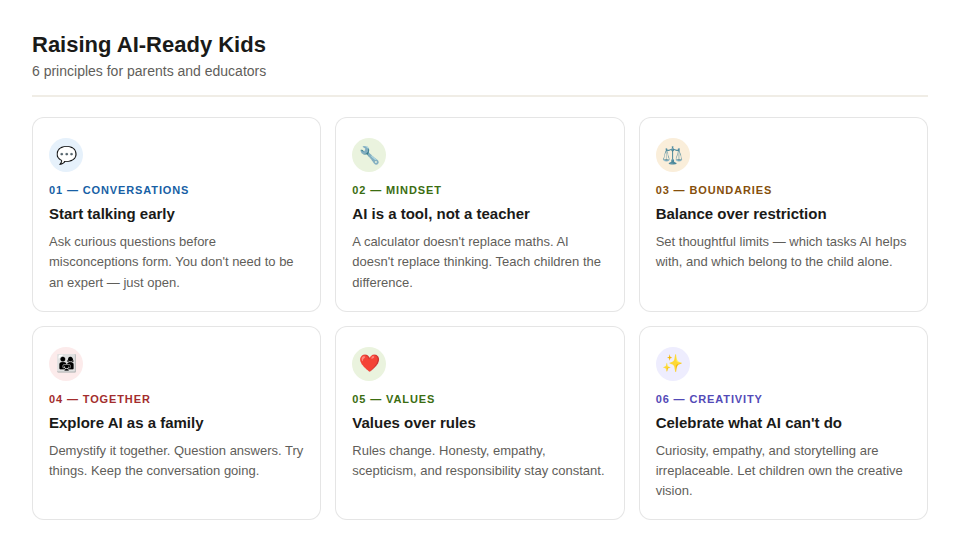
Raising AI-Ready Kids – A Practical Guide for Parents and Educators

Artificial intelligence is no longer something children will encounter one day in the future — it’s already part of their world. From smart assistants and recommendation algorithms to AI-powered tutoring tools, children are interacting with AI every day, often without realising it.

A 2024 report by Common Sense Media found that a majority of teens are already using AI tools — especially chatbots and AI-supported search — often without their parents’ awareness or any guidance from school. The question is no longer whether children will use AI. It’s whether we help them use it well.

As parents and educators, our role isn’t to shield children from AI — it’s to help them understand it, use it wisely, and grow alongside it. Here’s how to do that in a warm, practical way.

01 6 principles

Also Read:

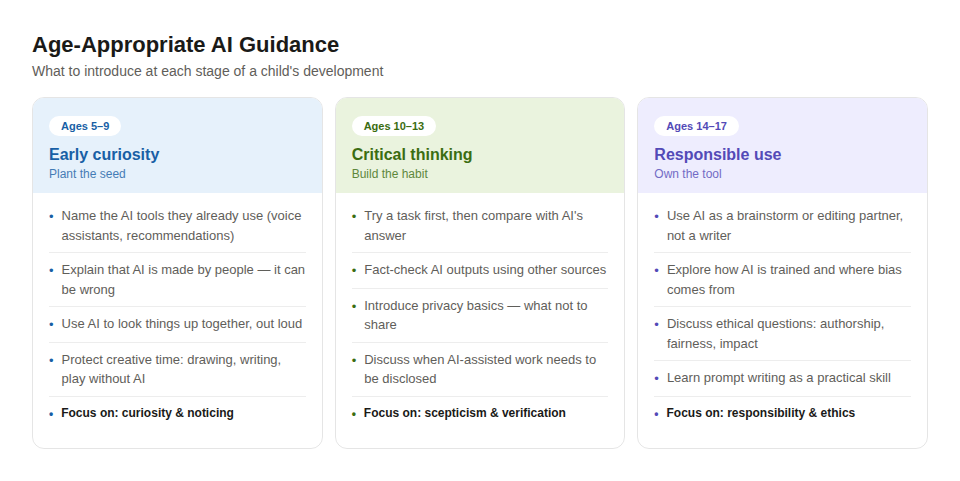
1. Start With Honest, Age-Appropriate Conversations

Children are naturally curious. Instead of waiting for them to form misconceptions, start the conversation early. You don’t need to be a tech expert — curiosity and openness are enough.

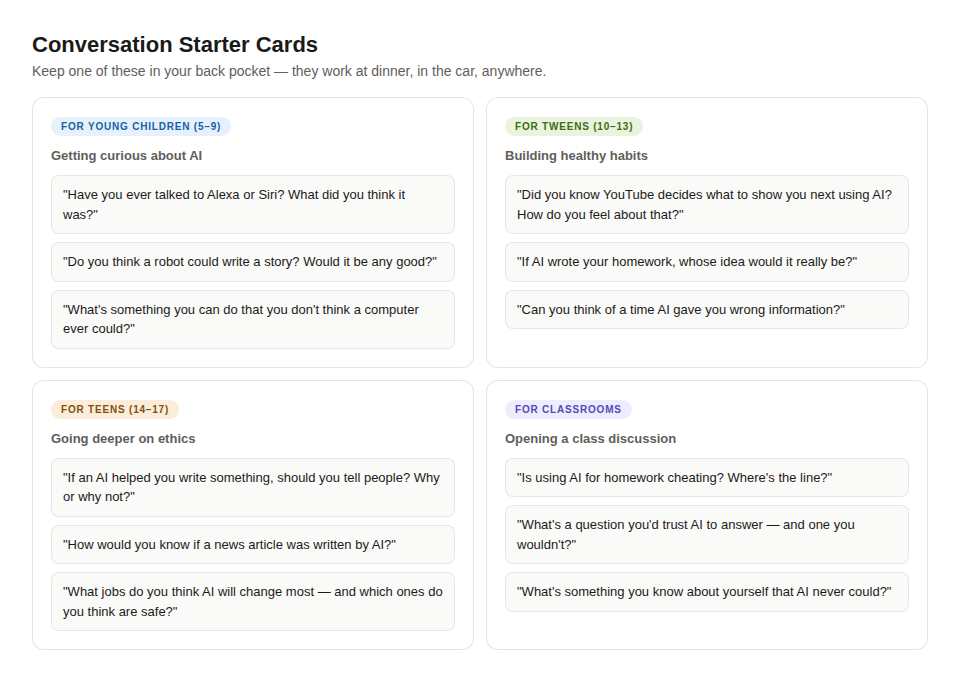
Try asking questions like:

  • “Have you ever talked to a voice assistant? What did you think it was?”
  • “Did you know YouTube and Netflix use AI to decide what to show you next?”
  • “What do you think AI can and can’t do?”

These conversations build critical thinking from the ground up and show children that it’s safe to ask questions about technology. Virginia Tech child psychologist Dr. Rosanna Breaux notes that parental monitoring of children’s AI use — much like monitoring screen time — is linked to better academic performance and social functioning. Awareness, she says, is the first and most important step.

2. Teach AI as a Tool, Not a Replacement

One of the most important mindsets to instil early is this: AI is a tool, not a teacher, friend, or authority. Just like a calculator helps with maths but doesn’t replace understanding numbers, AI tools help with tasks but don’t replace thinking.

Practical ways to reinforce this:

  • When a child uses AI to answer a homework question, ask them to explain the answer in their own words.
  • Encourage them to try a problem first, then use AI to check their reasoning.
  • Point out when AI gets things wrong — it will! — and discuss why.

The OECD’s research on AI and the future of skills highlights that as AI becomes more capable at replicating routine tasks, the skills that will matter most are those AI cannot easily replicate: creative thinking, empathy, ethical reasoning, and the ability to ask better questions. Teaching children to use AI as a tool — not a crutch — builds exactly these capabilities.

3. Set Healthy Boundaries Early

Just as we set screen time boundaries, it’s equally important to set thoughtful boundaries around AI use. The goal isn’t restriction — it’s balance.

  • Agree on which tasks AI can help with (brainstorming, checking spelling) versus tasks where independent effort matters (writing first drafts, solving maths).
  • Create ‘no AI zones’ — certain homework assignments, creative projects, or journaling where the child’s own voice is protected.
  • Discuss privacy: Common Sense Media advises that children should never share personal information — names, addresses, or photos — with AI tools, as this data can become a permanent part of the system.

In June 2025, the American Psychological Association issued a Health Advisory on AI and Adolescent Well-being, urging parents and educators to ensure children’s safety while using AI. Boundaries, the APA stresses, aren’t about fear — they’re about keeping children in the driver’s seat of their own learning.

02 age guide

4. Make AI Exploration a Family or Classroom Activity

The best way to demystify AI is to explore it together. This removes fear, builds understanding, and keeps the lines of communication open.

Ideas for parents:

  • Spend 20 minutes together asking an AI chatbot questions and evaluating the answers.
  • Try an AI art tool and discuss what’s creative versus what the AI generated.
  • Watch a short documentary about AI and discuss it over dinner.

Ideas for educators:

  • Use AI to generate a flawed essay and ask students to identify and correct the errors.
  • Assign a ‘spot the AI’ exercise where students evaluate whether content was human or AI-written.
  • Introduce prompt writing as a skill. MIT RAISE and Common Sense Media have developed free AI literacy toolkits specifically for families and classrooms — a great starting point.

5. Focus on Values, Not Just Rules

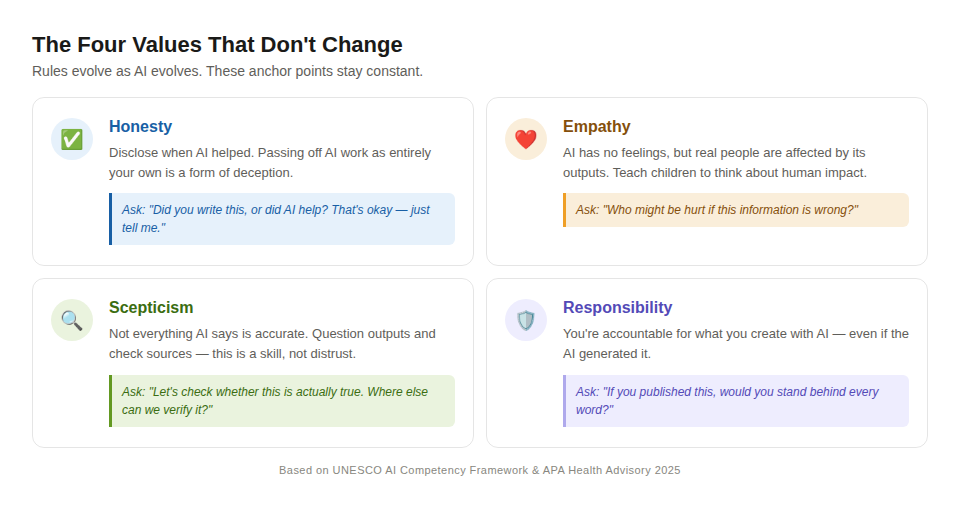
Rules change as technology evolves, but values stay constant. Ground your guidance in principles that will serve children across whatever AI landscape they face as adults.

  • Honesty: AI-assisted work should be disclosed when appropriate. Passing off AI writing as entirely your own is a form of deception.
  • Empathy: AI doesn’t have feelings, but the people affected by its outputs do. Teach children to think about the human impact of what they create with AI.
  • Scepticism: Not everything an AI says is true. Good critical thinking means checking sources and questioning outputs.
  • Responsibility: Using AI powerfully means being accountable for what you do with it.

UNESCO’s AI Competency Frameworks for Students and Teachers — launched in 2024 and now adopted across 58 countries — place ethics and values at the centre of AI education. They propose that learning to use AI responsibly is just as important as learning to use it effectively.

03 values framework

6. Celebrate Curiosity and Creativity

The skills that will matter most in an AI-driven future aren’t the ones AI is best at — they’re the uniquely human ones. Creativity, empathy, storytelling, ethical reasoning, collaboration, and curiosity are what make humans irreplaceable.

Research published in Frontiers in Digital Health (2025) and OECD education reports both point to the same conclusion: AI works best as an amplifier of human creativity and curiosity, not a substitute for it. Children who learn to guide, question, and direct AI will be far better prepared than those who simply follow its outputs.

Encourage children to use AI as a springboard for their own ideas, not a substitute for them. Let them be the creative director, the fact-checker, the editor. AI can draft a story, but only a child can give it heart.


The Bottom Line

Children who learn to use AI thoughtfully — with curiosity, discernment, and strong values — will be far better prepared for the world ahead than those who either avoid it entirely or rely on it without question.

As parents and educators, we don’t need to have all the answers. We just need to show children that asking the right questions — about AI and about everything else — is the most powerful skill of all.

04 conversation starters

If AI Is Strategic, Education Cannot Remain Peripheral

Artificial Intelligence is no longer discussed only in terms of apps, chatbots, or classroom tools. It is increasingly framed as infrastructure — economic infrastructure, security infrastructure, and productivity infrastructure.

Major economies have released national AI strategies. Public funding commitments have expanded. Private sector investment in AI research, data centers, and model development has reached unprecedented levels. AI capability is now regularly referenced in discussions about competitiveness, supply chains, defense systems, and industrial policy.

When a technology begins to occupy that kind of policy and capital space, it moves from being a trend to being treated as strategic.

If AI is indeed strategic at national and corporate levels, a serious question follows:

Can education afford to treat it as peripheral?

What “Strategic” Actually Implies

Calling something strategic is not rhetorical. It carries specific implications.

Strategic technologies typically involve:

  • Long-term capability development
  • Workforce pipeline planning
  • Research ecosystem expansion
  • Infrastructure investment
  • Coordination between state, industry, and academia

Historically, technologies such as electricity, telecommunications, and the internet were not treated merely as subjects of study. They reshaped industrial organization, labor markets, and state planning.

Current policy language around AI increasingly places it in a similar category.

Governments have articulated national missions around AI research. Industry leaders describe AI as foundational to next-generation productivity. Capital allocation reflects long-term bets rather than short-term experimentation.

If that framing holds, AI is not simply another software tool. It becomes part of the structural architecture of future economies.

Education, by design, builds long-term capability. That makes its position in this shift particularly important.

The Current Educational Position

In school systems today, AI is present — but typically in limited forms.

Common patterns include:

  • AI offered as an elective subject rather than a core requirement
  • Introductory modules focused on awareness
  • Project-based learning cycles
  • Basic data literacy components
  • Innovation or robotics labs in select institutions

Under boards such as the Central Board of Secondary Education (CBSE), Artificial Intelligence is available as a Skill Subject in Classes 9 and 10 and as an elective at the senior secondary level in schools that choose to offer it.

Policy frameworks such as the National Education Policy 2020 encourage exposure to coding and emerging technologies. Curriculum support materials have been developed by institutions including the National Council of Educational Research and Training.

These developments indicate that AI has entered formal educational structures.

But its position remains largely elective, introductory, and uneven in implementation.

That placement matters.

Peripheral vs Central: A Structural Distinction

In curriculum design, subjects occupy different statuses.

Core subjects:

  • Are mandatory.
  • Receive stable timetable allocation.
  • Are linked to assessment systems.
  • Shape academic pathways.

Peripheral subjects:

  • Are optional.
  • Depend on institutional capacity.
  • May not influence higher education eligibility.
  • Often function as enrichment rather than foundation.

At present, AI in most school systems resembles the latter more than the former.

It is visible.
It is expanding.
But it is not yet foundational.

This creates a structural tension.

If AI is treated as strategically central outside education, but structurally peripheral inside education, alignment becomes a legitimate question.

The Speed Mismatch

Industry and state investment in AI often operates on accelerated timelines.

Model development cycles are short.
Venture capital deployment is rapid.
Policy announcements respond quickly to technological breakthroughs.

Education systems function differently.

Curriculum revisions move through approval cycles.
Teacher training requires scaling.
Infrastructure rollout is uneven.
Assessment reforms are gradual.

These differences are not signs of failure. They reflect institutional design.

But they do create a potential speed mismatch.

When technological acceleration outpaces curriculum cycles, education may struggle to integrate change at the same velocity.

The issue is not whether schools are moving — they are.
The question is whether the scale and centrality of movement match the strategic framing outside the system.

Exposure vs Capability

Another structural distinction is between exposure and capability.

Exposure:

  • Introduces concepts.
  • Builds awareness.
  • Familiarizes students with terminology and tools.

Capability:

  • Requires mathematical depth.
  • Demands sustained practice.
  • Involves advanced problem-solving.
  • Connects to research ecosystems.

School-level AI, as currently structured, leans heavily toward exposure.

This is understandable. Schools serve broad populations, not specialized research cohorts.

However, if AI is to form part of long-term national capability, then exposure alone may be insufficient.

A system that introduces AI conceptually but does not strengthen foundational mathematics, statistics, and computational reasoning may produce familiarity without fluency.

That distinction becomes significant when AI is framed as economically transformative.

Where AI Meets Mathematics

Advanced AI systems rely on:

  • Linear algebra
  • Probability theory
  • Optimization methods
  • Statistical modeling

School-level AI courses, by contrast, often focus on:

  • The AI project cycle
  • Data awareness
  • Ethical discussion
  • Simplified model-building exercises

These elements are valuable. They build conceptual understanding.

But if AI remains detached from deeper mathematical rigor in mainstream pathways, students interested in advanced AI fields must rely on traditional math tracks rather than AI-labeled courses.

In that case, AI electives function more as orientation modules than as capability pipelines.

If AI is strategic, then the relationship between AI instruction and core mathematics deserves closer integration.

AI Learning and Uneven Capacity

Strategic technologies also demand infrastructure.

In education, AI integration often depends on:

  • Computer lab access
  • Reliable connectivity
  • Teacher training
  • Software resources

Where infrastructure varies, so does exposure.

If AI is peripheral, uneven access may be tolerable as an optional enrichment gap.

If AI is strategic, uneven access becomes a structural capacity issue.

This does not automatically imply crisis.
But it reframes the importance of distribution.

Strategic alignment implies not just availability, but scalability.

Rethinking Assignments in the Age of AI

AI tools increasingly influence how students complete assignments.

Generative systems can draft essays, assist coding, summarize material, and solve structured problems.

If AI becomes embedded in everyday cognitive workflows, assessment design must respond.

A peripheral subject can coexist with traditional assessment.

A strategic technology that reshapes knowledge production may require reconsideration of:

  • Originality standards
  • Problem-solving expectations
  • Evaluation methods

If education remains peripheral in this conversation, assessment systems may lag behind actual tool usage patterns.

That gap has implications for academic integrity and skill development.

Peripheral Treatment as a Transitional Phase

It is possible that AI’s current peripheral placement reflects caution rather than neglect.

Education systems often:

  • Pilot new subjects.
  • Observe outcomes.
  • Scale gradually.
  • Integrate deeper over time.

Peripheral introduction may be a transitional stage.

But transition implies direction.

If AI remains elective indefinitely while strategic narratives intensify externally, the divergence may widen.

If, however, exposure evolves into integrated mathematical and computational reinforcement, the system may realign organically.

The outcome depends on whether AI remains a labeled subject or becomes embedded across disciplines.

What Readiness Actually Requires

The real test is simple:

If AI were removed from elective lists tomorrow, would core curriculum structures still prepare students for an AI-shaped economy?

If the answer relies primarily on strong mathematics, logic, and data reasoning, then AI capability may already be indirectly supported.

If the answer depends heavily on elective exposure, the system may need deeper integration.

Strategic positioning ultimately demands coherence between policy ambition and educational architecture.

Conclusion: If AI Is Central, Education Must Reflect It

AI is increasingly treated by governments and corporations as central to economic and technological futures.

Education systems have begun responding.

But at present, the response remains largely elective, exploratory, and uneven.

If AI is strategic, education cannot remain peripheral indefinitely.

This does not require urgency rhetoric or abrupt overhaul.
It requires structural coherence.

Strategic technologies shape long-term human capital formation.
Education is the primary mechanism for that formation.

The question, then, is not whether AI appears in classrooms.

It is whether its presence reflects central alignment — or peripheral adaptation.

The answer will determine whether education mirrors strategic ambition, or trails it.

Understanding AI: A Practical Guide for School Students

Artificial Intelligence, or AI, is a term students now hear frequently — in classrooms, on social media, in news discussions, and in career conversations. Some schools offer AI as a subject. Others mention AI labs or digital innovation programs. Many students use AI-powered tools daily without always noticing.

But beyond the headlines and announcements, what does AI actually mean for a school student?

This guide explains what AI is, where you already encounter it, how it appears in school learning, and what you should realistically focus on if you are interested in understanding it better.

1. What Artificial Intelligence Actually Means

At its simplest, Artificial Intelligence refers to computer systems designed to perform tasks that typically require human intelligence.

These tasks include:

  • Recognizing patterns
  • Understanding language
  • Identifying images
  • Making recommendations
  • Learning from data

AI systems do not “think” in the human sense. They work by analyzing large amounts of data and identifying patterns within that data. Based on those patterns, they generate outputs — predictions, classifications, or responses.

For school students, the important point is this:

AI is not magic.

It is built on data, logic, mathematics, and programming.

Understanding these foundations is more important than memorizing definitions.

2. Where You Already Encounter AI

Many students use AI-powered systems every day, often without labeling them as AI.

Examples include:

  • Search engines that predict what you are typing
  • Video platforms that recommend content
  • Navigation apps that suggest routes
  • Voice assistants that respond to commands
  • Language tools that suggest corrections

These systems rely on:

  • Data collection
  • Pattern recognition
  • Statistical models
  • Continuous updates based on user behavior

Recognizing where AI operates in daily life is the first step toward understanding how it works.

3. How AI Appears in School Education

AI enters school learning in different ways depending on your board and institution.

Under the Central Board of Secondary Education (CBSE), Artificial Intelligence is offered as a Skill Subject (Code 417) in Classes 9 and 10 and as an elective in Classes 11 and 12 in schools that choose to offer it.

Schools may also introduce:

  • AI modules within Computer Science
  • Innovation or robotics labs
  • Project-based learning activities
  • Data-focused exercises

Support materials and curriculum guidance are developed with involvement from bodies such as the National Council of Educational Research and Training (NCERT), aligned with broader policy directions like the National Education Policy 2020.

However, AI is not compulsory nationwide. Availability depends on your board and your school.

At the school level, AI education usually focuses on:

  • Basic concepts
  • The AI project cycle
  • Introductory data handling
  • Ethical considerations
  • Guided practical exercises

It is foundational, not advanced research-level study.

4. What School-Level AI Typically Covers

If your school offers AI as a subject or module, you are likely to study:

1. Introduction to AI

What AI is, how it differs from regular programming, and where it is applied.

2. The AI Project Cycle

This includes:

  • Identifying a problem
  • Collecting relevant data
  • Exploring patterns
  • Building a simple model
  • Evaluating outcomes

This structure teaches systematic thinking rather than complex mathematics.

3. Data Basics

Students learn:

  • What data is
  • Types of data
  • Why quality of data matters
  • How bias can affect results

4. Ethical Awareness

Topics may include:

  • Responsible use of AI
  • Privacy considerations
  • Fairness and bias
  • Impact on society

5. Practical Activities

These might involve:

  • Beginner coding tools
  • Block-based platforms
  • Structured projects
  • Simple datasets

The emphasis is on understanding processes rather than mastering algorithms.

5. What AI in School Is Not

It is equally important to understand what AI at school level does not represent.

It does not automatically mean:

  • You are becoming a machine learning engineer.
  • You are learning advanced mathematical modeling.
  • You can skip mathematics or core science subjects.
  • You have a professional-level qualification.

School-level AI builds awareness and foundational skills. Advanced AI studies in higher education require strong mathematics, statistics, and programming knowledge.

6. Skills That Matter If You Are Interested in AI

If AI interests you, focus on building strong foundational skills.

Logical Thinking

Problem-solving and structured reasoning are essential. Practice breaking problems into steps.

Mathematics

Topics such as algebra, probability, and statistics are central to AI development. Strengthening mathematics in school is one of the most practical steps you can take.

Data Interpretation

Learn to:

  • Read graphs carefully
  • Understand patterns
  • Question conclusions

Data literacy is fundamental.

Basic Programming

Even simple exposure to programming helps. Understanding how instructions are written and executed builds clarity.

Ethical Awareness

AI systems affect people’s lives. Being aware of fairness, bias, and privacy issues is part of responsible learning.

These skills remain useful whether or not you pursue AI professionally.

7. Choosing AI as a School Subject: What to Check

If your school offers AI as an elective, consider the following:

  1. Does it carry board examination marks?
  2. How many periods per week are allocated?
  3. Is there practical lab work?
  4. Is the subject available for multiple years?
  5. Who teaches it — trained faculty or external trainers?
  6. Is prior coding knowledge required?

Understanding structure helps you make informed decisions.

8. AI and Subject Choices After Class 10

Some students wonder whether taking AI in school changes their academic pathway.

Currently:

  • Core subjects such as Mathematics and Science remain essential for advanced technical degrees.
  • AI as a school subject does not replace foundational requirements.
  • Early exposure may help clarify interest but does not determine eligibility for higher education programs.

If you are considering engineering, computer science, or data-related fields, maintaining strong performance in mathematics remains important.

9. AI Tools and Responsible Use

Students increasingly encounter AI tools that assist with writing, coding, or answering questions.

While these tools can support learning, it is important to:

  • Understand the underlying concept yourself.
  • Avoid copying without comprehension.
  • Use AI as a support tool, not a substitute for thinking.

Responsible use builds stronger long-term understanding.

10. Managing Expectations

AI is often described as transformative. However, in school education, its role is structured and gradual.

It is being introduced through:

  • Electives
  • Modules
  • Labs
  • Projects

Depth varies by institution.

Students should approach AI learning as:

  • Skill-building
  • Concept development
  • Exposure to emerging technology

Rather than as immediate specialization.

11. A Balanced Approach

For most school students, the balanced approach includes:

  • Strengthening mathematics and reasoning
  • Developing data awareness
  • Learning basic coding
  • Exploring AI electives if available
  • Participating in projects and competitions
  • Staying curious but grounded

AI is interdisciplinary. It connects mathematics, computer science, ethics, economics, and even humanities.

Understanding this broad connection is more useful than focusing only on terminology.

Final Takeaway

Artificial Intelligence is now part of school conversations and, in many institutions, part of the curriculum. But at the school level, it remains foundational and introductory.

For students, the key is not to treat AI as a shortcut or a trend. Instead:

  • Understand the basics.
  • Build strong core skills.
  • Ask informed questions about your curriculum.
  • Use AI tools responsibly.

AI in school is about learning how systems recognize patterns, use data, and solve structured problems. Developing clarity in these areas prepares you not only for AI-related studies, but for a wide range of future academic and professional paths.

Understanding AI begins not with advanced algorithms — but with strong fundamentals and thoughtful learning.

From Electives to Labs: How Schools Are Integrating AI into the Curriculum

Artificial Intelligence is now appearing in school prospectuses, college brochures, and subject lists. Some institutions advertise AI electives. Others mention AI labs or innovation programs.

But these labels can mean different things.

In one school, AI may be a full board subject with exams. In another, it may be a short module inside computer science. In a college, it may appear as a lab component or a credit-bearing paper.

So when an institution says it has “integrated AI,” what does that actually involve for a student?

This guide explains how AI is being added to courses today — and how to understand what that means for your learning.

1. AI as a Standalone Elective Subject

One of the most visible forms of integration is introducing AI as an elective.

In school education, the Central Board of Secondary Education (CBSE) offers Artificial Intelligence as a Skill Subject (Code 417) in Classes 9 and 10, and as an elective in Classes 11 and 12.

When AI is introduced this way, students typically experience:

  • A fixed timetable period
  • A defined syllabus
  • Board-approved textbooks or study material
  • Internal assessment and practical work
  • Final examination or project evaluation

At the higher education level, universities may introduce:

  • AI as a core paper in Computer Science
  • AI as an elective open to multiple streams
  • Minor or specialization tracks in Artificial Intelligence
  • Credit-bearing AI foundation courses

In this model, AI is treated like any other academic subject. It carries marks or credits and becomes part of the student’s formal academic record.

What students should check:

  • Does the subject carry board marks or university credits?
  • Is it theory-heavy, practical-heavy, or balanced?
  • Does it require prior coding knowledge?

An elective model usually signals structured curriculum and assessment.

2. AI Embedded Inside Existing Courses

Not every institution creates a new subject immediately. Many integrate AI into existing subjects.

For example:

  • AI modules inside Computer Science
  • Data analytics chapters in commerce or economics
  • AI tools used in media, design, or management courses
  • Introductory machine learning concepts within statistics courses

In such cases, AI may appear as:

  • A unit within a larger syllabus
  • A project component
  • A case-study-based module
  • A practical application section

Here, AI is not a separate subject on your marksheet. Instead, it becomes part of the course you are already studying.

This model is often easier for institutions to adopt because it does not require creating a new examination structure. It modifies an existing syllabus.

For students, this means:

  • You may gain exposure without choosing a new subject.
  • The depth may be limited compared to a full elective.
  • Assessment may be integrated into existing subject evaluation.

If your prospectus mentions “AI-enabled curriculum,” check whether it is a standalone paper or a module within another course.

3. AI Through Labs and Innovation Spaces

Another common integration model is through labs rather than lecture-based courses.

Schools and colleges are setting up:

  • AI and robotics labs
  • Innovation or tinkering labs
  • Digital learning labs
  • Applied data labs

In schools, these labs may operate as:

  • Weekly practical sessions
  • Club-based activities
  • Project periods
  • Interdisciplinary innovation hours

In higher education, labs may involve:

  • Programming assignments
  • Dataset analysis exercises
  • Applied machine learning projects
  • Capstone projects

The lab model emphasizes hands-on learning. Students may work with:

  • Beginner-friendly AI platforms
  • Coding environments
  • Guided datasets
  • Real-world simulation problems

However, the presence of a lab does not automatically mean formal academic credit.

Students should ask:

  • Is lab participation mandatory or optional?
  • Is it graded?
  • How many hours per week are allocated?
  • Is it supervised by trained faculty?

A well-equipped lab with structured guidance differs from occasional demonstration sessions.

4. AI Through Short-Term Certifications and Add-On Courses

Some institutions integrate AI through certificate programs.

These may include:

  • School-level AI foundation certificates
  • University add-on courses
  • Weekend AI workshops
  • Bridge programs for beginners

These programs are often:

  • Short duration (4–12 weeks)
  • Project-based
  • Conducted in partnership with training providers
  • Separate from core academic credit

In such cases, AI integration exists but functions as supplementary learning.

Students receive exposure and possibly a certificate, but it may not affect their board marks or university CGPA.

Before enrolling, students should clarify:

  • Does the certificate carry academic credit?
  • Who conducts the course — internal faculty or external trainers?
  • Is it mandatory or optional?
  • What level of prior knowledge is expected?

Certificate-based integration expands access but differs from curriculum-based integration.

5. Interdisciplinary AI Modules

AI is also entering non-technical streams through interdisciplinary modules.

For example:

  • Business analytics modules in commerce programs
  • AI ethics discussions in humanities
  • Data visualization in social sciences
  • AI tools in journalism or media studies

In these cases, AI is not treated as a technical subject alone. Instead, it is introduced as a tool or concept relevant to the field.

Students may:

  • Study how AI affects decision-making
  • Analyze data trends
  • Examine ethical implications
  • Use AI-assisted tools for research or design

This integration broadens exposure beyond science and engineering streams.

Students should evaluate:

  • Is the module conceptual or skill-based?
  • Does it involve tool usage or theoretical discussion?
  • Is there practical application or only case studies?

6. How Curriculum Integration Typically Happens

While students do not see the administrative process directly, integration usually follows structured steps.

In schools:

  • Boards approve subject frameworks.
  • Schools apply to offer the subject.
  • Teachers undergo training.
  • Infrastructure readiness is verified.

In higher education:

  • Academic councils approve new courses.
  • Departments design syllabi.
  • Credits are assigned.
  • Faculty recruitment or training is arranged.

Bodies like the National Council of Educational Research and Training (NCERT) develop support materials and training resources aligned with national policy directions such as the National Education Policy 2020.

This structured process explains why integration differs between institutions. Some adopt early; others wait until infrastructure and faculty capacity are in place.

7. What AI Integration Does Not Automatically Mean

It is important for students to interpret announcements carefully.

If a school or college says it has “integrated AI,” it does not necessarily mean:

  • Advanced machine learning training
  • Industry-level specialization
  • Replacement of core mathematics or programming foundations
  • Guaranteed career advantage

At the school level especially, AI integration is foundational and introductory.

It focuses on:

  • Awareness
  • Basic data understanding
  • Logical problem-solving
  • Responsible technology use

Depth increases at higher education levels but still depends on course design.

8. Questions Students Should Ask Before Choosing AI

To understand how meaningful the integration is, students can use this checklist:

  1. Is AI a full subject or a module?
  2. Does it carry examination marks or academic credits?
  3. Is there structured practical work?
  4. How many hours per week are allocated?
  5. Who teaches the course?
  6. Is prior coding required?
  7. Does it continue for more than one academic year?

These questions help distinguish between exposure and sustained academic engagement.

9. Differences Between School and Higher Education Integration

At the school level:

  • AI is usually introductory.
  • Focus is on awareness and basic application.
  • Mathematics remains foundational for advanced study.

At the university level:

  • AI may become mathematically and technically intensive.
  • Programming and statistics are often prerequisites.
  • Integration may extend into research and specialization.

Understanding this difference prevents unrealistic expectations at early stages.

10. The Current Pattern

Across institutions, AI integration currently follows a mixed pattern:

  • Elective subjects in secondary and senior secondary classes.
  • AI modules inside existing subjects.
  • Dedicated labs and innovation spaces.
  • Certificate-based programs.
  • Interdisciplinary exposure.

There is no single uniform national model.

Integration depends on board policy, institutional readiness, faculty training, and infrastructure.

Final Takeaway

Artificial Intelligence is being added to courses in multiple ways — through electives, embedded modules, labs, certifications, and interdisciplinary teaching.

For students, the key is not just whether AI is present, but how it is present.

A standalone elective with board assessment offers structured engagement.
A module inside another subject offers limited exposure.
A lab provides hands-on experience.
A certificate program adds supplementary learning.

Understanding these distinctions helps you make informed academic choices.AI integration in education is expanding — but its form varies.
Checking the structure behind the label is the most practical step you can take.

Is AI Taught in Your School? A Guide by Class and Board

Artificial Intelligence (AI) is increasingly visible in conversations about careers, technology, and the future of work. But a practical question for students and parents is simpler: Is AI actually being taught in Indian schools? If yes, from which class, and under which board?

The short answer is: Yes, AI is being taught in many schools — but not uniformly across all boards or states.

Its availability depends on your board, your school’s subject offerings, and the grade level.

This guide breaks down the current, observable structure of AI in school education in India — class by class and board by board — so you can check where your school stands.

AI in CBSE Schools

The most structured rollout of AI as a subject has taken place under the Central Board of Secondary Education (CBSE).

CBSE formally introduced Artificial Intelligence as a skill subject beginning in the 2019–20 academic session.

Classes 6 to 8: Foundational Exposure

In middle school, AI is not typically offered as a standalone board examination subject. Instead, schools may introduce:

  • Basic concepts of AI
  • Computational thinking
  • Logical problem-solving
  • Introductory data awareness
  • Ethics and responsible use of technology

These modules are often integrated into skill education, computer applications, or internal innovation programs. The level is introductory and designed to build awareness rather than technical mastery.

What this means for students:
If you are in Classes 6–8 in a CBSE school, AI exposure may exist, but it may not appear as a formal board subject. Ask whether your school has integrated AI modules under skill education.

Classes 9 and 10: AI as a Skill Subject (Code 417)

At the secondary level, AI becomes more formally structured.

CBSE offers Artificial Intelligence (Subject Code 417) as an optional Skill Subject for Classes 9 and 10.

It can be chosen in place of another skill-based subject, depending on what the school offers. It is assessed under CBSE’s board examination framework.

The syllabus typically includes:

  • Introduction to AI
  • AI project cycle
  • Data literacy basics
  • Machine learning concepts (at an introductory level)
  • Ethics in AI
  • Practical projects

Assessment includes both theory and practical components.

Important:
Not every CBSE school is required to offer AI. Schools must apply for and receive approval to run the subject. Availability depends on infrastructure, trained teachers, and administrative approval.

What students should check:

  • Does your school offer Subject Code 417?
  • Is it available for both Class 9 and 10?
  • Are there lab or project requirements?

Classes 11 and 12: AI as an Elective

At the senior secondary level, CBSE offers Artificial Intelligence as an elective subject.

This version goes deeper than the Class 9–10 syllabus and may include:

  • Advanced data handling concepts
  • Basics of supervised and unsupervised learning
  • AI project lifecycle
  • Applications across sectors
  • Ethical considerations
  • Hands-on implementation

Like other elective subjects, students choose it based on stream combinations and school offerings.

Availability Note:
Again, offering the subject depends on whether the school has opted to introduce it and meets CBSE requirements.

The Role of NEP 2020

The National Education Policy 2020 (NEP 2020) encourages the introduction of coding and exposure to emerging technologies from the middle school level onward.

The policy framework promotes:

  • Computational thinking from Class 6
  • Integration of digital skills
  • Exposure to emerging fields, including AI

However, NEP sets direction. Implementation depends on boards, state governments, and schools.

Key clarification:
NEP 2020 does not make AI compulsory nationwide. It provides policy encouragement for integration.

NCERT’s Role in Curriculum Support

The National Council of Educational Research and Training (NCERT) has developed:

  • AI awareness materials
  • Teacher training modules
  • Manuals and guides
  • Support content aligned with digital literacy

These materials support schools and boards implementing AI-related curriculum components.

NCERT’s involvement strengthens the academic framework, but it does not automatically mean every school is running AI as a subject.

What About State Boards?

AI rollout under state boards varies significantly.

Some states have introduced:

  • AI electives at the secondary level
  • Coding and robotics programs
  • Technology skill subjects that include AI modules
  • Innovation labs in government schools

However, unlike CBSE’s centralized subject code system, state-level implementation differs by region and may change year to year.

In many state boards:

  • AI may be part of computer science.
  • AI may be offered only in select model schools.
  • AI may exist as a pilot program.

If you are in a state board school:

  • Check the official subject list for Classes 9–12.
  • Confirm whether AI is an examinable subject or an enrichment module.
  • Ask whether it counts toward board examination marks.

Private and International Curriculum Schools

Schools affiliated with international boards such as IB or Cambridge may integrate AI under:

  • Computer Science
  • Digital Societies
  • Technology electives
  • Interdisciplinary projects

However, naming conventions and subject structure differ.

AI may appear:

  • As a module inside Computer Science
  • As a project-based learning component
  • As part of digital innovation labs

Students should review the subject guide specific to their board.

Is AI Compulsory in India?

No.

AI is not a compulsory subject nationwide at any grade level.

It remains:

  • Optional
  • Skill-based
  • Elective
  • School-dependent

The rollout is structured in some boards (like CBSE) but discretionary in availability.

What Does AI in School Actually Involve?

One common misconception is that AI in school means advanced programming or complex mathematics.

At the school level, AI education typically includes:

1. Conceptual Understanding

  • What AI is
  • Where it is used
  • How machines learn patterns

2. The AI Project Cycle

  • Problem identification
  • Data collection
  • Data exploration
  • Modeling basics
  • Evaluation

3. Data Awareness

  • Understanding datasets
  • Simple data handling
  • Recognizing bias

4. Ethical Awareness

  • Responsible AI
  • Data privacy
  • Impact on society

5. Practical Work

  • Simple projects
  • Block-based tools
  • Guided experiments

The focus is foundational and application-oriented rather than mathematically intensive.

Why Availability Differs Between Schools

AI as a subject requires:

  • Trained teachers
  • Computer labs
  • Software access
  • Project evaluation capacity
  • Board approval (in CBSE’s case)

Schools that lack infrastructure may not introduce it immediately.

This explains why two schools under the same board may differ in offerings.

How Students Can Check Their School’s Status

If you want clarity, here are practical steps:

  1. Review the subject list for your class on your school website.
  2. Look for Subject Code 417 (if CBSE).
  3. Ask the academic coordinator whether AI is examinable.
  4. Confirm assessment format — theory, practical, or project-based.
  5. Check senior secondary combinations if you plan to take it in Class 11 or 12.

Availability can change annually based on school decisions.

Does Taking AI in School Matter for Higher Education?

At present:

  • AI at the school level builds foundational familiarity.
  • It does not replace core mathematics or computer science requirements for university programs.
  • It may help students explore interest areas early.

Admission criteria for undergraduate engineering or AI-related degrees continue to rely primarily on mathematics and science performance.

AI as a school subject should be seen as exposure and skill-building rather than a specialized professional qualification.

The Current Status: A Snapshot

Here is the current observable picture:

  • Class 6–8: Introductory AI exposure in some CBSE and other schools.
  • Class 9–10: Optional AI Skill Subject under CBSE (Code 417); variable state board availability.
  • Class 11–12: Elective AI subject in CBSE and select schools.
  • Nationwide: Not compulsory.
  • State Boards: Mixed rollout.
  • Private Schools: Often project-based or elective integration.

AI education exists — but it is not yet universal.

What This Means for Students Today

If you are interested in AI:

  • Check availability early (Class 8 if planning for Class 9 subject choice).
  • Understand that infrastructure varies.
  • Treat AI as a complementary skill.
  • Continue strengthening mathematics and logical reasoning.

If your school does not offer AI as a subject, you are not at a disadvantage academically. Exposure can also come through coding clubs, competitions, or online platforms.

Final Takeaway

Artificial Intelligence has entered the Indian school curriculum in a structured way under CBSE and in varied forms across other boards. It is available from middle school exposure to senior secondary electives — but it is not universal or mandatory.

The key question is not whether AI exists in the system.
It is whether your school offers it, at which class level, and in what format.

Checking that is the most practical first step.

A National AI Tutor Without a National AI System

Recently, the government introduced Bharat Bodhan AI, a plan to use artificial intelligence in everyday studying — explaining lessons, giving practice questions, checking answers, and assisting teachers in classrooms. The proposal goes beyond providing digital material. It suggests that software can guide learning itself: identifying weaknesses, adapting explanations, and supporting teachers across subjects.

This is not a small promise.
It does not say education will become more accessible.
It says education will become more intelligent.

Improving access is a logistical task. Improving understanding is an institutional one. Understanding depends on feedback quality, exam expectations, teacher judgement, and long-term correction of mistakes — the most difficult parts of education to standardise.

A system claiming to improve understanding therefore depends less on software and more on the academic and technical ecosystem surrounding it.

Opinion

Bharat Bodhan AI is being presented as an educational transformation, but the supporting ecosystem — research depth, institutional integration, long-term funding, and independent evaluation — is still developing. The initiative therefore describes a level of capability the system intends to build rather than one it already possesses. The issue is not whether the reform is useful, but whether the scale of its claim matches the maturity of the structure behind it.

Access is easy. Understanding is slow.

For two decades, education reforms largely focused on access: more schools, more seats, online courses, recorded lectures, and open platforms. These changes worked within the limits of administration — making content available.

AI shifts the promise.
It moves from giving information to judging comprehension.

A recorded lecture works once created. An AI explanation must work repeatedly, for millions of mistakes, across boards and languages. It must recognise why an answer is wrong, not just that it is wrong.

To do this reliably, a system needs continuous correction:

student attempts → system analyses → educators review → model adjusts → student attempts again

Without this loop, the tool becomes a practice generator rather than a learning guide.

The credibility of Bharat Bodhan AI depends entirely on whether such a loop already operates at national scale.

The pattern of early declaration

Large public initiatives in India often begin by describing a future condition at launch. Over time, reality moves toward it, but more slowly and unevenly.

Digital education platforms expanded access to lectures nationwide. Yet independent learning assessments repeatedly showed comprehension improvements far smaller than access improvements. The technology solved distribution first; behavioural change lagged.

Expansion of higher-education institutions increased capacity significantly, but research output and academic culture remained concentrated in a limited set of institutions. Infrastructure scaled faster than intellectual ecosystems.

These examples are not failures. They show a pattern: announcements describe systemic transformation; implementation delivers partial change first.

Bharat Bodhan AI makes a larger claim than both — not access, not expansion, but improved learning — and therefore demands stronger evidence before declaration.

Infrastructure: pilots are not permanence

AI systems are often impressive in controlled environments. Education infrastructure must work in uncontrolled ones — millions of students, unpredictable questions, changing syllabi.

A national AI tutor must be continuously maintained:

  • retraining when curriculum changes
  • correcting incorrect reasoning
  • monitoring accuracy across languages
  • updating daily

If the country is still expanding computing capacity and maintenance teams while intelligent education is announced nationwide, the announcement describes the target condition rather than the operating one.

A tool can be launched quickly.
A reliable system must survive routine use indefinitely.

The research gap

Countries leading AI transformation produce educational knowledge alongside deploying tools. Universities study student misconceptions, publish findings, and refine systems through continuous academic involvement.

If teachers and researchers do not shape the system, AI remains external assistance rather than internal capability. The education system uses intelligence rather than generating it.

This distinction matters because learning patterns differ across boards and exam formats. Only ongoing research can align AI with these realities. Without it, the system remains general-purpose guidance layered onto education.

Bharat Bodhan AI implies research-driven adaptation while the research ecosystem around it is still forming.

Adoption outruns pedagogy

Technology adoption is immediate; teaching change is gradual.
A platform can reach every school within months. Teaching methods evolve over years.

Teachers trust tools only after repeated accuracy. Students rely on them only after consistent usefulness. Exam systems shape both behaviours.

Past digital initiatives showed this clearly: usage rose rapidly, but classroom practice changed slowly. The scale of adoption exceeded the scale of transformation.

AI will likely follow the same path. Availability will expand first; educational change will lag.

Calling the first the second creates a mismatch between description and reality.

The ecosystem question

Technological fields mature when multiple actors interact — researchers, startups, companies, and institutions correcting each other’s work. This diversity produces reliable systems.

A single centrally deployed platform spreads fast but evolves slowly because feedback channels are limited. Education varies too widely for one development path to capture all patterns.

Without a broad ecosystem, improvement plateaus early. The system becomes stable but not transformative.

The difference is between distributing a tool and cultivating a discipline.

Funding signals seriousness

Projects introduce technology. Fields sustain it.

Educational AI requires years of failure and revision. Models must be replaced repeatedly before stabilising. If progress depends on a scheme cycle rather than continuous research investment, the country is entering a field rather than operating at its frontier.

The announcement therefore marks intention rather than completion.

Measurement determines credibility

If learning improves, the improvement must be visible:

  • fewer conceptual errors over time
  • better performance on unfamiliar questions
  • improved retention

Independent evaluation is essential. Without it, success becomes assumed because the system exists.

Repeatedly equating introduction with achievement weakens trust. Citizens begin to treat major announcements as signals of direction rather than evidence of change.

Bharat Bodhan AI risks entering this category unless its educational impact is transparently measured.

What the system will actually do

AI assistance can help meaningfully:

  • faster explanations
  • extra practice in underserved areas
  • teacher workload reduction

These improvements matter. But they improve operation within the existing structure. They do not immediately transform how education functions.

The claim suggests transformation. The preparation supports assistance.

Why this distinction matters

Calling incremental improvement transformation does not stop progress. It changes expectations. When outcomes appear modest, the reform looks disappointing even when beneficial.

More importantly, it blurs the difference between adopting technology and possessing capability.

Adoption shows willingness. Capability shows readiness.

Educational transformation depends on the second.

Conclusion

Bharat Bodhan AI points toward a future in which learning is guided by responsive systems and continuous feedback. That future may well come.

But the surrounding ecosystem — stable infrastructure, research integration, distributed development, and independent evaluation — is still developing.

The initiative therefore marks the beginning of a journey rather than its completion.

The question is not whether artificial intelligence will enter education.
The question is whether its arrival is being described in advance.Adopting AI shows movement.
Building the system behind it shows arrival.

Engineering Colleges Are Being Used to Park Students, Not Prepare Them

Why many Tier-2 and Tier-3 institutions have quietly changed their role

Every year, millions of students enter engineering colleges in India with a simple expectation: that these institutions will prepare them for a working life. Not guarantee success, but at least provide direction, grounding, and a realistic pathway forward.

For a small group of colleges, this still happens.
For a much larger group, something else is happening instead.

Many engineering colleges today—especially Tier-2 and Tier-3 institutions—are being used to park students. Not to fail them outright, but to hold them safely inside the system while deeper problems remain unresolved.

This is not about bad intentions.
It is about what the system now relies on these colleges to do.

Also Read:

Parking is different from preparing

To “park” someone is not to abandon them. It is to delay movement.

These colleges absorb:

  • excess demand for higher education,
  • the pressure of youth unemployment,
  • and the social expectation that a degree must follow school,

without being required to convert that intake into clear professional outcomes.

Students remain enrolled, families remain hopeful, institutions remain functional. The system stays stable. But preparation—the hard work of aligning education with real futures—quietly moves to the background.

This does not apply to all colleges

It is important to be precise.

Tier-1 engineering institutions in India, which educate a small fraction of students, still provide:

  • strong academic foundations,
  • credible signaling to employers,
  • and relatively clear post-graduation pathways.

The pattern described here is concentrated in Tier-2 and Tier-3 colleges, which admit the overwhelming majority of engineering students.

These institutions operate under very different conditions:

  • large intakes,
  • limited industry linkage,
  • and almost no serious penalty for weak graduate outcomes.

That difference matters.

Expansion without responsibility

Over the past decade, engineering education has expanded steadily. Seats have increased. New engineering colleges have opened. Intake numbers remain high even during economic slowdowns.

What has not expanded at the same pace is responsibility for outcomes.

Colleges are rarely evaluated on:

  • where graduates actually end up,
  • how many leave engineering altogether,
  • or how much additional private effort is needed after graduation.

Accreditation systems focus heavily on:

  • infrastructure,
  • documentation,
  • and formal compliance,

not on whether students leave with usable direction.

In such a system, enrolling students is rewarded.
Reducing intake to protect quality is punished.

Parking becomes rational.

Also Read:

Where the risk goes

When preparation fails, the cost does not disappear.
It simply moves.

Today, the burden of correction lies almost entirely with the student:

  • learning new skills on their own,
  • paying for certifications,
  • spending years in trial-and-error career navigation.

Institutions continue to function normally. Degrees continue to be issued. The system does not register failure—only the individual does.

This is the clearest sign of a parking structure: the system stays protected while individuals absorb uncertainty.

Degrees as time-buying devices

For many students, these colleges function less as launchpads and more as time-buying spaces.

Four years of enrollment:

  • delays entry into a weak job market,
  • maintains social legitimacy,
  • and postpones difficult questions about work and identity.

Time itself is not worthless. But time without structured preparation is costly—financially, emotionally, and psychologically.

When education mainly buys time instead of building capability, it stops being developmental and starts being custodial.

Why this arrangement persists

This system survives because it quietly serves everyone involved:

  • The state avoids confronting limited job absorption.
  • Institutions survive through intake-based economics.
  • Employers externalize training and filtering costs.
  • Families hold onto hope without immediate collapse.

No single actor needs to say this out loud.
The structure speaks through what it allows—and what it never penalizes.

What this argument is not

This is not a claim that students are lazy or colleges are useless.
Many graduates succeed—but largely through personal adaptation, not institutional design.

If these colleges were truly built around preparation, we would see:

  • tighter alignment between intake and opportunity,
  • enforced accountability for graduate outcomes,
  • honest signaling about what pathways are realistic.

We do not see this consistently.

The cost of not naming the problem

As long as we avoid naming this parking function, reform stays shallow.

We keep talking about:

  • employability,
  • skill gaps,
  • curriculum tweaks,

while ignoring the deeper issue: the system is using enrollment itself as a way to manage pressure, instead of redesigning pathways.

Until that is acknowledged, responsibility will continue to flow downward—toward students who are told to endlessly “adapt” inside a structure that refuses to change.

A harder question than expansion or contraction

The real question is not whether engineering education should grow or shrink.

It is this: What is the system willing to be accountable for?

If colleges are expected only to enroll and certify, parking will continue.
If they are expected to prepare students for plausible futures—and be judged accordingly—the structure must change. Avoiding that choice keeps things calm.
It does not keep them honest.

Read More:

What Nvidia’s Bet on OpenAI Means for Education

A student preparing for an exam uses ChatGPT to understand a topic that did not make sense in class. Another uses it to improve a draft. A third debugs code with AI help. At the same time, AI is already being used in other parts of education — to design quizzes, personalise practice questions, flag assignments for review, and generate teaching material.

Together, these uses are changing how learning happens. Studying is no longer limited to textbooks and lectures. Coursework is no longer designed only for human-only effort. Assessment is no longer blind to the presence of AI tools.

As these changes settle in, education systems begin to adapt around them. Assignments change. Expectations shift. What counts as independent work quietly evolves.

It is in this context that a recent development matters. Nvidia has announced plans to invest billions of dollars in OpenAI, whose systems already sit behind many of the AI tools used in education. OpenAI’s future systems are also being built to run primarily on Nvidia’s machines, making such tools easier to deploy widely and continuously across platforms.

For education, this does not change whether AI will be present. That is already the reality. It changes how deeply AI is likely to be built into learning environments — into study tools, teaching workflows, and assessment design.

Once that happens, AI stops being something education reacts to. It becomes something education assumes.

Also Read:

What OpenAI is today

OpenAI is best understood not as a single product, but as a general-purpose AI platform.

Its systems are already used—directly or indirectly—for:

  • answering questions in natural language
  • summarising and generating text
  • writing and debugging code
  • analysing data
  • creating practice problems, explanations, and examples

These capabilities matter for education because they overlap with core academic activities: reading, writing, reasoning, and problem-solving.

At the same time, OpenAI’s systems have clear limits:

  • They can be confidently wrong
  • They reflect the data they were trained on
  • They do not “understand” context the way humans do
  • They are constrained by cost, speed, and availability

Until now, these limits have acted as natural brakes on how deeply AI could be embedded into education systems.

Why computing power matters more than it sounds

AI systems like those built by OpenAI are not limited mainly by ideas. They are limited by resources.

To work well at large scale, they require:

  • enormous numbers of specialised chips
  • constant electricity and cooling
  • fast communication between machines
  • ongoing upgrades as models grow larger

This is where Nvidia comes in.

Nvidia does not design AI models. What it controls is the capacity to run them reliably, quickly, and continuously—for millions of users at the same time.

Without this capacity:

  • AI tools slow down under heavy use
  • access becomes expensive or restricted
  • integration across platforms becomes difficult

With it:

  • AI can be embedded into everyday software
  • response times remain fast even at scale
  • costs per user fall over time

This difference—between AI that exists and AI that can be used everywhere—is crucial for education.

Also Read:

What changes when OpenAI and Nvidia coordinate closely

When the organisation building AI models and the organisation supplying the machines those models run on operate in close alignment, three things become more likely.

1. Faster rollout of new capabilities

New features do not have to wait for infrastructure to catch up. They are designed with scale in mind from the beginning.

2. Wider embedding across platforms

AI tools become easier to integrate into:

  • learning management systems
  • writing and editing software
  • coding environments
  • research databases

Not as add-ons, but as background features.

3. Lower friction for institutions

Universities, schools, and ed-tech platforms face fewer technical barriers when adopting AI-supported tools.

None of this guarantees that education will change in a specific way. But it removes many of the constraints that previously slowed adoption.

How this stacks up against other AI players

OpenAI is not the only AI developer. Other companies and research groups are building large models as well.

However, two factors distinguish this Nvidia–OpenAI coordination:

  1. Current reach
    OpenAI’s systems are already among the most widely used by students, developers, and educators worldwide.
  2. Infrastructure advantage
    Nvidia remains the dominant supplier of the specialised hardware required to run advanced AI models efficiently.

This combination does not create a monopoly, but it does create momentum. Education systems tend to adopt tools that are:

  • widely supported
  • stable
  • compatible with existing platforms

Momentum matters more than technical superiority alone.

What this means for education systems, realistically

Education does not adopt technology because it is impressive. It adopts technology when it becomes:

  • reliable
  • affordable
  • difficult to avoid

Closer coordination between OpenAI and Nvidia increases the likelihood that AI tools meet all three conditions at once.

For education systems, this raises practical issues:

  • How to design assignments when AI assistance is common
  • How to assess understanding rather than output alone
  • How to ensure students do not lose foundational skills

These are not future problems. Institutions are already grappling with them in uneven, often improvised ways.

The Indian context: speed, scale, and pressure

In India, the implications are sharper.

Indian education operates under:

  • intense competition
  • large student populations
  • strong employability pressures
  • uneven institutional resources

AI tools that promise efficiency, clarity, and scale are naturally attractive.

At the same time:

  • faculty training is uneven
  • infrastructure varies widely
  • regulatory clarity is still emerging

This creates a risk of uneven adoption:

  • some institutions embed AI deeply
  • others rely on ad hoc student use
  • assessment standards diverge

Without coordination at the system level, the gap between institutions may widen.

Current AI use in Indian education

AI use in India today is largely student-driven, not system-driven.

Students use AI for:

  • exam preparation
  • coding practice
  • writing assistance
  • conceptual clarification

Institutions use AI more cautiously, often limited to:

  • administrative automation
  • plagiarism detection
  • pilot teaching tools

The Nvidia–OpenAI coordination does not automatically change this. But it can lower the cost and complexity of deeper institutional use.

That makes more systematic adoption more likely over time.

What education systems should actually prepare for

The key challenge is not whether AI will exist in education. It already does.

The challenge is governance and design:

  • deciding where AI support is appropriate
  • deciding where human judgement must remain central
  • training educators to work with AI-aware students
  • updating assessment without diluting standards

These are slow, institutional tasks. Technology moves faster.

Closer coordination between OpenAI and Nvidia accelerates the technology side. Education systems must decide whether they will respond deliberately—or react piecemeal.

A realistic way to think about the future

This development does not signal an AI takeover of education.

It signals something more ordinary and more difficult: AI becoming normal infrastructure.

When that happens:

  • debates shift from “should we use AI?” to “how do we design around it?”
  • advantages accrue to systems that adapt thoughtfully
  • disadvantages fall on students caught between unclear rules and rising expectations

Education’s responsibility is not to resist this shift, nor to embrace it blindly, but to shape it consciously.

The question that remains open

Nvidia’s bet on OpenAI strengthens the foundations on which AI systems operate.

Whether those systems strengthen education or distort it depends less on technology and more on institutional choices—about curriculum, assessment, access, and values.

Students will adapt quickly. They always do.

The real question is whether education systems will adapt with the same speed—and with enough care—to ensure that what scales efficiently does not crowd out what matters educationally.

That question is now unavoidable.

Read More:

Why NEET-PG Is Such a High-Stakes Exam

0

NEET-PG is often described as a “tough” or “competitive” examination. But difficulty alone does not explain why this single test carries such disproportionate consequences for medical graduates in India. Every year, lakhs of MBBS doctors prepare for NEET-PG not merely to advance their training, but to decide the direction, viability, and stability of their entire professional lives.

What makes NEET-PG uniquely high-stakes is not the syllabus, the negative marking, or even the competition itself. It is the way the medical education system concentrates multiple irreversible decisions—career trajectory, financial burden, specialty choice, employment prospects, and social mobility—into one rank-based event.

This note examines why NEET-PG has acquired this weight, what is at stake for students, and how the structure of postgraduate medical education magnifies the consequences of success or failure.

Also Read:

1. Competition for Seats: A Capacity Mismatch at PG Entry

India produces a large and growing number of MBBS graduates each year, but postgraduate medical seats have not expanded at the same pace or in the same distribution. 

While exact figures change annually, the structural reality remains: the number of aspirants significantly exceeds the number of government PG seats, particularly in sought-after clinical specialties.

This creates a narrow funnel at the PG entry point. After 5.5 years of MBBS and compulsory internship, students face a single exam that determines whether they can continue clinical training, and if so, in what form. The competition is not merely between “good” and “bad” candidates; it is between many competent candidates for a limited number of seats.

Importantly, NEET-PG is not just an entry exam—it is a ranking exam. A difference of a few marks or even a few questions can translate into thousands of rank positions. This rank then governs access not only to postgraduate training, but to which kind of postgraduate training.

2. No Limits on Attempts, but the Burden of Repetition

Formally, there is no fixed upper limit on the number of times a candidate can attempt NEET-PG. In theory, this suggests flexibility and fairness. In practice, it produces a different outcome.

Unlimited attempts, combined with high stakes, encourage repeated cycles of preparation. Many graduates spend multiple years attempting to improve their rank—often at the cost of clinical experience, income, or personal stability. Over time, age, financial constraints, family responsibilities, and fatigue impose de facto limits.

This creates a stratified competition:

  • Students with financial support can afford repeated attempts and prolonged coaching.
  • Others are forced to settle early—either for less preferred specialties, private colleges, or non-PG roles.

The absence of structural exit pathways between attempts turns NEET-PG into a prolonged holding pattern rather than a clean selection mechanism.

3. When Rank Determines More Than Entry

Unlike many professional exams that simply determine eligibility, NEET-PG rank determines everything downstream.

A single rank decides:

  • Whether a student gets a PG seat at all
  • Whether the seat is in a government or private institution
  • Which specialty they enter
  • The geographic location of training
  • The fee burden they will carry
  • Their future income potential and work-life balance

This level of consequence is unusual. A candidate who narrowly misses a government seat may not just lose prestige—they may face a financial cliff.

Also Read:

4. Cost Differences Between Government and Private PG Seats

One of the sharpest sources of stress around NEET-PG is the gap between government and private medical education.

In government colleges, postgraduate fees are relatively modest. In private colleges, fees can range from tens of lakhs to several crores, depending on the specialty and institution. The difference between two ranks—sometimes even within the same score band—can mean the difference between manageable education costs and lifelong debt.

This creates a system where:

  • Merit is filtered once by rank
  • Then filtered again by ability to pay

Students who miss government seats are often forced into difficult choices:

  • Take on massive loans
  • Choose a less preferred specialty
  • Drop out of the PG pathway temporarily or permanently

This is not a marginal effect—it fundamentally shapes who becomes what kind of doctor.

5. What Happens If You Don’t Get PG?

NEET-PG’s high stakes are also defined by what lies outside the exam.

An MBBS degree without postgraduate qualification increasingly occupies an uncertain space in India’s healthcare labour market. While MBBS doctors remain essential to the system, the structure of employment has shifted.

Many MBBS graduates find:

  • Contractual or temporary medical officer roles
  • Limited promotion pathways
  • Lower pay relative to workload
  • Social and professional pressure to “do PG”

Over time, postgraduate qualification has become a gatekeeper not just for specialization, but for stability and respect within the profession. The system signals—implicitly but clearly—that MBBS alone is incomplete.

This makes failure to secure PG admission not just a delay, but a potential career ceiling.

6. Job Competition Even After PG

Ironically, clearing NEET-PG does not eliminate competition—it often redistributes it.

Certain specialties have become saturated in urban centres, leading to:

  • Intense competition for desirable hospital positions
  • Emphasis on institutional pedigree
  • Pressure to pursue further fellowships or super-specialisation

Thus, NEET-PG becomes the first major sorting mechanism in a longer chain of credential inflation. Early rank advantages compound over time, while early disadvantages are difficult to overcome.

7. “Alternatives” to NEET-PG: Choice or Compulsion?

Students who miss PG seats are often told that alternatives exist. Technically, they do—but these pathways are neither neutral nor equally accessible.

Common alternatives include:

  • Foreign licensing exams and migration pathways
  • Non-clinical careers (administration, public health, research)
  • Private PG education
  • Continuing as general practitioners or medical officers

Each option carries trade-offs:

  • Foreign pathways are expensive, uncertain, and highly selective
  • Non-clinical roles are socially undervalued despite systemic need
  • Private PG is financially exclusionary
  • MBBS-only practice offers limited upward mobility

These are not choices students freely make; they are adjustments forced by a constrained primary pathway.

8. Why All of This Concentrates Risk in One Exam

Taken together, these factors explain why NEET-PG carries such weight.

The exam:

  • Allocates scarce seats
  • Determines financial exposure
  • Channels students into rigid specialty tracks
  • Acts as a substitute for longitudinal assessment
  • Absorbs failures in governance, workforce planning, and institutional regulation

In effect, NEET-PG functions as a policy shortcut. Instead of distributing evaluation across training years, institutions, and competencies, the system compresses judgment into a single ranking event.

High stakes, in this context, are not accidental. They are the predictable outcome of design choices.

9. Non-Progressive Clinical Employment After MBBS

One overlooked aspect of NEET-PG’s high stakes is the cost of time—not just in abstract years, but in professional development foregone.

Each additional year spent preparing for NEET-PG is often a year spent:

  • Outside structured clinical training
  • In non-academic service roles
  • Or in coaching-driven, exam-oriented study detached from practice

Unlike many professions where a gap year can add experience or transferable skills, repeated NEET-PG attempts often place students in a holding pattern. Clinical exposure may stagnate. Skills plateau. Confidence can erode.

This creates a paradox:

The system asks for higher merit while simultaneously limiting opportunities to build merit meaningfully outside the exam.

For students who repeat attempts, this also introduces a quiet anxiety rarely articulated openly—the fear of falling behind peers not in rank, but in real-world competence. Yet the system offers no formal mechanism to recognise or reward clinical work done during these years.

Time, in this structure, is not a neutral resource. It is a hidden cost borne unevenly, depending on a student’s financial backing, institutional access, and personal circumstances.

10. NEET-PG as a Proxy for Institutional Trust

Another under-discussed reason NEET-PG has become so consequential is what it substitutes for: trust in institutions.

In theory, postgraduate selection could rely on:

  • Continuous assessment during MBBS
  • Institutional evaluations and recommendations
  • Standardised exit competencies
  • Distributed assessment across training years

In practice, the system places near-total faith in one centralised exam.

This can also convey a lack of confidence in the uniformity and credibility of undergraduate medical training across institutions. When regulators do not trust colleges to evaluate their own students fairly or consistently, a single national ranking exam becomes the default equaliser.

The consequence is that NEET-PG is no longer just an entrance test. It becomes:

  • A validator of undergraduate education
  • A corrective for institutional variation
  • A substitute for governance

Students carry the burden of this mistrust. Regardless of how they performed over five years of training, their competence is effectively re-adjudicated in one sitting.

This explains why NEET-PG scores are often treated as a moral and intellectual verdict rather than a limited measurement tool—and why students internalise outcomes so deeply.

11. The Silent Shift in What Students Optimise For

A more subtle effect of high-stakes design is how it reshapes student behaviour long before the exam.

When one rank governs everything, students adapt rationally:

  • Learning becomes exam-aligned rather than clinic-aligned
  • Risk-taking in learning is discouraged
  • Short-term score optimisation outweighs long-term skill acquisition

This is not a failure of motivation; it is a response to incentives.

Over time, the system signals that what matters most is not being a better doctor, but being a better test-taker at a specific moment. The impact of this shift is difficult to quantify, but it affects how students relate to their education, their patients, and their profession.

Conclusion: High Stakes Are a System Property, Not a Student Problem

NEET-PG is not high-stakes because students are overly anxious or because medicine is uniquely demanding. It is high-stakes because the structure of postgraduate medical education in India assigns too many irreversible consequences to one exam.

Understanding this distinction matters. It shifts the conversation away from individual resilience and towards system design. It also explains why phenomena like zero or negative cut-offs, repeated attempts, private fee inflation, and career uncertainty coexist within the same ecosystem.

This note does not argue for a particular reform. Its purpose is more basic: to clarify why NEET-PG occupies the position it does, and why so much depends on it.

Only after that clarity exists can meaningful policy conversations begin.