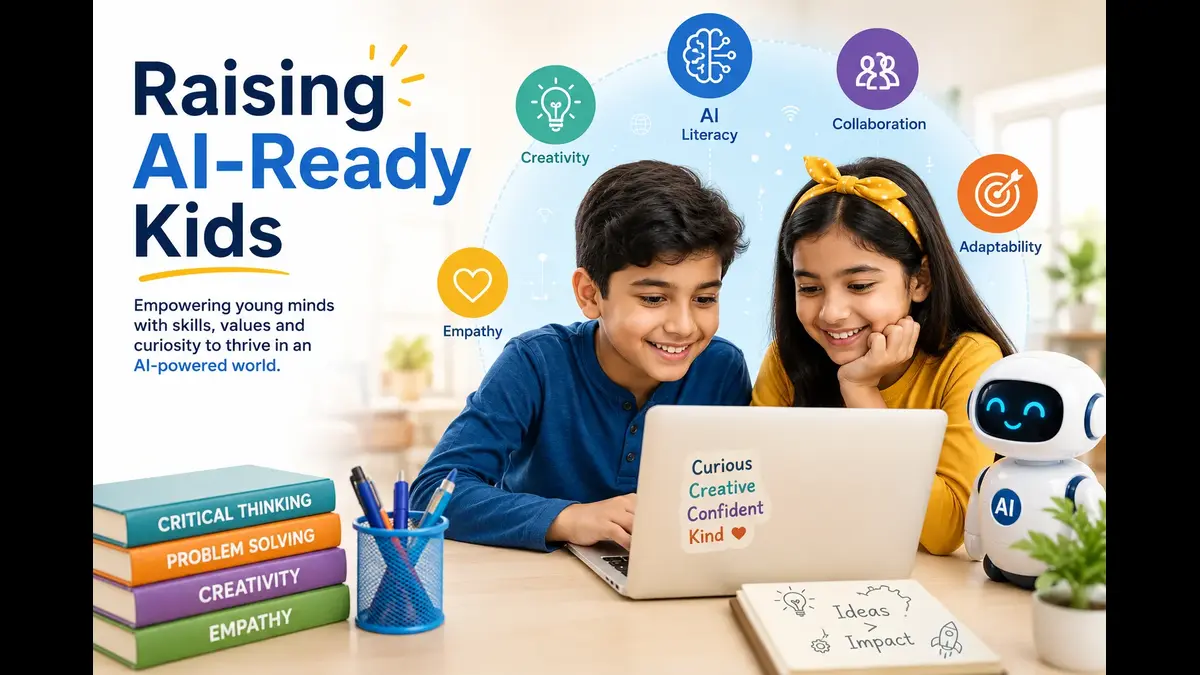
Artificial intelligence is no longer something children will encounter one day in the future — it’s already part of their world. From smart assistants and recommendation algorithms to AI-powered tutoring tools, children are interacting with AI every day, often without realising it.
A 2024 report by Common Sense Media found that a majority of teens are already using AI tools — especially chatbots and AI-supported search — often without their parents’ awareness or any guidance from school. The question is no longer whether children will use AI. It’s whether we help them use it well.
As parents and educators, our role isn’t to shield children from AI — it’s to help them understand it, use it wisely, and grow alongside it. Here’s how to do that in a warm, practical way.
Also Read:
- Understanding AI: A Practical Guide for School Students
- If AI Is Strategic, Education Cannot Remain Peripheral
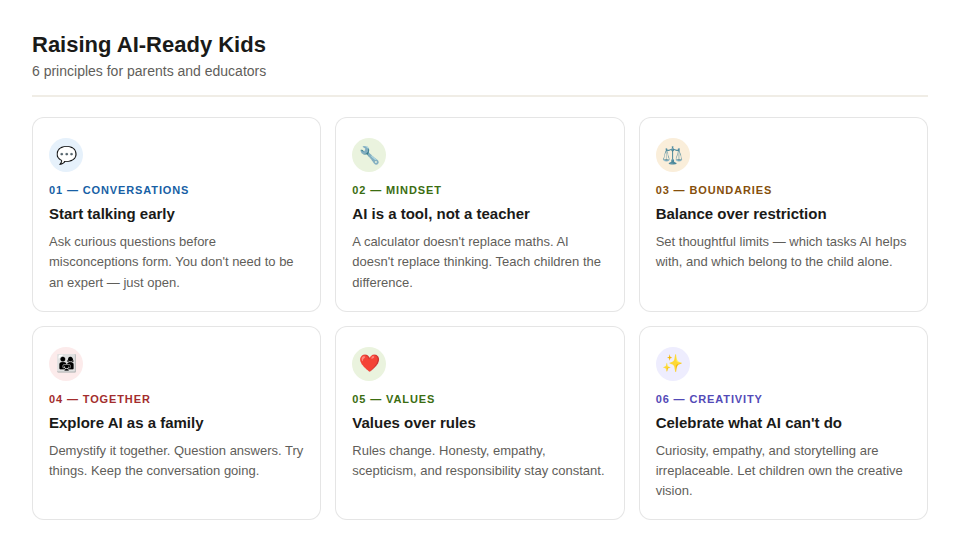
1. Start With Honest, Age-Appropriate Conversations
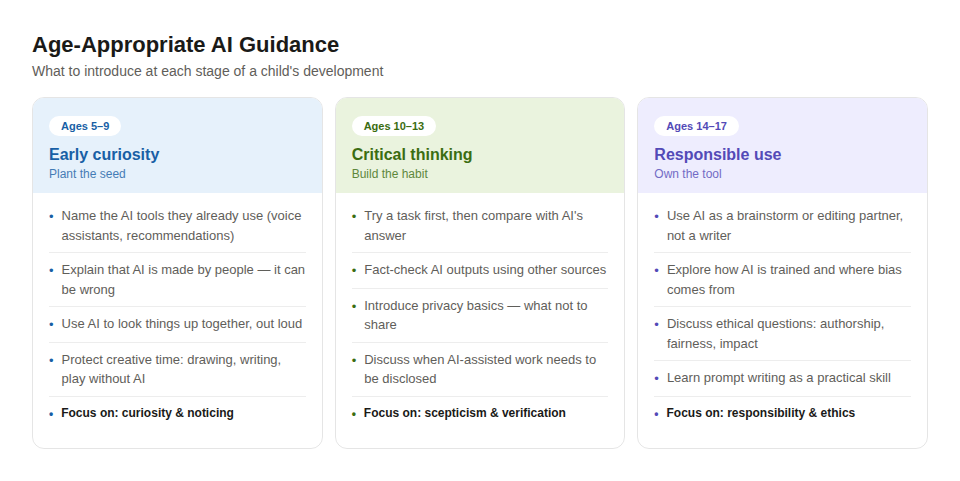
Children are naturally curious. Instead of waiting for them to form misconceptions, start the conversation early. You don’t need to be a tech expert — curiosity and openness are enough.
Try asking questions like:
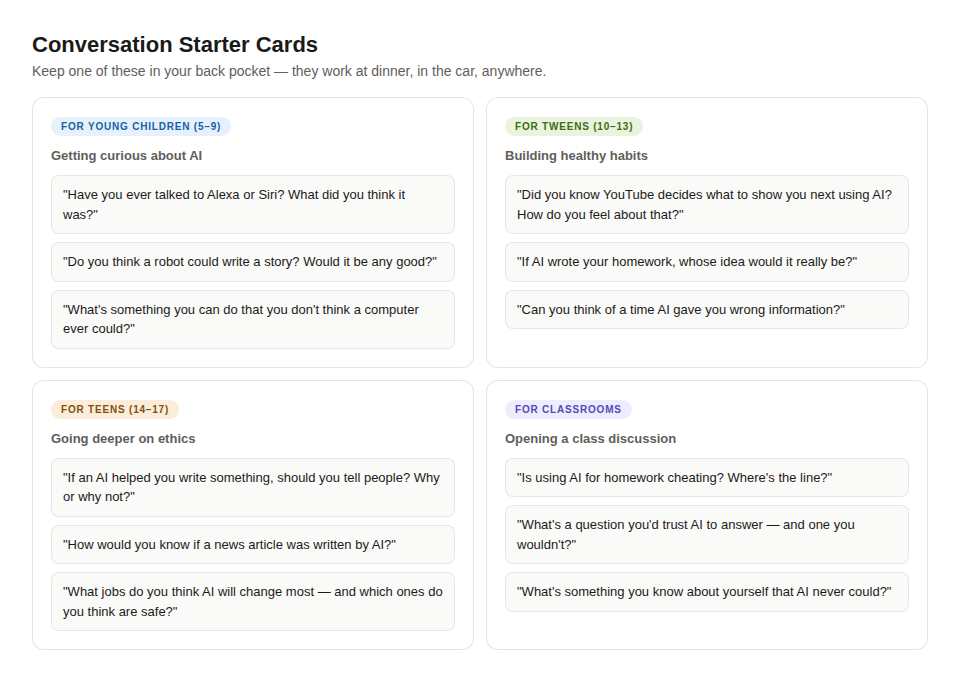
- “Have you ever talked to a voice assistant? What did you think it was?”
- “Did you know YouTube and Netflix use AI to decide what to show you next?”
- “What do you think AI can and can’t do?”
These conversations build critical thinking from the ground up and show children that it’s safe to ask questions about technology. Virginia Tech child psychologist Dr. Rosanna Breaux notes that parental monitoring of children’s AI use — much like monitoring screen time — is linked to better academic performance and social functioning. Awareness, she says, is the first and most important step.
2. Teach AI as a Tool, Not a Replacement
One of the most important mindsets to instil early is this: AI is a tool, not a teacher, friend, or authority. Just like a calculator helps with maths but doesn’t replace understanding numbers, AI tools help with tasks but don’t replace thinking.
Practical ways to reinforce this:
- When a child uses AI to answer a homework question, ask them to explain the answer in their own words.
- Encourage them to try a problem first, then use AI to check their reasoning.
- Point out when AI gets things wrong — it will! — and discuss why.
The OECD’s research on AI and the future of skills highlights that as AI becomes more capable at replicating routine tasks, the skills that will matter most are those AI cannot easily replicate: creative thinking, empathy, ethical reasoning, and the ability to ask better questions. Teaching children to use AI as a tool — not a crutch — builds exactly these capabilities.
3. Set Healthy Boundaries Early
Just as we set screen time boundaries, it’s equally important to set thoughtful boundaries around AI use. The goal isn’t restriction — it’s balance.
- Agree on which tasks AI can help with (brainstorming, checking spelling) versus tasks where independent effort matters (writing first drafts, solving maths).
- Create ‘no AI zones’ — certain homework assignments, creative projects, or journaling where the child’s own voice is protected.
- Discuss privacy: Common Sense Media advises that children should never share personal information — names, addresses, or photos — with AI tools, as this data can become a permanent part of the system.
In June 2025, the American Psychological Association issued a Health Advisory on AI and Adolescent Well-being, urging parents and educators to ensure children’s safety while using AI. Boundaries, the APA stresses, aren’t about fear — they’re about keeping children in the driver’s seat of their own learning.
4. Make AI Exploration a Family or Classroom Activity
The best way to demystify AI is to explore it together. This removes fear, builds understanding, and keeps the lines of communication open.
Ideas for parents:
- Spend 20 minutes together asking an AI chatbot questions and evaluating the answers.
- Try an AI art tool and discuss what’s creative versus what the AI generated.
- Watch a short documentary about AI and discuss it over dinner.
Ideas for educators:
- Use AI to generate a flawed essay and ask students to identify and correct the errors.
- Assign a ‘spot the AI’ exercise where students evaluate whether content was human or AI-written.
- Introduce prompt writing as a skill. MIT RAISE and Common Sense Media have developed free AI literacy toolkits specifically for families and classrooms — a great starting point.
5. Focus on Values, Not Just Rules
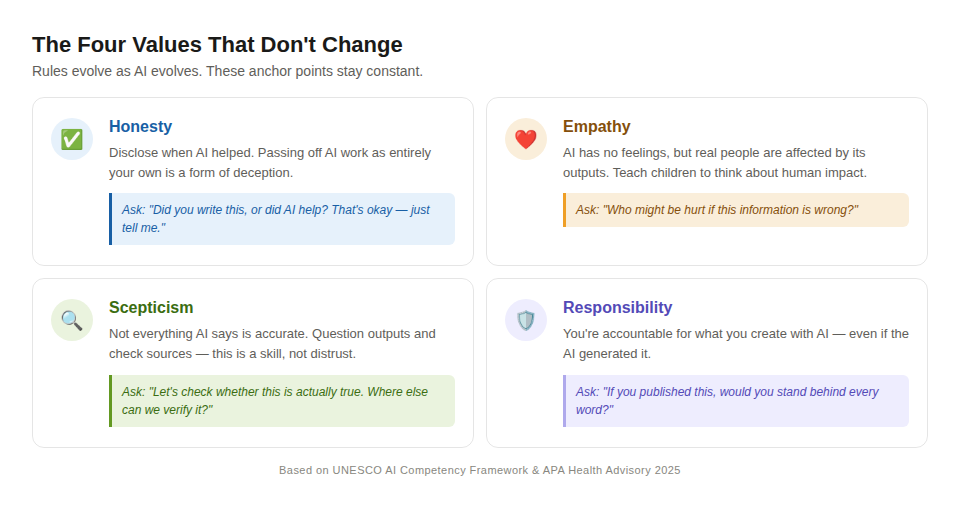
Rules change as technology evolves, but values stay constant. Ground your guidance in principles that will serve children across whatever AI landscape they face as adults.
- Honesty: AI-assisted work should be disclosed when appropriate. Passing off AI writing as entirely your own is a form of deception.
- Empathy: AI doesn’t have feelings, but the people affected by its outputs do. Teach children to think about the human impact of what they create with AI.
- Scepticism: Not everything an AI says is true. Good critical thinking means checking sources and questioning outputs.
- Responsibility: Using AI powerfully means being accountable for what you do with it.
UNESCO’s AI Competency Frameworks for Students and Teachers — launched in 2024 and now adopted across 58 countries — place ethics and values at the centre of AI education. They propose that learning to use AI responsibly is just as important as learning to use it effectively.
6. Celebrate Curiosity and Creativity
The skills that will matter most in an AI-driven future aren’t the ones AI is best at — they’re the uniquely human ones. Creativity, empathy, storytelling, ethical reasoning, collaboration, and curiosity are what make humans irreplaceable.
Research published in Frontiers in Digital Health (2025) and OECD education reports both point to the same conclusion: AI works best as an amplifier of human creativity and curiosity, not a substitute for it. Children who learn to guide, question, and direct AI will be far better prepared than those who simply follow its outputs.
Encourage children to use AI as a springboard for their own ideas, not a substitute for them. Let them be the creative director, the fact-checker, the editor. AI can draft a story, but only a child can give it heart.
The Bottom Line
Children who learn to use AI thoughtfully — with curiosity, discernment, and strong values — will be far better prepared for the world ahead than those who either avoid it entirely or rely on it without question.
As parents and educators, we don’t need to have all the answers. We just need to show children that asking the right questions — about AI and about everything else — is the most powerful skill of all.