The National Testing Agency (NTA) has released the provisional answer key for the CSIR UGC NET December 2025 examination. Along with the answer key, the agency has also made available the question papers and recorded response sheets of candidates on the official CSIR UGC NET website.
The CSIR UGC NET December 2025 examination was conducted on December 18, 2025 in two shifts – 9 am – 12 noon, and 3 pm – 6 pm.
Around 2.12 lakh candidates appeared for the national-level test conducted for eligibility to Junior Research Fellowship (JRF), Assistant Professor, and admission to PhD programmes. With the release of the provisional answer key, candidates can now assess their performance and estimate their probable scores before the declaration of the final result.
Objection window open till January 1
Candidates who are not satisfied with the provisional answer key can submit objections till January 1, 2026, up to 11:00 PM. To raise a challenge, candidates must log in using their application number and date of birth. A non-refundable fee of ₹200 per question is applicable for each objection submitted.
The National Testing Agency will examine all the challenges received from candidates. If any objection is found to be valid, the answer key will be revised accordingly. The final answer key prepared after reviewing all objections will be used for the preparation of the CSIR UGC NET December 2025 result.
How to check CSIR UGC NET December 2025 answer key
Candidates can check the provisional answer key by visiting the official CSIR UGC NET website and accessing the answer key and response sheet section. After logging in with their credentials, candidates can view and download the answer key and compare it with their recorded responses.
What happens next
After the objection window closes, NTA will release the final answer key, followed by the declaration of the CSIR UGC NET December 2025 result. Candidates who qualify will be eligible for Junior Research Fellowship, Assistant Professor positions, and PhD admissions based on the applicable cut-off marks and category-wise merit.
Picture this: two students with the same preparation level walk into the JEE Main exam hall. One feels calm, focused, and confident. The other feels anxious, foggy, and oddly blank. The difference? Not months of preparation – but what they did the night before the exam.
With JEE Main 2026 scheduled to be conducted between January 21 and January 30, lakhs of aspirants will soon face this exact moment. At this stage, preparation levels are more or less set—but performance is still very much negotiable. And that’s where the night before the exam quietly steps in as a game-changer.
The night before JEE Main doesn’t test your intelligence; it tests your decision-making under pressure. A single wrong choice – like cramming a new topic, scrolling endlessly on your phone, or taking a stressful mock test – can quietly sabotage months of hard work. On the other hand, a few right choices can sharpen your recall, steady your nerves, and help you perform to your true potential.
This article breaks down what to do and what not to do the night before JEE Main, backed by toppers’ experiences and psychological research, without sounding preachy or unrealistic. Think of it as a calm voice guiding you when your mind feels noisy.
1. Revise Lightly, Don’t Wrestle with New Concepts
One of the biggest temptations the night before JEE Main is to think: “Let me just start this one last chapter. Maybe it’ll come in the exam.”
This is almost always a mistake.
What toppers do:
They revise what they already know, not what they don’t.
Go through short notes, formulas, and key reactions
Revise mistakes you’ve already made in mocks
Skim through frequently asked concepts, not entire chapters
What psychology says:
Your brain consolidates memory best when information is already familiar. Trying to learn new topics under stress overloads working memory, increasing confusion and anxiety.
Your brain mistakes the mock for the actual exam, triggering stress
What psychology says:
High-pressure testing right before the real exam increases performance anxiety and reduces recall accuracy the next day.
What you can do instead:
Solve 5–10 previously attempted questions
Revisit marked or tricky problems you already solved
Do formula-based or direct questions to stay in touch
What NOT to do:
❌ Attempt a full 3-hour mock
❌ Analyze mock results deeply
❌ Compare scores with friends
Remember:
The goal of the night before is mental readiness, not performance evaluation.
3. Sleep Is Not Optional — It’s Your Secret Weapon
If there’s one piece of advice every topper agrees on, it’s this: Sleep well, no matter what.
Why sleep matters more than last-minute study:
Sleep strengthens memory recall
It improves focus and calculation speed
It reduces silly mistakes and panic
What psychology says:
Lack of sleep directly affects the prefrontal cortex, the part of your brain responsible for logic, decision-making, and attention – all crucial for JEE Main.
What toppers actually do:
Sleep 6–8 hours, even if revision feels incomplete
Stop studying at least 45–60 minutes before bed
Follow a familiar sleep routine (not an exam-night experiment)
What NOT to do:
❌ Pull an all-nighter
❌ Sleep thinking “I’ll manage on adrenaline”
❌ Keep checking the clock and stressing
Hard truth:
An extra hour of sleep is more valuable than an extra hour of revision.
4. Manage Your Mind: Anxiety Control Beats Motivation
The night before JEE Main is rarely about knowledge – it’s about emotional control.
What toppers focus on:
Not hype. Not pressure. But calm certainty.
They remind themselves:
“I’ve done what I could.”
“This exam tests concepts, not perfection.”
“One paper does not define my worth.”
What psychology suggests:
An anxious mind triggers the brain’s threat response, making even simple questions feel difficult. Calmness allows access to stored knowledge.
Practical ways to calm your mind:
Take 5–10 minutes of deep breathing
Visualize yourself sitting calmly in the exam hall
Talk to someone who reassures you, not panics you
What NOT to do:
❌ Read “expected cutoff” or “toughness prediction” articles
❌ Discuss “what if” scenarios with stressed friends
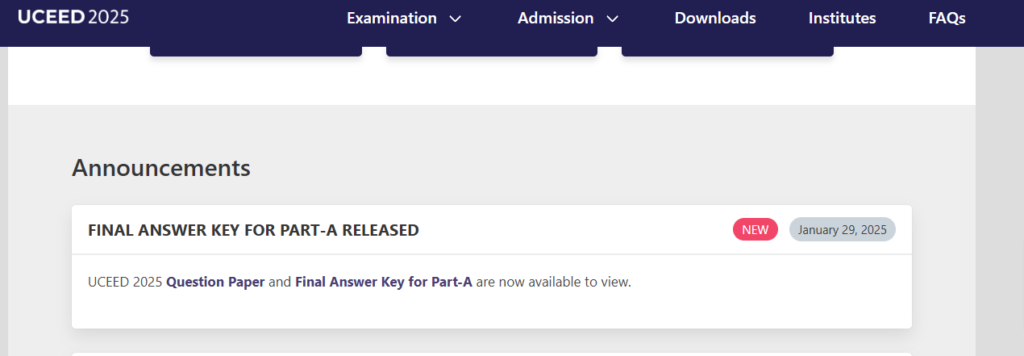
UCEED Question Paper and Answer Key 2026 – IIT Bombay will release the draft UCEED 2026 answer key, candidate’s response & question paper on January 20, 2026.
The UCEED 2026 draft key and question paper will be released online at uceed.iitb.ac.in.
No log-in is required to download the documents which will be available in PDF formats. Simply click on the document you want to download. Use the keys to calculate probable scores and access your chances of admission. The UCEED cut-off can be used for checking admission chances.
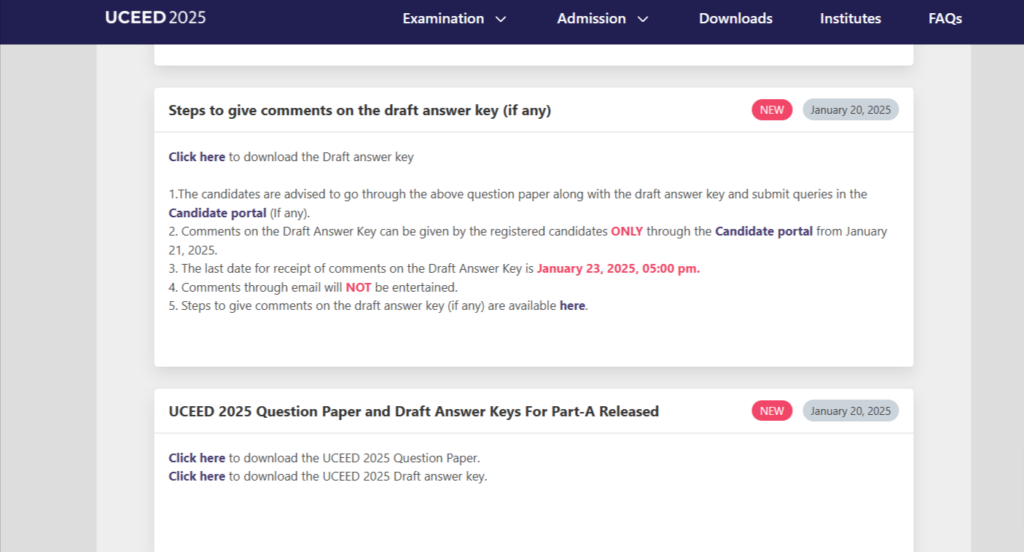
Objections against the draft key must be submitted through UCEED 2025 CANDIDATE portal; the objection window will be available from January 20-22, 2026 (5 pm).
The FINAL answer key and question papers of UCEED 2026 will be released on January 28, 2026 (5 pm). The UCEED final answer key will contain the official and correct answers to questions asked in the exam.
The candidate is allowed to challenge the draft key
Objections against the draft key have to be submitted through the Candidate Portal.
Admission officials will consider the challenges submitted by the exam conducting body and make modifications to the draft key, if required.
The UCEED FINAL key is released after any corrections that may be required to the draft key
The keys included in the final key are considered the final and correct answers to questions asked in the exam. No challenges to the final key will be accepted.
The final answer key will be used for UCEED 2026 answer booklet evaluation.
IIT Bombay will release the FINAL answer key on January 28, 2026.
Comments against Draft Answer Key of UCEED 2026
The candidate is allowed to submit objections against the draft UCEED 2026 answer key. The objection window will be open from January 20-22 (5 pm), 2026.
The candidate has to follow these steps to submit objections against the draft key.
How to Calculate Probable Scores Using UCEE 2026 Answer Key
The candidate can use the UCEED answer key to first calculate the number of correct attempts. Next, the candidate can use the marking scheme outlined in the UCEED 2026 exam pattern to assign marks to each correct answer.
Finally, tally the marks to arrive at the UCEED 2026 probable score.
This score will give you a fair idea about your chances of admission to your preferred institute. You can check out institute-wise UCEED cut-off.
UCEED Cut-off 2026 – IIT Bombay will release the cut-off marks for Part A on February 5, 2025.
The UCEED 2026 (Part A) cut-off marks will be released in the form of a mean and standard deviation. In the previous edition (UCEED 2025), the mean and standard deviations were 61.50 and 25.69, respectively.
The Part B answer booklets is evaluated only if the candidate meets Part A cut-off. Candidates who meet the UCEED 2025 (Part A) cut-off will get shortlisted. Further, candidates who meet Part A – UCEED cut-off are assigned merit ranks and the scorecard for such candidates will include the TOTAL score. However, if the candidate fails to qualify Part A, their Part B answer booklets will not be evaluated. The UCEED 2026 scorecard of such candidates only includes Part A score.
The UCEED 2026 admission cut-off will be released at the time of UCEED 2025 counseling and seat allotment. The UCEED 2026 counseling will include FIVE seat allotment rounds, and for each round, institute-wise opening and closing ranks will be released.
The admission cut-off is the minimum score one needs to secure for admission to the B.Des program.
The differences between the UCEED 2026 qualifying and admission cut-off is given in the table below.
Particulars
UCEED Cut-off – Part A
UCEED Admission Cutoff
Purpose
To shortlist candidates. Part B answer booklets will be evaluated only if the candidate meets Part A UCEED cut-off. Note that Part A score will not be considered for admission purposes.
The admission cut-off is the minimum UCEED 2026 marks a candidate needs to secure for admission to the B.Des program.
Based on
Part A scores
The TOTAL score of UCEED 2026. The total score will be calculated by giving weightage to Part A and Part B marks.
Number of candidates shortlisted
Candidates who meet the Part A cut-off determined by admission officials will get shortlisted.
All candidates meeting the cut-off will get admission to B.Des program.
The number of seats allocated will be equivalent to the number of seats available in each category.
Scorecard
The scorecard will be issued for all candidates irrespective of whether meet Part A cut-off or not.
–
TOTAL score
The total score will be available only for shortlisted candidates (or those candidates who meet Part A cut-off).
–
Merit Rank
Merit ranks, also, will be allotted to shortlisted candidates.
UCEED Cut-off 2025 – Institute-wise Opening and Closing Ranks
UCEED Cut-off 2025 – B.Des Admission List (Round 1) Opening and Closing Ranks
Open
Open-PwD
EWS
OBC-NCL
OBC-NCL-PwD
SC
ST
Institute
Opening
Closing
Opening
Closing
Opening
Closing
Opening
Closing
Opening
Closing
Opening
Closing
Opening
Closing
IITBombay
1
14
–
–
1
4
5
13
–
–
1
7
2
5
IIT Delhi
15
35
6
6
6
9
16
21
–
–
8
11
8
8
IITGuwahati
19
77
5
5
7
15
15
44
–
–
9
25
1
7
IITHyderabad
18
52
3
3
5
16
24
42
–
–
3
19
10
11
IIT Indore
56
80
4
4
19
22
49
54
–
–
23
24
13
13
IITRoorkee
54
91
–
–
17
18
47
51
2
2
26
28
9
12
IIITDMJabalpur
78
144
7
7
21
30
45
78
–
–
30
42
14
18
UCEED Cut-off 2025 – B.Des Admission List (Round 2) Opening and Closing Ranks
Open
Open-PwD
EWS
EWS-PwD
OBC-NCL
OBC-NCL-PwD
SC
ST
Institute
Opening
Closing
Opening
Closing
Opening
Closing
Opening
Closing
Opening
Closing
Opening
Closing
Opening
Closing
Opening
Closing
IITBombay
1
14
–
–
1
4
1
1
5
13
–
–
1
7
2
5
IIT Delhi
15
35
6
6
6
9
–
–
16
21
–
–
8
11
8
8
IITGuwahati
19
81
5
5
7
15
–
–
15
45
–
–
9
27
1
7
IITHyderabad
18
52
3
3
5
16
–
–
24
42
–
–
3
19
10
11
IIT Indore
56
83
4
4
19
22
–
–
49
54
–
–
23
24
13
13
IITRoorkee
54
96
–
–
17
18
–
–
47
51
2
2
26
29
9
12
IIITDMJabalpur
78
162
7
7
21
30
–
–
55
82
–
–
30
42
14
18
NOTE:
Opening/Closing Rank for OPEN Seats represents All India Rank (AIR).
Opening/Closing Rank for EWS, OBC-NCL, SC and ST Seats represents respective Category Rank.
Opening/Closing Rank for PwD Seats represents PwD Ranks within Respective Categories.
As published in the Information Brochure: a) Indian Citizens: Seat allocation is based on the All India Rank (merit order), reservation category and seat availability in each institute at the time of seat allocation. b) Foreign nationals holding OCI/PIO cards issued before 04/03/2021 will be allotted seats under the OPEN category and they are outside the ambit of reservation of seats under the EWS, OBC-NCL, SC, and ST categories. c) Candidates who are NOT citizens of India (by birth or naturalization) will be considered as FOREIGN NATIONALS. A seat in an institute will be allotted to a Foreign National candidate (Not the OCI/PIO card holder) if his/her rank is the same or better than the closing rank of the OPEN category candidate in that academic programme, subject to the 10% cap on seats published, in order of merit. d) Seats allotted to Foreign Nationals are supernumerary. e) Allocation of seats to PwD candidates is as per the Seat Matrix published in the Information Brochure.
UCEED Cut-off 2025 – Download Here
The UCEED cut-off for the Round V seat allotment was released on July 3. The round-wise UCEED 2025 cut-off is provided here.
AIBE XX (20) Exam Pattern 2025 – Candidates must refer to the official AIBE (XX) 2025 exam pattern prescribed by the Bar Council of India (BCI) to prepare for the exam. The exam pattern of AIBE 2025 includes insights into the types of questions asked, sections, section-wise questions, weightage, mode of the exam, test duration, and language.
BCI conducted the AIBE (XX) 2025 exam on November 30, 2025 (1 pm – 4 pm). The duration of the exam is 3 hours (revised from 3 hours 30 minutes in the previous edition). The exam will include only multiple-choice questions; so you don’t need to spend time practicing long-form answers.
Also, note that AIBE is not an open-book exam.
You are not allowed to carry books and study materials inside the AIBE (20) exam center 2025. However, you can carry Bare Actswithout comments (or notes). Do consult also the updated AIBE 2026 syllabus to prepare for the exam.
Keep reading to learn the full details about the AIBE XX exam pattern 2025.
The exam pattern for the AIBE 2025 exam is given in the table below.
Particulars
Description
Where to follow AIBE (XX) Exam Notification
To follow officialAIBE exam notification – Click Here
Exam duration
3 hours (1 pm – 4 pm)
Old Pattern: 3 hours 30 minutes (10 am to 1.30 pm)
Exam mode
Offline mode
Number of Questions
100
Topic/ Subject
The AIBE question paper will include questions from 19 sections.
The number of questions that will be asked from each section is given in the table below.
Total marks
100 marks
Type of questions
Multiple-choice questions (MCQs)
Marking Scheme
1 mark will be awarded for a correct attempt.
There is no negative marking.
Skills tested
1. The exam assesses basic level knowledge of a member 2. It also lays down a minimum benchmark for entering into practice of law 3. Assesses a candidate’s analytical skills.
Language options
Candidates can appear in the bar exam in English and 22 vernacular languages:
The AIBE exam will test a law graduate’s knowledge of fundamental legal subjects and ability to practice in a court of law.
To ace the exam you will need smart planning and consistent revision.
Begin by understanding the exam structure. While AIBE was previously an open-book exam, it currently only allows candidates to carry Bare Acts (uncommented statutory laws).
The offline-based exam will have 100 multiple-choice questions covering constitutional law, criminal law, IPC, CPC, CrPC, Evidence Act, professional ethics, recent judgments, etc.
Start by collecting the official syllabus and previous years’ question papers to identify recurring topics. Focus especially on frequently tested sections such as fundamental rights, landmark judgments, and procedural codes.
Prepare short notes or flowcharts for complex topics like CPC, CrPC, and Evidence Act to save time. Practice solving past AIBE question paperswithin the time limit to build speed and accuracy. Since negative marking does not apply, attempt all questions. Develop a strategy to attempt easier sections first, ensuring maximum scoring.
Alongside legal subjects, revise professional ethics and Bar Council rules thoroughly, as they carry significant weight. Keep updated with recent amendments and important Supreme Court rulings.
In the final week, revise key provisions daily instead of cramming. On exam day, carry well-organized bare acts without notes, stay calm, and manage time wisely. Consistent practice, clear organization, and effective referencing are the keys to cracking AIBE confidently.
AIBE XIX Exam-day Guidelines
The BCI conducted the All India Bar Examination (AIBE) on December 22, 2024 (10 am to 1) pm.
The BCI had released exam day guidelines that candidates needed to follow on exam-day. The guidelines were outlined in the admit card of AIBE 2024.
Candidates who break exam-day rules run the risk of being disqualified.
Dos and don’ts for the AIBE Exam
Dos
Don’ts
The candidate must carry a Blue/Black Ball Point Pen for filling the OMR answer sheet.
Electronic items including mobile phones, pager, watch, ipad and calculator, etc., are not allowed inside the AIBE 2024 exam venue.
Document checklist: AIBE XIX admit card A valid photo ID proof
Eatables are not allowed inside the exam venue.
Photo ID and a passport size photo
Entry gates will be close an sometime before the exam starts.
So, don’t be late.
Self-attest the self-declaration form before reaching the test centre.
The candidate is not allowed to carry the AIBE question paper outside the exam hall.
Arrive at the AIBE exam centre per the reporting time mentioned on the admit card.
Don’t obstruct frisking or identification activities conducted by exam officials.
Wear comfortable and decent clothing for the exam.
It is recommended to avoid jewellery and clothing with too many pockets. Also, don’t put on any face covering, except for religious purposes.
Rough sheets should be handed over to the invigilator once the exam is over
The exam syllabus for the AIBE 2025 exam has been released by the BCI.
The syllabus has been kept the same as in the last edition. BCI last revised the syllabus for the AIBE 2024 edition.
The candidate can consult the existing syllabus to prepared for the AIBE (XX) 2025 exam. The AIBE syllabus is divided in 19 units. The syllabus includes the number of questions that will be asked from each of these units/ topics.
Carefully refer to the syllabus for AIBE exam preparation.
What is a Certificate of Practice? Can a law graduate practice law without the CoP? Where can I download or collect the certificate? In this article, we discuss all these and much more.
AIBE (19) COP – The BCI will release the Certificate of Practice (CoP) for the AIBE (XX) 2025 exam soon after AIBE (XX) 2025 results are declared.
The Certificate of Practice (CoP) for the AIBE (19) 2024 exam is now OUT. The CoP is typically issued within three months after the declaration of AIBE results. BCI declared AIBE (19) XIX results on March 21, 2025.
For general information – the Certificate of Practice for the AIBE (18) exam was released on August 27, 2024.
The CoP is a mandatory certification that law graduates need to practice in a court of law. According to the Bar Council of India (BCI) regulation, all lawyers need to obtain the certification within two years of provisional enrollment.
The CoP will be issued to the candidates who qualify in the All India Bar Examination (AIBE). The CoP can be collected from the respective State Bar Councils or through the AIBESCOPE mobile applications.
The CoP certification process starts with the law graduate enrolling with a State Bar Council on a provisional basis. The candidate next has to appear in the AIBE exam, and if they qualify in the exam can obtain the CoP.
The draft answer keys of AIBE 2025 was released on December 3, 2025. Objections against the draft key was accepted from December 3-10. Go through the AIBE (XX) 2025 exam analysis for detailed insights into the exam, including paper length, sectional and overall difficulty, and expected cut-off.
AIBE (18) Certificate of Practice Released
The BCI released the AIBE (18) CoP on August 27, 2024. The candidate can collect the Certificate of Practice from the respective State Bar Councils.
How to get the AIBE XVIII CoP
Register with BCI
Fill in essential details like name, email ID, etc. Also, upload the AIBE XVIII scorecard, law degree certificates, address and ID proof.
Pay the registration fee
Pay the CoP issue fees
Submit the form.
The BCI will verify the details entered by the candidate and issue the AIBE XVIII Certificate of Practice (CoP) to verified candidates.
AIBE 19 Cut Off
The cut-off marks for the AIBE (19) XIX 2024 exam are given in the table below.
Category
Total Marks
Cut-off Percentage
Cut-off Marks
General/ OBC
93
45%
42
SC/ST
93
40%
37
Total marks adjusted in AIBE 2024 exam
The BCI has informed the withdrawal of 7 Questions, and as a result is based on 93 questions instead of 100 questions. For the General/OBC category, the passing mark is calculated as 45% of 93 marks, which rounds up to 42 marks. For the SC/ST/disabled category, the passing mark is calculated as 40% of 93 marks, which rounds off to 37 marks.
How to obtain COP from the State Bar Council?
The BCI will notify candidates about the release of the Certificate of Practice (CoP) on its portal – allindiabarexamination.com.
The candidate can collect the CoP from the State Bar Council where they have enrolled. Note that the State Bar Council will not send soft copies of the CoP to the candidate.
To obtain the CoP from a State Bar Council, the candidate will have to submit an application in the proper format.
Can I download the CoP
Yes, there is now an option to download the Certificate of Practice (CoP) online.
In 2021, the BCI launched a mobile application – AIBESCOPE. The candidate can log-in to the portal and download a digital copy of their COP until a hard copy is provided to them.
How to download CoP Application Form
The candidate can collect the CoP application forms from the respective State Bar Councils.
How to Submit Application to State Bar Council for Obtaining CoP
The candidate needs to follow the steps mentioned below to duly fill in and submit the CoP application form to the State Bar Council.
Step 1: Download or obtain the COP application form from the State Bar Council Website or address.
Step 2: Duly fill in the CoP application form. You will be required to enter details like academic qualification, bar council enrollment, and AIBE qualifying status
Step 3: Attach or upload the Enrollment form with the required documents
Step 4: Pay the application fee. The application fee may vary from one State Bar Council to another. So, check the details thoroughly before submitting the form.
Attach/ Upload the following documents:
AIBE Result/ Marksheet Academic Qualification Documents Three passport size photographs (colour and recent) Caste certificate Photograph and signature Other certificates, as mentioned in the application form
State Bar Council Enrollment Charges
The enrolment fees for the Bar Council of Delhi is INR 600. The candidate will have to obtain the enrollment application form from the Office of Bar Council of Delhi on payment of INR 1000.
The registration and other fees for the Bar Council of Delhi are given below for reference:
Particulars
Fees for 3-year LLB applicants (in INR)
Fees for 5-year LLB applicants (in INR)
Enrolment Fees
600
600
Identity Card
100
100
Building Fund
4,000
6,900
Library Fund
3,000
4,400
Indigent
2,900
4,300
Welfare Fun Fee U/R 40 BCI
3,000
3,000
Advocates Welfare Fund Bar Council of Delhi
700
700
Bar Council of India Fund
150
150
Total
14,450
20,150
Enrollment Fee for Retired Persons of Age 45 and Above
Particulars
Fees for Retired Persons of Age 45 years and Above
Enrolment Fees
600
Identity Card
100
Building Fund
11,900
Library Fund
9,400
Indigent
9,300
Welfare Fun Fee U/R 40 BCI
3,000
Advocates Welfare Fund Bar Council of Delhi
700
Bar Council of India Fund
150
Total
35,150
How to enroll with State Bar Councils for AIBE exam?
Candidates who want to obtain the Certificate of Practice (CoP) must get enrolled with their respective State Bar Councils.
The enrollment number will be required for filling out the AIBE exam application form. If the candidate doesn’t get enrolled with a State Bar Council, they won’t be able to appear in the AIBE exam.
The CoP certificate is issued to candidates only if they qualify in the All India Bar Examination.
Please note that the enrollment is done at a state level, so if you are from Delhi, get enrolled with the Delhi Bar Council. Likewise, if you are from Bihar, enroll with the bar council of that state.
Is AIBE qualification required for candidates who have passed graduation before 2000-2010?
If you have passed the 3-year or 5-year LLB program before 2009-2010, you don’t need to take the AIBE exam to practice in a court of law.
Key points related to State Bar Council Enrolment
Here are few key points related to the State Bar Council Enrolment that candidates need to know:
Without a state bar council enrollment number, you cannot apply for AIBE exam
Candidates who have completed 3-year and 5-year LLB programs can get enrolled with state bar councils
The bar council enrollment process can be either online or offline. Visit your State Bar Council website or office to learn about the enrollment process.
If an online enrollment process is available, you simply need to go to the enrollment portal, get registered and complete the formalities online.
As part of the State Bar Council enrollment process, you may need to fill in personal, academic, and contact details. Also, pay the enrollment fee and upload all mandatory documents.
Advocates Act, 1961 has entrusted the state councils with the powers to frame their own rules for advocate enrollment.
Once your enrollment is complete, your are eligible to fill out the AIBE 20 (XX) 2025 application form
Certificate of Practice (CoP) – If you qualify in the AIBE XX exam, you will be issued the CoP certificate, which makes you eligible to practice in a court of law.
The Consortium of National Law Universities (CNLU) will close the CLAT 2026 counselling registration process today, December 26, 2025. Candidates who have qualified the Common Law Admission Test (CLAT) 2026 must complete registration on the official website consortiumofnlus.ac.in to remain eligible for seat allotment in participating National Law Universities (NLUs).
As per official counselling guidelines, only registered candidates who have paid the counselling fee will be considered for the upcoming allotment rounds. The first seat allotment will be declared on January 7, 2026 (10 am). The CLAT 2026 exam was conducted on December 7, 2025.
How to Register for CLAT 2026 Counselling
Candidates must complete the counselling registration process online by logging into the official portal and submitting their preferences before the deadline.
Log in using CLAT 2026 credentials
Access the counselling registration link
Fill in personal and academic details
Submit NLU preferences
Pay the counselling registration fee
Finalise and submit the form
CLAT 2026 Counselling Registration Fee
The Consortium has prescribed a category-wise counselling registration fee, which must be paid online to confirm participation in the counselling process.
Category
Fee
General / OBC / EWS
₹30,000
SC / ST / PwD
₹20,000
The fee is adjustable against the seat acceptance amount and is refundable under conditions specified by the Consortium.
Documents Required for Counselling
Candidates are required to keep the following documents ready for verification during the counselling and admission process.
CLAT 2026 admit card
CLAT 2026 scorecard
Class 10 and 12 marksheets
Category certificate (if applicable)
Domicile certificate (if applicable)
Seat Allotment Process
CLAT 2026 seat allotment will be conducted in FIVE rounds. The allotment will be based on merit, candidate preferences, and category.
Allotment will depend on CLAT 2026 rank
Preferences submitted during counselling will be considered
Seat availability across NLUs will determine allotment
Candidates will be able to view their allotment status through the counselling portal.
What After Seat Allotment?
After seats are allotted, candidates must take action within the specified timeline to secure or withdraw their allotment.
Pay the seat acceptance fee to confirm the allotted seat
Choose Freeze to accept the seat and exit further rounds
Choose Float to accept the seat but remain eligible for upgrades
Opt for Exit to withdraw from the counselling process
Candidates not allotted a seat will be considered in subsequent rounds
Final admission will be confirmed only after document verification and payment of remaining fees at the allotted NLU.
The Uttar Pradesh Teacher Eligibility Test (UPTET) 2025, originally planned for January 29–30, 2026, has been postponed indefinitely as the state education authorities work on a revamped exam calendar.
The delay comes amid efforts to synchronize multiple teacher recruitment and eligibility exams and ensure smooth conduct across the state.
The announcement was confirmed by officials following a high-level meeting chaired by the newly appointed UP Education Service Selection Commission (UPESSC) Chairman, Dr. Prashant Kumar. Over 15 lakh candidates who had registered for the test are now waiting for revised dates expected to be released in the first quarter of 2026.
According to reports, the decision to defer the exam was taken to:
Avoid clashes with other major recruitment tests and streamline schedules across multiple state exams.
Address administrative and technical preparations, including finalizing exam centers and logistics.
State education sources say the new calendar will be scheduled after coordinating with other recruitment bodies – potentially shifting UPTET to late spring or summer 2026 – though exact dates have not been confirmed yet.
Impact on Aspirants
Candidates preparing for government teaching roles – who have been anticipating UPTET after a four-year gap – now face extended uncertainty, with many worried about overlapping recruitment cycles and eligibility for 2026 teaching vacancies.
Officials have urged aspirants to regularly check the official UPTET portal (updeled.gov.in) for updated notifications and not rely on unverified information on social media.
NTA has opened the CUET PG 2026 application form on 14 December 2025, with the last date to apply set as 14 January 2026. The Common University Entrance Test for Postgraduate programmes (CUET PG) will be a computer-based test (CBT) exam and will be held in March 2026 (NTA hasn’t given any specific date yet).
The duration of the exam will be 90 minutes.
The CUET PG 2026 application correction window will be available from 18 January to 20 January 2026 (11:50 pm), during which candidates can edit permitted fields in their submitted forms. No changes will be allowed after the correction window closes.
To download CEUT (PG) 2026 Information Bulletin – Click Here
CUET PG 2026 is conducted for admission to postgraduate programmes offered by central universities, state universities, deemed universities, and other participating institutions. Candidates who have completed or are appearing in the final year of their bachelor’s degree are eligible to apply. There is no age limit for appearing in the exam.
Based on previous years’ data, more than 7 lakh candidates are expected to appear for CUET PG 2026. The exam will be held for 157 subject papers, as notified in the information bulletin.
Candidates who have completed or are appearing in the final year of their bachelor’s degree are eligible to apply. There is no age limit for CUET PG 2026. Based on previous years’ data, over 7 lakh candidates are expected to appear for the exam. CUET PG 2026 will be conducted for 157 postgraduate subjects, as notified in the official information bulletin.
The application form of CUET PG 2026 is open at exams.nta.nic.in/registration-for-cuetpg-2026/
To fill out the form, follow these steps:
Visit the official CUET PG portal
Complete new registration and generate login credentials
Log in and fill personal, academic and contact details
Select subject paper(s) and preferred exam cities
Upload photograph and signature in prescribed format
Pay the application fee
Submit the form and download the confirmation page
CUET PG 2026 Application Fee
Category
Up to 2 Papers
Each Additional Paper
General
₹1400
₹700
OBC-NCL / EWS
₹1200
₹600
SC / ST / PwBD / Third Gender
₹1000
₹600
Outside India
₹7000
₹3500
CUET PG 2026 Exam Pattern
Particulars
Details
Mode of exam
Computer-based test
Duration
105 minutes
Total questions
75
Question type
Multiple Choice Questions
Marking scheme
+4 for correct, –1 for incorrect
Medium
English / Hindi (subject-wise)
CUET PG 2026 Syllabus Overview
Syllabus is subject-specific
Based on undergraduate-level curriculum
Focus on core concepts, fundamentals and application
No general aptitude section unless specified for a subject paper
How to prepare for CUET PG 2026
With CUET PG 2026 scheduled for March 2026, candidates now have limited but sufficient time to prepare effectively if they follow a structured approach. The first priority should be a thorough review of the official syllabus for the chosen subject. Since the syllabus is based on the undergraduate curriculum, candidates should focus on revising core concepts rather than attempting to cover new topics.
Creating a realistic revision timetable is essential. Divide time between concept revision, practice questions, and mock tests. At this stage, emphasis should be on strengthening weak areas identified through practice rather than broad reading. Candidates are advised to solve previous CUET PG and university-level postgraduate entrance questions, as these reflect the exam’s difficulty level and question patterns.
Mock tests play a crucial role in the final phase of preparation. Taking computer-based mock tests helps candidates improve time management, accuracy, and familiarity with the CBT format. After each mock test, careful analysis of mistakes is necessary to avoid repeating errors.
Given the negative marking scheme, accuracy should be prioritized over attempting all questions. Regular revision of formulas, definitions, and key concepts will help improve confidence and performance. Consistent practice combined with focused revision can significantly enhance scores in the remaining preparation period.
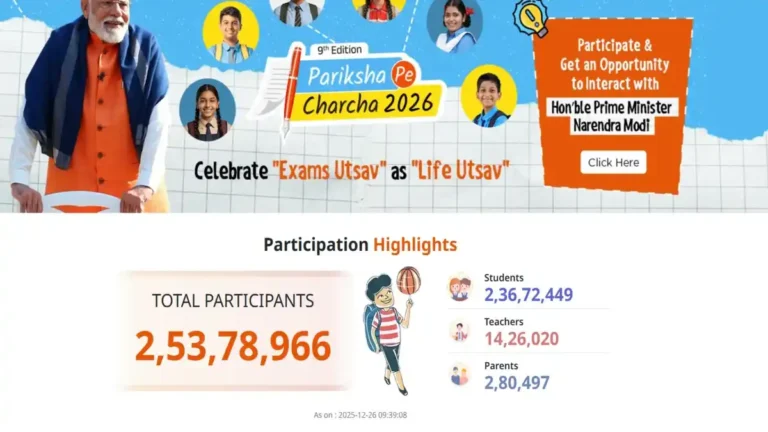
Pariksha Pe Charcha 2026 has recorded over 2.53 crore registrations so far, with students contributing more than 90 per cent of total participation, as the board examination season approaches. According to the latest official data, more than 2.3 crore students, over 14 lakh teachers, and around 2.5 lakh parents have registered for the programme, making it one of the largest student engagement initiatives in the country.
Registrations are currently open from December 1 to January 11, 2026.
The annual interaction programme, led by the Prime Minister of India, Narendra Modi, allows participants to submit questions related to examinations, stress management, preparation strategies and overall well-being. Registrations have witnessed a sharp surge in the last few weeks, particularly from students of Classes 10 and 12, as board exams draw closer. Pariksha Pe Charcha 2026 is scheduled to be held in January, continuing its tradition of engaging students ahead of major school examinations.
Latest Updates:
To visit Pariksha Pe Charcha 2026 Registration Portal – Click Here
Recent updates on Pariksha Pe Charcha 2026
Pariksha Pe Charcha 2026 registrations began in December 2025 and are currently underway. Participation has surged steadily, with total registrations crossing 2.5 crore within weeks of opening. The programme is scheduled to be held in January 2026, continuing its tradition of engaging with students ahead of board examinations. Students from Classes 6 to 12 form the majority of participants, followed by teachers and parents.
Total registrations for Pariksha Pe Charcha 2026
The participation figures continue to rise as registrations remain open.
Category
Number of registrations
Students
Over 2.36 crore
Teachers
Over 14.26 lakh
Parents
Over 2.6 lakh
Total
Over 2.53 crore
How to register for Pariksha Pe Charcha 2026 – step-wise process
Interested candidates can register online by following these steps:
Step 1: Log in to the official Pariksha Pe Charcha registration platform using a mobile number or email ID
Step 2: Select the participant category – student, teacher or parent
Step 3: Enter personal and educational details as required
Step 4: Submit a question related to exams, stress, or learning
Step 5: Review the details and complete the registration process
What is Pariksha Pe Charcha?
Pariksha Pe Charcha is an annual national-level interactive programme launched in 2018, in which the Prime Minister of India, Narendra Modi, interacts directly with students, parents and teachers ahead of the board examination season. The initiative was started to help students deal with exam-related stress and to promote a positive, confident and balanced approach towards examinations and learning.
The programme is led and addressed by the Prime Minister himself and does not have a separate anchor. It follows an interactive question-and-answer format, with questions selected from submissions received from across the country. Discussions during Pariksha Pe Charcha focus on exam preparation strategies, time management, mental well-being, motivation, handling pressure, and the role of parents and teachers in supporting students.
Pariksha Pe Charcha is usually held in January and is broadcast live nationwide through television and official digital platforms, ensuring wide access for students across different regions and backgrounds.
Students continue to dominate participation
Students remain the largest group of participants in Pariksha Pe Charcha 2026. The strong student turnout highlights the relevance of the programme during the board exam season, as learners seek guidance on handling pressure, improving focus and maintaining emotional well-being during examinations.
Other important information
Participation certificates are issued to registered candidates after the event. Selected participants may have their questions featured during the live interaction. Pariksha Pe Charcha continues to emphasise that examinations are only one part of a student’s learning journey and should be approached with confidence, balance and a positive mindset.