
For nearly two decades, the rules of content discovery remained largely unchanged. Users typed keywords into a search engine, scanned a list of blue links, clicked on a webpage, and hopefully found the information they were looking for.
Educational publishers built entire businesses around this model. Websites such as Shiksha, Careers360, Collegedunia, and CollegeDekho invested heavily in content creation, search engine optimization (SEO), and topical coverage to attract students searching for information on admissions, exams, colleges, scholarships, and careers.
However, the emergence of AI-powered search is beginning to alter this familiar journey.
Today, a student can ask ChatGPT, Gemini, Claude, or Perplexity a question in plain English and receive a direct answer within seconds. In many cases, the student may never visit the original website from which the information was sourced.
This shift raises an important question:
If AI systems increasingly become the primary gateway to information, how should educational content creators adapt?
The answer lies in a new discipline known as Generative Engine Optimization (GEO), which focuses on making content easier for AI systems to understand, retrieve, summarize, and cite.
Also Read:
- If AI Is Strategic, Education Cannot Remain Peripheral
- From Electives to Labs: How Schools Are Integrating AI into the Curriculum
What is GEO
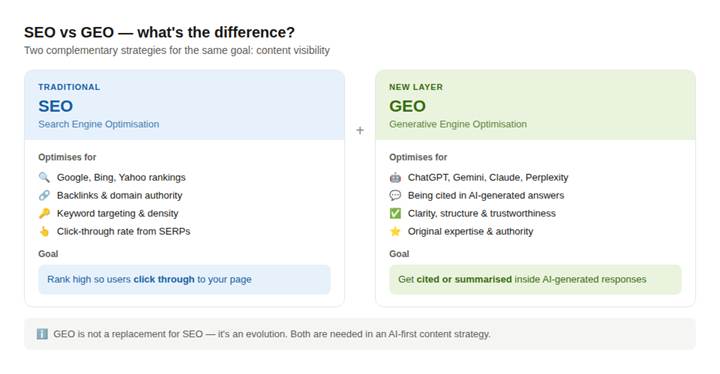
GEO, or Generative Engine Optimization, is the process of optimizing content for AI-powered platforms such as ChatGPT, Perplexity, Gemini, Claude, and Google AI Overviews.
The rise of GEO is closely linked to the growing adoption of AI assistants. Unlike traditional search engines that provide a list of links, AI systems generate direct answers, often supported by citations and sources. Users can continue the conversation, ask follow-up questions, and explore a topic in depth without leaving the interface.
As a result, content creators are increasingly competing not only for search rankings but also for visibility within AI-generated responses. A strong GEO strategy makes content discoverable, understandable, trustworthy, and citation-worthy for AI systems.
How AI Search Differs from Google Search
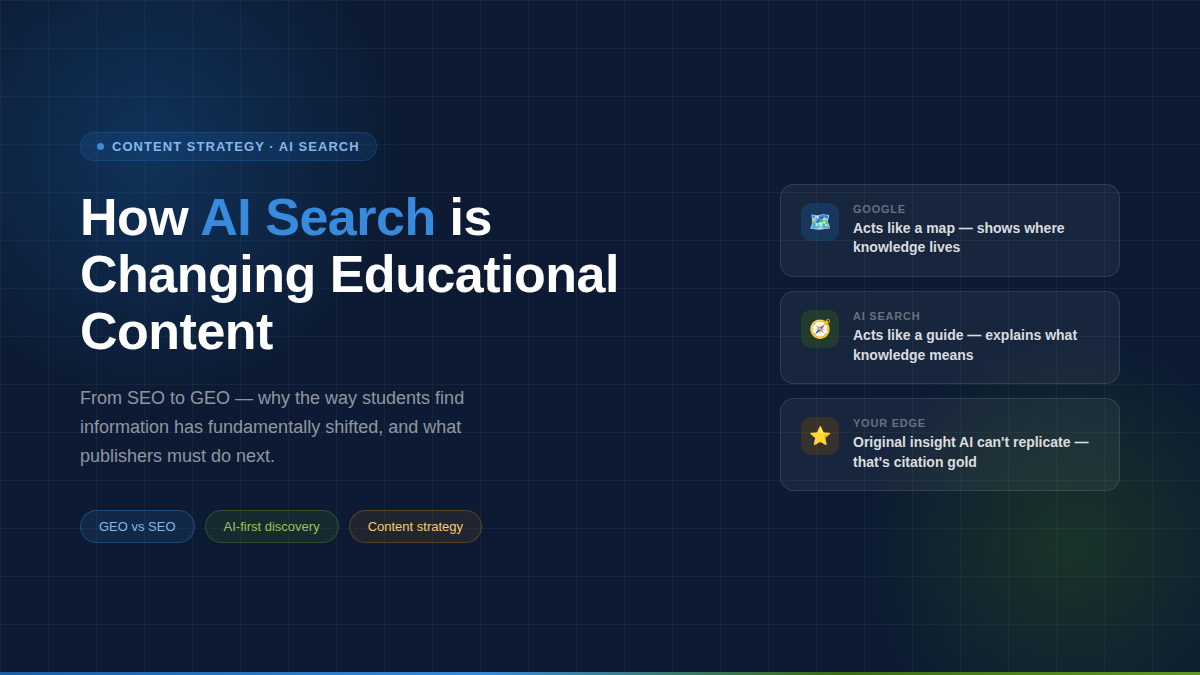
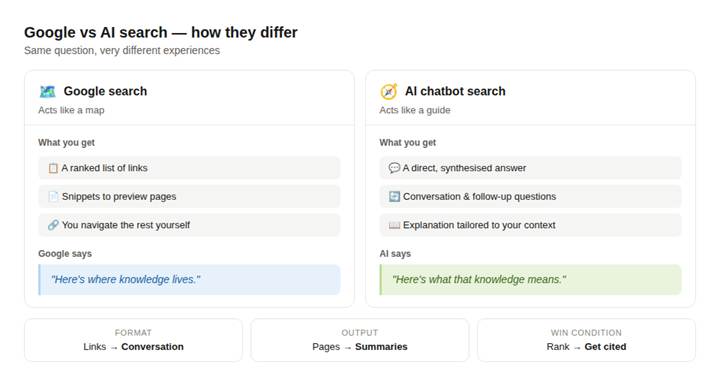
Google is like a map. It points users toward information and expects them to navigate the rest of the journey.
AI chatbots, on the other hand, act more like guides. They summarize information, explain concepts, compare options, and answer follow-up questions within the same conversation.
Put simply:
• Google says, “Here’s where knowledge lives.”
• AI chatbots say, “Here’s what that knowledge means.”
Both approaches have value, but conversational AI is increasingly becoming the preferred starting point for many information-seeking users.
How AI Is Changing the Way Students Discover Information
Growing up in a small town in Assam during the late 1980s, access to information was largely limited to textbooks. If a concept was poorly explained, students often had to search for alternative books or rely on teachers and peers for clarification.
The internet changed that by making information widely accessible. Search engines connected students to millions of webpages, while platforms such as Wikipedia enabled deeper exploration through interconnected content.
Today, AI chatbots represent the next major shift. Students can ask complete questions, receive tailored explanations, and continue refining their understanding through conversation.
For example, a student struggling to understand the double-slit experiment can ask a chatbot specific questions, challenge the explanation, and seek alternative examples until the concept becomes clear.
AI gives students unprecedented access to explanations, examples, and personalized guidance that were previously difficult to obtain.
What This Shift Means for Education Content Creators
This shift has major implications for educational publishers and content creators. If students increasingly receive answers directly from AI systems, educational content can no longer rely solely on keyword rankings.
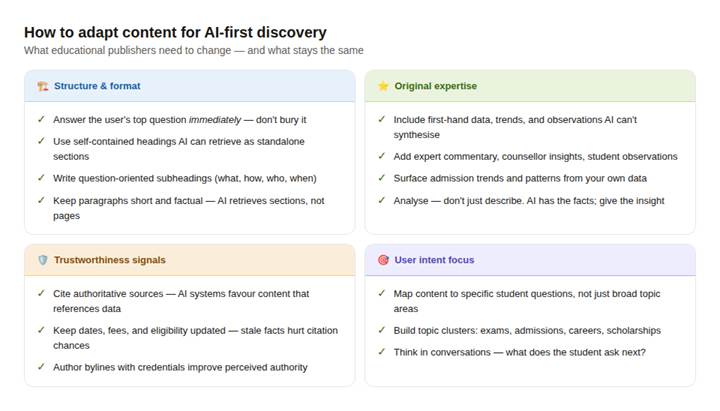
Content must be structured in ways that AI systems can easily understand, cite, and reference. At the same time, original insights, practical examples, first-hand observations, and subject expertise become increasingly valuable because they help content stand out from the vast amount of generic information already available online.
GEO is not simply about making content visible to AI systems. It is about making content understandable, trustworthy, and citation-worthy in an AI-first world.
How Content Creators Should Adapt
Until recently, content discovery strategies revolved around keywords and search rankings. While these remain important, AI-powered search is shifting the focus toward topical expertise and authority.
Educational publishers have been building topic clusters for years. Websites such as Shiksha, Careers360, Collegedunia, and CollegeDekho already organize content around exams, admissions, scholarships, placements, and careers.
The key change lies in how content is structured.
Educational content should answer user intent immediately. A page about applications should quickly address questions such as:
• Is the application window open?
• What is the fee?
• What are the important dates?
• Who is eligible?
AI systems often retrieve specific sections rather than entire pages. Therefore, content should use self-contained headings, direct answers, and question-oriented structures.
However, structure alone is not enough. Since AI can synthesize factual information from multiple sources, educational publishers must increasingly differentiate themselves through original analysis, expert commentary, admission trends, student insights, and data-backed observations.
The future belongs not to publishers who create the most content, but to those who create the most useful, trustworthy, and citation-worthy content.
Practical Examples
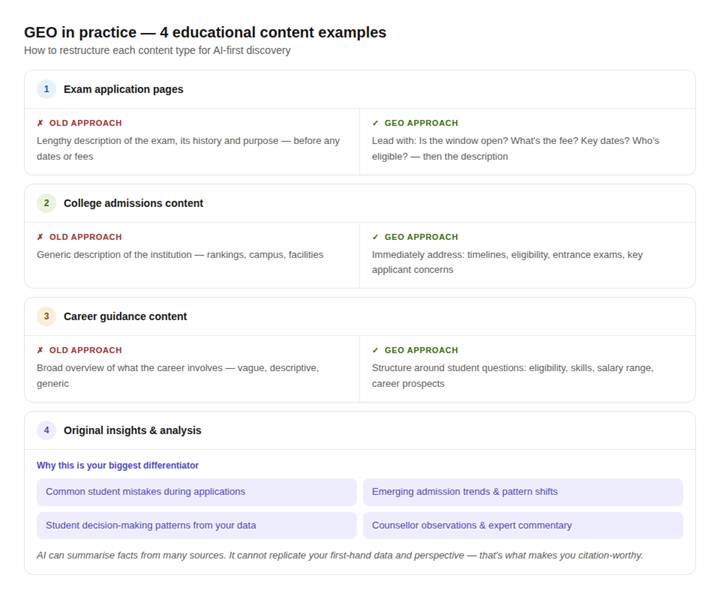
Example 1: CAT Exam Application Page
Pre-GEO Approach
Many education websites traditionally began with lengthy introductions similar to:
The Common Admission Test (CAT) is one of India’s most prestigious MBA entrance examinations conducted annually for admission to the Indian Institutes of Management (IIMs) and other leading business schools. Every year, lakhs of candidates appear for the examination hoping to secure admission to their dream MBA programme.
While factually correct, this introduction does not immediately answer the questions most students are searching for.
GEO-Friendly Approach
The article should begin by addressing the user’s primary intent.
| Student Question | Direct Answer |
| Is the CAT application form currently open? | No. The application process closed on September 20, 2025. |
| Is there an application correction window? | Yes. Registered candidates can edit specific fields during the correction period. |
| What is the CAT application fee? | General category candidates must pay ₹X, while reserved category candidates pay ₹Y. |
after answering these high-priority questions should the article move into detailed discussions about eligibility, important dates, exam pattern, registration steps, and preparation strategies.
The objective is not to eliminate detailed content but to surface the most useful information first. This improves user experience while also making the content easier for AI systems to retrieve, summarize, and cite.
Ultimately, GEO is not about abandoning traditional SEO principles. It is about creating content that answers questions clearly, demonstrates expertise, and is structured in a way that both humans and AI systems can easily understand, trust, and cite.
Instead of beginning with a lengthy description of the exam, answer the most important student questions first—application dates, fees, eligibility, and correction windows.
Example 2: College Admissions Content
Traditional Approach
“XYZ University is one of the leading universities in India offering a variety of undergraduate and postgraduate programmes.”
GEO-Friendly Approach
“XYZ University MBA admissions 2026 are expected to begin in October 2025. Candidates must have a bachelor’s degree with at least 50% marks and may be required to appear for CAT, XAT, or CMAT depending on the programme.”
The second version directly addresses user intent.
GEO Comparison
| Evaluation Criteria | Traditional Version | GEO-Friendly Version |
| Answers user intent immediately | No | Yes |
| Provides actionable information | No | Yes |
| Contains admission-specific facts | No | Yes |
| Easy for AI to cite or summarize | Limited | High |
| Useful to a prospective applicant | Limited | High |
| Demonstrates topical relevance | Generic | Strong |
Example 3: Career Guidance Content
Traditional Approach
Many career-guidance articles begin with broad descriptions of a career path:
Data Science is one of the fastest-growing careers in the world. Data Scientists work with large datasets to identify patterns, generate insights, and support decision-making.
While informative, such content may not directly address the student’s actual concern.
GEO-Friendly Approach
Students often have specific questions in mind.
| Student Question | Direct Answer |
| Is Data Science a good career for students from a non-technical background? | Yes, although additional training in statistics, programming, and data analysis may be required. |
| Does Data Science require coding? | Most Data Science roles require some knowledge of programming, particularly Python or R. |
| What is the average starting salary in Data Science? | Salaries vary by employer, location, and skill level, but entry-level professionals can expect competitive compensation. |
| Which undergraduate degrees can lead to a career in Data Science? | Students from Engineering, Mathematics, Statistics, Computer Science, Economics, and related disciplines may pursue Data Science careers. |
Once these questions are answered, the article can provide deeper information about skills, courses, career progression, and industry trends.
Example 4: Original Insights
Educational publishers can create value through content such as:
• Common mistakes students make during applications
• Emerging admission trends
• Student decision-making patterns
• Counsellor observations and expert analysis
Such content is harder to replicate and more likely to provide value beyond factual summaries.
Example 5: Frequently Asked Questions (FAQs)
Educational content should increasingly anticipate student questions.
For example, a CAT application page may include:
- Can final-year students apply for CAT?
- Can I edit my CAT application after submission?
- Is there any age limit for CAT?
- What documents are required during registration?
Each question can be answered in a concise, self-contained format, improving both usability and AI discoverability.
Conclusion
AI is changing not only how students search for information but also how educational content is discovered, consumed, and cited.
GEO should not be viewed as a replacement for SEO. Instead, it represents an evolution in how content is created and structured. Traditional SEO focuses on visibility and rankings, while GEO adds a new layer of optimization for AI understanding, retrieval, summarization, and citation.
As AI becomes an increasingly important gateway to information, educational publishers that prioritize clarity, expertise, trustworthiness, and user intent will be best positioned to remain visible and relevant.