The Rajasthan PTET 2025 refund portal has been reopened for candidates who did not apply for a fee refund earlier. Under Refund Order II, eligible candidates can submit their refund details from December 25, 2025, to January 25, 2026. During this period, candidates must provide valid bank account details to receive the refund.
Applicants are required to upload a clear copy of their bank passbook or a cancelled cheque showing the account holder’s name, bank account number, and IFSC code. Candidates are advised to regularly check the official PTET portal for updates related to the refund process.
Latest Updates:
To apply online for Rajasthan PTET 2025 Counseling Fee Refund – Click Here
What Is Rajasthan PTET and Why Refunds Are Being Issued
Brief Backstory
The Pre-Teacher Education Test (PTET) is a state-level entrance examination conducted for admission to:
2-year Bachelor of Education (B.Ed.) programmes
4-year integrated B.A. B.Ed. and B.Sc. B.Ed. courses
The PTET 2025 examination was conducted on June 15, 2025 across various centres in Rajasthan. After the exam, provisional and final answer keys were released, and objections were invited before the declaration of results.
Why Refunds Are Available
Refunds are applicable to candidates who:
Appeared in PTET 2025 but did not secure admission during counselling
Registered for counselling but did not join any allotted college
Paid counselling or admission fees but were found ineligible for seat allotment
Both counselling registration fees and admission-related fees are covered under the refund policy.
PTET 2025 Exam Status and Counselling Summary
The PTET 2025 results were declared after completion of the answer key and objection process. Multiple counselling rounds, including first, second, and third rounds, were conducted. Seat allotment, fee payment, and college reporting were completed as per the counselling schedule, with certain deadlines extended to facilitate candidates.
Refund Process – Step-by-Step
Who Can Apply
Candidates eligible for Refund Order II include:
Those who did not get a seat during PTET 2025 counselling
Candidates who registered but did not take admission
Applicants who missed applying during the first refund phase
How to Apply
Visit the official PTET website
Click on the Refund Order II or Fee Refund option
Log in using application or roll number and date of birth
Upload bank passbook or cancelled cheque with correct details
Submit the form and save the acknowledgment
Important Dates
Refund Order II application window: December 25, 2025 to January 25, 2026
How to Check Refund Status
Candidates can check their refund status through the PTET portal using their login credentials. Ensuring correct bank details is essential to avoid delays or rejection of refunds.
Key Points for Candidates
Verify bank account details carefully before submission
Apply before the deadline to avoid missing the refund
Keep a copy of all submitted documents and acknowledgments
This update aims to provide PTET 2025 candidates with complete clarity on the refund process, eligibility, and current exam status.
CAT Application Form 2025 – Registrations for CAT 2025 is now closed.
CAT applications were open from August 1 to September 20, 2025. Candidates had to register for the exam by following the application link that was given here. Before applying, they had to confirm CAT 2025 eligibility criteria. The CAT application fee is INR 2600.
To apply for CAT, you needed to register using your email ID and mobile number, fill in academic, personal, and contact details, select FIVE test centers for CAT 2025, upload documents, and pay the application fee.
CAT 2025 application form correction window was OPEN from October 4-7, 2025. Using the edit window, you could modify photograph, signature, and test city.
CAT 2025 exam was conducted on November 30, 2025. Keep reading to learn the full details about the CAT application form 2025.
Recent passport size photograph and signature. The photo must not be more than six months old and have a white background.
Caste/PwD/Scribe certificate
CITY options candidates need to select
5
The options must be entered in the order of priority
To check list of available city options – Click Here
Particulars that can be edited in CAT 2025 application form
You can edit the following particulars:
Photograph Signature Test City Preference
Help Desk Number
1800 210 0175
CAT Application Form 2026 – Important Dates
The registration process for CAT 2025 will close on September 15, 2025. Check out the important dates for CAT registration below.
Event
Dates
Start of application form
August 1, 2025
Last date to register for the exam
September 20, 2025
September 13, 2025
Issue of admit cards
November 5, 2025
CAT 2025 Test Day
November 30, 2025
CAT Application Form 2025 – Checklist before filling the form
The candidate must ensure they have the following items in place before proceeding to fill out the CAT 2025 application form.
Check your eligibility for CAT 2025
Ensure that you have a valid and unique email address and mobile number. You must retain this email ID and mobile number until the CAT Admission process is completed as all official communications will be done using them.
Scanned images of your passport size photo and signature are required for uploading. The photo must not be more than six months old and have a white background. NOTE that you are required to bring printed copies of the same photograph on the examination day.
The registration process for CAT 2025 will be conducted online. The stepwise process to register for the exam is explained in detail below.
Register for CAT 2025 – The candidate has to initiate the application process by first registering for the exam using their date of birth, country, email ID, and mobile number. On entering the details, an OTP will be generated and sent to the registered email id and mobile number. On confirming the OTP, the candidate account will be activated.
Fill in the form – The candidate needs to log in to the applicant account using CAT 2025 user ID and password. Fill in personal, academic, and contact details. Select FIVE city options from the drop-down menu in the order of priority. Also, select your program of study (Combination of academic institute and MBA program).
Pay the CAT 2025 application fee – The candidate has to next pay the category-specific registration fee to complete the application process.
CAT Application Fee 2025
The category-specific registration fee for the CAT exam is given in the table below. Fees once paid will not be refunded under any circumstances.
Category
CAT Exam Fee
SC, ST and PwD
INR 1,300
All other candidates
INR 2,600
Note: The candidate needs to pay the registration fee only once, irrespective of the number of institutes he/she is applying for. SC, ST and PwD candidates must upload a copy of their SC/ST/PwD certificates at the time of registration.
CAT Application Form 2025 – Required Documents, Format, Size
The candidate must upload the following documents when filling out the CAT 2025 application form.
Document
Size
Format
Scanned Passport Size Photograph
The photo should not be more than six months old and should have a white background.
Note: The candidates must bring printed copies of the same photograph on the examination day. So, ensure that you have sufficient copies of this photo.
Up to 1200 pixels x 1200 pixels (80KB)
The image should be clear with a minimum resolution of 150px/inch.
.jpg or .jpeg
Scanned Signature
Up to 80mm X 35mm (80KB)
The image should be clear with a minimum resolution of 150px/inch.
.jpg or .jpeg
EWS/NC-OBC/SC/ST Certificate
Download the caste certificate from the CAT website, enter the required information, self-attest it and upload the scanned copy.
–
PDF
PwD Certificate
Download the PwD certificate from the CAT website, fill it, self-attest it and upload the scanned copy.
–
PDF
CAT 2025 Application Form Correction Window
The candidate is given the option to make corrections in the CAT 2025 application form from October 4-7, 2025.
Using the CAT application form correction window, you could edit the following fields:
Photograph
Signature
Test City Preference
NOTE: The correction facility will be valid only for those candidates who have completed the CAT application form, including payment of the application fee.
CAT Exam 2025 Eligibility Criteria
Candidates planning to appear in the CAT 2025 exam must meet the specific eligibility criteria specified by the exam conducting body.
Qualifying exam passed – The candidate must have passed Bachelor’s degree with minimum marks.
Appeared/ awaiting results – Such candidates may also apply provided they meet the specific criteria by the given deadline.
Age limit – There is no age restrictions for appearing in the CAT 2025 exam.
What after submission of CAT 2025 application submission
The candidate will be given an opportunity to edit the submitted application form once the registration process ends. The candidate must use the opportunity to may any corrections, if required.
Next, candidates who duly complete the application process will be issued the CAT 2025 admit cards November 5, 2025. On the day of the exam, the candidate must bring the admit card and a valid photo ID proof.
The admit card will contain details like exam date and timings, name and address of the allotted CAT 2025 exam center, roll number, exam-day instructions, etc.
CAT Application Form 2025 – Correction Window
The CAT 2025 application form correction window is open from October 4-7. Note that the using the application form edit or correction window, the candidate can edit only a few of the particulars.
For instance, the candidate is allowed to edit the following THREE fields:
Photograph
Signature
Test city preference
Apart from these, no other particulars can be edited in the application form. So, it is important to bear caution when filling out the application form the 1st time around.
CAT Exam Center 2025 – The list of test cities for CAT 2025 is available at iimcat.ac.in. To check the list of available exam cities, go to the portal, and then click on the “Exam Cities” option. The list of cities is given state/ union territory-wise. So, select the applicable city or union territory to get the available city options.
The allotment of test centers will be based on the exam city selected and address of the candidate. Typically, the candidate will be allocated a center closest to their home address.
You are allowed to select an exam city; however, you can’t select any specific exam center.
Further, you must choose FIVE cities in the order of preference from the drop-down menu when filling out the application form. The CAT 2025 application form is now closed. The name and address of the exam center allocated to the candidate will be mentioned on the CAT admit card 2025, along with reporting and exam timings.
How to check name and address of allotted CAT 2025 Exam Center
The name and address of the CAT 2025 exam center allocated to the candidate will be mentioned on the CAT 2025 admit card, along with other key information like exam center reporting time and guidelines to be followed inside the exam venue.
The candidate must check that they have been allotted the correct exam center.
If there is any discrepancy, including wrong allotment of exam center, information missing, etc., the candidate must contact CAT 2025 exam officials without any delay.
CAT Helpdesk: cathelpdesk@iimcat.co.in
CAT Test Centre – Dos and Don’ts
The candidate must follow the following guidelines related to the CAT exam center.
Reporting Time – The exam center reporting time will be mentioned on the CAT admit card. The official recommendation is reaching the CAT exam center 1.5 hours before the exam commences.
Don’t arrive at the exam center late – Once the exam commences, the candidate will not be allowed inside the exam hall.
Gate closing time – Entry to the exam center will be STOPPED 15 minutes prior to the exam; so, do be late.
Document checklist – Bring the following documents with you – 1) TWO printouts of the CAT admit card, and 2) a photo ID proof in the original
How to identify your seat – Use the Reference Number printed on the CAT 2025 admit card to locate your exam hall and designated work station.
Barred items – Electronic gadgets including mobile phones, smartwatch, etc., are not allowed inside the exam hall. Also, don’t carry books, textual material, or any such items that can be used for gaining an unfair advantage in the exam. Exam officials also recommend candidates not to wear closed shoes, belts, caps, jackets and other outfit and accessories with metal inside the exam hall.
Do not use the keyboard at any point of time during the exam or your system will automatically get locked.
The candidate had to select their choice of exam city when filling out the form. As per the official instructions, you were allowed to select any five different Test Cities as per your preference from the drop-down menu.
You will be allotted a test city as per the selected preferences. In some rare cases, if you are not allotted any of the preferred city, then a nearby city will be allotted.
The CAT application form was open from August 1 – September 13, 2025.
CAT Admit Card 2025
The hall ticket-cum-admit card of CAT 2025 was released on November 12, 2025. It is released for all candidates who have duly completed the application process. The CAT 2025 exam committee has notified that for the current session, 2.95 lakh candidates have been issued admit cards.
The admit card contains details like the name and address of the allotted CAT 2025 exam center, exam date and slot, roll number, exam center reporting time, etc. On exam day, you must bring the admit card and a photo ID proof. Also, make sure that you strictly follow the CAT 2025 exam-day guidelines.
CAT syllabus 2025 – The CAT 2025 question paper has 3 sections – Verbal Ability & Reading Comprehension (VARC), Data Interpretation & Logical Reasoning (DILR) and Quantitative Aptitude (QA). The CAT syllabus includes the important topics for each of these sections.
Prescribed by the Indian Institute of Management, the CAT syllabus is widely regarded as the toughest of all MBA entrance exams. So, when preparing for CAT 2025 exam, you must tackle the syllabus smartly and with determination.
Important topics in the CAT syllabus include Geometry, Graphs, Algebra, Arithmetic, Percentage, Coding, etc. The VARC section gives more weightage to Reading Comprehension, so you will have to brush up your English. Likewise, treat each section with a sound knowledge of topic-weightage and difficulty level.
Questions asked in the CAT exam can be put in THREE broad categories or sections:
Data Interpretation and Logical Reasoning (DILR)
Verbal Ability and Reading Comprehension (VARC)
Quantitative Aptitude (QA)
The Quantitative Ability section typically includes math-based questions of 10th/12th-grade level. So, you need to study topics like arithmetic, algebra, numbers, geometry, and mensuration.
In the VARC section, verbal reasoning and reading comprehension will be asked.
Lastly, the CAT Exam syllabus for DILR will include questions related to analysis and interpretation of information provided in the form of tables, puzzles, and bar graphs.
CAT Syllabus 2025 – Exam Pattern
The exam pattern of CAT 2025 exam is given below.
Particulars
Description
CAT Exam syllabus sections
Questions asked in the CAT exam can be broadly placed in the following categories:
Verbal Ability and Reading Comprehension (VARC) Data Interpretation and Logical Reasoning (DILR) Quantitative Aptitude (QA)
The topics that will be covered in each section of the CAT exam is given in the table below:
CAT Session
CAT Exam Syllabus Topics
VARC
Verbal Ability
Para Jumbles Sentence Completion Para Summary Antonyms & Synonyms Error Detection Odd Sentence Out Phrase Modifiers Analogies Cloze Test Word Usage
Reading Comprehension
Facts Inference Judgement Critical Analysis of Passage Themes of the RC passage Idioms
DILR
Arithmetic Algebra Geometry Number System Modern Math
QA
Caselets Pie Charts Tabular Data Line Graphs Bar Graphs Column Graphs Combination Graphs/ Charts Puzzles Blood Relations Syllogisms Coding-Decoding Seating Arrangement Ranking Direction sense test Logical Sequence
CAT Exam Syllabus – VARC
VARC is the first section of the CAT question paper and has TWO sub-sections – 1) Verbal Ability, and 2) Reading Comprehension.
Of the two sections, more questions are asked from the Reading Comprehension section; in other words, it carries more weightage.
A total of 24 questions will be asked in the section that the candidate has to attempt in 40 minutes.
VARC topics for the CAT syllabus are given in the table below:
CAT VARC Topics
Fill in the blanks
Antonyms
Idioms
Foreign language words used in English
Sentence completion
Para jumbles
Verbal reasoning
Verbal logic
Errors in tenses
Parts of speech
Analogies
Syllogisms
Preposition
Articles usage
One word substitution
Types of clauses
Different usage of one word
Jumbled paragraphs
Phrases modifiers
Sentence correction
Subject-verb agreement
Para completion and inference
CAT Exam Syllabus for DILR Section
DILR stands for Data Interpretation and Logical Reasoning.
So, you will get DI and LR-based questions in this section.
The section will include 20 questions and you will get 40 minutes to attempt these questions.
Important Topics for DILR section
CAT DILR Topics
DI Topics
LR Topics
Bar Graphs
Order and Ranking
Column Graphs
Binary Logic
Venn Diagrams
Arrangements
Data Caselets
Games and Tournaments
Pie Charts
Team Formations
Tables
Line Charts
Scatter Plot
Routes and Network
Bubble Chart
Radar Chart
CAT Exam Syllabus for QA Section
The 3rd and final section of the CAT exam paper is Quantitative Aptitude. The section will have 22 questions.
Like in the other sections, you will get 40 minutes to attempt the paper.
Here are important topics from the CAT exam syllabus for QA
Distance MBA or Correspondence MBA is a popular choice for working professionals, entrepreneurs, and students who want to pursue higher education without putting their careers or personal commitments on hold. Unlike a regular MBA, this mode offers flexibility of time and location, allowing learners to study at their own pace through online lectures, recorded sessions, or self-study materials. It is usually cost-effective, with fees considerably lower than traditional MBA programs, while still being recognized by the UGC and Distance Education Bureau (DEB) in India. Many reputed universities such as IGNOU, NMIMS, and Symbiosis offer Distance MBAs, ensuring a credible curriculum and exposure to industry-relevant topics.
However, the Distance MBA also has certain limitations. The lack of regular face-to-face interaction with faculty and peers can sometimes reduce networking opportunities, which are considered a strong advantage of full-time MBAs. Placement assistance is also limited, so much depends on the learner’s self-initiative in applying knowledge to career growth. Additionally, some employers may value a full-time MBA more than a distance program.
In essence, a Distance MBA is a practical, affordable, and flexible route to management education, best suited for those who prioritize learning alongside work, but it requires self-discipline and proactive effort to fully reap its benefits.
Most importantly, a Distance or Correspondence MBA will deliver real value only when pursued from a reputed and well-recognized institute.
A regular MBA is a two-year program that is delivered through the regular classroom sessions. With distance and online MBA programs, however, you have the flexibility of learning without mandatory classroom attendance.
A Distance MBA is best suited for:
Working professionals who want to upgrade their managerial or leadership skills without leaving their jobs. So, it can be ideal for mid-career professionals aiming for promotions or transitions into management roles.
Entrepreneurs seeking structured knowledge, in areas like finance, marketing, etc., to grow their businesses.
Graduates who need an affordable alternative to a full-time MBA.
Government/PSU employees aiming for promotions.
Career returnees (like homemakers or break-takers) reskilling for the job market.
Cost-conscious learners looking for a recognized degree at lower fees.
Distance MBA Eligibility Criteria
Typically, the program has a duration of two years, though students are allowed up to four years to complete it.
The eligibility requirements for a Distance or Correspondence MBA may differ across institutes. So, you can visit the institute website and verify the eligibility requirements.
The general criteria distance MBA eligibility criteria are:
A Bachelor’s degree or equivalent from a recognized university.
Work experience is preferred but not mandatory.
Certain institutes accept MBA entrance exam scores such as CAT 2025 exam, MAT, CMAT, or XAT.
Some universities also conduct their own entrance tests for admission.
Here are some of the top Distance / Correspondence / Open-University MBA / PGDM colleges in India (2025) based on rankings, fees, recognition, and student feedback.
Distance MBA College
Key strengths
Fees (2 years)
NMIMS Global Access / NMIMS Centre for Distance Learning
Strong brand, good acceptance, variety of specialisations.
~ ₹1,96,000
Symbiosis Centre for Distance Learning (SCDL), Pune
Well-known, good curriculum for distance/online MBA / PGDM.
~ ₹70,000-₹80,000
Indira Gandhi National Open University (IGNOU)
Very affordable, widespread recognition, large network of study centers.
~ ₹62,000 for full program (2 yrs)
Institute of Management Technology (IMT), Ghaziabad – Centre for Distance Learning
Good reputation, solid PGDM/PGDBM equivalents; decent recognition by industry.
~ ₹1,60,000 (varies by specialization)
Amity University Distance / Online MBA
Large private university, variety of specialisations, flexible mode.
~ ₹1,50,000-2,00,000 depending on specialization and mode
Annamalai University (Tamil Nadu)
Public university, affordable, good reputation especially regionally.
~ ₹39,000-₹80,000 depending on specialisation etc.
Lovely Professional University (LPU)
Flexible schedule, decent infrastructure, name recognition in the private sector.
~ ₹60,000-₹70,000 approx for full program
ICFAI University / IFHE (distance mode)
Good curriculum, recognized, many specialisations.
~ ₹75,000-₹2,00,000 depending on specialisation and level.
Welingkar (Prin L.N. Welingkar Institute of Management Development)
Known name, industry-oriented courses.
~ ₹60,000-₹1,30,000 depending on options.
Suresh Gyan Vihar University (Jaipur)
Good private option, recognized courses and specialisations.
~ ₹75,000-₹80,000 approx.
What to Check Before Choosing a Distance MBA
Here are some criteria you should verify before selecting a college:
Is the program approved by UGC / Distance Education Bureau (DEB)? Recognition matters for the job market and further studies.
Are the specializations offered aligned with what you want (Finance, HR, Operations, Analytics, etc.)?
What’s the mode of delivery (online lectures, weekend contact classes, recorded videos, etc.)?
How good are study centres / support facilities? Counselling, library, exam centres, etc.
Fee structure and hidden costs (materials, travel, assignments).
Placement tie-ups or support services (though often lighter in distance mode).
Benefits of Distance MBA
Flexibility – Study at your own pace without leaving your job or other commitments.
Affordability – Much lower fees compared to full-time MBA programs.
Accessibility – Available to students across India and abroad through online/distance modes.
Work-Study Balance – Allows professionals to gain qualifications while continuing their careers.
Recognized Degrees – UGC-DEB approved programs from reputed institutes carry industry value.
Wide Choice of Specializations – Options like HR, Finance, Marketing, IT, Analytics, etc.
Career Advancement – Enhances chances of promotion, role change, or entrepreneurship success.
Time Flexibility – Many institutes allow students extra years to complete the program.
Skill enhancement: A Distance MBA enhances management, leadership, analytical, communication, and time management skills, while offering specialized knowledge and a strategic mindset, helping professionals grow in their careers without leaving work.
MBA admissions in India are carried out in a phase-wise manner, with most B-schools completing the process by May- June and academic sessions beginning in July- August. However, the journey typically starts almost a year in advance, around July – August, with the opening of registrations for national-level MBA entrance exams.
Candidates can apply to a wide variety of government and private management institutes across India, depending on their preferred location, specialization, and budget.
The MBA admission process generally includes THREE stages:
Group Discussion (GD) / Written Ability Test (WAT) – to assess communication and analytical skills.
Personal Interview (PI) – to evaluate motivation, clarity of goals, and overall personality.
Currently, for the 2025 admission cycle, a few B-schools are still accepting applications. For the 2026 academic session, the process has already begun:
CAT, XAT, SNAP, and NMAT registrations are now open.
MAT and ATMA applications remain open throughout the year, offering multiple test windows.
CMAT 2026 registrations are expected to open in November 2025.
Choosing the right B-School for MBA admission is a crucial decision that can shape your career.
Here are some key factors to consider:
Accreditation & Recognition – Ensure the institute is approved by AICTE, UGC, or AIU and holds reputed accreditations like NBA, NAAC, AMBA, AACSB, or EQUIS.
Ranking & Reputation – Refer to NIRF 2025 rankings, global rankings, and trusted surveys. Higher-ranked institutes usually provide better exposure, placements, and networking.
Placement Record – Check average and highest packages, recruiting companies, and alumni network strength.
Faculty & Pedagogy – Look for experienced faculty, industry exposure, case-study based learning, live projects, and international collaborations.
Specializations Offered – Choose a college that excels in your preferred domain (Finance, Marketing, HR, Operations, Analytics, Consulting, etc.).
Infrastructure & Location – Location matters for internships and corporate exposure. Metro-based B-schools often have an advantage.
Fees & ROI – Compare tuition fees with average placement salaries to evaluate the return on investment.
Admission Process & Cut-offs – Review which entrance exams the college accepts (CAT, XAT, MAT, NMAT, SNAP, CMAT, etc.) and its cut-off trends.
MBA Colleges in India: Admission Process & Selection Criteria
1. Admission Process
The MBA admission process in India generally follows these steps:
Apply for an Entrance Exam – The candidates must apply for exams like national, state, or institute-level exams like CAT, XAT, SNAP, NMAT, MAT, CMAT, ATMA, or university-specific tests.
Take the entrance exam – Appear for the chosen exam, which tests quantitative ability, logical reasoning, data interpretation, verbal ability, and general awareness.
Shortlisting by Colleges – Based on cut-offs and scores, B-schools shortlist candidates for the next round.
Group Discussion (GD) / Written Ability Test (WAT) – Assesses communication, analytical skills, and knowledge of current issues.
Personal Interview (PI) – Final stage will evaluate the personality, motivation, leadership, and career goals of the candidate.
Final Admission Offer – Institutes will release merit lists for admission considering – 1) exam score, 2) GD/WAT + PI performance, 3) academic profile, 4) work experience.
2. Selection Criteria
While the selection criteria vary by college, most B-schools consider:
Entrance Exam Score – Weightage varies (IIMs give ~40–60%; other B-schools may give higher).
GD/WAT Performance – ~10–20% weightage, depending on the institute.
PI Performance – Often the most important factor, ~20–30% weightage.
Academic Record – Past scores in Class 10, 12, graduation (5–15%).
Work Experience – Adds extra points, especially for executive or premium MBA programs.
Diversity Factors – Some institutes give weightage to gender or academic diversity.
MBA Admission & Selection Criteria of Top MBA Colleges
As discussed above, the MBA admission process includes an entrance exam followed by GD/PI for shortlisted candidates.
The entrance exam accepted may vary from one institute to the other. Here detail the entrance exams and GD/PI accepted by the top MBA colleges.
MBA College Name
MBA Entrance Exam
Group Discussion/Personal Interview (GD/PI)
Management Development Institute, Gurgaon
CAT/GMAT
Yes
Symbiosis Institute of Business Management
SNAP
Yes
MICA, Ahmedabad
CAT/XAT/CMAT and MICAT
Yes
Jamnalal Bajaj Institute of Management Studies, Mumbai
MAH-CET
Yes
Narsee Monji Institute of Management Studies, Mumbai
NMAT by GMAC
Yes
SP Jain Institute of Management & Research, Mumbai
CAT/XAT/GMAT
Yes
XLRI-Xavier School of Management
XAT/GMAT
Yes
Institute of Management Technology
CAT/XAT/CMAT/GMAT
Yes
Indian Institute of Foreign Trade, Delhi
CAT/GMAT
Yes
Prin. L. N. Welingkar Institute of Management Development & Research
How to crack GD-PI-WAT – If you crack the CAT 2025 exam or any management entrance exam, it is only half the job done.
The GD-PI-WAT round plays a decisive role in admissions to top MBA colleges, going beyond entrance exam scores to evaluate a candidate’s overall personality and potential. These stages are designed to test skills essential for future managers – communication, analytical ability, teamwork, and clarity of thought.
In the Group Discussion (GD), assessors look for meaningful participation, structured arguments, and the ability to listen and build on others’ ideas rather than dominate.
The Personal Interview focuses on self-awareness, confidence, academic knowledge, and clarity of career goals, while also checking how well your aspirations align with the MBA journey.
The Written Ability Test examines your ability to think critically, structure ideas, and express them concisely within a limited timeframe.
Cracking these rounds requires a balance of content knowledge, communication skills, and self-confidence. Staying updated on current issues, practicing structured responses, and approaching discussions with humility and clarity can significantly improve your chances.
Cracking the GD–PI–WAT (Group Discussion, Personal Interview, Written Ability Test) round for top MBA colleges (like IIMs, XLRI, FMS, SPJIMR, etc.) requires a mix of knowledge, communication skills, personality, and strategy.
1. Preparation for Written Ability Test (WAT)
Read daily: Newspapers (The Hindu, Indian Express), magazines (Business Today, Economist), and editorials.
Structure your writing: Practice 250–300 word essays with clear introduction, body (arguments + examples), and conclusion.
Cover common themes: Current affairs, economic policies, social issues, ethical dilemmas, and abstract topics.
Work on clarity: Avoid jargon, be concise, and ensure grammatical correctness.
2. Preparation for Group Discussion (GD)
Develop content depth: Read about major issues (Economy, AI, Sustainability, Geopolitics, Indian education, Gender equality).
Practice articulation: Join mock GDs, learn to speak to the point without repeating.
Be balanced: Don’t dominate, but don’t be silent either. Aim for 3–4 meaningful entries.
Listen actively: Acknowledge others’ points, use phrases like “Adding to what X said…”.
Body language: Sit straight, maintain eye contact, don’t fidget or point fingers.
Frameworks help: For structured points, use PESTLE (Political, Economic, Social, Tech, Legal, Environmental) or SWOT.
3. Preparation for Personal Interview (PI)
Know your basics: Academic subjects from graduation, work experience projects, internships.
Personal questions: Be ready for “Tell me about yourself”, “Why MBA?”, “Career goals”, “Strengths & weaknesses”.
Current affairs: Stay updated on global & national issues. Expect “Your views on India’s economy”, “Impact of AI on jobs”, etc.
6. If you don’t know an answer, simply acknowledge it
If you don’t know the answer to a question, it’s better to admit it with a simple ‘I don’t know’ instead of trying to bluff. Interviewers can usually see through such pretenses, and it may end up costing you more than you realize.
7. Introducing yourself to the interview panel
One of the most common opening questions in an MBA interview is: ‘Tell me something about yourself.’ The way you answer this question will set the stage for the next set of questions.
Ideally, give a concise answer – touching upon your family, education, career goals, hobbies, and interests. Mention in brief your educational background, life journey, and future aspirations. However, avoid long monologues dwelling on the past.
8. Where do you see yourself in five years from now?
When answering this question, focus on how the MBA course can help you achieve specific professional goals, such as developing new skills, taking on leadership roles, or pivoting to a new industry. Also, don’t forget to showcase how your goals align with that of the business school.
Be specific but also flexible, showcasing a clear but not overly rigid career trajectory that emphasizes growth and contribution.
The WAT is a short essay-writing round conducted by top B-schools (IIMs, XLRI, etc.) to evaluate: clarity of thought, ability to structure arguments, awareness of current affairs, and written communication skills.
The test may include questions from Abstract Topics, like “Red is the new black”, to Current Affairs & Economy, like “Impact of AI on employment in India”, to Social Issues, like “Is India prepared for climate change?”, to Business & Technology, like “Cryptocurrency – Boon or Bane?”.
9. So, to prepare for WAT questions, make it a habit of reading newspaper editorials, current affairs magazines, articles on social trends, etc.
10. To master the essay-writing task, learn how to define/ interpret the topic. In the body part, present balanced arguments (pros/cons, facts, examples). Finally, give a clear, forward-looking, or solution-oriented ending.
11. When writing the essay, stick to simple, clear language. Stay away from jargon. Importantly, make sure the voice of the stay is neutral if it is a controversial topic; avoid sounding too extreme. If you are handwriting the essay, make sure that the content is legible.
MBA Group Discussion
12. Group Discussion Dos and Don’ts
Dos
Things to avoid
If you start, define the topic and set a direction.
Dominating the group or cutting others off.
Make 3–4 solid interventions of 20–30 seconds each.
Speaking without content just to “participate”.
Support good points by others (“I agree with X, and to add…”).
Getting too emotional or aggressive.
Use facts, data, and real-world references.
Using jargon or irrelevant examples.
Sit straight, maintain eye contact, no finger pointing.
Staying silent throughout (fatal mistake).
Wrap up by covering all perspectives neutrally.
13. To prepare for the GD, read newspapers daily (The Hindu, Indian Express, Mint). Follow business magazines, YouTube explainers, RBI/NITI Aayog reports. Make short notes on Economy, Technology, Politics, Social issues, Environment. Join a mock GD group. Work on articulation: short, crisp sentences. Develop listening skills: note key points to build on others’ ideas.
14. Avoid trying to prove others wrong in a GD. After all, it’s a discussion, not a debate, and every participant is entitled to their perspective.
CAT Question Papers 2025 – IIM Kozhikode has released the question papers of CAT 2025 for all THREE sessions. The link to download the question papers is given below.
The CAT 2025 exam was conducted on November 30, 2025.
Candidates preparing for the exam are recommended to solve previous year’ CAT question papers to understand the CAT exam pattern, question type, how questions are framed, specific questions asked, important topics, difficulty level, extent and scope of the questions, etc.
Use these insights for making an effective exam preparation strategy for CAT . For instance, the difficulty level of topics can help you decide whether you need coaching or whether self-study is sufficient. If you decide to go for self-study, you will need a more robust exam-preparation plan, including selecting the best books for CAT.
The previous years’ CAT question paper banks below. Or you can buy them online from portals like Amazon, Flipkart, etc. Or, you can download them for from coaching and counseling portals after paying a certain fee or for free. The current years’ question paper, i.e., CAT 2025 question paper has been released in the form of response sheets and answer keys on the official CAT website.
Caution: Avoid random Google downloads—some sites have incorrect answers.
Decoding Recent CAT Papers (2020-2023)
Section
Exam Analysis
Quantitative Ability
2023: 8 Algebra, 5 Arithmetic, 4 Geometry questions 2022: Increased focus on Modern Math (P&C, Probability) 2021: Surprise questions from Number Systems
VARC
RC passages increased from 16 to 18 questions (2021-23) Critical reasoning questions reduced by 40%
DILR
Data Interpretation now combines:
2 traditional sets (tables/graphs) 2 logical reasoning caselets
When and how many Sample Papers to Solve for CAT Exam
Solve sample papers very early on in your CAT exam preparation. For instance, after completing a few topics, solve related problems in the sample papers. That being said, do this exercise after you have solved the problem sets given at the end of each chapter.
Also, as you move deeper into your CAT exam preparation, you will be able to solve more and more questions in the sample papers. And by the time you complete the CAT exam syllabus, you should ideally be able to complete an entire CAT sample paper.
Coming to the question – how many sample papers you must solve – the answer is “more the better”. So, solve as many sample papers as you can. The more sample papers you solve, the more confidence you will get apart from getting better at problem-solving and time management. Closer to the exam, say in the last week or so, also attempt a few mocks to give finishing touches to your preparation. The CAT 2025 mock test will also help you understand the format of the test.
CAT Question Paper 2025 – FAQs
Q: How many papers should I solve? A: It is recommended to solve around 15 question papers; also, it can be a combination of old and new patterns (5 old patterns + 10 new patterns).
Q: Are 10-year-old papers relevant? A: You can use old papers for concept practice, but maybe not for pattern analysis.
Q: Best time to start solving papers? A: You can start solving sample- and previous years’ papers at any stage of the exam. However, in the early stages, you will only be able to solve only a few questions.
Once you go deep into the preparation cycle, you should be able to solve more questions.
Q: Are sample papers and previous years’ CAT question papers the same? Ans: No, they are not the same.
The previous years’ CAT question papers are the actual question paper for the specific CAT exam edition. For instance, CAT 2024 question paper will include all the questions asked in that edition of the CAT exam. So, by solving previous years’ papers, you can understand the types of questions asked, topic-wise weightage, difficulty level, marking scheme, and many other useful insights.
On the other hand, sample papers, as the name indicates, are sample questions. These questions are not necessarily asked in the CAT exam. However, they are prepared to mirror the actual questions, be it in difficulty level, question framing, weightage, etc., so that you get some sort of reliable preparation material. Consequently, the more sample papers you solve, the better you are supposed to get at understanding the underlying concepts, and importantly, at problem solving.
CAT 2025 Answer Key: IIM Kozhikode released the CAT 2025 final answer key on December 17, 2025. You can download the CAT 2025 Answer Key and response sheet using your CAT 2025 User ID and password (link given below).
The final key is released after considering objections submitted by candidates against the provisional key from December 8-10. The candidate could submit their feedback on payment of INR 1200 per objection. The provisional CAT Answer Key 2025 and candidate response sheet were released on December 4, 2025.
The slot-wise CAT 2025 answer key PDFs are also given below. No log-ins required to download the answer keys.
The answer key has been released for all the exam slots. Use the CAT 2025 response sheet in tandem with the answer key to calculate probable CAT scores. The FINAL answer key of CAT 2025 is released after considering feedback of candidates. CAT 2025 results will be based on final key.
The following information will be mentioned on the CAT 2025 answer key.
Name of the candidate
CAT 2025 registration number
CAT 2025 exam centre name and address
Status (attempted/not attempted)
Candidate’s response
Right option/answer
Test date
Test time
Question
Question Type
Question ID
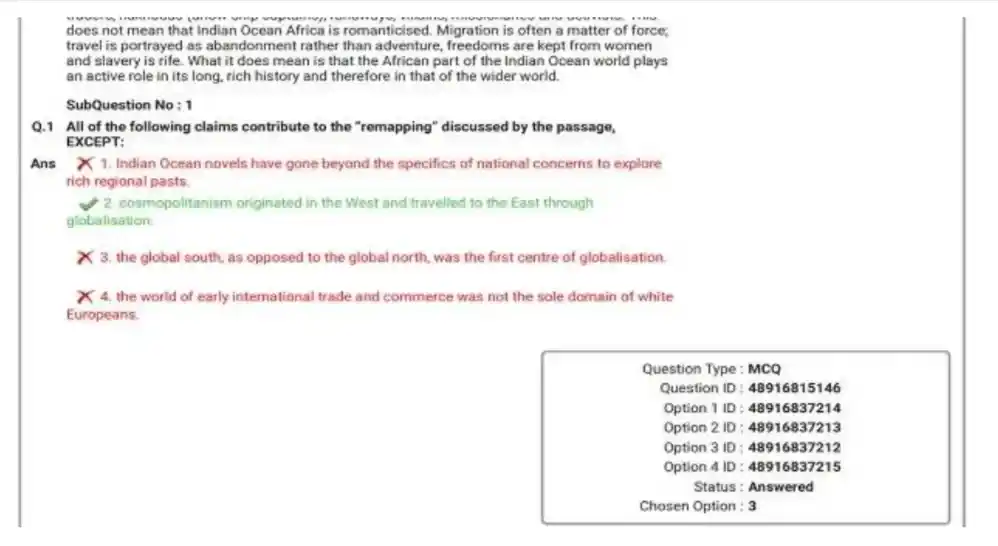
Snapshot of CAT Answer Key
This is what a CAT answer key looks like.
CAT Response Sheet 2025
The CAT 2025 response sheet will be released around the last week of November 2025. To download the response sheet, log-in to the portal using your CAT User ID and password.
Candidates can use the CAT score vs percentile to evaluate their percentile after examining the response sheet.
For instance, you can use the response sheet and answer key to first calculate the number of correct attempts. Next, calculate the score following the CAT 2025 marking scheme, before finally comparing your score.
How to calculate scores using CAT 2025 answer key
The candidate must follow these steps to calculate probable CAT 2025 scores:
Using the response sheet and answer key, first calculate the number of correct attempts.
Next, assign marks to each correct question. Follow the marking scheme given in the CAT 2025 exam pattern for the purpose.
Then tally the marks to get the probable score.
Note: The CAT 2025 raw score will be normalized by exam officials using a specific formula. The scores are normalized so that differences in difficulty level across various exam slots are accounted for.
This means, if the question paper in your exam slot is considered to be the toughest, you may get a few additional marks after the normalization. However, if your test slot is deemed to be the easiest, you will not get any extra marks.
CAT 2025 Marking Scheme
Type of Questions
Correct Answer
Incorrect Answer
MCQ
3
-1
Non-MCQ
3
0
How to Raise Objections against CAT 2025 Answer Key
The window to submit objections against the CAT 2025 answer key will open soon after it has been released. Any candidates who have any reservations against any key (s), can use the window to submit their feedback.
Stepwise process to submit objections against CAT 2025 answer key
Go to the CAT 2025 exam portal – iimcat.ac.in
Click on the “Answer Key Objection” tab
In the log-in window that opens, enter your CAT login ID and password
Click on the Objection tab
Next, click on ‘+’ sign to add an objection
Then select the question number, upload supporting documents, etc.
Pay the CAT 2025 answer key objection fee, which is INR 1,200 per objection
Submit the form.
What you need to know about CAT 2025 answer key objection:
If the objection is upheld, the objection processing fee will be refunded.
But if the objection is deemed to be invalid, the fee will not be refunded. So, make sure that you have enough supporting evidence in your claims.
Objections will only be considered if the payment has been made; if the fee has not been paid, such objections will be cancelled.
The objection fee will be refunded in 5 working days
There is no provision to edit an objection once it has been submitted.
The candidate can raise objections against any or all the questions.
Exam officials will consider the objections/ feedback submitted by candidates before releasing the FINAL answer key of CAT 2025.
CAT result will be based on the final answer key.
No objection will be entertained after the release of final CAT answer key and result
Requests for re-checking of CAT question paper or candidate responses will not be entertained.
CAT Counseling 2025 – The Written Ability Test and Personal Interview (WAT/PI) for admission to the participating IIMs will be conducted through February, March and April 2025. Candidates who meet the CAT 2025 cut off are eligible to participate in the WAT-PI process . The final selection or seat allotment will be done by giving weightage to CAT 2025 scores and WAT-PI performance.
The admission committee may also consider other factors like academic performance, work experience, gender and academic diversity, etc.
CAT score is the minimum requirement for admission.
The CAT 2025 exam was held on November 30, 2025. Keep reading to learn the full details of CAT 2025 counseling process, including participating and score-accepting institutes.
Candidates seeking admission to the IIMs must mandatorily take the CAT 2025 exam. However, each of the IIMs will also conduct subsequent selection rounds like Written Ability Test and Personal Interview (WAT/PI). Scores of Class 10, 12th, and bachelor’s may also be considered.
For instance, IIT Bangalore will only award 25% weightage to CAT 2025 score. In contrast, the Personal Interview carries a hefty 40% weightage.
The IIM admission counseling process will commence sometime in June-July 2025 and can be up to three- four months long.
The admission process may depend on FOUR parameters including: CAT score, WAT/GD-PI, academic record, and work experience.
Stages of IIM Admission Procedure 2025
Stage 1 – Declaration of CAT Result
Stage 2 – Release of SHORTLIST by the IIMs
Stage 3 – Interview Stage
Stage 4 – FINAL selection and Eligibility Verification
NOTE: 93 non-IIM institutions will also use CAT 2025 scores this year for admission into their management programs. The details of non-IIM institutions registered with CAT 2025 can be found on the CAT 2025 website. Candidates are advised to check the CAT website to ensure that the institutions to which they are applying with their CAT score are registered with the CAT 2025 center.
CAT Counseling 2025 – Selection Parameters
The IIMs may consider some or all of the parameters given below to calculate the composite score for final selection.
IIM Admission Parameter
Description
CAT score
Overall CAT percentile.
Graduation Score
The aggregate percentage obtained in a three-year degree course or equivalent.
10+2 score
Aggregate percentage obtained in Class 12 or equivalent
Class 10 Score
Aggregate percentage obtained in Class 10 or equivalent
WAT, GD, and PI
The performance of the candidate in each test component will be given specific weightage
Academic Diversity
Candidates from non-engineering backgrounds will be given extra points to ensure fair representation. The points awarded in this category may vary for each campus.
Gender Diversity
Extra points to be awarded to female and transgender candidates. Again, the points awarded may vary for each campus.
Work Experience
Extra points (from 1-5) to be allocated for prior work experience.
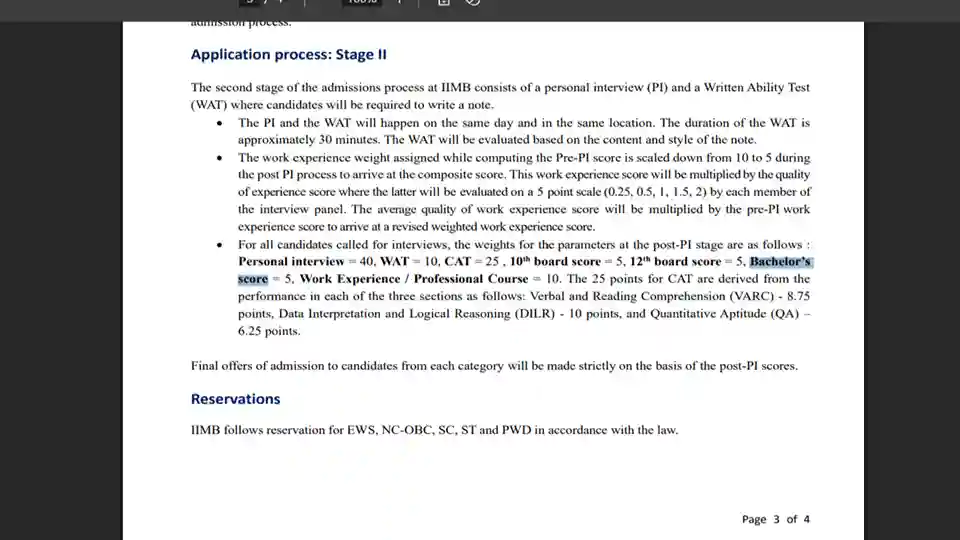
The selection process for IIM Bangalore is described in the table below for the reference and easy understanding of the candidate:
IIM Bangalore Selection Parameters
Weights for Parameters
Personal Interview
40
CAT score
25 Verbal and Reading Comprehension (VARC) – 8.75 points Data Interpretation and Logical Reasoning (DILR) – 10 points Quantitative Aptitude (QA) – 6.25 points
WAT
10
10th board score
5
12th board score
5
Bachelor’s score
5
Work Experience / Professional Course
10
Total
100
This is what the official document says about IIM Bangalore admission components & weightage:
CAT Counseling 2025 – IIM-wise Selection Process
The preliminary screening for admission to the IIMs will be done on the basis of CAT 2025 scores. Shortlisted candidates will next have to appear in subsequent stages, like Written Ability Test (WAT) & Personal Interview (PI).
Candidates can visit the official admission portal of the participating institute and read the important updates by following the links given below.
Name of the IIM
Selection Process – WAT, PI, Weightage, Work Experience