CBSE 10th board Exam – Registration & EXAM Date, Syllabus, Download QP, Best Books

CBSE class X board exam

CBSE Class 10 board exam 2025 – The Central Board of Secondary Education (CBSE) has released the supplementary date sheet of CBSE 10th Board Exam 2025. The supplementary exams will be held from July 15 to July 22, 2025.

The Date Sheet of CBSE class 10 Board exam (supplementary) has been released.

The exam will be held in a pen-and-paper mode. Candidates can download the CBSE date sheet 2025 Class 10 PDF download from the official website – cbse gov in. The CBSE 10th admit card 2025 for the supplementary exams will be released a few days before the exam. The admit card has to be collected from the school.

Note that starting next year, the CBSE 10th board exam will be conducted in TWO sessions – February and May. The February session will be mandatory, while the May session will be optional.

The CBSE 10th practice questions and CBSE Class 10 Sample Papers 2025 are released at cbseacademic.in. 

Latest Updates:

About CBSE 10th Board Exam 

The CBSE Class 10 board exams are conducted by the Central Board of Secondary Education (CBSE). The exam is conducted in a pen-and-paper mode once every year. Candidates can appear in the CBSE Class 10 board exam after studying a year in Class 10. To appear in the exam, the candidate will have to complete registration formalities and pay the exam fees. 

The Central Board of Secondary Education releases the official syllabus and sample papers for the exam. Students appearing in the CBSE 2025 class 10th board exam are recommended to strictly follow the syllabus and practice sample papers to prepare for the exam.

CBSE 10th Board Exam 2026 – Highlights

ParticularsDescription
Conducting bodyCentral Board of Secondary Education (CBSE)
FrequencyAnnual
Exam Level Matriculate
Difficulty levelEasy to Moderate
Exam websitecbse.nic.in

cbse.gov.in 
CBSE 10th Board Exam DateSession 1: February 2026
Session 2: May 2026
CBSE 10th Board Exam (2025) – Date SheetDownload Here 

To download the Supplementary Date Sheet – Click Here
When will the date sheet be released?November 2025
CBSE 10th Board Exam SyllabusClick Here
Mode of examOffline, pen-and-paper mode

The candidate has to write their answers on answer sheets provided inside the exam hall.
CBSE 10th Board Exam Pass CriteriaThe candidate needs to secure minimum 33% marks in all subjects (both theory and practical)
Result portalresults.cbse.nic.in

cbseresults.nic.in 

CBSE 10th Board Exams 2025 – What’s New?

  • No percentage of marks, overall division, distinction or aggregate marks will be released with CBSE Result 2025

The CBSE will not announce percentage marks nor release overall distinction, division or aggregate marks in the CBSE Class 10+2 results.

  • Special CBSE Board 2025 exams for students participating in sports events, Olympiad

In case of students participating in international olympiads and sports events (recognized by sports bodies SAI, BCCI, and HBCSE) and thereby unable to appear for regular CBSE 12th board exams, the CBSE will conduct the 10th board exams separately.

But note that no separate or special CBSE 2025 examination will be conducted for the compartment and practical exams. The decision of the board in this regard is aimed at promoting sports and other educational competitions among the youths.

CBSE Class 10th board exam 2025 Date Sheet 

The CBSE will release the date sheet for the Class 10 2025 board exams soon. Refer to the tentative table below:

Exam DateDaySubject
Feb 2025ThursdayPainting, Gurung, Rai, Tamang, Sherpa
Feb 2025FridaySecurity, Automotive, Introduction to Financial Markets, Introduction to Tourism, Beauty and wellness, Agriculture, Food Production, Front Office Operation, Banking & Insurance, Marketing & Sales, Apparel, MultiMedia, Physical Activity Trainer, Data Science, Electronics and Hardware, Design Thinking and Innovation
Feb 2025SaturdayHindustani Music (Melodic Instruments), Hindustani Music (Percussion Instruments), Elements of Book Keeping & Accountancy, Hindustani Music (Vocal)
Feb 2025MondaySanskrit (Communicative), Sanskrit
Feb 2025TuesdayUrdu Course-A, Bengali, Tamil, Telugu, Marathi, Gujarati, Manipuri, French, Urdu Course-B
Feb 2025WednesdayHindi Course A, Hindi Course B
Feb 2025FridayTibetan, National Cadet Corps, Telugu-Telangana, Bodo, Tangkhul, Japanese, Bhutia, Spanish, Kashmiri, Mizo, Bahasa Melayu
Feb 2025SaturdayPunjabi, Sindhi, Malayalam, Odia, Assamese, Kannada, Kokborok
Feb 2025MondayEnglish (Language and Literature), English (Communicative)
Feb 2025WednesdayElements of Business, Healthcare, Retail
Mar 2025SaturdayScience
Mar 2025MondayHome Science, Multi Skill Foundation Course
Mar 2025TuesdayArabic, Russian, Persian, Lepcha, Persian, Nepali, Limboo, German, Carnatic Music (Melodic Instruments), Carnatic Music (Vocal), Carnatic Music (Percussion Instruments), Thai
Mar 2025ThursdaySocial Science
Mar 2025MondayMathematics Standard, Mathematics Basic
Mar 2025WednesdayComputer Applications, Information and Technology, Artificial Intelligence

CBSE Class 10 Board Exams – Syllabus

The CBSE 10th syllabus 2025 will be released online at cbseacademic.nic.in. The syllabus is released in the form of downloadable PDF. The student needs to click on the corresponding subject-PDF to download it.

Note that the CBSE class 10 syllabus is released for all the subjects.

CBSE follows the NCERT syllabus, so questions in the exam will be framed as per the syllabus covered in the NCERT books. It is recommended that you complete the syllabus on time so that you have enough time for revision.

CBSE follows the NCERT books for class 10th while creating the board exam question papers. Students are suggested to cover the complete CBSE Class 10 Syllabus as early as possible so that they have ample time for revision.

Also Read:

Higher Education Apex Level Bodies
CBSE 12th Board Exam – Registration and Exam DATE Sheet, Pattern, Syllabus, Result
National Council of Educational Research and Training

CBSE 10th Exam Pattern 2025

Students preparing for the Class 10 board exams must go through the CBSE Class 10 exam pattern 2025 to get insights into the question paper, including the marking scheme, test duration, types of questions asked, chapter-wise weightage of marks, etc. 

In 2023-24, the board increased the number of MCQs and reduced the number of long and short-type questions. Each subject has a different paper pattern and marking scheme. Some subjects have practicals while others only have theory papers. So, it is important that the candidate is familiar with the CBSE 10th exam pattern 2025 for the subjects he or she is appearing in.

The board will follow the official CBSE class 10 exam pattern and syllabus when framing questions for the CBSE 2025 Class 10 board exams. The CBSE class 10th paper will cover the complete syllabus of theory subjects while the internal assessment segment consists of periodic tests, notebook submission, and subject enrichment activities. 

As per the minimum passing criteria released by the CBSE, the student must secure a minimum of 33% marks in both theory and practical to qualify in the exam. 

CBSE Class 10 Practice Questions 2025

SubjectPractice Questions PDF
CBSE 10th Science Question Bank 2024Click to download
CBSE 10th Mathematics Question Bank 2024Click to download
CBSE 10th English Question Bank 2024Click to download

NCERT Mathematics Class 10 Exemplar Problems

UnitLink to download
Unit 1- Real NumbersDownload PDF
Unit 2 – PolynomialsDownload PDF
Unit 3 – Pair of Linear Equations in Two VariablesDownload PDF
Unit 4 – Quadratic EquationDownload PDF
Unit 5 – Arithmetic ProgressionsDownload PDF
Unit 6 – TrianglesDownload PDF
Unit 7 – Coordinate GeometryDownload PDF
Unit 8 – Introduction to Trigonometry & its EquationDownload PDF
Unit 9 – CirclesDownload PDF
Unit 10 – ConstructionDownload PDF
Unit 11 – Area related to CirclesDownload PDF
Unit 12 – Surface Area & VolumesDownload PDF
Unit 13 – Statistics & ProbabilityDownload PDF
Design of Question Paper Set-IDownload PDF
Design of Question Paper Set-IIDownload PDF
AnswersDownload PDF

Read More:

BITSAT Syllabus 2026 – Section-wise Topics, Download Syllabus PDF

BITSAT Syllabus 2026 – BITS Pilani will conduct the BITSAT 2026 (Session 1) exam in May 2026.

Candidates appearing in BITSAT must follow the updated syllabus to prepare for the exam. BITS Pilani will conduct the BITSAT exam based on NCERT syllabus (Class 11 & 12). To paraphrase, the BITSAT 2026 syllabus will be the same as the NCERT syllabus 2026. 

The direct link to download the official BITSAT syllabus 2026 pdf is given below. To download the syllabus pdf, simply click on the syllabus link; no log-in is required.

The BITSAT syllabus contains the subject-wise sections and corresponding topics that candidates need to prepare for the BITSAT entrance exam 2026. The candidate must also consult the BITSAT 2026 exam pattern to prepare for the exam.

The candidate may divide the syllabus in segments, like – easy, moderate, difficult. This way it will be easier to allocate time and resources for effective exam preparation.

Latest Updates:

Why refer to official syllabus to prepare for BITSAT

It is of paramount importance that the candidate refers to the syllabus released by BITS Pilani for BITSAT 2026 exam preparation. Here is why:

  • Questions in the BITSAT 2026 exam will be asked only from the official BITSAT 2026 syllabus.
  • That being said, please note that the BITSAT Syllabus 2026 is the same as the NCERT syllabus.
  • The candidate must download the BITSAT syllabus from the BITS Pilani admission portal; or they can use the link given below to download the official syllabus
  • The BITSAT 2026 syllabus includes the topics and topic-wise questions for all the subjects included in the BITSAT exam.
  • So, the candidate needs to prepare for these topics only.
  • The candidate mustn’t prepare for any other topics for the BITSAT 2026 exam.
  • If the candidate prepares for topics not included in the BITSAT syllabus 2026, they can’t expect to get questions from these topics in the exam. Consequently, such effort may go to waste.

BITSAT Syllabus 2026 – Download Here 

The candidate can go through the BITSAT 2026 syllabus for each of the sections below. They may also download the syllabus using the link given below.

It is recommended that the candidate also goes through the BITSAT 2026 exam pattern along with the syllabus for in-depth exam preparation. 

To Download BITSAT Syllabus – Click Here

Also Read:

BITSAT Syllabus 2026 – Physics

SectionTopics
Units & MeasurementUnits (Different systems of units, SI units, fundamental and derived units) 
Dimensional Analysis 
Precision and significant figures 
Fundamental measurements in Physics (Vernier calipers, screw gauge, Physical balance etc) 
KinematicsProperties of vectors 
Position, velocity, and acceleration vectors 
Motion with constant acceleration 
Projectile motion 
Uniform circular motion 
Relative motion
Newton’s Laws of MotionNewton’s laws (free body diagram, resolution of forces) 
Motion on an inclined plane 
Motion of blocks with pulley systems 
Circular motion – centripetal force 
Inertial and non-inertial frames
Impulse and MomentumDefinition of impulse and momentum 
Conservation of momentum 
Collisions 
Momentum of a system of particles
Center of mass
Work and EnergyWork done by a force
Kinetic energy and work-energy theorem 
Power 
Conservative forces and potential energy 
Conservation of mechanical energy
Rotational MotionDescription of rotation (angular displacement, angular velocity and angular acceleration) 
Rotational motion with constant angular acceleration 
Moment of inertia, Parallel and perpendicular axes theorems, rotational kinetic energy 
Torque and angular momentum 
Conservation of angular momentum 
Rolling motion
GravitationNewton’s law of gravitation 
Gravitational potential energy, Escape velocity 
Motion of planets – Kepler’s laws, satellite motion
Mechanics of Solids and FluidsElasticity 
Pressure, density and Archimedes’ principle 
Viscosity and Surface Tension 
Bernoulli’s theorem
OscillationsKinematics of simple harmonic motion 
Spring mass system, simple and compound pendulum 
Forced & damped oscillations, resonance
WavesProgressive sinusoidal waves 
Standing waves in strings and pipes 
Superposition of waves, beats 
Doppler Effect
Heat and ThermodynamicsKinetic theory of gases 
Thermal equilibrium and temperature 
Specific heat, Heat Transfer – Conduction, convection and radiation, thermal conductivity, Newton’s law of cooling Work, heat and first law of thermodynamics 
2nd law of thermodynamics, Carnot engine – Efficiency and Coefficient of performance
ElectrostaticsCoulomb’s law 
Electric field (discrete and continuous charge distributions) 
Electrostatic potential and Electrostatic potential energy 
Gauss’ law and its applications 
Electric dipole 
Capacitance and dielectrics (parallel plate capacitor, capacitors in series and parallel)
Current ElectricityOhm’s law, Joule heating 
D.C circuits – Resistors and cells in series and parallel, Kirchoff’s laws, potentiometer and Wheatstone bridge 
Electrical Resistance (Resistivity, origin and temperature dependence of resistivity).
Magnetic Effect of CurrentBiot-Savart’s law and its applications 
Ampere’s law and its applications 
Lorentz force, force on current carrying conductors in a magnetic field 
Magnetic moment of a current loop, torque on a current loop, Galvanometer and its conversion to voltmeter and ammeter
Electromagnetic InductionFaraday’s law, Lenz’s law, eddy currents 
Self and mutual inductance 
Transformers and generators 
Alternating current (peak and rms value) 
AC circuits, LCR circuits 
OpticsLaws of reflection and refraction XV 
Lenses and mirrors 
Optical instruments – telescope and microscope 
Interference – Huygen’s principle, Young’s double slit experiment 
Interference in thin films 
Diffraction due to a single slit 
Electromagnetic waves and their characteristics (only qualitative ideas), Electromagnetic spectrum 
Polarization – states of polarization, Malus’ law, Brewster’s law
Modern PhysicsDual nature of light and matter – Photoelectric effect, De Broglie wavelength 
Atomic models – Rutherford’s experiment, Bohr’s atomic model 
Hydrogen atom spectrum 
Radioactivity 
Nuclear reactions: Fission and fusion, binding energy
Electronic DevicesEnergy bands in solids (qualitative ideas only), conductors, insulators and semiconductors; 
Semiconductor diode – I-V characteristics in forward and reverse bias, diode as a rectifier; I-V characteristics of LED, photodiode, solar cell, and Zener diode; Zener diode as a voltage regulator. 
Junction transistor, transistor action, characteristics of a transistor; transistor as an amplifier (common emitter configuration) and oscillator 
Logic gates (OR, AND, NOT, NAND and NOR). Transistor as a switch.

BITSAT Syllabus 2026 – Chemistry 

SectionsTopics
States of MatterMeasurement: Physical quantities and SI units, Dimensional analysis, Precision, Significant figures. 
Chemical reactions: Laws of chemical combination, Dalton’s atomic theory; Mole concept; Atomic, molecular and molar masses; Percentage composition empirical & molecular formula; Balanced chemical equations & stoichiometry 
Three states of matter, intermolecular interactions, types of bonding, melting and boiling points Gaseous state: Kinetic energy and molecular speeds; Gas Laws, ideal behavior, ideal gas equation, empirical derivation of gas equation, Avogadro number, Deviation from ideal behaviour – Critical temperature, Liquefaction of gases, van der Waals equation. 
Liquid state: Vapour pressure, surface tension, viscosity. 
Solid state: Classification; Space lattices & crystal systems; Unit cell in two dimensional and three dimensional lattices, calculation of density of unit cell – Cubic & hexagonal systems; Close packing; Crystal structures: Simple AB and AB2 type ionic crystals, covalent crystals – diamond & graphite, metals. Voids, number of atoms per unit cell in a cubic unit cell, Imperfections- Point defects, non-stoichiometric crystals; Electrical, magnetic and dielectric properties; Amorphous solids – qualitative description. Band theory of metals, conductors, semiconductors and insulators, and n- and p- type semiconductors.
Atomic StructureIntroduction: Subatomic particles; Atomic number, isotopes and isobars, Thompson’s model and its limitations, Rutherford’s picture of atom and its limitations; Hydrogen atom spectrum and Bohr model and its limitations. 
Quantum mechanics: Wave-particle duality – de Broglie relation, Uncertainty principle; Hydrogen atom: Quantum numbers and wave functions, atomic orbitals and their shapes (s, p, and d), Spin quantum number. XVI 
Many electron atoms: Pauli exclusion principle; Aufbau principle and the electronic configuration of atoms, Hund’s rule. 
Periodicity and BondingBrief history of the development of periodic tables Periodic law and the modern periodic table; Types of elements: s, p, d, and f blocks; Periodic trends: ionization energy, atomic, and ionic radii, inert gas radii, electron affinity, electronegativity and valency. Nomenclature of elements with atomic number greater than 100. 
Valence electrons, Ionic Bond: Lattice Energy and Born-Haber cycle; Covalent character of ionic bonds and polar character of covalent bond, bond parameters 
Molecular Structure: Lewis picture & resonance structures, VSEPR model & molecular shapes 
Covalent Bond: Valence Bond Theory- Orbital overlap, Directionality of bonds & hybridization (s, p & d orbitals only), Resonance; Molecular orbital theory- Methodology, Orbital energy level diagram, Bond order, Magnetic properties for homonuclear diatomic species (qualitative idea only). 
Dipole moments; Hydrogen Bond
ThermodynamicsBasic Concepts: Systems and surroundings; State functions; Intensive & Extensive Properties; Zeroth Law and Temperature 
First Law of Thermodynamics: Work, internal energy, heat, enthalpy, heat capacities and specific heats, measurements of ∆U and ∆H, Enthalpies of formation, phase transformation, ionization, electron gain; Thermochemistry; Hess’s Law, Enthalpy of bond dissociation, combustion, atomization, sublimation, solution and dilution 
Second Law: Spontaneous and reversible processes; entropy; Gibbs free energy related to spontaneity and non-spontaneity, non-mechanical work; Standard free energies of formation, free energy change and chemical equilibrium
Physical and Chemical EquilibriaConcentration Units: Mole Fraction, Molarity, and Molality 
Solutions: Solubility of solids and gases in liquids, Vapour Pressure, Raoult’s law, Relative lowering of vapor pressure, depression in freezing point; elevation in boiling point; osmotic pressure, determination of molecular mass; solid solutions, abnormal molecular mass, van’t Hoff factor. Equilibrium: Dynamic nature of equilibrium, law of mass action. 
Physical Equilibrium: Equilibria involving physical changes (solid-liquid, liquid-gas, solid-gas). 
Chemical Equilibria: Equilibrium constants (KP, KC), Factors affecting equilibrium, Le- Chatelier’s principle. 
Ionic Equilibria: Strong and Weak electrolytes, Acids and Bases (Arrhenius, Lewis, Lowry and Bronsted) and their dissociation; degree of ionization, Ionization of Water; ionization of polybasic acids, pH; Buffer solutions; Henderson equation, Acid-base titrations; Hydrolysis; Solubility Product of Sparingly Soluble Salts; Common Ion Effect. 
Factors Affecting Equilibria: Concentration, Temperature, Pressure, Catalysts, Significance of ΔG and ΔG0 in Chemical Equilibria.
ElectrochemistryRedox Reactions: Oxidation-reduction reactions (electron transfer concept); Oxidation number; Balancing of redox reactions; Electrochemical cells and cell reactions; Standard electrode potentials; EMF of Galvanic cells; Nernst equation; Factors affecting the electrode potential; Gibbs energy change and cell potential; Secondary cells; dry cells, Fuel cells; Corrosion and its prevention. XVII 
Electrolytic Conduction: Electrolytic Conductance; Specific and molar conductivities; variations of conductivity with concentration, Kolhrausch’s Law and its application, Electrolysis, Faraday’s laws of electrolysis; Electrode potential and electrolysis. 
Chemical KineticsAspects of Kinetics: Rate and Rate expression of a reaction; Rate constant; Order and molecularity of the reaction; Integrated rate expressions and half-life for zero and first order reactions. 
Factor Affecting the Rate of the Reactions: Concentration of the reactants, catalyst; size of particles, Temperature dependence of rate constant concept of collision theory (elementary idea, no mathematical treatment); Activation energy, Arrhenius Equation. 
Surface Chemistry: Adsorption – physisorption and chemisorption; factors affecting adsorption of gasses on solids; catalysis: homogeneous and heterogeneous, activity and selectivity: enzyme catalysis, colloidal state: distinction between true solutions, colloids and suspensions; lyophilic, lyophobic multi molecular and macromolecular colloids; properties of colloids; Tyndall effect, Brownian movement, electrophoresis, coagulations; emulsions–types of emulsions.
Hydrogen and s-block elementsHydrogen: Element: unique position in periodic table, occurrence, isotopes; Dihydrogen: preparation, properties, reactions, and uses; Molecular, saline, ionic, covalent, interstitial hydrides; Water: Properties; Structure and aggregation of water molecules; Heavy water; Hydrogen peroxide: preparation, reaction, structure & use, Hydrogen as a fuel. 
s-block elements: Abundance and occurrence; Anomalous properties of the first elements in each group; diagonal relationships; trends in the variation of properties (ionization energy, atomic & ionic radii). 
Alkali metals: Lithium, sodium and potassium: occurrence, extraction, reactivity, and electrode potentials; Biological importance; Reactions with oxygen, hydrogen, halogens and water; Basic nature of oxides and hydroxides; Halides; Properties and uses of compounds such as NaCl, Na2CO3, NaHCO3, NaOH, KCl, and KOH. 
Alkaline earth metals: Magnesium and calcium: Occurrence, extraction, reactivity and electrode potentials; Reactions with O2, H2O, H2 and halogens; Solubility and thermal stability of oxo salts; Biological importance of Ca and Mg; Preparation, properties and uses of important compounds such as CaO, Ca(OH)2, plaster of Paris, MgSO4, MgCl2, CaCO3, and CaSO4.
p- d- and f-block elementsGeneral: Abundance, distribution, physical and chemical properties, isolation and uses of elements; Trends in chemical reactivity of elements of a group; electronic configuration, oxidation states; anomalous properties of first element of each group. 
Group 13 elements: Boron; Properties and uses of borax, boric acid, boron hydrides & halides. Reaction of aluminum with acids and alkalis; 
Group 14 elements: Carbon: carbon catenation, physical & chemical properties, uses, allotropes (graphite, diamond, fullerenes), oxides, halides and sulphides, carbides; Silicon: Silica, silicates, silicone, silicon tetrachloride, Zeolites, and their uses 
Group 15 elements: Dinitrogen; Preparation, reactivity and uses of nitrogen; Industrial and biological nitrogen fixation; Compound of nitrogen; Ammonia: Haber’s process, properties and reactions; Oxides of nitrogen and their structures; Properties and Ostwald’s process of nitric acid production; Fertilizers – NPK type; Production of phosphorus; Allotropes of phosphorus; Preparation, structure and properties of hydrides, oxides, oxoacids (elementary idea only) and halides of phosphorus, phosphine. 
Group 16 elements: Isolation and chemical reactivity of dioxygen; Acidic, basic and amphoteric oxides; Preparation, structure and properties of ozone; Allotropes of sulphur; Preparation/production properties and uses of sulphur dioxide and sulphuric acid; Structure and properties of oxides, oxoacids (structures only).
Group 17 and group 18 elements: Structure and properties of hydrides, oxides, oxoacids of halogens (structures only); preparation, properties & uses of chlorine & HCl; Inter halogen compounds; Bleaching Powder; Uses of Group 18 elements, Preparation, structure and reactions of xenon fluorides, oxides, and oxoacids. 
d-Block elements: General trends in the chemistry of first row transition elements; Metallic character; Oxidation state; ionization enthalpy; Ionic radii; Color; Catalytic properties; Magnetic properties; Interstitial compounds; Occurrence and extraction of iron, copper, silver, zinc, and mercury; Alloy formation; Steel and some important alloys; preparation and properties of K2Cr2O7 , KMnO4. 
f-Block elements: Lanthanoids and actinoids; Oxidation states and chemical reactivity of lanthanoids compounds; Lanthanide contraction and its consequences, Comparison of actinoids and lanthanoids. 
Coordination Compounds: Coordination number; Ligands; Werner’s coordination theory; IUPAC nomenclature; Application and importance of coordination compounds (in qualitative analysis, extraction of metals and biological systems e.g. chlorophyll, vitamin B12, and hemoglobin); Bonding: Valence-bond approach, Crystal field theory (qualitative); Isomerism including stereoisomerisms.
Principles of Organic Chemistry and HydrocarbonsClassification: General Introduction, classification based on functional groups, trivial and IUPAC nomenclature. Methods of purification: qualitative and quantitative,
Electronic displacement in a covalent bond: Inductive, resonance effects, and hyperconjugation; free radicals; carbocations, carbanions, nucleophiles and electrophiles; types of organic reactions, free radial halogenations. 
Alkanes: Structural isomerism, general properties and chemical reactions, free redical helogenation, combustion and pyrolysis. 10.4 Alkenes and alkynes: Structure of double and triple bonded compounds; General methods of preparation and reactions, physical properties, electrophilic and free radical additions, addition of hydrogen, halogen, water, hydrogen halides; (Markovnikov’s addition and peroxide effect), ozonolysis, oxidation, mechanism of electrophilic addition; acidic character of alkynes and (1,2 and 1,4) addition to dienes. 
Aromatic hydrocarbons: Sources; properties; isomerism; resonance delocalization; aromaticity; polynuclear hydrocarbons; IUPAC nomenclature; mechanism of electrophilic substitution reaction, directive influence and effect of substituents on reactivity; carcinogenicity and toxicity. 
Haloalkanes and haloarenes: Physical properties, nomenclature, optical rotation, chemical reactions and mechanism of substitution reaction. Uses and environmental effects; di, tri, tetrachloromethanes, iodoform, freon and DDT. 
StereochemistryConformations: Ethane conformations; Newman and Sawhorse projections. 
Geometrical isomerism in alkenes
Organic Compounds with Functional Groups Containing Oxygen and NitrogenGeneral: Nomenclature, electronic structure, important methods of preparation, identification, important reactions, physical and chemical properties, uses of alcohols, phenols, ethers, aldehydes, ketones, carboxylic acids, nitro compounds, amines, diazonium salts, cyanides and isocyanides. 
Specific: Reactivity of alpha-hydrogen in carbonyl compounds, effect of substituents on alphacarbon on acid strength, comparative reactivity of acid derivatives, mechanism of nucleophilic addition and dehydration, basic character of amines, methods of preparation, and their separation, importance of diazonium salts in synthetic organic chemistry.
Biological, Industrial and Environmental chemistryCarbohydrates: Classification; Monosaccharides; Structures of pentoses and hexoses; Simple chemical reactions of glucose, Disaccharides: reducing and non-reducing sugars – sucrose, maltose and lactose; Polysaccharides: elementary idea of structures of starch, cellulose and glycogen. 
Proteins: Amino acids; Peptide bond; Polypeptides; Primary structure of proteins; Simple idea of secondary, tertiary and quaternary structures of proteins; Denaturation of proteins and enzymes. 
Nucleic Acids: Types of nucleic acids; Primary building blocks of nucleic acids (chemical composition of DNA & RNA); Primary structure of DNA and its double helix. 

Vitamins: Classification, structure, functions in biosystems; Hormones. 
Polymers: Classification of polymers; General methods of polymerization; Molecular mass of polymers; Biopolymers and biodegradable polymers; methods of polymerization (free radical, cationic and anionic addition polymerizations); Copolymerization: Natural rubber; Vulcanization of rubber; Synthetic rubbers. Condensation polymers. Some important polymers: natural and synthetic like polythene, nylon, polyesters, bakelite, and rubber. 
Pollution: Environmental pollutants; soil, water and air pollution; Chemical reactions in atmosphere; Smog; Major atmospheric pollutants; Acid rain; Ozone and its reactions; Depletion of ozone layer and its effects; Industrial air pollution; Greenhouse effect and global warming; Green Chemistry, study for control of environmental pollution. 
Chemicals in medicine, health-care and food: Analgesics, Tranquilizers, antiseptics, disinfectants, anti-microbials, anti-fertility drugs, antihistamines, antibiotics, antacids; Preservatives, artificial sweetening agents, antioxidants, soaps and detergents. 
Theoretical Principles of Experimental ChemistryVolumetric Analysis: Principles; Standard solutions of sodium carbonate and oxalic acid; Acidbase titrations; Redox reactions involving KI, H2SO4, Na2SO3, Na2S2O3 and H2S; Potassium permanganate in acidic, basic and neutral media; Titrations of oxalic acid, ferrous ammonium sulphate with KMnO4, K2 Cr2O7/Na2S2O3, Cu(II)/Na2S2O3. 
Qualitative analysis of Inorganic Salts: Principles in the determination of the cations Pb2+, Cu2+, As3+, Mn2+, Al3+, Zn2+, Co2+, Ca2+, Sr2+, Ba2+, Mg2+, NH4 +, Fe3+, Ni2+ and the anions CO3 2- , S2- , SO4 2- , SO3 2- , NO2 – , NO3 – , Cl- , Br- , I- , PO4 3- , CH3COO- , C2O4 2- . 
Physical Chemistry Experiments: preparation and crystallization of alum, copper sulphate. Benzoic acid ferrous sulphate, double salt of alum and ferrous sulphate, potassium ferric sulphate; Temperature vs. solubility; Study of pH charges by common ion effect in case of weak acids and weak bases; pH measurements of some solutions obtained from fruit juices, solutions of known and varied concentrations of acids, bases and salts using pH paper or universal indicator; Lyophilic and lyophobic sols; Dialysis; Role of emulsifying agents in emulsification. Equilibrium studies involving ferric and thiocyanate ions (ii) [Co(H2O)6] 2+ and chloride ions; Enthalpy determination for strong acid vs. strong base neutralization reaction (ii) hydrogen bonding interaction between acetone and chloroform; Rates of the reaction between (i) sodium thiosulphate and hydrochloric acid, (ii) potassium iodate and sodium sulphite (iii) iodide vs. hydrogen peroxide, concentration and temperature effects in these reactions.
Purification Methods: Filtration, crystallization, sublimation, distillation, differential extraction, and chromatography. Principles of melting point and boiling point determination; principles of paper chromatographic separation – Rf values. 
Qualitative Analysis of Organic Compounds: Detection of nitrogen, sulphur, phosphorous and halogens; Detection of carbohydrates, fats and proteins in foodstuff; Detection of alcoholic, phenolic, aldehydic, ketonic, carboxylic, amino groups and unsaturation.
Principles of Organic Chemistry Experiments: Preparation of, acetanilide, p-nitro acetanilide, dibenzayl acetone, aniline yellow, beta-naphthol-aniline dye. 
Basic Laboratory Technique: Cutting glass tube and glass rod, bending a glass tube, drawing out a glass jet, boring of cork.

BITSAT Syllabus 2026 – Part III: (a) English Proficiency and (b) Logical Reasoning 

(a) English Proficiency

This test is designed to assess the test takers’ general proficiency in the use of English language as a means of self-expression in real life situations. It specifically tests the test takers’ knowledge of basic grammar, their vocabulary, their ability to read fast and comprehend, and also their ability to apply the elements of effective writing.

SectionTopics
GrammarDeterminers, Prepositions, Modals, Adjectives, Relative Pronouns 
Agreement, Time and Tense 
Parallel Construction 
Voice, Transformation 
Question Tags, Relative Clauses
VocabularyOdd Word, One Word, Spelling & Word Formation, Homophones 
Contextual Meanings of Vocabulary (Definitions, Academic Vocabulary, Connotation) 
Synonyms, Antonyms, Collocations 
Phrasal Verbs & Idioms 
Analogy
Reading ComprehensionContent/Ideas (Finding Main Ideas, Reaching Conclusions Using Supporting Evidence, Anticipation of Ideas, Distinguishing Facts from Opinions) 
Vocabulary (Figurative Usage: Metaphors and Similes; Select CLOZE) 
Summary (Findings from Options the Correct Summary)
Referents Reorganization of Information (Jigsaw Reading)
CompositionRearrangement (Word Order; Logical Organization of Paragraph) 
Paragraph & Unity (Identifying the Correct Topic Sentence;) 
Linkers/Connectives

(b) Logical Reasoning

The test is given to the candidates to judge their power of reasoning spread in verbal and nonverbal areas. The candidates should be able to think logically so that they perceive the data accurately, understand the relationships correctly, figure out the missing numbers or words, and apply rules in novel contexts. These indicators are measured through performance on such tasks as detecting missing links, following directions, classifying words, establishing sequences, and completing analogies.

SectionTopics
Verbal ReasoningAnalogy: Analogy means correspondence. In the questions based on analogy, a particular relationship is given and another similar relationship has to be identified from the alternatives provided. 
Classification: Classification means to assort the items of a given group on the basis of certain common quality they possess and then spot the odd option out. 
Series Completion: Here series of numbers or letters are given and one is asked to either complete the series or find out the wrong part in the series. 
Logical Deduction: Reading Passage: Here a brief passage is given and based on the passage the candidate is required to identify the correct or incorrect logical conclusions. 
Chart Logic: Here a chart or a table is given that is partially filled in and asks to complete it in accordance with the information given either in the chart / table or in the question.
Nonverbal ReasoningPattern Perception: Here a certain pattern is given and generally a quarter is left blank. The candidate is required to identify the correct quarter from the given options.
Figure Formation and Analysis: Here the candidate is required to analyze and form a figure from the various given parts. 
Paper Cutting: Here the candidate analyses a pattern that is formed when a folded piece of paper is cut into a definite design.
Figure Matrix: Here the candidate is given more than one set of figures in the form of a matrix, which follow the same rule. The candidate is required to follow the rule and identify the missing figure. 
Rule Detection: Here a particular rule is given and the candidate is required to select from the given sets of figures, a set of figures, which obey the rule and form the correct series.

BITSAT Syllabus 2026 – Part IV: Mathematics 

SectionsTopics
AlgebraComplex numbers, addition, multiplication, conjugation, polar representation, properties of modulus and principal argument, triangle inequality, roots of complex numbers, geometric interpretations; Fundamental theorem of algebra. 
Theory of Quadratic equations, quadratic equations in real and complex number system and their solutions. 
Arithmetic and geometric progressions, arithmetic, geometric and arithmetico geometric series, sums of finite arithmetic and geometric progressions, infinite geometric series, sums of squares and cubes of the first n natural numbers. 
Logarithms and their properties. 
Exponential series. 
Permutations and combinations, Permutations as an arrangement and combination as selection, simple applications. 
Binomial theorem for a positive integral index, properties of binomial coefficients, Pascal’s triangle 
Matrices and determinants of order two or three, properties and evaluation of determinants, addition and multiplication of matrices, adjoint and inverse of matrices, Solutions of simultaneous linear equations in two or three variables, elementary row and column operations of matrices, Types of matrices, applications of determinants in finding the area of triangles. 
Sets, Relations and Functions, algebra of sets applications, equivalence relations, mappings, one to one, into and onto mappings, composition of mappings, binary operation, inverse of function, functions of real variables like polynomial, modulus, signum and greatest integer.
Mathematical reasoning and methods of proofs, mathematically acceptable statements. Connecting words/phrases – consolidating the understanding of “if and only if (necessary and sufficient) condition”, “implies”, “and/or”, “implied” by”, “and”, “or”, “there exists” and through variety of examples related to real life and Mathematics. Validating the statements involving the connecting words – difference between contradiction, converse and contra positive, Mathematical induction 
Linear Inequalities, solution of linear inequalities in one variable (Algebraic) and two variables (Graphical).
TrigonometryMeasurement of angles in radians and degrees, positive and negative angles, trigonometric ratios, functions with their graphs and identities. 
Solution of trigonometric equations. 
Inverse trigonometric functions
Two-dimensional Coordinate GeometryCartesian coordinates, distance between two points, section formulae, shift of origin. 
Straight lines and pair of straight lines: Equation of straight lines in various forms, angle between two lines, distance of a point from a line, lines through the point of intersection of two given lines, equation of the bisector of the angle between two lines, concurrent lines. 
Circles: Equation of circle in standard form, parametric equations of a circle. 
Conic sections: parabola, ellipse and hyperbola their eccentricity, directrices & foci
Three dimensional Coordinate GeometryCo-ordinate axes and co-ordinate planes, distance between two points, section formula, direction cosines and direction ratios, equation of a straight line in space and skew lines. 
Angle between two lines whose direction ratios are given, shortest distance between two lines. 
Equation of a plane, distance of a point from a plane, condition for coplanarity of three lines, angles between two planes, angle between a line and a plane.
Differential calculusDomain and range of a real valued function, Limits and Continuity of the sum, difference, product and quotient of two functions, Differentiability. 
Derivative of different types of functions (polynomial, rational, trigonometric, inverse trigonometric, exponential, logarithmic, implicit functions), derivative of the sum, difference, product and quotient of two functions, chain rule, parametric form. 
Geometric interpretation of derivative, Tangents and Normal. 
Increasing and decreasing functions, Maxima and minima of a function. 
Rolle’s Theorem, Mean Value Theorem and Intermediate Value Theorem. 
Integral calculusIntegration as the inverse process of differentiation, indefinite integrals of standard functions. 
Methods of integration: Integration by substitution, Integration by parts, integration by partial fractions, and integration by trigonometric identities. 
Definite integrals and their properties, Fundamental Theorem of Integral Calculus, applications in finding areas under simple curves. 
Application of definite integrals to the determination of areas of regions bounded by simple curves.
Ordinary Differential EquationsOrder and degree of a differential equation, formulation of a differential equation whole general solution is given, variables separable method. 
Solution of homogeneous differential equations of first order and first degree 
Linear first order differential equations
ProbabilityVarious terminology in probability, axiomatic and other approaches of probability, addition and multiplication rules of probability. 
Conditional probability, total probability and Baye’s theorem 
Independent events 
Discrete random variables and distributions with mean and variance
VectorsDirection ratio/cosines of vectors, addition of vectors, scalar multiplication, position vector of a point dividing a line segment in a given ratio. 
Dot and cross products of two vectors, projection of a vector on a line. 
Scalar triple products and their geometrical interpretations. 
StatisticsMeasures of dispersion 
Analysis of frequency distributions with equal means but different variances
Linear ProgrammingVarious terminology and formulation of linear Programming 
Solution of linear Programming using graphical method, feasible and infeasible regions, feasible and infeasible solutions, optimal feasible solutions (upto three nonitrivial constraints)
Mathematical modelingFormulation of simple real life problem, solution using matrices, calculus and linear programming. 

BITSAT Syllabus 2026 – Part IV: Biology

SectionTopics
Diversity in Living WorldBiology – its meaning and relevance to mankind 
What is living; Taxonomic categories and aids; Systematics and Binomial system of nomenclature. 

Introductory classification of living organisms (Two-kingdom system, Five-kingdom system); 
Plant kingdom – Salient features of major groups (Algae to Angiosperms); 

Animal kingdom – Salient features of Nonchordates up to phylum, and Chordates up to class level
Cell: The Unit of Life; Structure and FunctionCell wall; Cell membrane; Endomembrane system (ER, Golgi apparatus/Dictyosome, Lysosomes, Vacuoles); Mitochondria; Plastids; Ribosomes; Cytoskeleton; Cilia and Flagella; Centrosome and Centriole; Nucleus; Microbodies. 

Structural differences between prokaryotic and eukaryotic, and between plant and animal cells. 

Cell cycle (various phases); Mitosis; Meiosis. 
Biomolecules – Structure and function of Carbohydrates, Proteins, Lipids, and Nucleic acids. 

Enzymes – Chemical nature, types, properties and mechanism of action. 
Genetics and EvolutionMendelian inheritance; Chromosome theory of inheritance; Gene interaction; Incomplete dominance; Co-dominance; Complementary genes; Multiple alleles; 

Linkage and Crossing over; Inheritance patterns of hemophilia and blood groups in humans. 

DNA –its organization and replication; Transcription and Translation; 

Gene expression and regulation; DNA fingerprinting. 

Theories and evidences of evolution, including modern Darwinism.
Structure and Function – PlantsMorphology of a flowering plant; Tissues and tissue systems in plants; Anatomy and function of root, stem (including modifications), leaf, inflorescence, flower (including position and arrangement of different whorls, placentation), fruit and seed; Types of fruit; Secondary growth; XXIV 

Absorption and movement of water (including diffusion, osmosis and water relations of cell) and of nutrients; Translocation of food; Transpiration and gaseous exchange; Mechanism of stomatal movement. 

Mineral nutrition – Macro- and micro-nutrients in plants including deficiency disorders; Biological nitrogen fixation mechanism. 
Photosynthesis – Light reaction, cyclic and non-cyclic photophosphorylation; various pathways of carbon dioxide fixation; Photorespiration; Limiting factors. 
Respiration – Anaerobic, Fermentation, Aerobic; Glycolysis, TCA cycle; Electron transport system; Energy relations. 
Structure and Function – AnimalsHuman Physiology – Digestive system – organs, digestion and absorption; Respiratory system – organs, breathing and exchange and transport of gases. 
Body fluids and circulation – Blood, lymph, double circulation, regulation of cardiac activity; Hypertension, Coronary artery diseases. 
Excretion system – Urine formation, regulation of kidney function 
Locomotion and movement – Skeletal system, joints, muscles, types of movement. 

Control and co-ordination – Central and peripheral nervous systems, structure and function of neuron, reflex action and sensory reception; Role of various types of endocrine glands; Mechanism of hormone action.
Reproduction, Growth and Movement in PlantsAsexual methods of reproduction; 

Sexual Reproduction – Development of male and female gametophytes; Pollination (Types and agents); Fertilization; Development of embryo, endosperm, seed and fruit (including parthenocarpy and elminth). 

Growth and Movement – Growth phases; Types of growth regulators and their role in seed dormancy, germination and movement; 

Apical dominance; Senescence; Abscission; Photo- periodism; Vernalisation;
 
Various types of movements
Reproduction and Development in HumansMale and female reproductive systems; 
Menstrual cycle; Gamete production; Fertilisation; Implantation; 
Embryo development; 
Pregnancy and parturition; 
Birth control and contraception.
Ecology and EnvironmentMeaning of ecology, environment, habitat and niche. 
Ecological levels of organization (organism to biosphere); Characteristics of Species, Population, Biotic Community and Ecosystem; Succession and Climax. Ecosystem – Biotic and abiotic components; Ecological pyramids; Food chain and Food web; 
Energy flow; Major types of ecosystems including agroecosystem. 
Ecological adaptations – Structural and physiological features in plants and animals of aquatic and desert habitats. 
Biodiversity and Environmental Issues – Meaning, types and conservation strategies (Biosphere reserves, National parks and Sanctuaries), Air and Water Pollution (sources and major pollutants); Global warming and Climate change; Ozone depletion; Noise pollution; Radioactive pollution; Methods of pollution control (including an idea of bioremediation); Deforestation; Extinction of species (Hot Spots). 
Biology and Human WelfareAnimal husbandry – Livestock, Poultry, Fisheries; Major animal diseases and their control. Pathogens of major communicable diseases of humans caused by fungi, bacteria, viruses, protozoans and helminthes, and their control. 
Cancer; AIDS. 
Adolescence and drug/alcohol abuse; 
Basic concepts of immunology. 
Plant Breeding and Tissue Culture in crop improvement.
Biotechnology and its ApplicationsMicrobes as ideal system for biotechnology; 
Microbial technology in food processing, industrial production (alcohol, acids, enzymes, antibiotics), sewage treatment and energy generation. 
Steps in recombinant DNA technology – restriction enzymes, NA insertion by vectors and other methods, regeneration of recombinants 
Applications of R-DNA technology in human health –Production of Insulin, Vaccines and Growth hormones, Organ transplant, Gene therapy. 
Applications in Industry and Agriculture – Production of expensive enzymes, strain improvement to scale up bioprocesses, GM crops by transfer of genes for nitrogen fixation, herbicide-resistance and pest-resistance including Bt crops. 

Read More:

BITSAT Exam Pattern 2026 – Mode, Subjects, No. of Questions, Weightage, How to Attempt the Paper

BITSAT Exam Pattern 2026  – BITS Pilani will release the exam pattern for BITSAT 2026 in the BITSAT 2026 Information Brochure. 

The exam pattern will provide insights like the test mode, subjects, types of questions asked, test duration, and marking scheme. 

The BITSAT 2026 exam will be administered in a computer-based mode, will be of THREE hours duration, and include 130 multiple-choice questions. Interestingly, the candidate will also have the option to attempt additional questions within the allotted time. It is recommended that you also refer to the BITSAT 2025 syllabus to prepare for the exam.

BITSAT 2026 (Session 1) exam will be conducted in May 2026. The application form of BITSAT 2026 will open in January 2026.

Keep reading to learn more about the BITSAT 2026 exam pattern.

Latest Updates:

BITSAT Exam Pattern 2026 – Key Highlights

The detailed exam pattern of BITSAT 2026 is given below.

ParticularsDescription
Mode of the examComputer Based Online test
LanguageEnglish
Type of QuestionsObjective MCQ (Multiple Choice Questions)
SectionsThe BITSAT 2025 question paper has four sections.
Part I : Physics
Part II : Chemistry
Part III : (a) English Proficiency and (b) Logical Reasoning
Part IV : Mathematics or Biology (For B.Pharm candidates)
Duration3 Hours
Time limitThere is no time limit for individual parts of the test.
The candidate can go back and change any of his/her answers among the 130 questions.
Total Number of Questions130
Marking Scheme3 marks for a correct attempt
1 mark will be deducted for an incorrect answer
Extra QuestionsIf a candidate answers all the 130 questions (without skipping any question), they have an option of attempting 12 (twelve) extra questions, if there is still time left.

These extra questions will be from Physics, Chemistry, Mathematics/ Biology and Logical Reasoning only; three questions from each of them.

But note that, once the candidate has opted for extra questions, they can’t go back for correction of any of the earlier answered 130 questions.
How questions will be set?The questions will be selected at random from a large question bank.

Different candidates will get different question sets. An expert committee will ensure that the question sets are of comparable difficulty level, content, question type etc.

In this matter, the decision of the expert committee will be final and binding on the candidate.

Also Read:

BITSAT Exam Pattern 2026 – Subjects, No. of Questions

PartSubjectNo. of Questions
Part IPhysics30
Part IIChemistry30
Part III(a) English Proficiency10
(b) Logical Reasoning20
Part IVMathematics/Biology (For B. Pharm)40
Total130

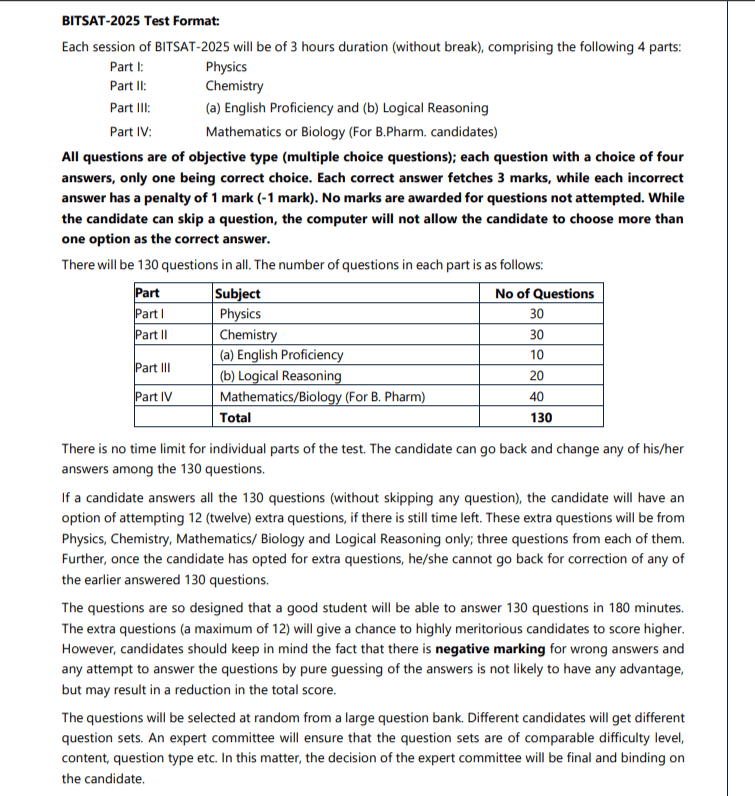
BITSAT-2026 Test Format:

BITSAT 2026 test pattern

Why consult BITSAT Exam Pattern 2026

The candidate is recommended to consult the exam pattern without fail to prepare for the BITSAT 2026 exam. Here is why:

  1. The exam pattern will provide insights into the BITSAT 2026 exam structure – mode, types of questions asked, marking scheme, sections, number of questions, etc.
  2. It will also contain any nuances. For instance, BITSAT allows candidates to attempt additional questions if they are able to complete the regular questions in the allotted time.
  3. The exam pattern tells us that the question paper will include 130 multiple-choice questions.
  4. Since the test duration is 180 minutes, you have around 1.38 minutes to attempt per question. This means you must not be able to answer a question, but answer it fast enough to complete the paper within the given time limit.
  5. Also, depending on the course opted by the candidate, the subject combination will be different.

How to Attempt the BITSAT 2026 Question Paper

When attempting the BITSAT question paper 2026, the candidate needs to follow these steps:

  • To start with, reach the BITSAT exam center 2026 on time. The reporting time will be mentioned on the admit card.
  • Carry the BITSAT 2026 admit card and photo ID with you.
  • Latecomers will not be allowed to take the BITSAT 2026 exam.
  • The candidate needs to quickly go through the pre-exam guidelines before attempting the paper.
  • Attempt the easy questions first. This way you will lock sure-shot marks.
  • If you are not able to solve a problem, don’t spend much time. Move to the next question.
  • If you have time left after attempting remaining questions, you can attempt the questions you skipped the 1st time.
  • Also, keep a close tab on the clock. If you spend all the time attempting just a handful of questions, you will be in big trouble. 

Read More:

Stationery required for taking the BITSAT 2026 Exam

The candidate must bring the following stationery to the BITSAT 2026 exam center:

  • A pen for the purpose of rough work, signing etc.
  • A scratch pad for rough work will be provided.

Calculators and logarithmic tables are not allowed in the test centers. Candidates are not allowed to bring any other
personal belongings such as mobiles.

BITSAT Exam Pattern 2026 – Score Normalization Process

The questions in the exam will be selected at random from a large question bank.

Different candidates will get different question sets. An expert committee will ensure that the question sets are of comparable difficulty level, content, question type etc. In this matter, the decision of the expert committee will be final and binding on the candidate.

BITSAT Exam Center 2026 – Check State-wise List, Reporting Time, Exam-Center Guidelines

BITSAT Exam Center 2026 – BITS Pilani will likely conduct the BITSAT 2026 exam (Session 1) in the last week of May 2026.

The exam will be administered in 74 cities across India. The list of BITSAT 2026 exam centers will be outlined in the BITSAT 2026 admission brochure. The candidate must select THREE choices in the order of priority at the time of filling out the BITSAT application form 2026.

Based on the choices entered by the candidate, test center allotment will be announced to candidates. After this, the candidate will have to book a test date and slot. This will be followed by the release of admit cards.

The name and address of the exam center allocated to the candidate will be mentioned on the BITSAT 2026 admit card. The admit card also contains the exam center reporting time, exam timings, and BITSAT 2026 exam-center guidelines.

On the day of the exam, the candidate must report to the BITSAT 2026 exam center as per the reporting time mentioned in the BITSAT 2026 admit card. Latecomers will not be allowed inside the BITSAT exam hall. Also, follow BITSAT 2026 exam-center guidelines (mentioned in detail below).

BITSAT 2026 Session 1 exam will be conducted in May 2026.

Latest Updates:

BITSAT Exam Center 2026 – List of Test Cities

The expected list of exam cities for BITSAT 2026 is given in the table below. The candidate can select their choice of exam center when applying for BITSAT 2026. Note that the candidate must SELECT three test centers in the order of priority.

Test Centers for BITSAT-2026 (Session-1 and Session-2)
S.NoBITSAT CityStateS.NoBITSAT CityState
1AgartalaTripura38KochiKerala
2AgraUttar Pradesh39KolhapurMaharashtra
3AhmedabadGujarat40KolkataWest Bengal
4AjmerRajasthan41KotaRajasthan
5AllahabadUttar Pradesh42LucknowUttar Pradesh
6AnantapurAndhra Pradesh43MadgaonGoa
7AurangabadMaharashtra44MaduraiTamil Nadu
8Bangalore (Bengaluru)Karnataka45MangaloreKarnataka
9BareillyUttar Pradesh46MehbubnagarTelangana
10BhopalMadhya Pradesh47MohaliPunjab
11BhubaneswarOdisha48MumbaiMaharashtra
12ChandigarhChandigarh49NagpurMaharashtra
13ChennaiTamil Nadu50NasikMaharashtra
14CoimbatoreTamil Nadu51NizamabadTelangana
15DelhiDelhi52NoidaUttar Pradesh
16DhanbadJharkhand53PanajiGoa
17DibrugarhAssam54PatnaBihar
18Dubai Campus of BITSDubai, UAE55Pilani Campus of BITSRajasthan
19DurgapurWest Bengal56PuducherryTamil Nadu
20GhaziabadUttar Pradesh57PuneMaharashtra
21K K Birla Goa Campus of BITSGoa58RaipurChhattisgarh
22GorakhpurUttar Pradesh59RajahmundryAndhra Pradesh
23GulbargaKarnataka60RajkotGujarat
24Gurgaon (Gurugram)Haryana61RanchiJharkhand
25GuwahatiAssam62RoorkeeUttarakhand
26GwaliorMadhya Pradesh63SambalpurOdisha
27Hyderabad Campus of BITSTelangana64ShimlaHimachal Pradesh
28Hyderabad CityTelangana65SiliguriWest Bengal
29IndoreMadhya Pradesh66SuratGujarat
30JabalpurMadhya Pradesh67ThiruvananthapuramKerala
31JaipurRajasthan68TiruchirappalliTamil Nadu
32JalandharPunjab69TirupatiAndhra Pradesh
33JammuJammu and Kashmir70UdaipurRajasthan
34JamshedpurJharkhand71VadodaraGujarat
35JodhpurRajasthan72VijayawadaAndhra Pradesh
36KanpurUttar Pradesh73VisakhapatnamAndhra Pradesh
37Kathmandu, NepalKathmandu (Nepal)74WarangalTelangana

Also Read:

How to Select BITSAT 2026 Exam City

The candidate must select their choice of BITSAT 2026 exam city during the BITSAT 2026 registration process.

A maximum of THREE exam center must be selected in the order of priority.

The list of available test cities will be given in the drop-down menu. Select the preferred option before submitting the BITSAT 2026 application form.

Candidates must note that they won’t be able to directly select any specific BITSAT exam center 2026; instead the candidate will be allotted the test center based on the exam city they have opted for and their address. 

How to check details of Allotted BITSAT Exam Center 2026

The name and address of the BITSAT 2026 exam center allocated to the candidate will be mentioned on the BITSAT 2026 admit card.

So, after downloading the admit card, check whether you have been allocated the exam center and slot that you have selected. If there is any discrepancy, you need to contact BITSAT 2026 exam officials.

BITSAT 2026 Helpline:

Email – bitsat@pilani.bits-pilani.ac.in
Helpline number – +91-9513166170
Admission Office – 01596-255330, 01596-255540, 01596-255541

BITSAT Exam Center 2026 – To be monitored using Web Cameras

All centers will be closely monitored for security reasons and candidates’ identity and activities will be recorded using web cameras and/or closed circuit TV cameras fitted in the test centers.

Candidate’s finger print and photograph will be taken at the time of the test (BITSAT-2026) and will be matched at the time of admission at particular BITS campus.

Anyone violating the rules of the test center will not be allowed to continue with the test and will automatically be disqualified.

BITSAT Exam Center 2026 – Reporting Time, Guidelines

  • All centers will be closely monitored for security reasons and candidates’ identity and activities will be recorded using web cameras and/or closed circuit TV cameras fitted in the test centers. 
  • Candidate’s fingerprint and photograph will be taken at the time of the BITSAT-2026 and will be matched at the time of admission at the particular BITS campus. 
  • Anyone violating the rules of the test center will not be allowed to continue with the test and will automatically be disqualified. 
  • List of Barred Items – Calculators, Logarithmic tables, mobile phones, electronic gadgets, etc. are not allowed inside the test venue. Personal belongings are also not allowed.
  • What to carry – The candidates must bring a pen for signing the attendance sheet and for doing rough work. A scratch pad for rough work will be provided. 
  • All the questions and instructions of the test will be in English only

BITSAT Admit Card 2026

BITS Pilani will release the admit card-cum-hall ticket of BITSAT 2026 (Session 1) a few days before the exam. The candidate can download the hall ticket from till the exam date.

The hall ticket is mandatory for taking the BITSAT exam.

Also, make sure to preserve the admit card until the admission process is over. Note that the admit card has to be produced during BITSAT counseling.

Also Read:

Assam CEE Sample Paper 2026 – Download Question Paper PDF, How & When to Solve Sample Papers

Assam CEE Sample Paper 2026 – ASTU is expected to conduct the Assam CEE exam 2026 in the 4th week of April 2026.

Candidates appearing in the exam must solve sample papers and previous years’ Assam CEE question papers. There are multiple benefits of solving Assam CEE sample papers like you can test your understanding of various concepts and whether you are able to solve problems. Sample papers are also great tools to learn time-management and hone problem-solving skills.

Previous years’ Assam CEE question papers can help get insights into the types of questions asked, specific questions asked, the difficulty level, weightage, and topics covered.

Here we have PDFs of previous years’ Assam CEE sample and question paper that candidate’s can use for practice.

Latest Updates:

Assam CEE 2026 Exam Patten

Candidates preparing for the exam must refer to the Assam CEE 2026 exam pattern to get insights into the question paper structure.

The exam will be administered offline. The Assam CEE question paper will include 120 MCQs that candidates have to attempt in 3 hours.

Meanwhile, the Assam CEE 2026 syllabus will provide insights into the subjects, important topics, skills evaluated, etc.

Assam CEE 2025 Exam Pattern

ParticularsDetails
Mode of ExamOffline 
The exam will be held as a Pen-and-Paper Test
Duration3 Hours
Medium of ExamEnglish, Assamese
SectionsPhysics, Chemistry and Mathematics
Question TypeMultiple-Choice Questions
Total Questions120
Total Marks480
Marking Scheme4 marks for every correct answer 
-1 mark for every wrong answer

Assam CEE Question Papers – Download PDF

Assam CEE EditionDownload PDF
2023Download – Assam CEE 2023 Question Paper
2022Download – Assam CEE 2022 Math Question Paper
Download – Assam CEE 2022 Physics Question Paper
Download – Assam CEE 2022 Chemistry Question Paper
Official Assam CEE Sample PaperOfficial Assam CEE Sample Paper – Download Here

Also Read:

Assam CEE Sample Papers – How will it benefit you?

There are multiple benefits of solving sample papers to prepare for the Assam CEE 2026 exam. The important ones are listed here.

  • Understanding the types of questions asked – The sample papers will contain similar types of questions to those asked in the Assam CEE exam. So, you can prepare for those questions beforehand and don’t get surprised on exam-day.
  • Difficulty level – Until you start solving the sample papers, you won’t be able to correctly judge the difficulty level of the questions. Now until you know the difficulty level, it will be very difficult to make an effective study plan.
  • Weightage of questions are asked – If you know how much weightage a topic carries, you will know how to prioritize and allocate time for the topic. For instance, if a topic carries negligible weightage, it will be foolish to spend an inordinate amount of time preparing for them.
  • Developing time-management and problem-solving skills – Sample papers of Assam CEE will also help the candidate learn the nitty gritties of problem-solving. Time management is another major skill that can be developed; make sure that you use a time when solving the sample papers.
  • Evaluate one’s progress – Finally, the Assam CEE 2026 sample papers will help you evaluate your progress. If you are able to solve an entire sample paper and on time, it will mean that you are doing fairly well. However, if late in your preparation, you are not able to complete a good portion of the sample paper, you will have to work hard to get your preparation on track.
  • Getting realistic about what lay’s ahead – Simply going over the concepts without enough practice could leave you in a very dicey situation. This is because your problem-solving credentials will be untested, this may lead to very error-prone and frustrating day on exam-day when even simple-looking problems appear unmovable. So, to be on the safer side, solve as many sample papers and previous years’ question papers as possible.

What is the right time to solve Assam CEE Sample Papers 2026?

The candidate can start solving sample papers as part of the Assam CEE 2026 exam preparation strategy very early on. 

However, note that in the early stages, you may not be able to solve most, if not all, of the questions. In these situations, you can pick up the problems for the topics you have just or recently studied.

As you move deeper into your Assam CEE preparation, you will be able to solve more and more questions in the sample paper.

Assam CEE Mock Test 2026

Unlike sample papers, the mock tests are designed to be taken in the last few days of the exam.

Mock tests will help the candidate get acquainted with the structure of the Assam CEE 2026 exam. ASTU is unlikely to conduct any official mock tests for the Assam CEE 2026 exam.

 Mock tests can also help the candidate fix last minute gaps in one’s preparation.

However, the candidate can take mock tests conducted by third parties, including by coaching and counseling institutes.

Also Read:

IELTS Exam – Which one to Take & Why, Dates, Exam Pattern, Scores

IELTS Exam – IDP Education Ltd. conducts the IELTS exam, which is an English-language proficiency test. The candidate has the option to take the exam in a paper-based or computer-based format.

The two most popular types of IELTS tests are the IELTS Academic Test and the IELTS General Training test. 

Students planning to pursue higher education or work in an English-speaking country can take the IELTS Academic test. The test assesses the English-language proficiency of the candidate at an academic level and determines whether the student is ready for the UG or PG program, or intends to work in a professional setting, such as doctor, nurse, teacher or lawyer.

The Academic test determines the English-language proficiency of the candidate across the four skillsets – listening, reading, writing, and speaking. 

Note that the Listening and Speaking parts of the test are the same for both Academic and General Training, while the Reading and Writing parts are different.

Note that you can take the IELTS General Training test if you intend to:

  • Migrate to English-speaking countries, including Canada, Australia, New Zealand or the UK
  • Study or train below degree level (read about IELTS Academic here) 
  • Work in an English-speaking country, or get another job in your own country
  • Or explore other opportunities.

PTE Exam Highlights

ParticularsDescription
Full FormInternational English Language Testing System
Conducting bodyIDP IELTS
Exam descriptionIELTS Academic is an English-language proficiency test that is accepted for admission to UG or PG programs and for work visas in English-speaking countries, including Canada, Australia, New Zealand, or the UK.
IELTS Exam FeeINR 18,000

To check official IELTS exam fee – Click Here
Mode of examIELTS on paper test or IELTS on computer test
ScoringScores are released in the form of band scores ranging from 0-9
The IELTS scorecard will have the following scores:
Overall band score
Band scores for each part – reading, writing, listening, speaking.
Why take the test?Accepted by leading universities and academic institutions worldwide
Uses both human and artificial intelligence to ensure fairness
Frequent test dates, last-minute availability
Friendly test center experience. Take your test in a small, friendly test center environment – with no more than 15 seats per test room.
When to take the exam?IELTS Test Dates

Which IELTS test do you need to take?

Depending on the purpose of the proficiency test, the candidate has the following options.

PurposeIELTS test you need to take
IELTS for studyYou can take the IELTS Academic test or the IELTS General Training test depending on the level of study in an English-speaking country.
IELTS for migrationIf you are looking to migrate to UK, Canada, Australia or New Zealand, you must choose IELTS.
IELTS for workYou have two options for IELTS, with the IELTS General Training and the IELTS Academic tests. You can check with the organisation directly which test is needed.

Also Read:

IELTS Test Fee

The IELTS exam fees is INR 18,000.

The test fee applies to both the IELTS Academic test and the IELTS General Training test. Whether you choose the IELTS on Paper or IELTS on Computer, the IELTS test fees remains the same at INR 18,000.

Below is a detailed list of the IELTS exam fees and other costs included.

Test TypeIELTS Test Fee 2025Action
IELTS on Computer for UKVIINR 18,250Book Here
IELTS on ComputerINR 18,000Book Here
IELTS Life Skills (A1 and B1)INR 17,000Book Here
IELTS for UK Visas and ImmigrationINR 18,250Book Here
IELTS on PaperINR 18,000Book Here
One Skill RetakeINR 12,000Book Here

To visit official IELTS test fee page – Click Here

IELTS Test Pattern

The IELTS exam will be conducted in two modes – IELTS on paper test or IELTS on computer test.

In the computer-based test, The Reading, Writing, and Listening tests are on a computer, but the Speaking test is a face-to-face discussion.

Note that the IELTS exam will have four parts – Listening, Reading, Writing, and Speaking. 

Now we know that there are two types of IELTS – Academic and General Training. 

The Speaking and Listening tests are the same in both types, but the Reading and Writing tests are different.

IELTS Exam – Section-wise questions, tasks, duration

SectionContentDuration
Listening40 questionsApproximately 30 minutes (plus 10 minutes’ transfer time)
Reading40 questions60 minutes
Writing2 tasks60 minutes
Speaking3 parts11–14 minutes

IELTS Academic Test – Section-wise tasks and syllabus

SectionQuestion paper structure
WritingThe section will include TWO tasks:  

Writing Task 1: You will be shown a visual representation of information; a graph, table, chart or diagram, and you have to summarise, describe or explain the information you see. Make sure you organise your response into three main parts, the introduction, an overview and the main features supported by figures from the diagram.
Writing Task 2: You will be presented with a point of view, argument, or problem. The topics can range from the environment to immigration, culture, and even technology. You might be asked to, agree or disagree with a point of view or argument, discuss two opposing views, write about the advantages or disadvantages of a topic, or explain a given problem, or the cause of a problem and offer a solution. Your response for Academic Writing Task 2 will need to be in an essay format.
Timing: 60 minutes. 
So, you may ideally spend 20 minutes on Task 1, and 40 minutes on Task 2. Note that you are responsible for managing your own time.
ReadingThe Academic Reading test assesses a wide range of reading skills including your ability to follow an argument, recognise a writer’s opinion, attitude or purpose. It looks at how well you can read to understand main ideas, details, opinions and implied meanings. Your reading comprehension skills are tested, covering skimming, scanning and reading for detail.
The Academic Reading test is made up of 3 long texts which are taken from current books, journals, magazines and newspapers. The texts are related to topics you might face if you were to study at an undergraduate or postgraduate level or apply for professional registration in an English-speaking environment.
You will have to answer 40 questions in the Academic Reading test. These questions can range from multiple choice to identifying information or a writer’s view, matching headings, features and sentence endings, as well as sentence, summary, note, table and flow-chart completions, and short-answer questions.
Timing: 60 minutes including the transfer time
SpeakingThe IELTS Speaking is the same for both General Training test and Academic test and assesses your use of spoken English. All speaking tests are conducted face-to-face with a certified IELTS examiner and are recorded in case they need to be reviewed.
The Speaking test takes between 11 and 14 minutes and consists of 3 parts. Part 1 is the first part of the test where the examiner will ask you some general questions about familiar topics like work, family, studies and hobbies.
In Part 2 you will be given a card with a topic. You will be given one minute to take notes on the topic and will be given a pencil and paper to prepare your response. You will then speak on the topic for two minutes. In Part 3 of the interview, you will have a two-way discussion with the examiner where they will ask questions related to the topic discussed in Part 2.
The Speaking test may be conducted on the same day as the other tests or a week before or after the other test parts.
Timing: 11-14 minutes
ListeningThe IELTS Listening is the same for both the IELTS Academic test and General Training test. The Listening test assesses your ability to understand main ideas, detailed information, opinions, purpose and attitudes of the speakers, as well as your ability to follow the development of ideas.
You will listen to 4 recordings in your Listening test and need to answer 40 questions based on these recordings. The first two recordings deal with situations you might experience in an everyday context. The last two recordings, however, focus on situations that might occur in an education or training context.
In recordings 1 and 3 you will hear a conversation between two or more speakers, however in recordings 2 and 4 will hear a monologue. You will need to answer questions connected to the recordings ranging from multiple choice to matching information, headings, features and sentence endings, as well as sentence, summary, note, table, diagram or flow-chart completion.
Timing: The test takes approximately 30 minutes. In addition, you are allowed an extra 10 minutes to transfer your answers from the question booklet to the answer sheet.

Learn more about IELTS Test Pattern

IELTS Test Center 2025

IDP has test centers in 75 cities across India. To secure your desired test date and time, you are recommended to register and book your test center in advance.

To check availability and book a ILETS test center – Click Here

IELTS Result 2025

The IELTS results for the paper-based test will be released after 13 days. However, the results for the computer-based test can be obtained within 3-5 days from the test date. 

Candidates can download the IELTS Test Report form (TRF) online at ieltsidp.com. The other option is to collect the TRF directly from the relevant IELTS test centres. 

The validity of the IELTS TRF is up to 2 years.

IELTS Band Score

The English-language skills of the candiddate during the IELTS exam are measured against band scores. These band scores range from 0 – 9; each band score corresponds to a level of English-language competence.

For example, if you get a band score of 6, it signifies you are a competent user with more or less effective command of the language despite some inaccuracies, inappropriacies and misunderstandings. They can also use and understand fairly complex language, particularly in familiar situations.

Note that the candidate will be assigned a band score for each part in addtion to an overall band score. The overall score is the average of your band scores for Speaking, Reading, Writing, and Listening. Your band scores are given as whole or half-band scores and are rounded up to the nearest half or whole band score.

For example, if you get a 6.5 in Reading, 5 in Writing, 7 in Speaking, and 6.5 in Listening, the average of these 4 scores would be 6.25. This score would be rounded up to 6.5 for your overall band score.

IELTS Band Scores – Skill Level, Description

Part 
ReadingIELTS Reading band score – Skill Level, Description
ListeningIELTS Listening band score – Skill Level, Description
WritingIELTS Listening band score – Skill Level, Description
SpeakingIELTS Listening band score – Skill Level, Description

Difference between band score and raw score

The Listening and Reading will be scored out of 40 and then converted  to a  band score which ranges  from  band 1  to  band 9.

The Listening and Reading tests contain 40 questions and each correct question will be awarded 1 mark (so the maximum a test  taker can score here is 40).  Band scores, ranging from band 1 to band 9, are  awarded based on the raw scores.  

Review of IELTS band scores

If you are not happy with your band score, you can ask for a review of the band scores (called an Enquiry on Results).

However, the review request must be sumbitted at your test centre within six weeks of the test date.

You must pay an enquiry fee, which will be fully refunded if your band score changes. 

Further, if your band score changes, you will be issued a new Test Report Form (TRF).

Read More:

TOEFL Exam – Full Form, Syllabus, Exam Fee, Exam Date & Center

TOEFL iBT Exam – The TOEFL iBT is an English language proficiency test that is accepted by more than 13,000 universities and other institutions in over 160 countries. 

The TOEFL iBT test scores are accepted for study, work and immigration purposes.

The TOEFL iBT exam has four sections – Reading, Listening, Speaking, and Writing. The duration of the exam is under two hours; however, including a check-in time of around 30 minutes, the exam can extend to nearly 2.5 hours.

The validity of the TOEFL iBT scorecard is 2 years from the date of the exam.

The TOEFL iBT, along with the PTE Academic and IELTS exam, constitute the three most popular English language proficiency tests. 

TOEFL Exam Highlights

TOEFL-iBT-Test-ContentDescription
Full FormTest of English as a Foreign Language
Conducting bodyETS (Educational Testing Service)
Exam descriptionTOEFL is an English-language proficiency test that is by more than 12,000 universities and other institutions in over 160 countries.
TOEFL iBT Exam FeeINR 16,900

To read official TOEFL iBT fee details – Click Here
Testing OptionsTOEFL iBT Testing Options:

– Test at a test center
– Test at home

Note: TOEFL Test on Paper – Discontinued

To read official TOEFL iBT testing option details – Click Here
Test durationThe total test takes just under 2 hours to complete, but exam officials recommend you plan for 2.5 hours, allowing 30 minutes for check in.
SectionsReading, Listening, Speaking, Writing
ScoringYou’ll receive four scaled section scores and a total score.

Each section has a score range of 0–30.
These are added together for a total score of 0–120.

Each skill has four or five proficiency levels, so where your score falls within that range tells you your proficiency for that skill.

Why take the test?

  • Accepted by 13,000+ institutions worldwide
  • Test at home or a test center in your area
  • Quicker Registration and Scheduling. A simpler registration and scheduling process, with local payment options available to select countries.
  • Shorter Test. The total testing time is now less than 2 hours
  • Instant Scores. View your unofficial Reading and Listening scores at the end of your test1.
  • Faster Official Scores. Get your full, official scores as soon as 4–8 days after your test (11–13 business days for Paper Edition).
  • Best Scores. Show your best overall test performance, which is the combination of your best section scores from the past 2 years.
  • In-depth Score Reporting. In addition to simple scores, you get personalized performance feedback and deeper insights into your results.
  • Free Practice Materials. You can prepare for test day with a full-length practice test, practice sets, and the TOEFL Go! ® app and more.

Also Read:

TOEFL iBT Test Pattern

ParticularsDescription
Mode of examTOEFL iBT – Internet-based test,  TOEFL Test on Paper and TOEFL at Home test
DurationFour – Reading, Listening, Speaking, and Writing.
Sections Four – Reading, Listening, Speaking and Writing.
ScoringThe TOEFL scorecard will have four scaled section scores and a total score.

Each section has a score range of 0–30.
These are added together for a total score of 0–120.

Each skill will have four or five proficiency levels, with each level indicating a level of proficiency.

TOEFL iBT Test Sections Overview

Use the table below to view the breakdown of each TOEFL iBT test section.

SectionEstimated TimingQuestions/TasksDescription
Reading35 minutes20 questionsRead passages and respond to questions.
Listening36 minutes28 questionsAnswer questions about brief lectures or classroom discussions.
Speaking16 minutes4 tasksTalk about a familiar topic and discuss material you read and heard.
Writing29 minutes2 tasksRead a passage, listen to a recording, and type your response. State and support an opinion in an online classroom discussion.
TOTALThe total test takes just under 2 hours to completeBut the candidate should plan for 2.5 hours, allowing 30 minutes for check in.

Read official – TOEFL iBT Sections Overview

TOEFL iBT Test Content

TOEFL iBT Test Content

TOEFL iBT – Section-wise tasks and syllabus

SectionDescription
ReadingThe Reading section assesses how well you can read and understand materials used in an academic environment.
It includes two reading passages, each approximately 700 words long, with 10 questions per passage. It should take about 35 minutes to complete the Reading section.
Passages are excerpts from university-level textbooks that would be used in introductions to a topic. The passages cover a variety of subjects. All the information you need to answer the questions will be included in the passage, so even if you’re not familiar with the topic it shouldn’t be a problem. 
Further, there will be a glossary feature available to define words not commonly used, if you need it.
ListeningThe TOEFL iBT Listening section is designed to measure your ability to understand conversations and lectures in English. It includes listening for:

basic comprehension
understanding the speaker’s attitude and degree of certainty
connecting information

Listening questions:
You’ll hear lectures and conversations in this section. Both use campus-based language.

3 lectures, some with classroom discussion, each 3–5 minutes; 6 questions per lecture
2 conversations, each 3 minutes; 5 questions per conversation

You can take notes on any audio item throughout the test to help you answer questions.
SpeakingThe TOEFL iBT Speaking section measures your ability to speak English effectively in academic settings. The section includes four questions/tasks that resemble real-life situations you might encounter both in and outside of a classroom.

Question 1: Independent Speaking Task — requires you to draw entirely on your own ideas, opinions and experiences when you respond.

Questions 2–4: Integrated Speaking Tasks — require you to combine your English-language skills — listening and speaking, or listening, reading and speaking — just as you would in or out of a classroom.

Prep time: You’ll get 15–30 seconds of preparation time before each response, and your response will be 45 or 60 seconds long.

Speaking response: To respond, you’ll speak into the microphone and your responses will be recorded.

Test time: It should take about 16 minutes to complete the Speaking section.

Scoring: Speaking tasks are scored based on the Speaking Scoring Guides (Rubrics) by a combination of AI scoring and certified human raters. Raw scores are converted to a scaled section score of 0–30.
WritingThe TOEFL iBT test Writing section measures your ability to write in English in an academic setting and to present your ideas in a clear, well-organized way.
There are two writing tasks.
Integrated writing task (20 minutes) — read a short passage and listen to a short lecture, then write in response to what you read and listened to. Writing for an Academic Discussion task (10 minutes) — state and support an opinion in an online classroom discussion.
You have to type your responses on a computer keyboard.
Test time: It should take about 29 minutes to complete the Writing section.
Scoring: Writing tasks are scored based on the Writing Scoring Guides (Rubrics) by a combination of AI scoring and certified human raters. Raw scores are converted to a scaled section score of 0–30.

TOEFL iBT Scores

You will be able to check your TOEFL iBT scores through your ETS account. 

  • TOEFL iBT scores will be available in your ETS account 4–8 days after your test date.
  • The exact date you can expect to receive your official scores will be displayed at the end of your TOEFL iBT test.

How to check TOEFL iBT scores?

  1. Through your ETS account – You’ll get an email when your scores are available, and you can access your account online. Your scores are valid for 2 years, so you may want to download and print a PDF copy of your score report. PDF score reports are ready for download 1 day after you receive your scores electronically through your ETS account. If you have questions about your score report, contact TOEFL Services.
  2. By mail – If you requested a paper copy of your score report before you took the test, it will be mailed 11–15 days after your test date, or sooner depending on how you took the test. Delivery times will vary based on local postal services.
  3. Express shipping – You can also get a paper copy of your score report faster with the express shipping option. Express score reports are usually delivered only 2–5 business days after test scores are confirmed or the additional score report is ordered. Note that if you will have the option to select this service during test registration or when ordering an additional score report.

Sample TOEFL iBT Scorecard

TOEFL iBT Scores Scorecard Sample

Validity of TOEFL iBT scores

The scores will be valid for 2 years.

So, download the PDF copy of the score report. 

Note that the PDF score reports are ready for download 1 day after you receive your scores electronically through your ETS account.

If you have questions about your score report, contact TOEFL Services.

Sending TOEFL iBT Scores to Recipients

Choosing score recipients before the test

The TOEFL iBT test fee includes up to FOUR free official TOEFL score reports to be sent to the institutions, agencies or other recipients that you select before you take the test. You can add or delete recipients through your ETS account until 10 p.m. (local test center time) on the day before your test.

However, note that if you choose any institution or agency to receive your scores, you won’t be able to request a score review of your Writing and/or Speaking sections.

When institutions will receive your scores

The time required to deliver the score will vary depending on how you took the test and how your designated score recipients receive scores:

  • ETS® Data Manager: 4–8 business days
  • Server feeds: 8–10 business days
  • Postal mail: 10–12 business days plus mailing time. Allow an additional 7–10 days for mail delivery in the United States, and 4–6 weeks for mail delivery to other locations.

Additional score reports

The TOEFL iBT scores are valid for 2 years after the test date. During that time, you can order additional score reports for a fee of US$25 per institution/agency.

To learn more about TOEFL iBT additional score reports – Click Here

Read More:

IIAD DAT 2025 – Application (Open), Exam, Eligibility, Pattern, Syllabus

IIAD DAT 2025 – The Indian Institute of Art and Design (IIAD) is accepting applications for IIAD DAT 2025.

No last date is given for the submission of the application form for IIAD DAT 2025. Candidates who meet the prescribed eligibility criteria for the chosen courses must apply before the last date. The application link is given below.

The candidate has to next appear in the IIAD DAT 2025 exam, which will be held in online and offline modes. The mode can be selected when filling out the IIAD DAT application form 2025.

Note that the exam will be conducted at the IIAD Campus.

Latest Updates:

IIAD Exam Highlights 2025

ParticularsDescription
Name of ExamIIAD Entrance Test
Conducting BodyIndian Institute of Art and Design (IIAD)
Exam LevelNational-Level Exam
ModeThe exam is available in  Online and Offline modes.
LanguageEnglish
Test Duration150 Minutes
Total Marks200
Application FeeINR 2,000
Official Websitehttps://www.iiad.edu.in
OTHER Popular Design Entrance ExamsNIFT Entrance Exam 2025
NID DAT 2025
PU DAT 2025
UID DAT 2025
UPES DAT 2025
Pearl Academy Entrance Exam 2025
IIAD DAT 2025 Help Line+91 11413 80000 / +91 98713 83633Write at apply@iiad.edu.in

IIAD Important Dates 2025

The Indian Institute of Art and Design (IIAD) has released the important dates for IIAD 2025. 

EventsDates
START of application formOpen
Last date to submit applicationTo be notified
Last date to apply with late feesTo be notified
IIAD 2025 exam dateTo be notified

IIAD DAT Exam Pattern 2025

Candidates seeking admission to Communication Design, Interior Architecture & Design, Fashion Communication and Fashion Design must appear in the iDAT exam as a part of the screening process.

The IIAD Design Aptitude Test (IDAT) is a written test designed to assess a candidate’s creative and visual ability, cultural awareness and logical thinking

The IIAD DAT 2025 exam paper is a combination of:

  • visual tasks
  • writing tasks
  • one-word answers 
  • multiple choice questions

Also Read:

IIAD DAT Eligibility Criteria 2025

The candidate is urged to go through the program-wise eligibility criteria before applying for IIAD DAT admission 2025. 

Note that if the candidate fails to meet the eligibility criteria of IIAD DAT 2025 in their applied program, he or she will be disqualified. 

ProgramIIAD DAT 2025 Eligibility Criteria
UG coursesThe candidate must have passed 10+2 or equivalent in any stream (Science, Commerce, Humanities/Arts) with an aggregate of minimum 50% marks. 

Candidates appearing for 10+2 in the admission year or awaiting results may also apply. 

Boards accepted – CBSE/ISC/State/IB or any other equivalent Indian or International Higher Secondary Board
PG coursesThe candidate must be graduate in any stream or discipline from a recognized institute/university are eligible to apply. 

Final year graduate students or students awaiting results may also apply.

IIAD DAT 2025 – Programs Offered

The Indian Institute of Art and Design offers both UG and PG courses.

UG courses

The UG courses has a combined intake of 200 seats:

  • Communication Design
  • Animation Film Design
  • User Experience Design
  • Interior Architecture & Design
  • Product Design
  • Fashion Design
  • Fashion Communication
  • Fashion Business Management
  • Luxury Business Management

PG courses

The institute offers a Fashion Business Management course with an intake capacity of 20 seats.

IIAD DAT 2025 – Fee Structure

The Indian Institute of Art and Design has released the fee structure of IIAD DAT 2025 for the UG and PG courses.

The candidate can pay the IIAD DAT 2025 fee in two installments.

The annual fees for the UG courses is INR 5,26,884. Meanwhile, the annual fees for the PG courses is INR 5,02,478. 

The candidate, in addition, will also have to pay other fees (one-time fee payable at the time of admission), including Admission Fee and Security Deposit & Alumni Fund. 

Read More:

PTE Academic – Dates, Eligibility, Application, Exam Pattern, Scores

PTE Academic is an English language exam that tests your skills in speaking, writing, reading, and listening in a single, two-hour test. Here we bring you everything you need to know about the exam – pattern, dates, application, scores, and much more.

PTE Exam 2025 – The Pearson Test of English (PTE), along with TOEFL Exam and IELTS Exam, constitutes among the most popular English Language tests for candidates seeking to study in countries where English is the primary language of communication.

PTE scores accepted in 3500+ academic institutions across the world. Additionally, countries like Australia, the UK, and New Zealand also accept PTE scores for visa applications. 

The PTE Academic exam is a single test that is of two-hour duration. The PTE academic test evaluates four major skills – speaking, writing, reading, and listening. The PTE Academic question paper has THREE sections – 1) Part 1: Speaking & Writing, 2) Part 2: Reading, and 3) Part 3: Listening.

The results of PTE Academic test will be available typically in 48 years.

PTE Exam Highlights

ParticularsDescription
Full FormPearson Test of English (PTE)
Exam descriptionEnglish language testing for study applications worldwide, and for visa applications for work and migration in Australia, the UK, New Zealand, and Canada.
Duration of the test2-hour
PTE FeesPTE Academic: INR 18,000
PTE Core: INR 18,000

Checkofficial PTE Exam Fee Details
Format of examCompletely computer-based English test
ScoringMachine scoring
Book Tests and Check ResultsResults are typically available in 2 days.

To Book Tests and Check Results – Click Here
Why take the test?Measures your English speaking, listening, reading, and writing skills in a single, short test.

Frequent test dates, last-minute availability

Friendly test center experience. Take your test in a small, friendly test center environment – with no more than 15 seats per test room.
Test CenterThere are 62 test centers across India, including Delhi, Mumbai and Bengaluru.

To check the list of PTE Test Centers in India – Click Here
Official Websitepearsonpte.com

Who accepts PTE tests?

Who accepts PTE tests Pearson PTE 02 19 2025

PTE Academic Test Centers:

The PTE Academic exam will be conducted in 62 test centers across India.

Language TestTest Centre Fee
PTE PTE has 62 test centers across India, including Delhi, Mumbai and Bengaluru and regular exam dates.

So, it is easy to find a test booking that suits you.
PTE Academic – INR 18,000
PTE Core – INR 18,000


UK Visa and Immigration tests (These are tests for study, migration, and citizenship specifically for the UK.)

PTE Academic UKVI – INR 18000
PTE Home A1 – INR 15284
PTE Home A2 – INR 15824
PTE Home B2 – INR 15284

Note: Prices are inclusive of 18% tax.

To check Official PTE Test Center and Fee Details – Click Here

Also Read:

PTE Academic Test Centre Locations and Availability

PTE ExamBook Test Date
PTE Academic, PTE CoreClick Here
PTE Academic UKVI
PTE Home A1
PTE Home A2
PTE Home B1
Click Here

PTE Academic Test Pattern

Candidates appearing in the PTE Academic test are urged to carefully go through the exam pattern given below.  

ParticularDescription
Mode of examComputer-based
Duration2 hours
SectionsPart 1: Speaking & Writing

This part will take between 54–67 minutes to complete

Part 2: Reading

This part will take around 30 minutes to complete

Part 3: Listening

This part will take approximately 30 minutes to complete

To learn more – Click Here

PTE Academic Scores – Accessing and Sending Scores

The results of PTE Academic are typically available in 48 hours.

Pearson will email you to let you know as soon as your scores are available. Then you simply need to sign in to your myPTE account (the same one you used to book your test) to see your score report.

The PTE Academic score report will contain the following details:

  • Your personal details and photo
  • Your Test Registration ID and Score Report Code
  • Your overall score (between 10-90, with 90 being the highest possible score)
  • individual scores for your communicative skills to identify your strengths and areas for improvement.

Note that scores will be graded against the Global Scale of English (GSE).

Scores are graded against the Global Scale of English (GSE).

What you will see on your Skills Profile

  • Include a detailed report of your performance across different language skills
  • Personal recommendations on how to improve your English proficiency even further.

Learn more about Accessing & Sending PTE Academic scores

How to share the score report

You can send the digital PTE Academic score report to your chosen universities and colleges FREE of charge.

All you have to do is sign in to your myPTE account, go to your score, and start the process to send it to your choice of institution and program.

Understand your PTE Academic score

PTE Academic score is reported on a range from 10–90 on the Global Scale of English.

PTE Academic Score Ranges

Score RangeRequired For
85-90Typically, universities or governments don’t request scores this high.
76-84Australian Skilled Migration Visas
59-75Typically, this is the level required to be able to follow academic level instruction and to participate in academic education, including both coursework and student life, and may be set for undergraduate or post-graduate entry requirements. This is also the level required for professional registration and employment, and also for Australian skilled migration visas.
43-58Typically, this may be required for undergraduate level study.
30-42Typically, this level is too low to engage in academic coursework, but may be set for Foundation Year courses.
10-29Typically, this level is too low to engage in academic coursework or Foundation Year courses.

Learn more about PTE Academic Score (Ranges) & Their Interpretation

PTE Academic Score Comparison

Candidates who are confused as to which English language test to take, here are the comparison of scores for PTE Academic and other popular language tests.

IELTS comparison

PTE Academic232936465666768489NA
IELTS← 4.5 →← 5.0 →← 5.5 →← 6.0 →← 6.5 →← 7.0 →← 7.5 →← 8.0 →← 8.5 →← 9.0 →

TOEFL Comparison

PTE Academic3842465053596468727884
TOEFL iBT40-4454-5665-6674-7579-8087-889499-100105113120

Read Here – Official PTE Academic Scoring Pattern

PTE Academic Eligibility

Before appearing in the PTE Academic, it is recommended that the candidate takes a glance at the eligibility criteria for the test. 

Age Criteria:

PTE Academic Eligibility CriteriaAge Criterion
Minimum age for appearing in PTE Academic16 years
Parental consent requiredBelow 18 years
Maximum ageNo age bar

Academic Requirements

Pearson PLC Group, which conducts PTE Academic, doesn’t prescribe any specific academic eligibility criteria for appearing in the PTE Academic test. 

PTE Academic Application Form

The registration or application filling process for PTE Academic is commonly known as SLOT booking. So, candidates who want to appear in the PTE Academic exam need to book their slots. 

Note that to book slots for PTE Academic, you will need a valid passport. In fact, the candidate will be required to display their ID on the day of the PTE Academic exam.

PTE Slot Booking

  1. Visit the official PTE Academic website 
  2. Create a Pearson account by entering personal details.
  3. Upon completion of PTE registration, you will receive an email within 48 hours with your login details.
  4. Log-in using the applicant credentials to search for a nearby PTE test center.
  5. You also have the option to take the PTE Academic Online, which is conducted in remote-proctored mode
  6. Select a suitable time and date for the PTE Academic exam.
  7. Finally, pay the PTE Exam Fee of INR 18,000 to complete the PTE exam booking process.

PTE Test Centers and Fees

PTE Exam Fees in India

PTE Academic Fees:

TestFees
PTE AcademicINR 18,000
PTE Core INR 18,000

UK Visa and Immigration Test Fees:

TestFees
PTE Academic UKVIINR 18,000
PTE Home A1INR 15,284
PTE Home A2INR 15,284
PTE Home B1INR 15,284

* Prices are inclusive of 18% tax.

What to expect of PTE test day?

The candidate must note the following points about PTE test day:

  • On arrival
  • During the test
  • ID requirements
  • Test day checklist

To read up on the above points, click here

Read More:

Design Aptitude Test Questions and Preparation

0

Design Aptitude Test or DAT is a part of design entrance exams that checks the creative and sketching ability of candidates and identifies whether they are suited for a design course.

Given the complexities and nuances involved with the test, it takes time and effort to prepare. To get a good score in DAT, the candidate must work hard on their sketching, drawing, and observation skills. Additionally, they must be resourceful enough to find on the spot solutions to design-related questions.

Here we bring you important tips to prepare for the Design Aptitude Test (DAT).

Design Entrance Exams 2026 – Application, Exam Dates

Entrance ExamEventDate
NIFT 2026 Entrance ExamStart of application form3rd week of November 2025
Exam Date1st week of February 2026
NID DAT 2026 ExamStart of application form1st week of September 2025
Exam DateJanuary 18, 2026
UCEED 2026 examStart of application form1st week of October 2025
Exam Date3rd week of January 2026
CEED 2026 examStart of application form1st week of October 2025
Exam DateJanuary 18, 2026

What is the Design Aptitude Test (DAT)?

The Design Aptitude Test (DAT) is a section of Design Entrance Exams that evaluates a candidates’ visual perception, creative thinking, problem-solving, design fundamentals, and spatial understanding.

Most design entrance exams have the DAT section, though the nomenclature may change. For instance, it is called the Creative Ability Test (CAT) in the NIFT Entrance Exam and DAT Prelims and DAT Mains in the NID Entrance Exam

Why is DAT so important?

The Design Aptitude Test (DAT) frequently carries the maximum weightage. 

  • CAT carries 50% weightage (NIFT)
  • DAT Mains carries 60% (NID DAT)

So, if you are preparing for any design entrance exam, you must first master the Design Aptitude Test (DAT) questions. This way you can assure yourself a good score in any entrance exam.

Design Aptitude Test (DAT) Questions

The DAT question paper will include mainly TWO types of questions.

  1. Drawing/Sketching Questions
  2. General Aptitude/Logical Reasoning Question

Sample Drawing/Sketching Questions

  1. Imagine trees have started growing defensive mechanisms to prevent themselves from being cut. Conceptualize 3 such defensive mechanisms. Describe in brief and draw the ideas in the space given below. (15 marks).
  2. Rabindranath Tagore once said “Where the mind is without fear and the head is held high, where knowledge is fee”

Make a poster depicting the above idea along with a tagline. (10 marks)

  1. You have an old bulb. Conceptualize 5 ways in which the bulb can be reused humorously. Describe in brief and draw your ideas in the space given below. (15 marks). 
  2. Imagine and draw a real-life situation which represents “All that is good does not glitter” in a meaningful way. Use the space given below to draw and explain your interpretation in five lines. No color to be used. (20 marks)

The topics that will be covered in the NID DAT Prelims for B.Des admissions are given in the table below. Practice these topics to get a good score in the NID DAT exam.

Design Outline for BeginnersColour TerminologyInspiration & Design Development
Mood, Theme & Colour Inter-relationshipDesign TheoryElements & Principles Of Design
Natural & Geometrical FormInnovation in DesignPrinciples of Composition
LetteringOptical IllusionUnderstanding Light & Shade
Colour Psychology & Optical IllusionsForm & FunctionPresentation Techniques
Theme DevelopmentCreative thinking & writingPicture Analysis
Visual LogicGood Design vs Bad DesignDrawing Fundamentals
Use of Measurements, Scale & proportionsOptical IllusionInspiration & Creativity
Colour, Pattern & TextureDeveloping ObservationDeveloping Themes & Colour Associations
Memory DrawingUsage of Colour in CompositionsExpression & Emotion
Exercises on imaginationLateral ThinkingStory Pictures
Imagination & DoodlingOrnaments & motifs3D Visualisation
Graphics & PictogramsInnovation & CreationDesign Awareness
Foreshortening & Perspective

Sample General Aptitude/Logical Reasoning Questions

The DAT section sometimes also contains general aptitude and logical reasoning questions. For instance, the DAT Prelims paper includes both general aptitude and reasoning questions.

Given below some examples to get an idea of these types of questions asked in DAT.

1. What geometric solid is formed when you fold along the lines of the given image?

(A) Pyramid

(B) Tetrus

(C) Tetrahedron

(D) Harmonica

General Aptitude 1

2. In the figure given below, which number will replace the question mark?

(A) 30

(B) 28

(C) 33

(D) 16

General Aptitude 2

Reasoning questions for practice:

Q1. In which direction does the dark Gear rotate?

(A) Clockwise
(B) Counterclockwise
(C) No rotation
(D) All of the above

DAT question 5

Which net when folded along with the dotted line, will give the shape of the 3D solid given Below?

(A) 
(B) 
(C) 
(D)

DAT question 4

In the following figure, the circle represents artists, the triangle represents sculptors, and the rectangle represents girls. The number in the shape is the number of persons of that particular category. How many girls are artists but NOT sculptors?

(A) 17
(B) 19
(C) 40
(D) 22

DAT question 6

If you remove 18 alternating colour squares from a chessboard, how many squares of alternating colours remain on the board?

(A) 44 (B) 47 (C) 39 (D) 46 

Choose the box that is similar to the box formed by folding the given sheet of paper along the edge lines.

(A) 1 & 3 only (B) 2 & 4 only (C) 3 & 4 only (D) 1 & 4 only 

DAT question 7

Which box is next in the Sequence?

(A) (B) (C) (D) 

DAT question 9

Which piece fits correctly from the template below without flipping? 

DAT question 8

Which of the following words have all letters that have the same mirror image?

(A) TEAM (B) TOUR (C) THAT (D) THIS 

If BUT=PUT and MAT=CAT then COP=?

(A) ROB (B) TAP (C) MOB (D) None of these

Drawing/sketching questions for practice

Draw a complete proportionate sketch of a bicycle referring to the parts given on the next Page. (15 marks)

DAT question 2

Your friend has come to visit you. He is looking at you from the window outside your room as shown in the image given below. 

Visualize and draw what he is seeing from his point of view (15 marks)

DAT question 3

Modify the below given water tap considering the requirements for different users as mentioned below:

a) A six year old child

b) An artist

c) A visually impaired person

Draw the modified water tap for each of the users and write 3 points as to why you consider the modified idea of a water tap suitable for them. (15 marks)

DAT question 1 1

Draw the given pattern in the 2D cut out surfaces onto the respective surfaces of the 3D cube (5 marks). 

Q4 PartII

A drawing of a kitchen is given below. A three old child enters the kitchen and observes the scenario from the pointed mark (X) on the floor.

Visualize and draw the scene from the child’s point of view.

Q5

Observe the image of the scene as given below. A person tries to enter the room by a ladder from outside the window and sees the scene inside the room. Visualize and draw the scene from the person’s point of view. No color to be used. (15 marks).

DAT question 10