BITSAT Application Form 2025 (Closed) – Step-wise Process, Fee, Correction Window

BITSAT Application Form 2025 – BITS Pilani has closed the application form of BITSAT 2025 for Session 2. Applications were accepted from May 26 to June 10, 2025. The direct link to fill out the form was given here.

The option to edit the BITSAT application form 2025 was available from June 13-14, 2025.

BITSAT 2025 application form for Session 1 was open from January 20 to April 24, 2025.

To apply for BITSAT 2025, get registered, fill in contact, academic, and personal details, select BITSAT 2025 exam center, upload documents, and pay the application. 

BITSAT 2025 exam is conducted in TWO sessions. The exam for Session 2 will be conducted from June 22-26, 2025.

If the candidate appears in one session, the BITSAT 2025 application fee is INR 3500 (INR 3000 for female and transgender candidates. However, if both sessions are selected, the application fee is INR 5500 (INR 4500 for female and transgender candidates). 

Admissions to all Integrated First Degree (FD) programs offered will be on the basis of the BITS Admission Test – 2025 (BITSAT 2025). The BITSAT admit card 2025 will be released only for candidates who successfully complete the registration process.

Latest Updates:

BITSAT Application Form 2025 – Important Dates

The important dates for the BITSAT 2025 application form is given in the table below.

EventsDates
BITSAT 2025 application start date (Session 1)January 20, 2025
Last date for online submissionApril 24, 2025
Window to edit BITSAT 2025 application formApril 29 – May 1, 2025
Issue of Admit CardsMay 23, 2025
BITSAT 2025 exam (Session 1)May 26 – 30, 2025
BITSAT 2025 application start date (Session 2)May 26, 2025
Last date to applyJune 10, 2025
Window to edit BITSAT 2025 application formJune 13-14, 2025
BITSAT 2025 exam (Session 2)June 22-26, 2025

Stepwise process to fill BITSAT Application Form 2025

The BITSAT 2025 application form is open from January 20 to April 24, 2025. Applications have to be submitted online through the official BITS Pilani admission website – bitsadmission.com.

The direct application link is also given above.

Candidates who meet the prescribed eligibility criteria must apply before the last date.

How to apply for BITSAT 2025 exam

  1. Register for BITSAT 2025 – The candidate will need a valid email id and mobile number to register. Also, enter name, date of birth, gender, etc. On successful registration, a system-generated unique 8-digit Application Number (User ID) and Password will be generated. The application number and password will be sent to the registered email id and mobile number of the candidate.
  2. Select the exam session – Candidates can register for Session-1 or both sessions while submitting the application. If the candidates initially register only for Session-1, they may opt for Session-2 later (application window: May 26 to June 10, 2025). For candidates appearing in both sessions, the higher of the two scores will be considered for admission.
  3. Fill in the form – The candidate has to fill in the rest of the form, including entering personal, academic, and personal details.
  4. Upload documents – The candidate has to next upload a photograph and a signature in the given format.
  5. Pay the application fee –  This is the last step in the application process. Pay the relevant application fee to complete the BITSAT 2025 application process.

Also Read:

BITSAT 2025 Application Fee

The category-wise application fee for BITSAT 2025 is given below. Note that the application fee is non-refundable and non-transferable. 

CategoryApplication Fees
Candidates appears only in one session (Session 1 or 2)Appear in both sessions
MaleINR 3500INR 5500
Female/ TransgenderINR 3000INR 4500

BITSAT Application Form 2025 – Document Checklist

DocumentSizeFormat
Photograph50 KB to 100 KBJPEG/JPG
Signature10 KB to 100 KBJPEG/JPG

BITSAT Application From 2025 – Helpline Number

If the candidate has any query related to the BITSAT application form, they may contact admission officials at the following address:

  • Application form related query – bitsat@pilani.bits-pilani.ac.in
  • Helpline number – +91-9513166170

Corrections in the BITSAT Application Form 2025

The candidate will also be allowed to make corrections to the submitted application form from April 29 to May 1, 2025.

Using the correction window, the candidate can make changes/ corrections to some of the particulars in the application form.

Note that the candidate all the particulars in the application form, except the following details:

  • Gender
  • Email id and
  • Contact number

These three details can’t be edited using the correction window. Therefore, take caution when entering these details in the application form.

BITSAT 2025 Application Form – What’s next after application closes?

The application form for BITSAT 2025 (Session 2) will close on June 10, 2025. The application form edit window will be available from June 13-14.

Candidates who register for the exam next have to book BITSAT 2025 test date and slots. The slot booking window will open after application closes. The slots will be offered on a first-come, first-served basis. So, the candidate must book their slots without any delay.

Candidates who duly complete the slot booking process will be issued the BITSAT 2025 admit card.

Assam CEE Syllabus 2026 – Subject-wise Important Topics

Assam CEE Syllabus 2026– ASTU will release updates on the syllabus of Assam CEE 2026 exam on its exam portal – astu.ac.in. 

The Assam CEE 2026 will be conducted as per the AHSEC/NCERT syllabus. This means, no separate Assam CEE 2026 exam syllabus will be released. Questions in the Assam CEE 2026 exam will be asked from three subjects – Physics, Chemistry, and Mathematics. The Assam CEE syllabus 2026 will cover the subject-wise topics that the candidate must refer to for exam preparation.

Assam CEE exam 2025 will be held sometime in June 2025.

The exam will be conducted in a pen-and–paper mode and include 120 MCQs. The candidate must also refer to the Assam CEE 2026 exam pattern for effective exam preparation.

Go through the rest of the article to learn more about Assam CEE syllabus 2026.

Latest Updates:

Assam CEE 2026 Syllabus

As mentioned above, the Assam CEE 2026 syllabus will be based on the Assam Higher Secondary Education Council/NCERT syllabus. The subject-wise syllabus is given below.

Assam CEE Physics Syllabus 

Units for Class 11thUnits for Class 12th
Unit I: Physical World and MeasurementUnit I: Electrostatics
Unit II: KinematicsUnit II: Current Electricity
Unit III: Laws of MotionUnit III: Magnetic Effects of Current and Magnetism
Unit IV: Work, Energy and PowerUnit IV: Electromagnetic Induction and Alternating Currents
Unit V: Motion of System of Particles and Rigid BodyUnit V: Electromagnetic Waves
Unit VI: GravitationUnit VI: Optics
Unit VII: Properties of Bulk MatterUnit VII: Dual Nature of Matter and Radiation
Unit VIII: ThermodynamicsUnit VIII: Atoms and Nuclei
Unit IX: Behavior of Perfect Gas and Kinetic TheoryUnit IX: Electronic Devices
Unit X: Oscillations and WavesUnit X: Communication Systems

Useful resource:

Assam CEE Mathematics Syllabus 

Units for Class 11thUnits for Class 12th
UNIT I: Sets and FunctionsUNIT I: Relations and Sets
UNIT II: AlgebraUNIT II: Algebra
UNIT III: Coordinate GeometryUNIT III: Calculus
UNIT IV: CalculusUNIT IV: Vectors and 3-Dimensional Geometry
UNIT V: Mathematical ReasoningUnit V: Linear Programming
UNIT VI: Statistics and ProbabilityUnit VI: Probability

Assam CEE Chemistry Syllabus 

Units for Class 11thUnits for Class 12th
Unit I: Some Basic Concepts of ChemistryUnit I: Solid State
Unit II: Structure of AtomUnit II: Solutions
Unit III: Classification of Elements and Periodicity in PropertiesUnit III: Electrochemistry
Unit IV: Chemical Bonding and Molecular StructureUnit IV: Chemical Kinetics
Unit V: States of Matter: Gases and LiquidsUnit V: Surface Chemistry
Unit VI: ThermodynamicsUnit VI: General Principles and Processes of Isolation of Elements
Unit VII: EquilibriumUnit VII: p-Block Elements
Unit VIII: Redox ReactionsUnit VIII: d and f Block Elements
Unit IX HydrogenUnit IX Coordination Compounds
Unit X: s- Block Elements (Alkali and Alkaline earth metals)Unit X: Haloalkanes and Haloarenes
Unit XI: Some p-Block ElementsUnit XI: Alcohols, Phenols and Ethers
Unit XII: Organic Chemistry – Some Basic Principles and TechniquesUnit XII: Aldehydes, Ketones and Carboxylic Acids
Unit XIII: HydrocarbonsUnit XIII: Organic Compounds Containing Nitrogen
Unit XIV: Environmental ChemistryUnit XIV: Biomolecules
Unit XV: Polymers
Unit XVI: Chemistry in Everyday Life

Also Read:

Assam CEE Exam Pattern 2026

Candidates appearing in the state entrance exam must refer to the Assam CEE 2026 exam pattern to get insights into the question paper like types of questions asked, marking scheme, test duration, and medium of exam.

The Assam CEE 2026 exam will be of 3 hours duration, include 120 questions, each carrying 4 marks. There is negative marking of -1 for each incorrect attempt. Physics, Chemistry, and Mathematics will each contribute 40 questions.

GRE Test – Full Form, Syllabus, Exam Fee, Exam Date & Center

GRE Test – The Graduate Record Examination (GRE) is a computer-based exam developed and administered by ETS. GRE scores are accepted for admission to graduate, law, and graduate business programs (MBA) globally. The standardized scores of the GRE exam provide these institutions with a common yardstick to measure the qualifications, skills, and preparedness of the candidate to pursue the graduate-level program.

As per the official exam content, GRE will test the candidate’s understanding of basic arithmetic, data analysis, algebra, and geometry. Additionally, it will also test the college-level vocabulary of the candidate.

Furthermore, the test will delve deeper and examine whether you possess the ability to analyze and evaluate written content, have a critical bent of mind and whether you are a problem solver.

GRE Exam Highlights

Particulars Description
Name of the examGraduate Record Examinations (GRE)
Official India websiteClick Here
Conducting bodyEducational Testing Service (ETS)
DownloadGRE Information Bulletin – Click Here
Mode of the examComputer-delivered Test
Purpose of the exam Accepted by graduate, business, and law schools across the world. 
GRE Exam FeesGRE General Test: INR 22,000

GRE Subject Test: INR 14,500

Click here to visit official GRE Fee Portal
Validity of GRE scores5 years
Score RangeVerbal Reasoning score range: 130–170
Quantitative Reasoning score range: 130–170
Analytical Writing score range: 0–6
Similar ExamsTOEFL exam

PTE Academic Exam

IELTS Exam

Types of GRE Tests

The GRE exam is available in two types:

  • GRE General Test
  • GRE Subject Test

The candidate can select their GRE type based on the academic requirement.

GRE General Test

The GRE General Test is a standardized test that measures the academic readiness of a candidate to attend graduate school. The GRE test will evaluate the analytical writing, quantitative ability, and verbal reasoning skills of the candidate.

Also Read:

GRE Test Content

The GRE Test evaluates four basic skills of the candidate – verbal reasoning, quantitative reasoning, critical thinking, and analytical writing skills. These skills are typically developed over a long period and aren’t related to a specific field of study.

The GRE General Test is designed to closely reflect the kind of thinking that pervades today’s demanding graduate school programs, including business and law. 

SectionTest Content
Verbal ReasoningThe Verbal Reasoning section measures the ability of the candidate to:

analyze and draw conclusions from discourse; reason from incomplete data; identify author’s assumptions and/or perspective; understand multiple levels of meaning, such as literal, figurative and author’s intent 

select important points; distinguish major from minor or irrelevant points; summarize text; understand the structure of a text

understand the meaning of individual words, sentences and entire texts; understand relationships among words and among concepts
Quantitative ReasoningThe Quantitative Reasoning section measures your ability to:

understand, interpret and analyze quantitative information
solve problems using mathematical models
apply basic skills and elementary concepts of arithmetic, algebra, geometry and data analysis
Analytical WritingThe Analytical Writing section measures your ability to:

articulate complex ideas clearly and effectively
support ideas with relevant reasons and examples
sustain a well-focused, coherent discussion
control the elements of standard written English

It requires you to provide focused responses based on the tasks presented, so you can accurately demonstrate your skill in directly responding to a task.
GRE Test ContentVisit Official GRE General Test Content Page

GRE General Test – Test Structure

ParticularDescription
Duration1 hour and 58 minutes (approx.)
Number of questions55
SectionsThe GRE exam will have total FIVE sections. These include:

Verbal Reasoning (One section)
Quantitative Reasoning (Two sections)
Analytical Writing (Two sections)

Note: The Analytical Writing section appears first. The Verbal Reasoning and Quantitative Reasoning sections may appear in any order after the Analytical Writing section.

GRE General Test – Sections, Time Allotted for Each Section

MeasureNumber of QuestionsAllotted Time
Analytical Writing (One section)One “Analyze an Issue” task30 minutes
Verbal Reasoning (Two sections)Section 1: 12 questions
Section 2: 15 questions
Section 1: 18 minutes
Section 2: 23 minutes
Quantitative Reasoning (Two sections)Section 1: 12 questions
Section 2: 15 questions
Section 1: 21 minutes
Section 2: 26 minutes

GRE General Test Design Features

An advanced adaptive design has been introduced for the GRE General Test. It allows the candidate to move forward and backward throughout an entire section. 

Specific features include:

  • preview and review capabilities within a section
  • “Mark” and “Review” features to tag questions, so you can skip them and return later if you have time remaining in the section
  • the ability to change/edit answers within a section
  • an on-screen calculator for the Quantitative Reasoning section

GRE Online Practice Test

GRE General Online Practice (Powerprep®) – Click Here

The online practice test will help the candidate:

  • understand what’s being tested
  • gain familiarity with the various question types
  • become familiar with the testing tools, including the on-screen calculator
  • experience the test-taker friendly design features, such as moving back and forth between questions and changing answers within a section
  • practice your test-taking strategies, such as time management, by taking a test under timed conditions
  • understand scoring

GRE General Test Registration

Scheduling GRE General Test

The candidate is allowed to take the GRE General Test once every 21 days, up to five times within any continuous rolling 12-month period (365 days). 

Note that, if you canceled your scores on a test taken previously, it will still be considered as an attempt. 

When selecting a test date, make sure that the test scores reporting schedule is in time for your application deadlines. GRE General Test scores are reported 8–10 days after the test date.

Also, the time required by schools to receive scores may depend upon which delivery method you have chosen. Electronic scores are delivered to schools twice a week. When choosing a test date, it is therefore important that you allow time for delivery of scores and processing by the institution.

Here is how you register for GRE General Test

  1. Select the test you want to take – GRE General or GRE General at Home
  2. Choose an area and date range
  3. Choose the preferred date and test location

GRE Test Fees

Particular Fee
GRE General TestINR 22,000
GRE Subject TestINR 14,500
Rescheduling FeeINR 5,000
Changing Test CenterINR 5,000

To visit GRE Official website to check fee details – Click Here

Scoring services

The services mentioned below have to be accessed through the applicant ETS account. Any scoring service not listed below, such as the GRE Diagnostic Service, doesn’t have an associated fee.

ParticularsFee
Additional Score Reports (ASR) — Per recipientINR 2,900
Score ReviewINR 5,000
Score Reinstatement FeeINR 5,000
Returned PaymentINR 2,900

How to get GRE General Test Scores

What scores are reported?

SectionScore Scale
Verbal Reasoning130–170, in 1-point increments
Quantitative Reasoning130–170, in 1-point increments
Analytical Writing0–6, in half-point increments

If no questions are answered for a specific measure (e.g., Verbal Reasoning), then you will receive a No Score (NS) for that measure.

When will I receive GRE General Test scores?

You can check the official GRE General Test scores through your ETS account 8-10 days after the test date.

Once test scores are ready, you will get an email notification from ETS.

Details included in GRE General Test Score Report

The official GRE Test-taker Score Report is intended only for informational purposes and personal records. It will contain the following information:

  • contact information (name, phone number and email)
  • date of birth
  • gender
  • intended graduate major
  • test date(s)
  • GRE test score(s) and the associated percentile ranks
  • authorized score recipients or fellowship sponsors and the scores reported to those institutions
  • cumulative record of scores reported within the last 5 years

Download Sample GRE Test-taker Score Report

What information is sent to institutions?

Official score reports sent to the institutions you designate will include the following information:

  • your contact information (name, address, phone number, email)
  • date of birth
  • gender
  • your intended graduate major field
  • the GRE test dates and score(s) you choose to report with the ScoreSelect® option and the associated percentile ranks

The score report don’t include:

  • any information concerning the other score recipients you have chosen
  • any scores you’ve chosen not to report
  • any indication that you’ve taken other GRE tests

DownloadSample GRE General Test Institution Score Report 

Validity of GRE General Test Scores

GRE scores are reportable for 5 years from the test date. 

You can also check the exact date your scores will be reportable based on your test date.

GRE Subject Tests

The GRE Subject tests measure the knowledge the candidate has on a specific subject.

As per the official website, the GRE Subject Tests are achievement tests that measure the knowledge and skill level of the candidate in a particular field of study. 

Note that these tests are intended for students who have an undergraduate major or extensive background in any of the following disciplines:

  • Mathematics
  • Physics
  • Psychology

GRE Subject Test scores are used by admissions or fellowship panels to supplement the undergraduate records, recommendation letters and other qualifications of the candidate for graduate-level study.

The GRE Subject Tests in Mathematics, Physics and Psychology will be conducted in a computer-delivered format.

Also, the Physics and Psychology Tests will be of 2 hours.

GRE Subject Test Registration

The GRE Subject Tests are offered 2 weeks per month in September, October and April at computer-delivered centers worldwide. The tests can also be taken at home on certain dates during those 3 months. 

GRE Subject Tests Fees

Particular Fee
GRE Subject Test FeeINR 14,500
Rescheduling feeINR 5,000
Changing test centerINR 5,000

Scoring services

The following services have to be accessed through the applicant’s ETS account. 

ParticularsFee
Additional Score Reports (ASR) — Per recipientINR 2,900
Score Reinstatement FeeINR 5,000

Also Read:

NIFT Lateral Entry Admission 2026 – Registration, Exam Date, Admission Process, Seat Matrix, Pattern

0

NIFT Lateral Entry Admission 2026 – NTA will conduct the entrance exam for NIFT Lateral Entry Admission 2026 (or NLEA 2026) around the 1st week of February 2026. The NLEA 2026 exam will include one paper – the General Ability Test (GAT). The paper will be conducted in a computer-based mode.

The candidate can select NLEA 2026 exam centers when filling out the application form.

NLEA 2026 application will open around the 3rd week of November 2025. After regular application closes, the candidate can still apply with a late fee of INR 5000. The window to edit the NLEA application form 2026 will be available once the application closes.

The scores of the NLEA 2026 entrance exam will be used to shortlist candidates for a Studio Test + PI (B.Des) / TAT + PI (B.F.Tec).

Keep reading to learn the full details about the NIFT Lateral Entry Admission 2026.

Latest Updates:

NIFT Lateral Entry Admission 2026 – Key Highlights

ParticularsDescription
Name of the examNLEA Admission
Conducting BodyNTA
Frequency of examAnnual
Number of attemptsNTA hasn’t prescribed any number of attempts.
However, the candidate needs to meet age and academic requirements
What is NLEA admission 2026?Under the NLEA scheme, the candidate will be considered for admission directly to the 3rd semester of the B.Des/ B.F.Tech program.
Stages of the NLEA 2026 entrance examThe exam will be conducted in TWO stages:

Stage 1 – The candidate must appear in GAT exam
Stage 2:

B.Des – Shortlisted candidates next appear in a Studio Test + Personal Interview.
B.F.Tech – The candidate next appears in a Technical Ability Test (TAT) + Personal Interview
NLEA 2026 FINAL resultThe final result will be prepared by giving weightage to both Stage 1 and Stage 2.
Useful ResourcesNIFT 2025 – Prospectus

NIFT 2025 – Information Bulletin

NIFT 2025 – Admission Guidelines

NLEA 2025 Seat Matrix
Difference with NIFT 2026 entrance examNTA will conducts the NIFT 2026 entrance exam for regular admission.

Meaning, candidates who qualify NIFT 2026 will be eligible for admission to the 1st semester.

In contrast, NLEA offers direct admission to 3rd semester.
NLEA 2025 official websitehttps://www.nift.ac.in/admission
https://exams.nta.ac.in/NIFT/ 

NIFT Lateral Entry Admission 2026 Important Dates

NLEA EventsTentative Dates
Registration STARTS for NLEA 20263rd week of November 2026
Last date to apply1st week of January 2026
Last date to apply with a late fee of INR 50002nd week of January 2026
Window to edit the application form2nd week of January 2026
Advance City Intimation Slip To be announced later through the website
Admit card download3rd week of January 2026
NLEA 2026 entrance exam
The paper includes the GAT Test
1st week of February 2026
Answer Key for GAT Examination only (using registered user ID & password)February 2026
Result of Entrance ExaminationMarch 2026
Situation Test (Regular) / Studio Test, Personal Interview & documents verification (NLEA) at Test CentresMay 2026
Declaration of Final Result (Online) June 2026
Seat AllocationJune-July 2026

NLEA Application Form 2026

NTA will release the NLEA 2026 application form around the 3rd week of November 2025. The application will be released online at exams.nta.ac.in/NIFT.

The candidate must carefully go through the NLEA 2026 eligibility criteria before applying for NLEA 2026.

Note that admission officials will verify all the data entered by the candidate at the time of NLEA 2026 counseling and seat allotment.

If any fake or incorrect data is found, NTA officials may disqualify the candidate. So, use only genuine and verifiable information.

Also Read:

How to fill out NLEA 2026 application form

  1. Online registration – The candidate needs to go to the NIFT admission portal and click on fresh registration. Share your Aadhaar details and then fill in other preliminary information to get registered.
  2. Login – The candidate needs to log-in to the newly created candidate account and fill in the application form, including contact, academic, and personal details.
  3. Select test center – The NIFT 2026 exam will be conducted in 85 cities. The candidate needs to select their choice of exam cities in the order of priority.
  4. Upload documents – The list of document and image specifications are mentioned in the guidelines. Upload the documents following the guidelines. 
  5. Fee payment – Once the application is complete in all respects, pay the application fee to complete the NLEA application process 2026.

NLEA Application Fee 2026

CategoryNIFT 2026 Application Fee (non-refundable)
General/OBC (Non-Creamy)/GEN-EWS CategoryINR 3,000
SC/ ST/ PwD CategoryINR 1,500

NLEA Application Form 2026 – Document Checklist

DocumentSizeFormat
A recent Photograph10Kb – 200Kbjpeg
Signature4kb – 30kbjpeg

NLEA Eligibility Criteria 2026

The eligibility criteria for NIFT Lateral Entry Admission 2026 is given below for the B.Des and M.Des courses.

NIFT NLEA Eligibility Criteria 2026

ProgramNLEA 2026 Eligibility Criteria
Bachelor of Design (B.Des)Passed Secondary School Examination/10th 
AND 
Passed 3 or 4-year diploma recognized by AICTE/AIU/ UGC or a State Board of Technical Education in courses related to Fashion / Apparel / Textile and Accessories / Home Science/ Handloom Technology / Products / Visual Communication / Graphic Design / Industrial Design / Interior Design / Multimedia Design / Apparel Technology / Leather/ Fine arts. 
OR 
Passed Senior Secondary /12th recognized by AIU. 
AND 
Students who have completed the 2-year regular UG Diploma Programme at NIFT after passing the Senior Secondary Examination/ 12th standard.
Bachelor of Fashion Technology (B.F.Tech)Passed Secondary School Examination/10th
AND
Passed 3- or 4-year diploma recognized by AICTE/AIU/UGC or a State Board of Technical Education in courses related toFashion/Apparel/Textile/Home Science/Handloom Technology.
OR
Passed Senior Secondary/12th standard recognized by AIU with Mathematics.
AND 
Students who have completed 2 years UG Diploma Program at NIFT after passing Senior Secondary Examination/ 12th Standard

NLEA Exam Pattern 2026

The exam pattern for the NLEA 2026 exam will be outlined in the NIFT NTA information Bulletin 2026.

The exam pattern provides insights into the NLEA 2026 question paper, for instance the exam type, types of questions asked, weightage, and test timings.

Note that the NLEA 2026 question paper will include a General Ability Test (GAT).

Candidates who qualify in the GAT exam will be shortlisted for the next stage of the admission process.

NLEA Exam Pattern 2026 – B.Des

TestWeightageTimelinesVenue
GAT40Exam date – 1st week of Feb
Timings: 9- 11 am
Test centers will be allotted per the choices selected by the candidate when filling the form.
Studio Test40May 2026
PersonalInterview20
Verification ofdocuments/eligibility

NLEA Exam Pattern 2026 – B.F.Tech

TestWeightageTimelinesVenue
GAT40Exam date – 1st week of Feb
Timings: 9- 11 am
Test centers will be allotted per the choices selected by the candidate when filling the form.
Technical Ability Test (TAT)40May 2026
PersonalInterview20
Verification ofdocuments/eligibility

NLEA Exam Center 2026

The candidate will have to select exam centres when applying for NLEA 2026.

The list of NIFT 2026 exam centres will be published in the NIFT 2026 information brochure. The list includes the name of 85 cities where the exam will be conducted.

Select your preferred cities in the order of priority.

S. No.StateCity
1Andaman & Nicobar IslandsPort Blair
2Andhra PradeshKurnool
3Andhra PradeshVijayawada
4Andhra PradeshVisakhapatnam
5Andhra PradeshRajahmundry
6Andhra PradeshTirupathi
7Arunachal PradeshNaharlagun
8AssamGuwahati
9BiharMuzaffarpur
10BiharPatna
11ChandigarhChandigarh/Mohali
12ChhattisgarhRaipur
13ChhattisgarhJagdalpur
14Dadra & Nagar HaveliSilvassa
15DelhiDelhi NCR
16GoaMapusa
17GujaratAhmedabad/ Gandhinagar
18GujaratRajkot
19GujaratSurat
20GujaratAnand
21GujaratGandhinagar
22GujaratMehsana
23HaryanaHisar
24HaryanaKurukshetra
25Himachal PradeshBilaspur Hp
26Himachal PradeshKangra
27Jammu And KashmirJammu
28Jammu And KashmirSrinagar
29JharkhandDhanbad
30JharkhandRanchi
31KarnatakaBengaluru
32KarnatakaMysuru (Mysore)
33KarnatakaMangalore (Mangalore)
34KeralaErnakulam
35KeralaKannur
36KeralaKozhikode
37KeralaKollam
38KeralaKottayam
39KeralaThiruvananthapuram
40KeralaThrissur
41LadakhLeh / Kargil
42LakshadweepKavaratti
43Madhya PradeshBhopal
44Madhya PradeshJabalpur
45Madhya PradeshGwalior
46Madhya PradeshSatna
47Madhya PradeshUjjain
48MaharashtraMumbai / Thane
49MaharashtraNagpur
50MaharashtraPune
51MaharashtraChhatrapati Sambhaji Nagar
52MaharashtraAmravati
53MaharashtraKolhapur
54MaharashtraNanded
55ManipurImphal
56MeghalayaShillong
57MizoramAizawl
58NagalandKohima
59OdishaBerhampur-Ganjam
60OdishaBhubaneswar
61PuducherryPondicherry
62PunjabLudhiana
63RajasthanJaipur
64RajasthanJodhpur
65RajasthanUdaipur
66SikkimGangtok
67Tamil NaduChennai
68Tamil NaduCoimbatore
69Tamil NaduMadurai
70Tamil NaduSalem
71Tamil NaduTiruchirappalli
72Tamil NaduVellore
73TelanganaHyderabad
74TripuraAgartala
75Uttar PradeshMeerut
76Uttar PradeshMuzaffarnagar
77Uttar PradeshKanpur
78Uttar PradeshLucknow
79Uttar PradeshVaranasi
80UttarakhandDehradun
81UttarakhandHaldwani
82West BengalKolkata

NIFT Lateral Entry Admission 2026 – Result

NTA will declare the NLEA 2026 written exam results in March 2026.

The results will be declared online and has to be checked by entering one’s application number and date of birth.

The scores of the NLEA 2026 entrance exam will be used to shortlist candidates for the Studio Test and PI (B.Des)/ TAT and PI (B.F.Tech).

The FINAL result of NLEA 2026 will be prepared by giving weightage to each of the exam components.

The NLEA 2026 merit rank will be used for the counseling and seat allotment process.

NIFT 2026 – NLEA Counseling

The National Institute of Fashion Technology (NIF) will conduct counseling and seat allotment for NLEA 2026 soon after the final results are declared.

Candidates will be shortlisted for counseling based on their NLEA merit rank 2026.

As part of the counseling process, candidates will have to get registered and select campus in the order of priority.

The NLEA 2026 seat allotment will be based on:

  • NLEA 2026 merit rank of the candidate
  • Seat available for the applied program
  • Admission Category 

NLEA 2026 Seat Intake

ProgramsTOTALG. TOTAL
Open/OBC/EWSSCSTNRI
Bachelor Programmes – Bachelor of Design (B.Des)
Fashion Design (FD)53192451
Leather Design (LD)31091537
Accessory Design (AD)9293940117
Textile Design (TD)15334937134
Knitwear Design (KD)16191844
Fashion Communication (FC)36322162
Bachelor Programme – Bachelor of Fashion Technology (B.F.Tech.)
Apparel Production (AP)128675059304
Total164154217214749

Also Read:

NID Studio Test 2026- Date, Reporting Time, Sample Tasks, Material Used, Tips

0

NID DAT Studio Test 2026 – The National Institute of Design (NID) will likely conduct the Studio Test for B.Des program in the 1st week of May 2026. Candidates will be shortlisted for the Studio Test based on their DAT Prelims performance.

Note that, 

  • DAT Mains (B.Des) = Studio Test (60% weightage)
  • DAT Mains (M.Des) = Studio Test (40%) + Person Interview (30%) 

The candidate has to report to the NID DAT 2026 Studio Test venue on time.

Registration for the Studio Test was conducted before the test date.

The NID DAT 2026 admit cards for the Studio Test will be available around the 2nd week of April 2026. On the day of the exam, the candidate has to bring the admit card a valid photo ID proof.

The Studio Test for M.Des course will be conducted from March to April 2026. The NID DAT 2026 (M.Des) Personal Interview includes a Studio Test and a Personal Interview.

The National Institute of Design will conduct the NID DAT 2026 (Prelims) exam on December 21, 2025.

Keep reading to learn more about the NID Studio Test.

Latest Updates:

NID DAT Studio Test Schedule 2026

The tentative important dates for the NID Studio Test 2026 are given below for the B.Des and M.Des courses.

NID DAT 2026 (Mains) Dates – B.Des

EventTentative Dates
B.Des DAT Prelims result 1st week of April 2026 
Issue of admit cards for Studio Test2nd week of April 2026
B.Des DAT Studio Test date1st week of May 2026
NID DAT Mains 2026 result3rd week of May 2026

NID DAT 2026 (Mains) Dates – M.Des

EventDates
M.Des DAT Prelims result 3rd week of Feb 2026
M.Des DAT Mains exam date1st week of March to 1st week of April 2026 
Declaration of results1st week of May 2026

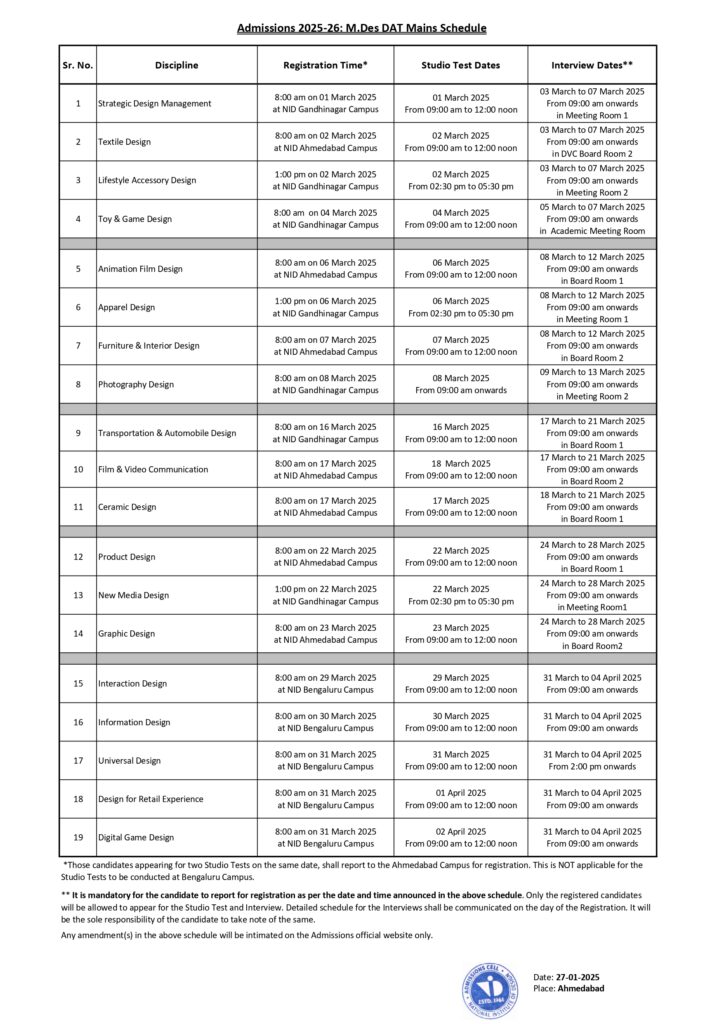
M.Des DAT Mains 2026 Schedule

NID DAT 2025 Mains Schedule MDES

Venue for the B.Des NID Studio Test 2026

The Studio Test for the B.Des program will be conducted in the following NID campuses (venues):

  • NID Ahmedabad
  • NID Bengaluru
  • NID Andhra Pradesh
  • NID Haryana
  • NID Madhya Pradesh
  • NID Jorhat

The seat capacity at each test center is given below.

Seating Capacity in Each Center
Studio Test CenterNID AhmedabadNID BengaluruNID Andhra PradeshNID HaryanaNID Madhya PradeshNID Jorhat
Seating Capacity533300300450400120

The candidate will be given the option to choose a test center for B.Des DAT Mains 2026 Studio Test.

Venue for the M.Des NID Studio Test 2026

The M.Des DAT Mains 2026 Studio Test was conducted in the following NID campuses (venues):

  • NID Gandhinagar Campus
  • NID Ahmedabad Campus
  • NID Bengaluru Campus

As per the official notification, candidates appearing for TWO Studio Tests on the same day had to report to the Ahmedabad Campus for registration. This was not applicable for the Studio Tests conducted at the Bengaluru Campus.

The name and address of the M.Des DAT Mains 2026 exam center (or NID Campus) allocated to the candidate will be mentioned in the M.Des DAT Mains 2026 admit card.

What is NID Studio Test?

The NID Design Aptitude Test (DAT) exam is conducted in TWO stages. 

The candidate 1st appears in DAT Prelims. If shortlisted, the candidate next appears in DAT Mains.

The DAT Mains includes a Studio Test

M.Des candidates are required to appear in a Personal Interview (PI) in addition to the Studio Test. However, DAT Mains for the B.Des program only includes the Studio Test.

The Studio Test carries 60% weightage for the B.Des program, and 40% weightage for the M.Des program.

Skill Tested

The NID Studio Test 2026 will evaluate the candidate’s design aptitude, creativity, as well as problem-solving and hands-on abilities.

Studio Test Topics

  • Doodling exercise
  • 3D Model Making
  • Story Illustration
  • Clay Modelling
  • Wire Moulding
  • Thematic Apperception
  • Psychometric Test
  • Audio Visual Test

Common Materials for NID Studio Test 2026

ParticularsDescription
Basic StationeryPencils (HB, 2B, 6B for sketching)
Eraser
Sharpener
Ruler
Scale
Colored pencils or sketch pens
Markers or highlighters
Drawing and Sketching ItemsDrawing sheets 
Tracing paper
Charcoal or pastels (for shading and detailing)
Model-Making MaterialsClay or modeling dough
Thermocol (styrofoam)
Cardboard or mount board
Paper (colored, origami, or craft paper)
Scissors
Glue or adhesive (Fevicol, tape, etc.)
Cutter or precision knife
Thread or strings
Straws or sticks
Recycled or Found ObjectsBottle caps
Ice cream sticks
Old newspapers or magazines
Wire or metal strips
Rubber bands
Any other everyday objects that can be repurposed creatively
Optional ToolsStencils (for shapes and patterns)
Compass
Protractor
Cutting mat (if allowed)

Question Paper Structure of DAT Mains for M.Des

The DAT Mains for M.Des consists of TWO parts:

  • Studio Test – This may include tests in different formats. The question paper will be in English only.
  • Interviews – The interviews will be conducted separately for each discipline, immediately after the Studio Test, and at the same exam center as the Studio Test.

Note that in unforeseen circumstances, the schedules as well as the nature and structure of the exams may be changed, and the tests may be conducted entirely online or entirely offline, or in a combination of online & offline modes. 

Also Read:

What to Expect in the NID Studio Test?

The Studio Test may vary based on the program (B.Des or M.Des) but generally includes the following:

  • Model Making – The candidate will have to create 3D models based on a brief using materials provided to them.
  • Doodling & Sketching – Quick sketching exercises to assess visualization skills.
  • Material Manipulation – The candidate will be asked to use different materials creatively.
  • Observation & Perception Test – Analyzing objects, situations, or images and drawing insights.
  • Thematic Illustration – Creating storyboards or illustrations on given themes.
  • Personal Interviews – For M.Des candidates, the DAT Mains also includes a personal interview.

How to prepare for the NID Studio Test

The candidate needs to follow these tips to prepare for the NID DAT 2026 Studio Test.

  • Practice working with clay, paper, wire, and other materials.
  • Learn how to quickly sketch and draw perspective drawing without compromising on quality and creativity
  • Develop ideation and storytelling abilities
  • Stay updated on design trends and problem-solving methods 
  • To prepare for the hands-on task, you can practice making small models with limited materials. Learn basic cutting, folding, and joining techniques. Experiment with structural stability and aesthetics.
  • Also, pay attention to communication and presentation techniques.
  • Be prepared for surprises – The Studio Test he test may provide specific materials or ask you to use unconventional items. So, being flexible and having the ability to think on your feet could be life-saving.

Examples of NID DAT 2026 Studio Test Tasks

Here are a few Studio Test tasks the candidate may be asked to perform.

  • Create a 3D model of a product using cardboard and paper.
  • Design a functional object using clay and straws.
  • Sketch a solution to a given problem and explain it.
  • Build a prototype using recycled materials.

What to carry for NID DAT Studio Test 2026

The candidate needs to bring the following items with them on the day of the Studio Test.

  • NID DAT Admit Card 2026 for the Studio Test
  • Photo ID proof
  • Basic tools (pencils, erasers, cutters, etc.) unless specified otherwise.

Note that the National Institute of Design will release separate admit cards for the DAT Mains exam.

The NID DAT 2026 (Prelims) admit card will not be accepted for entry into the exam hall. 

Also Read:

Entrance Exam Coaching – The Good, the Bad, and the Ugly

0

If you plan to appear for entrance exams like JEE Main, NEET, CAT, and NIFT, or any entrance exam worth its salt, there is a chance that you may be tempted to take up coaching. 

This is often driven by peer pressure and also previous years’ topper results. After all there is no denying the fact that many toppers emerge from the coaching institutes.

But while coaching institutes can help students in some respects, is self study completely useless? Can’t a student by dint of their labour and mental aptitude crack these exams, or even top them? And what exactly is the difference between coaching and self-study?

The sad reality is, today, many students, even the meritorious ones, don’t believe in their abilities to crack these exams on their own. So, they end up taking coaching.

Latest Updates:

How good are the coaching institutes

Coaching institutes come in all hues. Some coaching institutes have a better record than others, but can also be expensive. Also, each centre may have different standards, even if they are from the same institute.

For instance, the teaching faculty will vary across centers. And some of these faculty members can be good while others may not be equally good. So, when choosing a coaching institute, you also need to be particular about the center

Institutes like Aakash, Allen, FIITJEE, Career Point, Topper Academy, Resonance, Super 30, Bansal Classes, Vidyamandir, etc., rank among the best coaching institutes in the country.

These institutes have become such huge brands that they exert tremendous influence on the student community and the academic ecosystem of the country as a whole. Their influence can be felt the most when results of top entrance exams are declared – JEE Main, JEE Advanced, NEET, CAT, etc. 

The toppers, many from these institutes, can be found giving interviews to media channels and speaking in glowing terms how a coaching institute helped them crack the entrance exam. The coaching institutes in turn use these bites for further promotion of their brand.

This is how the coaching institutes thrive!

Why can’t our educational institutes create toppers?

The so-called pillars of our education system – schools and colleges – are the places where the toppers should have originally emerged.

But as we all know most of our schools and colleges have turned into job-generation sectors, employing scores of teachers and administrations. The express purpose of public schools and colleges today seems to be creating lucrative jobs for people. 

Sadly, a lot of these people who get the jobs are only interested in clinging on to these jobs with little output in return. So, we see a lot of pot-bellied, unfit people managing the business of running a school.

The government is also doing precious little to improve the standard of schools and colleges. While the top ranked colleges and schools are doing a bit better, even students from these institutes can’t seem to manage without coaching.

The state of affairs in the country is so bad that CBSE recently had to come out with an advisory against dummy schools!

The dummy schools concept has cropped up because these students no longer want to attend a regular school. If you ask why, the answer is most schools are ill equipped to prepare students for entrance exams. So, these students who are preparing for entrance exams get admission to a dummy school, where they don’t have to attend school at all. This allows them to focus entirely on exam preparation.

What is the government doing to improve the condition of schools and colleges?

Nothing of substance!

While our PM is doing pariksha pe charcha and taking other initiatives, concrete measures are missing.

Still many parents think twice about admitting their wards to government schools and colleges, despite the fact that educators in these institutes get far better salary and facilities than private institutes.

Where is the accountability?

Accountability that these educators have towards the students and parents. It is where the government could have laid down a few guidelines.

We are not talking about drastic measures, but at least START with some baby steps. To bring accountability. 

The icing on the cake is the Delhi government typing up with Physics Wallah (PW) to provide free coaching to Class 12 students preparing for NEET and CUET. The initiative will surely benefit the students.

But is it the correct solution? Why did the Delhi government fall at the mercy of a private institute like Physics Wallah. What happened to the scores of government teachers and academicians retained on Delhi government salary?

Aren’t they good enough? If they are not good enough, what is the reason?

Also, if they aren’t good enough, why are they retained on government salary?

Sadly, nobody is asking these questions.

Short-time solutions will make things worse

Measures like tie-ups with private institutes like Physics Wallah show that there are serious shortcomings in the education system. 

Also, these short-term measures can only make matters worse.

For one, it will ensure there is no improvement in the status quo. Second, the measure will encourage more institutes like Physics Wallah while sidelining government colleges and schools.

But with the sanction of state governments, private organizations like Physics Walla will get even more powerful. 

TG EAPCET Exam Pattern 2026 – Stream-wise Subjects & No. of Questions, Marking Scheme, Mode

TG EAPCET Exam Pattern 2026 – Candidates preparing for the TG EAPCET 2026 exam must consult the updated exam pattern. This will provide insights into the question paper structure, like the mode of the exam, types of questions asked, marking scheme, etc.

The exam pattern will be outlined in the TG EAPCET 2026 information bulletin. Separate information bulletins are available for the Engineering Stream (E) and Agriculture & Pharmacy Stream (A & P). The candidate must refer to the TG EAPCET 2026 exam pattern for their chosen stream.

As per the official exam pattern, the TG EAPCET 2026 exam will be of 3 hours duration and include 160 objective-type questions (each carrying 1 mark). Do also consult the TG EAPCET 2026 syllabus for exam preparation.

Keep reading to learn the full details about TG EAPCET exam pattern 2026 below.

Latest Updates:

TG EAPCET Exam Pattern 2026 – Key Features

The important highlights of the TS EAMCET 2026 exam pattern (or TG EAPCET exam pattern 2026) are outlined in the table below.

ParticularsDescription
Mode of the examOnline, computer-based test
Test duration3 hours
No. of questions160
Question typeObjective type (multiple choice) questions
Subject combination and number of questions asked from these subjectsEngineering (E)
Physics – 40 questions
Chemistry – 40 questions
Mathematics – 40 questions

Agriculture and Pharmacy (AP)
Physics – 40 questions
Chemistry – 40 questions
Biology – 80 questions (Botany – 40, Zoology – 40)
Medium of examEnglish, Telugu, and Urdu
Marking scheme+1 for each correct answer; there is no negative marking
Instruction BookletsDownload – TG EAPCET 2025 Instruction Booklet Engineering (E)

Download – TG EAPCET 2025 Instruction Booklet Agriculture & Pharmacy (A&P)

Also Read:

TG EAPCET Exam Pattern 2025 – Subject Combination, No. of Questions

The subject combination for the TG EAPCET 2025 exam will depend on the stream selected by the candidate:

  • Engineering Stream (E) or
  • Agriculture & Pharmacy Stream (A & P)

TG EAPCET 2025 Subject Combination and No. of Questions – Engineering Stream (E)

Subject Combination for Engineering Stream (E)Number of Questions
Physics40
Chemistry40
Mathematics80

TG EAPCET 2025 Subject Combination and No. of Questions – Agriculture & Pharmacy Stream (A & P)

Subject Combination for Engineering Stream (E)Number of Questions
Physics40
Chemistry40
BiologyBotany – 40
Zoology – 40

TG EAPCET Syllabus 2025

Along with the exam pattern, the candidate is also recommended to carefully go through the TG EAPCET 2025 syllabus.

While the exam pattern has instructions on how to prepare for the exam, the TG EAPCET syllabus will include the subject-wise topics from which questions will be asked in the exam. So, the syllabus will tell the candidate what to read.

When to start TG EAPCET 2025 exam preparation?

Being a state entrance exam, TG EAPCET 2025 is not going to be easy. According to statistics, every year more than 3 lakh candidates take the test. So, to be in contention for a seat in one of the top colleges, you will have to get a very good score and rank.

One way to get a good score in the exam is to start your TG EAPCET 2025 exam preparation early. This way, you will have enough time to complete the syllabus, solve sample papers, do timely revision, and revisit difficult topics (if required).

Also Read:

TG EAPCET Syllabus 2026 – Subject-wise Topics, Download PDF, Important Topics

TG EAPCET Syllabus 2026 – JNTUH will release the syllabus for TG EAPCET 2026 at eapcet.tgche.ac.in. The syllabus will be available separately for Engineering (E) and Agriculture, Pharmacy, Veterinary etc. (AP) streams. 

Download the TG EAPCET syllabus pdfs following the links given below.

The syllabus for each stream contains the subject-wise topics that candidates must prepare for the TG EAPCET 2026 exam. Additionally, the syllabus also includes mode questions for each subject. 

So, after completing the syllabus, you can solve TG EAPCET 2026 sample questions to test your understanding of various concepts as well as the ability to solve various types of problems using these concepts.

When preparing for the TG EAPCET exam, make sure that you also refer to the TG EAPCET 2026 exam pattern

Latest Updates:

TG EAPCET Syllabus – Download Stream-wise PDFs

StreamTG EAPCET 2025 Syllabus Download Links
Engineering (E) StreamDownload here
Agriculture, Pharmacy, Veterinary etc. (AP) StreamDownload here

TG EAPCET Syllabus 2026 for Mathematics

The TG EAPCET syllabus for mathematics is given in the table below.

SubjectMain Topics
MathematicsAlgebra
Trigonometry
Vector Algebra
Probability
Coordinate Geometry
Calculus

Also Read:

TG EAPCET Syllabus 2026 for Physics

Refer to the TG EAPCET syllabus for physics given below to prepare for the exam.

SubjectMain Topics
PhysicsPhysical World
Units and Measurements
Motion in a Straight Line
Motion in a Plane
Laws of Motion
Work, Energy, and Power
Systems of Particles and Rotational Motion
Oscillations
Gravitation
Mechanical Properties of Solids
Mechanical Properties of Fluids
Thermal Properties of Matter
Thermodynamics
KInetic Theory
Waves
Ray Optics and Optical Instruments
Wave Optics
Electric Charges and Fields
Electrostatic Potential and Capacitance 
Current Electricity
Moving Charges and Magnetism
Magnetism and Matter
Electromagnetic Induction
Alternating Current
Electromagnetic Waves
Dual Nature of Radiation and Matter
Atoms
Nuclei
Semiconductor Electronics: Materials, Devices and Simple Circuits
Communication Systems

TG EAPCET Syllabus 2026 for Chemistry

Candidates can consult the TG EAPCET syllabus for Chemistry in the table given below.

SubjectMain Topics
ChemistryAtomic Structure
Classification of Elements and Periodicity in Properties
Chemical Bonding and Molecular Structure
States of Matter: Gases and Liquids
Stoichiometry
Thermodynamics
Chemical Equilibrium and Acids-Bases
Hydrogen and its Compounds
s-Block Elements (Alkali and Alkaline Earth Metals)
p-Block Elements – Group 13 (Boron Family)
p-Block Elements – Group 14 (Carbon Family)
Environmental Chemistry
Organic Chemistry – Some Basic Principles, Techniques and Hydrocarbons
Solid State
Solutions
Electrochemistry and Chemical Kinetics
Surface Chemistry
General Principles of Metallurgy
p-Block Elements
d and f Block Elements and Coordination Compounds
Polymers
Biomolecules
Chemistry in Everyday Life
Haloalkanes and Haloarenes
Organic Compounds Containing C, H, and O (Alcohols, Phenols, Ethers, Aldehydes, Ketones, and Carboxylic Acids)
Organic Compounds Containing Nitrogen

TG EAPCET Syllabus 2026 for Botany

Candidates can consult the TG EAPCET syllabus for Botany in the table given below.

SubjectMain Topics
BotanyDiversity in the Living World
Structural Organization in Plants – Morphology
Reproduction in Plants
Plant Systematics
Cell Structure and Function
Internal Organization of Plants
Plant Ecology
Plant Physiology
Microbiology
Genetics 
Molecular Biology
Biotechnology
Plants, Microbes, and Human Welfare

TG EAPCET Syllabus 2026 for Zoology

Candidates can consult the TG EAPCET syllabus for Zoology in the table given below.

SubjectMain Topics
ZoologyZoology – Diversity of Living World
Structural Organization in Animals
Animal Diversity – I: Invertebrate Phyla 
Animal Diversity – II: Phylum: Chordata
Locomotion and Reproduction in Protozoa
Biology and Human Welfare
Type Study of Periplaneta Americana
Ecology and Environment
Human Anatomy and Physiology-I
Human Anatomy and Physiology-II
Human Anatomy and Physiology-III
Human Anatomy and Physiology-IV
Human Reproduction
Genetics
Organic Evolution
Applied Biology

TG EAPCET Exam Pattern 2026

The exam pattern for the TG EAPCET 2026 exam is given in the table below.

ParticularsDescription
Mode of the examComputer-based Mode
Test duration3 hours
No. of questions160
Question typeObjective type (multiple choice) questions
Subject combination and number of questions asked from each subjectEngineering (E)
Physics – 40 questions
Chemistry – 40 questions
Mathematics – 40 questions

Agriculture and Pharmacy (AP)
Physics – 40 questions
Chemistry – 40 questions
Biology – 80 questions (Botany – 40, Zoology – 40)
Medium of examEnglish, Telugu, and Urdu
Marking scheme+1 for each correct answer; there is no negative marking

Also Read:

How to Prepare for NIFT Personal Interview 2026 – Skill Tested, Questions Asked, Mock Tests

0

How to Prepare for NIFT 2026 Personal Interview – PG candidates will be shortlisted for the NIFT 2026 personal interview based on NIFT 2026 exam scores or result. As per the result notification released by the NTA, candidates will be shortlisted in the ratio of 1:4 (one seat: four candidates), category-wise for the Personal Interview (PI).

The NIFT 2026 written exam will be conducted around the 1st week of February 2026.

Eligible candidates must attend the Personal Interview in New Delhi; if the candidate doesn’t attend the interview, they will be disqualified.

The personal interview for NIFT 2026 will be conducted in May 2026.

Preparing for the NIFT 2026 personal interview requires a combination of self-awareness, industry knowledge, and effective communication skills. 

The NIFT personal interview carries a solid 30% weightage making it crucial for the candidate to do well. If you want some useful and easy tips to ace the interview, we have it covered!

So, keep reading.

Latest Updates:

NIFT 2025 Final Result (OUT Soon) – Download Scorecard, Merit List, Tie-breaker

Ten Tips to Prepare for the NIFT 2026 Personal Interview

The personal interview is the 2nd stage of the NIFT 2026 admission process. The 1st stage is the written exams (GAT and CAT).

Here’s a step-by-step guide to help you prepare:

1. Understand the Purpose of the NIFT 2026 Personal Interview

Shortlisted candidates for PG courses are required to undergo a Personal Interview (PI).

The personal Interview will be conducted by a panel and will evaluate the candidate on the following parameters:

  1. Career orientation
  2. Aptness for the course
  3. Overall personal achievements in academics and co-curricular activities
  4. Communication
  5. General awareness, aptitude, creative and lateral thinking

The candidate may refer to the NIFT 2026 exam syllabus for detailed inputs.

2. Research and Prepare

Know Your Portfolio: If you’re required to present a portfolio, ensure it reflects your best work. Be ready to explain your design process, inspiration, and the story behind each piece.

Stay Updated on Fashion Trends: Follow fashion magazines, blogs, and social media to stay informed about current trends, designers, and industry news.

Learn About NIFT: Research NIFT’s history, courses, faculty, and alumni. Understand why you want to join NIFT and how it aligns with your career goals.

General Knowledge: Be aware of current affairs, especially those related to the fashion and design industry.

3. Practice Common Interview Questions

Prepare answers for questions like:

  • Tell us about yourself.
  • Why do you want to join NIFT?
  • Who is your favorite designer, and why?
  • What inspires your designs?
  • How do you handle criticism?
  • What are your strengths and weaknesses?
  • Where do you see yourself in 5 years?

4. Work on Your Communication Skills

Be Clear and Confident: Practice speaking clearly and confidently. Avoid using filler words like “um” or “uh.”

Body Language: Maintain good posture, eye contact, and a positive demeanor.

Listen Carefully: Pay attention to the interviewer’s questions and respond thoughtfully.

5. Showcase Your Passion and Creativity

Share your unique perspective on fashion and design.

Discuss any personal projects, internships, or experiences that highlight your creativity and dedication.

Be prepared to sketch or discuss ideas on the spot if asked.

Also Read:

6. Dress Appropriately

Wear something that reflects your personal style but is also professional and neat.

Avoid over-the-top outfits; instead, opt for something that shows your understanding of aesthetics and appropriateness.

7. Take Mock Interviews

Practice with friends, family, or mentors to simulate the interview environment.

Record yourself to identify areas for improvement in your tone, body language, and answers.

8. Stay Calm and Positive

Be yourself and let your passion for fashion and design shine through.

Don’t panic if you don’t know an answer; it’s okay to admit it politely and move on.

9. Prepare Questions for the Interviewer

At the end of the interview, you may be asked if you have any questions. Prepare thoughtful questions like:

What opportunities does NIFT provide for internships and industry exposure?

How does NIFT support students in building their portfolios?

What are the key qualities NIFT looks for in a student?

10. Final Tips

Arrive early on the interview day.

Carry all required documents, including your portfolio (if applicable).

Stay confident and believe in your abilities.

By following these steps, you’ll be well-prepared to ace the NIFT 2026 personal interview. 

NIFT 2026 Exam – Test Components and Weightage

The test components for the NIFT 2026 PG exam and the weightage carried by various components, including the Personal Interview, is given below.

As you can see from the table below, the Personal Interview carries 30% weightage for all PG courses.

ProgramTestWeightage
Master of Design (MDes)CAT40%
GAT
(Section-A)
30%
Personal Interview30%
Master of Fashion Technology (MFTech)GAT70%
Personal Interview30%
Master of Fashion Management (MFM)GAT
(Section-A & Section-B)
70%
Personal Interview30%

Also Read:

How to Prepare for NIFT Personal Interview 2026 – Best Books

Candidates preparing for the NIFT 2026 personal interview are also recommended to consult the NIFT best books. The reason being NIFT 2026 best books will cover the entire syllabus, explain the concepts in simple, easy-to-understand language, contain few to no errors, include examples and infographics, and practice questions.

So, if you use these books for exam preparation, you can start with a big edge.

NIFT Situation Test 2026 – Overview

Candidates seeking admission to the B.Des program next need to prepare for the NIFT 2026 Situation Test if they qualify the written exams.

ParticularsDescription
When will the Situation Test be held?May 2026
Who will conduct the NIFT Situation Test 2026?The Situation Test will be conducted by the National Institute of Fashion Technology (NIFT).

The shortlist for the Situation Test will be done based on NIFT 2026 written exams conducted by the NTA.

Note that the role of the NTA is limited to the conduct of the written exams and declaration of results. It will play no further role in the NIFT admission process.
Eligibility criteria for appearing in the Situation TestCandidates will be shortlisted for the Situation Test based on NIFT 2026 written test scores.
Mode of the Situation TestThe Situation Test will be conducted offline at NIFT Delhi Campus
Structure of the examThe Situation Test will evaluate:

The candidate’s material handling 
Creative skills in a given scenario 

The candidate will be provided with the material for a specific task inside the exam hall.
How to register for NIFT Situation TestThe registration process will be held online.

When filling out the form, SELECT your choice of NIFT participating institutes in the order of priority.

Read More:

NIFTEE 2025 Exam Analysis (OUT) – Download Here
How to Prepare for NIFT Personal Interview 2026 – Skill Tested, Questions Asked, Mock Tests
NIFT Acceptance Rate

How to Prepare for NIFT 2026 Situation Test – TEN Easy Tips, Model Making, Material Handling

0

How to Prepare for NIFT 2026 Situation Test – NTA will likely conduct the NIFTEE 2026 (Stage 2) exam for UG courses in June 2026. Stage 2 for B.Des candidates will include a Situation Test that will be conducted in 18 cities across the country. NIFT 2026 Situation Test carries 20% weightage and will evaluate the candidate’s ability in model construction, material handling, creativity, and innovation. 

Candidates will be shortlisted for NIFTEE 2026 (Stage 2) based on NIFT 2026 entrance exam results.

Effective preparation for the NIFT Situation Test requires a combination of creativity, practical skills, and quick thinking. Here we share ten tips to prepare for the Situation Test, and explain in great detail model making and material handling.

The NIFT 2026 written exam will be held around the 1st week of February 2026.

Latest Updates:

Ten Tips to Prepare for NIFT Situation Test 2026

Here’s a step-by-step guide to help you prepare for the NIFT 2026 Situation Test:

Tip 1 – Understand the NIFT 2026 Exam Pattern for the Situation Test 

The Situation Test is a hands-on practical test where you are given a design problem or theme.

You are required to create a 3D model or prototype using materials provided (e.g., paper, cardboard, clay, fabric, etc.). You are not allowed to use any other material except the ones provided inside the exam hall.

The Situation Test will evaluate your creativity, innovation, material handling, and presentation skills.

2. Develop Key Skills

The candidate must build the following skills to do well in the NIFT 2026 Situation Test:

  • Creativity and Innovation: Practice brainstorming unique ideas for given themes.
  • Material Handling: Learn to work with different materials like paper, cardboard, thermocol, clay, fabric, etc.
  • Time Management: Practice completing tasks within a limited time frame (usually 2-3 hours).
  • Presentation Skills: Ensure your final model is neat, visually appealing, and effectively communicates your idea.

3. Practice with Past Questions

The candidate must download previous years’ NIFT Question Papers (Situation Test) and solve all the questions. The candidate must also include sample papers to ensure variety and good practice. 

Research past NIFT Situation Test themes (e.g., “Sustainability,” “Cultural Heritage,” “Future Cities,” etc.).

Practice creating 3D models or prototypes based on these themes.

Focus on originality and practicality in your solutions.

4. Work on Mock Projects

Set a timer and simulate the test environment at home.

Use readily available materials to create models.

Practice presenting your ideas clearly and concisely.

Also Read:

5. Learn Basic Craft Techniques

Familiarize yourself with basic crafting techniques like cutting, folding, pasting, and assembling materials.

Experiment with textures, colors, and patterns to enhance your designs.

6. Stay Updated on Design Trends

Follow design blogs, magazines, and social media to stay informed about current trends in fashion, product design, and innovation.

Incorporate modern and sustainable design practices into your work.

7. Seeks Ways to Improve Observation and Conceptualization

Observe everyday objects and imagine how they can be redesigned or improved.

Practice sketching and conceptualizing ideas quickly.

8. Join a Coaching Institute (Optional)

If you need structured guidance, consider joining a coaching institute that specializes in NIFT preparation.

They often provide mock tests, material kits, and feedback.

9. Prepare for the Day of the Test

Carry essential tools like scissors, glue, rulers, and cutting mats (check the official guidelines for allowed items).

Dress comfortably and stay calm during the test.

Read the instructions carefully and plan your approach before starting.

10. Stay Confident and Positive

Trust your creativity and problem-solving abilities.

Remember that the Situation Test is about showcasing your unique perspective and skills.

Solve previous years’ NIFT Situation Test Questions

A great way to get ready for the NIFT 2026 situation test is to solve previous editions of the entrance exam.

If you solve previous years NIFT Situation Test questions, it will help you understand the type of questions asked, how questions are asked, and what the interviewer is trying to evaluate.

The NIFT situation test is a hand-on test that may include tasks like model-making, material manipulation, and problem-solving.

If you solve previous years’ papers, you can get ready for the exam in the right earnest. However, make sure not to limit yourself only to the question papers; instead also solve sample papers.

Best Books to Prepare for NIFT 2026 Situation Test

Here are the best books to prepare for NIFT 2026 Situation Test recommended by toppers and experts.

Name of the bookAuthor (Publication)
Universal Principles of DesignTom Kelley and David Kelley
100 Things Every Designer Needs to Know About People (Voices That Matter)Weinschenk Susan
Creative Confidence: Unleashing the Creative Potential Within UsTom Kelly
The Design of Everyday ThingsDon Norman
Emotional Design: Why We Love (or Hate) Everyday ThingsDon Norman
NIFT Situation Test 2026 – Download free 10 years papersDownload Here – NIFT Question Papers

By following these steps and practicing regularly, you can confidently approach the NIFT 2026 Situation Test and showcase your design potential. Good luck!

Also Read:

When to START preparation for NIFT Situation Test

It is recommended that candidates don’t leave their NIFT 2026 situation preparation very late. The situation test is not something that you can master in a matter of days. In fact, learning the nitty gritty and nuances of the test will require you to go through the process in a step-wise manner.

For instance, you need to know about the various material that can be used for the test, how to use them. Also, you must work on your creative and observation abilities.

Read More: