

If you’re gearing up for JEE Main 2026, it’s time to get moving — the application window is open, and the Session 1 exam dates are out.
This year’s game-changing twist: for the first time ever, you’ll have access to an on-screen calculator during the Computer-Based Test has turned OUT to be a DUD! In a clarification issued on November 2, the NTA has notified that candidates will not be allowed to use calculators during the JEE Main 2026 exam. NTA has also released a revised JEE Main 2026 information Bulletin. While the calculator surprise has flopped, elsewhere, NTA has increased the number of JEE Main 2025 exam cities to 308 (from 300 in the last edition).
That’s not just all!
The National Testing Agency (NTA) has also released a detailed information brochure, confirming key details about the exam pattern, syllabus, JEE Main 2026 application process and fees, exam cities, and how the merit list will be prepared. Some things have stayed steady, but a few finer updates might just influence how you approach your preparation this year.
So, before you fill out that form or fine-tune your study plan, here’s a quick, clear look at what’s new in JEE Main 2026 — and what every aspirant should know right now.
Latest Updates:
- JEE Main 2026 Application Form (OPEN) – Apply Here
- To download revised JEE Main 2026 Information Brochure – Click Here
- Read Here – NTA’s Clarification on Use of Virtual Calculator in JEE (Main) 2026
- To visit JEE Main 2026 Exam Portal – Click Here
Table of Contents
What’s new in JEE Main 2026?
Here’s a quick overview of all the key updates, changes, and continuations announced for JEE Main 2026.
- Big news for JEE aspirants! The JEE Main exam will not feature an on-screen calculator after all — putting a dampener on speculations and the accompanying excitement. The NTA has withdrawn its previous notification where it had announced the introduction of an on-screen calculator that candidates could use for quick computations during the Computer-Based Test (CBT). If implemented, this move would have marked a significant shift in how students approach numerical and calculation-heavy questions in the exam.
- The exam will once again be held in two sessions — January and April 2026, continuing the same annual schedule followed in 2025.
- There is no change in the overall exam pattern. Paper 1 (B.E./B.Tech), Paper 2A (B.Arch), and Paper 2B (B.Planning) remain identical in format and marking.
- Each subject still features 20 multiple-choice questions and 10 numerical value questions, with any five numerical questions to be attempted.
- Negative marking for both MCQs and numerical questions, introduced in 2025, continues in 2026.
- The marking scheme and duration stay the same: +4 for correct answers, –1 for incorrect, and 0 for unanswered, with a 3-hour exam time (3 hours 30 minutes for combined papers).
- The JEE Main 2026 syllabus is unchanged, matching 2025 word-for-word. Previously deleted topics such as Communication Systems, Environmental Chemistry, and Mathematical Induction remain excluded.
- The application fee structure and payment options are identical to last year, with no revisions in category-wise charges.
- NEW Test Cities Added – JEE Main 2026 just got a little closer to home — with 308 Indian cities now slated to host the exam (up from 300 last year). The 15 international centers remain the same, and you’ll still get to select four cities of your choice.
- The merit list preparation method is unchanged, continuing to rely on NTA percentile scores with the same normalization, tie-breaking order, and “best of two sessions” rule.
In short: The on-screen calculator is the headline update for JEE Main 2026 — everything else, from pattern to syllabus, stays exactly as it was in 2025.
JEE Main 2026 Application Fee – What’s New?
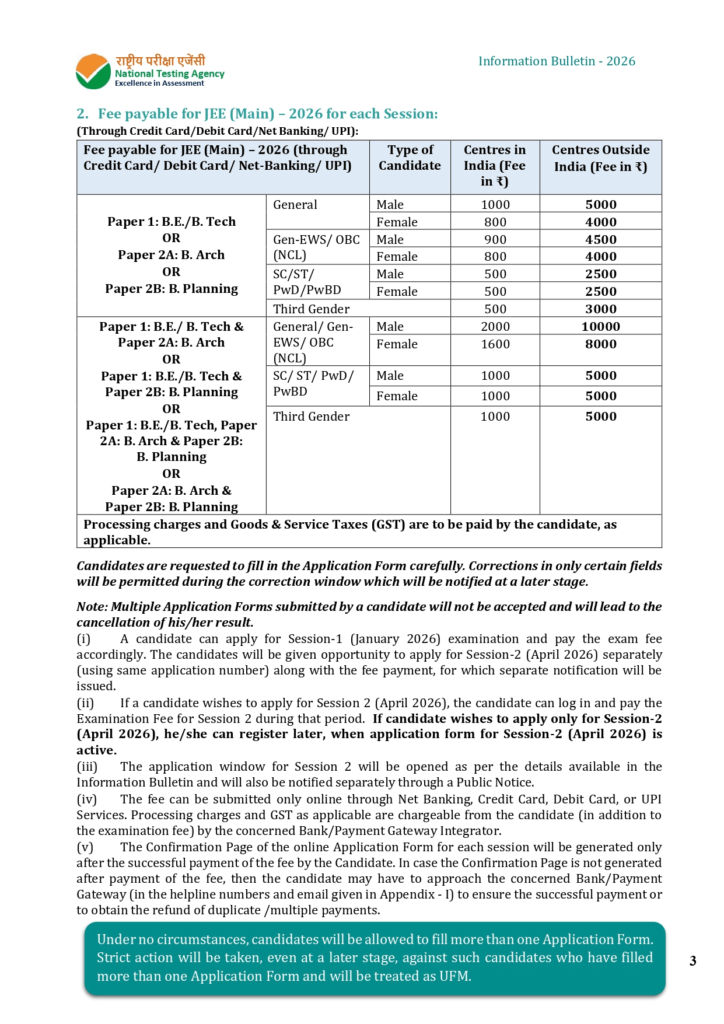
The JEE Main 2026 application fee remains the same as 2025, with no changes in category-wise charges or payment process.
JEE Main 2026 vs. 2025 Application Fee
| Fee payable for JEE (Main) – 2026 (through Credit Card/ Debit Card/ Net-Banking/ UPI) | Type of Candidate | Centres in India (Fee in ₹) | Centres Outside India (Fee in ₹) | |
| Paper 1: B.E./B. Tech OR Paper 2A: B. Arch OR Paper 2B: B. Planning | General | Male | 1000 | 5000 |
| Female | 800 | 4000 | ||
| Gen-EWS/ OBC (NCL) | Male | 900 | 4500 | |
| Female | 800 | 4000 | ||
| SC/ST/ PwD/PwBD | Male | 500 | 2500 | |
| Female | 500 | 2500 | ||
| Third Gender | 500 | 3000 | ||
| Paper 1: B.E./ B. Tech & Paper 2A: B. Arch OR Paper 1: B.E./B. Tech & Paper 2B: B. Planning OR Paper 1: B.E./B. Tech, Paper 2A: B. Arch & Paper 2B: B. Planning OR Paper 2A: B. Arch & Paper 2B: B. Planning | General/ Gen- EWS/ OBC (NCL) | Male | 2000 | 10000 |
| Female | 1600 | 8000 | ||
| SC/ ST/ PwD/ PwBD | Male | 1000 | 5000 | |
| Female | 1000 | 5000 | ||
| Third Gender | 1000 | 5000 | ||
| Processing charges and Goods & Service Taxes (GST) are to be paid by the candidate, as applicable. | ||||
To download JEE Main 2026 Application Fee (Official PDF copy) – Click Here
Check (official) – JEE Main 2026 Application Fee
JEE Main Exam Pattern 2026 – What’s New?
The JEE Main 2026 exam pattern remains largely unchanged from 2025, maintaining the same paper structure, marking scheme, and number of questions across all subjects.
The only notable update was supposed to be the introduction of an on-screen calculator, designed to help candidates perform quick computations during the Computer-Based Test (CBT). However, the NTA has since clarified (and released a fresh Information Bulletin) saying the “no-Calculator” policy will be followed in the upcoming exam (JEE Main 2026) as well.
So, most of the core aspects—such as the two-session format, question distribution, and negative marking for both MCQs and Numerical Value Questions—remain exactly the same as in 2025.
JEE Main 2026 vs. 2025 Exam Pattern
| Feature | JEE Main 2025 | JEE Main 2026 | Difference |
| Mode of Exam | Computer-Based Test (CBT) for all papers except Drawing Test (offline) for Paper 2A. | Same — CBT mode; Drawing Test remains offline. | No change |
| Papers Conducted | Paper 1 (B.E./B.Tech), Paper 2A (B.Arch), Paper 2B (B.Planning) | Same. | No change |
| Exam Sessions | Two sessions (January & April 2025) | Same. | No change |
| Question Types | Section A: MCQs; Section B: Numerical Value Questions. | Same format retained. | No change |
| Section B (Numerical) Attempt Rule | 10 numerical questions given per subject — any 5 to be attempted. | 10 numerical questions given per subject — any 5 to be attempted. | No change |
| Negative Marking | Negative marking for MCQs continued; introduced for NVQs in 2025 (–1 for incorrect answers in both types). | Continues unchanged in 2026. | No change |
| Total Marks (Paper 1) | 300 marks (Physics, Chemistry, Mathematics = 100 each). | Same. | No change |
| Paper 2A (B.Arch) | 400 marks (Math 100 + Aptitude 200 + Drawing 100). | Same. | No change |
| Paper 2B (B.Planning) | 400 marks (Math 100 + Aptitude 200 + Planning 100). | Same. | No change |
| Duration | 3 hours for one paper; 3 h 30 min if attempting both 2A and 2B together. | Same. | No change |
| Medium of Exam | 13 languages (English, Hindi, Assamese, Bengali, Gujarati, Kannada, Malayalam, Marathi, Odia, Punjabi, Tamil, Telugu, Urdu). | Same 13 languages. | No change |
| New Features | Negative marking for numerical questions introduced. | On-Screen Calculator introduced for the first time. | ✅ New in 2026 |
| Marking Scheme Summary | +4 for correct answer; –1 for incorrect; 0 for unanswered. | Same marking scheme. | No change |
| Session & Tie-Breaking Method | NTA score-based normalization; same criteria for tie resolution. | The same procedure continued. | No change |
JEE Main Syllabus 2026 – What’s New?
There are no differences between the 2025 and 2026 syllabus documents.
Both PDFs have identical structure, subject breakdown, topic listing, and formatting, confirming that the NTA has not introduced any syllabus changes for JEE Main 2026.
JEE Main 2025 vs. 2026 Syllabus
| Category | JEE Main 2025 | JEE Main 2026 | Change |
| Physics | Same 20 units | Same 20 units | None |
| Chemistry | Same 3 sections | Same 3 sections | None |
| Mathematics | Same 16 units | Same 16 units | None |
| Deleted Topics (e.g., Polymers, Mathematical Induction) | Remain deleted | Remain deleted | None |
| New Topics | None added | None added | None |
About Deleted Topics (Syllabus revised in 2024)
The JEE Main syllabus for 2026 remains unchanged from 2025, which means that the topics removed during the 2024 revision continue to be excluded. These deletions were part of NTA’s effort to align the exam with the updated NCERT Class 11 and 12 textbooks.
Students should avoid spending time on these older, non-exam topics.
Physics – Removed Topics
- Communication Systems (entire unit removed)
- From Kinematics:
- Scalars and Vectors
- Vector Addition and Subtraction
- Scalar and Vector Products
- Resolution of Vectors
- Unit Vectors
- Redundant derivations and examples trimmed for brevity
Chemistry – Removed Topics
- Environmental Chemistry
- Polymers (no longer a full chapter)
- Chemistry in Everyday Life
- Minor reductions in Surface Chemistry and General Principles and Processes of Isolation of Elements
Mathematics – Removed Topics
- Mathematical Induction
- Certain advanced portions of Three-Dimensional Geometry
- Redundant examples in Statistics and Probability
JEE Main 2025 – Exam Pattern and Syllabus Revised
The National Testing Agency (NTA) revised both the JEE Main 2025 syllabus and exam pattern to further align with the updated NCERT curriculum.
While the syllabus largely continued the 2024 reductions with minor topic removals, the exam pattern introduced key changes—most notably, all numerical questions were made compulsory and negative marking applied to them. These updates were made with an aim to promote accuracy and conceptual clarity among aspirants.
JEE Main 2024 vs. 2025 exam pattern
| Feature | JEE Main 2024 | JEE Main 2024 |
| Section B Questions (Numerical) – Paper 1 | 10 questions, of which 5 were mandatory to attempt. | 5 questions, all of which are mandatory to attempt. |
| Total Questions per Subject – Paper 1 | Each subject (Mathematics, Physics, Chemistry) had 30 questions (20 MCQs + 10 numerical-value) but from those 10 NVQs only 5 needed to be attempted → effectively 25 to be answered per subject. | 25 (20 MCQs + 5 compulsory numerical questions) |
| Negative Marking | -1 for incorrect MCQ answers. | -1 for incorrect MCQ answers and -1 for incorrect numerical value answer questions. |
| Drawing Test Weightage (Paper 2A) | 25% | 30% |
JEE Main 2024 vs. 2025 Syllabus
| Subject | JEE Main 2024 | JEE Main 2025 |
| Physics | The syllabus was reduced significantly in 2024 (overall units dropped from 64 to ~53 across all 3 subjects) to align with NCERT. Some specific topics removed: e.g., “Communication Systems” (in Electronics devices unit) from Physics. No major additions were announced; the focus was on pruning less-core topics. | For 2025, the syllabus shows further minor deletions in Physics: topics from Kinematics such as “Scalars & Vectors”, “Vector Addition & Subtraction”, “Scalar & Vector Products”, “Unit Vectors”, and “Resolution of a Vector” were removed. Otherwise, the Physics syllabus remains largely the same structure as in 2024. |
| Chemistry | 2024 saw major syllabus reduction: many chapters removed (such as from Polymers, Environmental Chemistry) to align with NCERT. Students needed to note the reduced number of units. | For 2025, no major additions; the reductions from previous years continue. Chemistry syllabus remains mostly unchanged compared to 2024. |
| Mathematics | Significant reduction. For example, topics like “Mathematical Induction” and parts of “Three-Dimensional Geometry” were removed. | For 2025, very minor changes: the maths syllabus is largely the same as 2024. There is no major new topic addition in Maths for 2025. |
JEE Main 2026 Exam Cities – What’s New?
The exam city list for JEE Main 2026 remains identical to 2025, with no additions, deletions, or code changes. Candidates can still choose up to four preferred cities during registration, and the NTA retains the same allocation policy based on availability and administrative convenience.
The list of JEE Main 2026 exam cities is outlined in the information brochure.
JEE Main 2026 vs. 2025 Exam Cities
| Aspect | JEE Main 2025 | JEE Main 2026 | Change / Remarks |
| Section in Brochure | “List of Cities for JEE (Main) – 2025” | “List of Cities for JEE (Main) – 2026” | Both brochures include full city lists |
| Number of Indian Exam Cities | 300 | 308 | Eight new cities added |
| Number of Foreign Exam Cities | 15 | 15 | No change |
| City Names (Domestic) | All cities (state/UT-wise) identical | Same names in same order | No change |
| City Codes (Domestic) | Format: State prefix + two-digit code (e.g., AP01, UP16) | Same format and same codes | No change |
| City Names (International) | 15 cities (e.g., Abu Dhabi, Doha, Dubai, Singapore, Riyadh) | Same | No change |
| City Codes (International) | Format: ZZ01 – ZZ24 | Same | No change |
| Choice of Cities allowed when filling JEE Main 2026 application | Up to 4 preferences | Up to 4 preferences | No change |
| Allocation Policy | Based on availability; final decision by NTA | Same | No change |
| Notes / Instructions | NTA may add or remove cities as needed | Same note with updated year | No change |
JEE Main Merit List 2026 (Preparation) – What’s New?
The method for preparing the JEE Main 2026 merit list remains unchanged from 2025. Rankings continue to be based on NTA Scores (percentiles), with the same normalization process, tie-breaking rules, and the “best of two sessions” policy for determining the All India Rank.
JEE Main Merit List & Result Preparation – 2025 vs 2026
| Aspect | JEE Main 2025 | JEE Main 2026 | Change / Remarks |
| Basis of Merit List | Based on NTA Scores (percentile) obtained in Paper 1, not raw marks. | Same — NTA Scores used for ranking; raw marks not considered. | No change |
| Normalization Process | Normalization across sessions using standard NTA formula: percentile calculated for each session, then combined for final score. | Same normalization formula and explanation. | No change |
| Tie-Breaking Criteria (Paper 1) | Mathematics scorePhysics scoreChemistry scoreThe older candidate will be given preference.If tie persists, the merit will be decided by a random draw. | Same | No change |
| Tie-Breaking (Paper 2A & 2B) | Based on scores in Aptitude, Drawing/Planning, then Mathematics; followed by age and random draw. | The same sequence will be followed. | No change |
| Separate Merit Lists | Separate lists for B.E./B.Tech, B.Arch, and B.Planning. | Same – separate merit lists maintained. | No change |
| All India Rank (AIR) | Will be prepared using NTA scores of both sessions (best of two considered). | Same method – best of two sessions used for AIR. | No change |
| Result Display Format | Will be available on NTA website; scorecard will show subject-wise and total NTA score. | Same format and details. | No change |