CLAT 2026 Expected Cut-off (OUT), Previous Years’ Institute-wise Opening and Closing Ranks

0

CLAT Cut-off 2025 – The unofficial cut-off of CLAT 2026 released by various coaching and education institutes is now OUT.

The Consortium of NLUs will release the (official) admission cut-off at the time of CLAT 2026 counseling. The cut-off will be available for each round of CLAT 2025 counseling-cum-seat allotment. 

The cut-off would be available in the form of a PDF.

You can download the cut-off pdf simply by clicking on it. No log-in is required.

The CLAT 2026 cut-off for a specific round will indicate the minimum marks a candidate needs to secure to get admission to their chosen program and NLU.

If a candidate fails to meet the cut-off in an earlier round, he or she may be considered for admission in subsequent rounds. However, if the candidate fails the cut-off for the last round of allotment, then chances of admission are almost nil. 

The consortium conducted the CLAT 2026 exam on November 30, 2025. Keep reading to learn more about CLAT cut-off 2026, determining factors, and much more.

Latest Updates:

CLAT Cut-off 2026 (Expected) – Category-wise Closing Ranks

CategoryExpected CLAT 2026 Cut-off (Marks) – Top NLUs (UG)
General (UR)87 – 98
OBC83 – 95
SC74 – 90
ST70 – 86
EWS85 – 96
PwD65 – 80

What is CLAT Cut-off?

The cut-off is the minimum rank or score a candidate needs to secure to get admission to an NLU. The cut-off will be released for each of the participating NLUs, and will be category-specific. 

Further, the cut-off will be released for each seat-allotment round.

Candidates appearing in the CLAT 2025 exam are urged to refer to the previous years’ cut-off to get an idea as to what is a good score to have the best shot at admission.

Factors determining CLAT Cut-off 2026

Here are key parameters that will decide CLAT 2026 Cut-off

  • Total number of candidates appearing in CLAT 2026 exam
  • Number of candidates who qualify CLAT 2026
  • Total number of applicants
  • CLAT 2025 merit rank of applicants
  • The previous year’s trends
  • NLU opted by the candidate
  • Seat intake for the applied program
  • Category under which admission is sought (SC, ST, OBC, etc)

Also Read:

CLAT 2024 Cut-off

CLAT 2024 Cut-off Marks [as per CLAT Fifth Allotment List] for participating NLUs is given below:

NLUsGeneral(Opening Rank – Closing Rank)OBC(Opening Rank – Closing Rank)SC(Opening Rank – Closing Rank)ST(Opening Rank – Closing Rank)
NLSIU Bangalore1-102107-971372-3007224-7487
NALSAR Hyderabad4-167189-1116319-3574263-6083
NLIU Bhopal [BA LLB]159-452879-13153161-51788860-11527
NLIU Bhopal [BSc LLB]187-10471112-19596497-76223764-15219
WBNUJS [BA LLB]140-279Reserved for WB Domicile2056-45032856-8860
WBNUJS [BSc LLB]289-1010Reserved for WB Domicile4663-895811405-11917
NLU Jodhpur112-379487-14243574-51784411-8960
HNLU Raipur413-7911858-20695192-67659218-12035
GNLU Gandhinagar8-4641284-18584988-61757712-11580
RMLNLU Lucknow357-764Reserved for UP DomicileReserved for UP DomicileReserved for UP Domicile
RGNUL Punjab220-12503234-102539562-16875
CNLU Patna [BA LLB]790-1358Reserved for Bihar DomicileReserved for Bihar Domicile
CNLU Patna [BBA LLB]1051-1552Reserved for Bihar DomicileReserved for Bihar Domicile
NUALS Kochi231-1136Reserved for Kerala DomicileReserved for Kerala Domicile
NLU Odisha591-12055997-986911580-16676
NUSRL Ranchi637-15941943-30055972-1112416875-19635
TNNLU Tiruchirappalli [BA LLB]806-16281672-313510681-11289Reserved for TN Domicile
TNNLU Tiruchirappalli [BCom LLB]821-17112178-380010861-1241818980-21607
DSNLU Vishakhapatnam656-13902068-29408057-1056812009-18342
MNLU Mumbai222-590Reserved for Mah DomicileReserved for Mah DomicileReserved for Mah Domicile
MNLU Nagpur [BA LLB]491-1587Reserved for Mah DomicileReserved for Mah DomicileReserved for Mah Domicile
MNLU Nagpur [BBA LLB]784-1685Reserved for Mah DomicileReserved for Mah DomicileReserved for Mah Domicile
MNLU Aurangabad [BA LLB]945-1832Reserved for Mah DomicileReserved for Mah DomicileReserved for Mah Domicile
MNLU Aurangabad [BBA LLB]681-2115Reserved for Mah DomicileReserved for Mah DomicileReserved for Mah Domicile
NLUJA Assam1400-1704Reserved for Assam DomicileReserved for Assam DomicileReserved for Assam Domicile
HPNLU Shimla [BA LLB]885-21022387-1215812423-20412
HPNLU Shimla [BBA LLB]1059-21509789-1274018233-23188
MPDNLU Jabalpur1060-18242082-34453836-1255612887-23145
DBRANLU Sonepat909-20502273-386110545-1244717161-23000
GNLU, Silvassa593-10602103-24297751-1076415471-16048
NLUT Agartala1881-2243Reserved for Tripura DomicileReserved for Tripura Domicile

CLAT 2023 Cut-off

The college-wise CLAT 2023 cut-off (4th and final provisional allotment list) for various categories is given in the table below

NLUSGeneral (Opening Rank – Closing Rank)OBC (Opening Rank – Closing Rank)SC (Opening Rank – Closing Rank)ST (Opening Rank – Closing Rank)
NLSIU Bangalore1-114171-923181-26741781-4059
NALSAR Hyderabad25-177931-1116702-33884600-6174
WBNUJS Kolkata136-260588- 42176121- 7792
NLIU Bhopal186-463591-12684505- 53118143- 10960
NLU Jodhpur70-3832360- 44576615- 8076
HNLU Raipur425 -8051877 – 20616710 – 713710117 -11277
GNLU Gandhinagar147 – 4621150 – 18783680 – 56837852 -10837
RMLNLU Lucknow432- 749
RGNUL Punjab537 -13075693-885610300 – 15585
CNLU Patna628 -1541
NUALS Kochi552 -1461
NLU Odisha504 -12075789 – 795712030 -16910
NUSRL Ranchi939 -18951888- 27567695 – 1003216626 -18477
TNNLU Tiruchirappalli577- 20452509 – 41195122- 1055714452
DSNLU Vishakhapatnam538 – 2080
MNLU Mumbai325- 590
MNLU Nagpur606 – 2102
MNLU Aurangabad1578 -2655
NLUJA Assam1102- 2569
HPNLU Shimla822- 28168337 -1198213021 -20699
DNLU Jabalpur1521 – 26983021 – 431810030 – 1207317883 – 23002
DBRANLU Sonepat767- 27132931 – 45158628 -1084110923- 21673
GNLU, Silvassa810- 18202435-39928339 – 1010413276- 14846

CLAT Exam Analysis 2026 (OUT) – Difficulty Level, Paper Length, Expected Cut-off, Good Attempts

0

CLAT Exam Analysis 2026 – The NLU Consortium conducted the CLAT 2026 exam on December 7, 2025 (2 pm – 4 pm).

With the exam now over, we bring you the detailed CLAT exam analysis covering insights like – sectional and overall difficulty, the expected cut-off,  specific questions asked, section-wise weightage, good attempts, length of the paper, etc.

The exam analysis provides a Peer + Expert review of the CLAT 2026 question paper.  

We also bring you the CLAT 2026 question booklet (QB) and unofficial answer key (released by coaching institutes). 

So, keep reading!

Latest Updates:

What insights will CLAT 2026 Exam Analysis Cover?

The exam analysis of CLAT 2026 is OUT. The analysis provides the following aspects:

  • Section-wise difficulty (easy, moderate, difficult)
  • Overall Difficulty Level 
  • Specific Questions Asked
  • Topic-wise Weightage
  • Expected Cut-off marks for all categories
  • Did the CLAT 2026 question paper contain any incorrect questions
  • Paper Length

Additionally, also brings you updates whether there were any technical or other issues faced by candidates during the CLAT 2026 exam.

Note that in case of technical issues/ or if the candidate is not able to complete the exam due to exam administration-related issues, exam officials may re-conduct the exam (say in affected exam centers).

CLAT Exam Analysis 2026 – Summary & Quick Highlights

  • Difficulty Level: Overall moderate and more balanced compared to the CLAT 2025 exam. In other words, the difficulty was evenly spread across sections, and no part of the paper felt unfair, unpredictable, or unusually tough – unlike CLAT 2025.
  • The exam followed the usual pattern of 120 questions in 120 minutes with a +1/–0.25 marking scheme.
  • The English section was easy to moderate, with slightly lengthy passages and questions based on inference and contextual vocabulary.
  • Current Affairs & GK was one of the easiest sections, with questions mainly from recent events and almost no static GK.
  • Legal Reasoning was easy to moderate, using familiar principles–fact passages that were straightforward for prepared students.
  • Logical Reasoning was the toughest section, featuring puzzle-heavy and analytical reasoning sets that made it time-consuming.
  • Quantitative Techniques was moderate, containing calculative DI and basic arithmetic-based problems.
  • The paper felt manageable overall but slightly time-pressed because Logical Reasoning required multiple steps per question.
  • Students widely reported that the exam was fair and predictable, with no major technical or administrative issues.
  • Expected cut-offs for the General category are estimated around 87–98, with 95+ considered strong for top NLUs.
  • The overall structure, question styles, and difficulty distribution indicate that Logical Reasoning was the rank-deciding section for most candidates.
  • OUT of syllabus questions – There were no questions in the question paper that were asked outside of CLAT 2026 exam syllabus. 
  • Paper LengthEnglish: easy but lengthy; LR & QT: time-consuming. In fact, the number of questions and time were the same as previous years, but the reading and puzzles made it feel long.

CLAT 2026 Exam Analysis – Section-wise Topics, Questions Asked

SectionNo. of Qs / %Main topic clusters / examples (memory-based)
English24 Q (20%)RC passages on social change, environment, public policy, human behaviour; literature-inspired RCs (Sapiens, Animal Farm); inference and tone questions; contextual vocabulary, para-based inference.
GK & CA28 Q (23.3%)Hardcore current affairs: American taxation, SCO, Air India, Pahalgam; national & international events; policies and bills like Waqf Amendment Bill, Article 200/201 (Governor’s powers), India–Nepal protests, G20 & SCO summits, Operation Sindoor, etc. Minimal static GK.
Legal Reasoning30 Q (25%)Principle–fact passages on constitutional themes, fundamental rights, basic tort concepts, governance and same-sex marriage; classic CLAT-style legal reasoning with direct application of stated principles.
Logical Reasoning26 Q (21.7%)Heavily AR-flavoured: blood relations, sequences, caselets, coding–decoding, arrangements; puzzle sets like ECG, Sunburst theft, family symbols, Olympiad teams; multi-step argumentative/inference questions; time-consuming.
Quantitative Techniques12 Q (10%)DI sets on health insurance, state electricity reports; arithmetic word problems on percentage, ratio, proportion, basic calculations; 2–3 step questions needing careful calculation more than advanced concepts.

Specific Questions / Themes Students Reported

English RC sources/themes

  • Passages inspired by “Sapiens” and “Animal Farm”.
  • Social issues, public policy, behaviour, environment.

GK / Current Affairs examples

  • American taxation policy.
  • SCO (Shanghai Cooperation Organisation).
  • Air India disinvestment/ownership questions.
  • Pahalgam-related CA.
  • G20 & SCO summits.
  • Operation Sindoor, India–Nepal protests.
  • Waqf Amendment Bill, Articles 200/201 (Governor’s powers).

Legal Reasoning

  • Same-sex marriage and governance issues.
  • Basic legal principles (contract, constitutional rights, etc.).
  • Principle–fact based; very CLAT-standard.

Logical Reasoning

  • Puzzles on ECG, sunburst theft, family symbols, Olympiad teams etc.
  • Analytical sets with ordering, arrangements, relations, coding-decoding.

Quantitative Techniques

  • DI sets on health insurance and electricity data.
  • Arithmetic: percentage, ratio, proportion, simple calculation-based questions.

CLAT 2026 Exam Analysis – Difficulty, Good Attempts, Section-wise Weightage

SectionNo. of QsTypical DifficultyGood Attempts (approx.)Comments
English Language24Easy–Moderate~16–21Lengthy but straightforward; vocab tilt, lit-style RCs.
Current Affairs & GK28Easy / Easy–Moderate~22–25+Direct CA-based; biggest score booster.
Legal Reasoning30Moderate / Easy–Moderate~20–26Very CLAT-typical, predictable, high scoring.
Logical Reasoning26Moderate to Difficult~16–19Dominated by AR-style questions & puzzles; time trap.
Quantitative Techniques12Moderate (calculative)~7–11DI + arithmetic; 2–3 step calcs.
Total120Moderate overall~110+ attempts85–90+ seen as a high score band.

CLAT 2026 Exam Analysis – Section-wise weightage

  • Legal Reasoning – 30 Q (~25%) → Heaviest section
  • Current Affairs & GK – 28 Q (~23.3%)
  • Logical Reasoning – 26 Q (~21.7%)
  • English – 24 Q (~20%)
  • Quantitative Techniques – 12 Q (~10%)

CLAT 2026 Expected Cut-off Marks (Category-wise)

CategoryExpected CLAT 2026 Cut-off (Marks) – Top NLUs (UG)
General (UR)87 – 98
OBC83 – 95
SC74 – 90
ST70 – 86
EWS85 – 96
PwD65 – 80

CLAT 2025 – Exam Analysis

The CLAT 2025 exam was on December 1, 2024 (2 pm – 4 pm) in a single slot across the country. Here we bring you a quick analysis of the exam.

  • The CLAT 2025 exam followed the same exam pattern as before: 120 questions in 2 hours across five sections. 
  • Difficulty level: Paper overall was easy to moderate, with most sections being “easy to doable”. 
  • Passages in most sections were the usual length or shorter
  • However, Quantitative Techniques (Quants) was considered time-consuming and lengthy, making quant potentially the bottleneck.
  • There was a noteworthy inclusion/change: a passage in the Logical Reasoning section was based on Analytical Reasoning (AR) – something that many test-takers flagged as a novel or surprising inclusion. 
  • No major syllabus overhaul or pattern change was reported between 2024 and 2025; the structure remained largely consistent. 
  • There were no major reported technical snags during the exam (i.e. smooth nationwide conduct) as per available analyses. 
  • As per the analysis, it was predicted that the cut-off for top-tier NLUs would be high, given paper ease — general-category aspirants aiming for top NLUs may need around 92–100+ marks. 

CLAT 2025 Exam: Difficulty Level, Good Attempts, Expected 

SectionNo. of QuestionsDifficulty LevelGood AttemptKey Observations / Notes
English Language24Easy~ 22–24Passages short/readable; direct questions.
Current Affairs / GK28Easy~ 25Balanced mix of static + current events. Predictable topics.
Legal Reasoning32Easy~ 27–30Mostly straightforward reasoning; combination of static and current law.
Logical Reasoning (incl. AR)24Easy to Moderate~ 18–20One AR-type passage added; some tricky inference questions.
Quantitative Techniques12Moderate (time-consuming)~ 8–9Calculation-heavy, time-pressure — quant remained a challenge for many.
Overall120Easy to Moderate overall≈ 105–115+ (good) / 110+ (safe)Given the overall ease, 110+ attempts are likely to secure a seat in top NLUs.

CLAT Answer Key 2026

The Consortium of NLUs will release the CLAT 2026 answer key (provisional) likely on December 8, 2026. It will contain the keys (or answers) to questions asked in the entrance exam.

Using the keys, you can calculate the number of correct attempts and then expected score. 

To calculate probable score, use this formula:

Probable Score = No. of Correct Attempts X 1 – No. of Incorrect Attempts X (0.25)

Note that the candidate is allowed to take away the carbonised OMR Response Sheet along with the QB at the end of the test.

CLAT Question Paper 2026 (OUT) – Download Previous Years’ Papers, QP with Answers

0

Make sample papers a mandatory part of your exam preparation to improve problem-solving & time-management skills. Download previous years’ question papers here.

The Consortium of NLUs conducted the CLAT 2026 exam on December 7, 2025.

If you are appearing in the next edition of the CLAT entrance exam, solve sample papers and previous years’ question papers. This will help you get a better and deeper understanding of various concepts, learn how to use these concepts to solve various types of problems, learn time management, and much more.

You can download the previous years’ CLAT question papers in PDF format below.

The CLAT 2026 question paper was released on December 10, 2025. In the previous edition, CLAT 2025 question paper was first released on December 2 (for context, CLAT 2025 exam was held on December 1). This was followed by the release of a revised question paper (Where 4 questions were dropped, and total marks of CLAT 2025 exam was reduced to 116 from 120), on December 7, 2025.

The CLAT 2026 answer key was released alongside the question paper.

Latest Updates:

CLAT Question Paper Format 2026

The question paper structure or exam pattern for CLAT 2026 for the UG and PG courses is given in the table below.

ParticularsDescription
Mode of ExamOffline.
Will be held in pen-and-paper-based mode
Type of QuestionsMultiple-Choice Questions
Total MarksUG: 120 marks
PG: 120 marks
Exam Duration120 minutes
Medium of paperEnglish
Marking SchemeEach objective-type question carries one mark
0.25 marks will be deducted for each wrong attempt
CLAT 2026 exam portalClick Here

Also Read:

CLAT Question Paper 2026 – Section-wise No. of Questions, Weightage

The CLAT question paper will include multiple-choice questions (MCQs). The number of questions asked in each section of the CLAT paper and weightage is given below. 

CLAT UG Question Paper 2024 – Section-wise No. of Questions, Weightage

Sections of CLAT Question PaperNo. of QuestionsMaximum Marks
English Language22-2622-26
Current Affairs including General Knowledge28-3228-32
Logical Reasoning22-2622-26
Legal Reasoning28-3228-32
Quantitative Techniques10-1410-14
Total120120

CLAT PG Question Paper 2025 – Section-wise No. of Questions, Weightage

CLAT LLM SubjectsTotal MCQsTotal Marks
Constitutional Law

Various Law subjects including Constitutional Law, Jurisprudence, Administrative Law, Law of Contract, Torts, Family Law, Environmental Law, Criminal Law, Property Law, Company Law, Public International Law, Tax Law, and Labour & Industrial Law
120120

Download previous years’ CLAT Question Papers

The previous years’ question papers and answer keys for CLAT is given in the table below in downloadable PDF format.

CLAT question papersResource
CLAT 2026 Question Paper + Provisional Answer KeyDownload Here
CLAT 2025 Question Paper with Answer KeyDownload – Provisional Answer Key and Question Paper

Download – Final Answer Key and Revised Question Paper
CLAT 2023 UG Question Paper with Answer KeyDownload Here
CLAT 2022 UG Question PaperDownload Here
CLAT 2022 PG Question Paper with Answer KeyDownload Here
CLAT 2021 UG Question Paper with Answer KeyDownload Here
CLAT 2021 Question Paper & Answer KeyDownload Here
CLAT 2021 PG Question Paper & Answer KeyDownload Here
CLAT 2020 UG Question Paper with Answer KeyDownload Here
CLAT 2020 official sample paperDownload Here
CLAT 2020 PG Question Paper with Answer KeyDownload Here
CLAT 2019 Question Paper & Answer Key (UG: Set A)Download Here
CLAT 2019 Question Paper & Answer Key (UG: Set B)Download Here
CLAT 2019 Question Paper & Answer Key (UG: Set C)Download Here
CLAT 2019 Question Paper & Answer Key (UG-Set D)Download Here
CLAT 2018 question paper & answer keyDownload Here
CLAT 2017 question paper & answer keyDownload Here
CLAT 2016 question paper & answer keyDownload Here
CLAT 2015 question paper & answer keyDownload Here
CLAT 2014 question paperDownload Here
CLAT 2013 question paperDownload Here

Download Official CLAT Sample Papers 

ResourceDescription
UG CLAT 2020 – Sample Paper 1Download Here

How many CLAT sample papers should you solve?

It is recommended that the candidate solves as many sample papers as possible to prepare for the CLAT 2026 exam.

Also, the candidate can START solving the sample papers very early in their exam prep. For instance, after completing a few chapters, the candidate can solve the related problems given in the sample papers.

Early on in your preparation, you will not be able to solve the entire paper. But as you move deep into your preparation and complete more and more topics in the syllabus, you should be able to solve a major chunk of questions given in the paper.

Along with the sample papers, the candidate must also solve previous years’ CLAT question papers to get insights into the difficulty level, the scope and nature of questions asked, weightage of questions asked, etc.

How to properly use CLAT Question Papers for Maximum Benefit

CLAT previous year papers are the most reliable tools to understand the real exam pattern, question style, and time pressure. When used systematically, they help improve accuracy, speed, and confidence.

Follow these steps to get the maximum benefit from them:

  1. Understand the Purpose – Real exam questions reveal pattern, difficulty, and important topics that are actually asked in the CLAT exam.
  2. Start Gradually – Begin with one paper at a time; read carefully before attempting full-length timed tests.
  3. Attempt Under Exam Conditions – Simulate a real 2-hour test without distractions or breaks. To ensure this, make sure you have a quiet place, so that that no one disturbs you for the entire duration of the exam.
  4. Check and Analyze – After the test is over, review the answers and note the errors. Understand the reason behind an error and see how you can fix it, so that you are better prepared the next time.
  5. Maintain an Error Log – Record wrong questions by topic and reason (conceptual, careless, or time-related).
  6. Identify Weak Sections – Track your performance across English, Legal Reasoning, Current Affairs, Logical Reasoning, and Quantitative Techniques.
  7. Revise and Reattempt – Re-solve difficult papers or sections after a few weeks to measure improvement. Also, solve similar and related problems so that you get better at using various concepts for solving problems.
  8. Study Trends – Observe how the exam has evolved yearly (e.g., shift toward passage-based questions).
  9. Balance Old and New Papers – Use older papers for concept clarity, newer ones for realistic simulation.
  10. Learn from Experts – Refer to topper strategies and official answer keys for benchmarking.
  11. Stay Consistent – Practice regularly, even short 30-minute drills, to maintain momentum.

Tip: Practice + Analysis + Reflection = Mantra for success in CLAT 2026.

CLAT Result 2026 (OUT)- Download Here, Shortlisting for Counseling, Toppers

0

CLAT Result 2026 – The Consortium of NLUs declared CLAT 2026 results on December 16, 2025. The results were declared online at consortiumofnlus.ac.in. CLAT 2026 exam was conducted on December 7, 2025.

The direct link to download the CLAT 2026 scorecard is given below.

Log-in to the result portal using your 1) CLAT Application Number / Admit Card Number, and 2) Date of Birth.

CLAT exam result include details like total marks, All-India, and category ranks. Candidates who qualify in the exam will be shortlisted for CLAT 2025 counseling based on their scores.

The candidate was allowed to submit grievances against the conduct of the CLAT 2026 exam from December 17-24, 2025.

In the previous edition, revised results for CLAT 2025 (UG) were declared on May 17, 2025 (original results were declared on December 7, 2024). The revised results were released following a Supreme Court order after errors were found in the CLAT 2025 question paper.

Latest Updates:

CLAT Exam Result 2026 – Highlights

ParticularsDescription
Who declares CLAT resultThe Consortium of National Law Universities (NLUs)
Mode in which the results can be checkedCLAT result is released online at:

https://consortiumofnlus.ac.in/ 

Hard-copies of the result will not be sent to the candidate.
Credentials required to check CLAT resultThe candidate will need the following details to check CLAT 2025 result:

CLAT Application Number / Admit Card Number
Date of Birth
CLAT 2026 result dateOUT
Details included in CLAT scorecardThe scorecard of CLAT includes the following information:

Candidate’s photograph
Application No.
Admit card No.
Candidate’s name
Date of birth
Marks Obtained
All-India Rank
Category Rank
Shortlisting for CLAT counseling Candidates will be shortlisted for counseling based on the CLAT scores.

Further, allotment of seats will be made considering:

Candidate’s CLAT merit rank
College options selected at the time of counseling choice filling
Availability of seats
Category of the candidate.

CLAT 2026 Result Portal

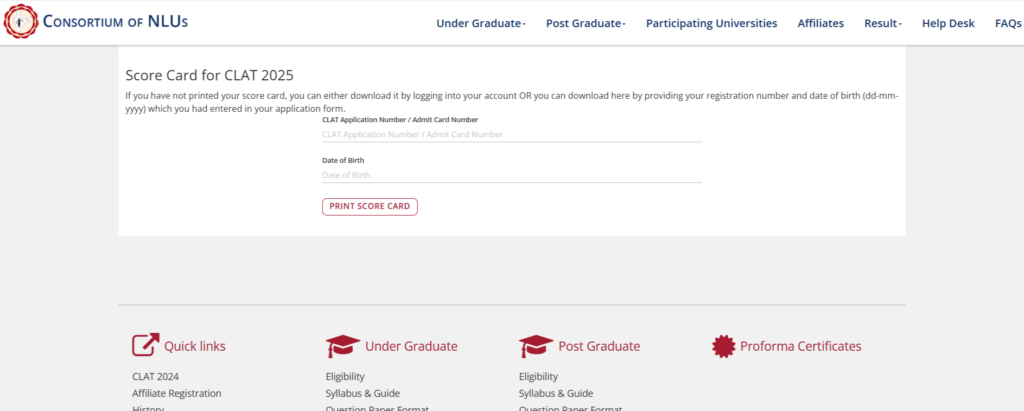
This is what the CLAT result log-in window will look like:

CLAT 2025 result log in portal

How to check CLAT 2026 results

The consortium will release the results of the CLAT 2026 exam online at consortiumofnlus.ac.in. To check your result, follow these steps:

  1. Go to the CLAT 2026 result portal – Click Here
  2. You will be redirected to a log-in window
  3. Enter the following credentials: 1) CLAT application number/ Admit Card Number and 2) Date of Birth
  4. On log-in, the CLAT 2026 scorecard will be displayed on the screen
  5. Download and take a printout of the scorecard.

Sample CLAT Scorecard

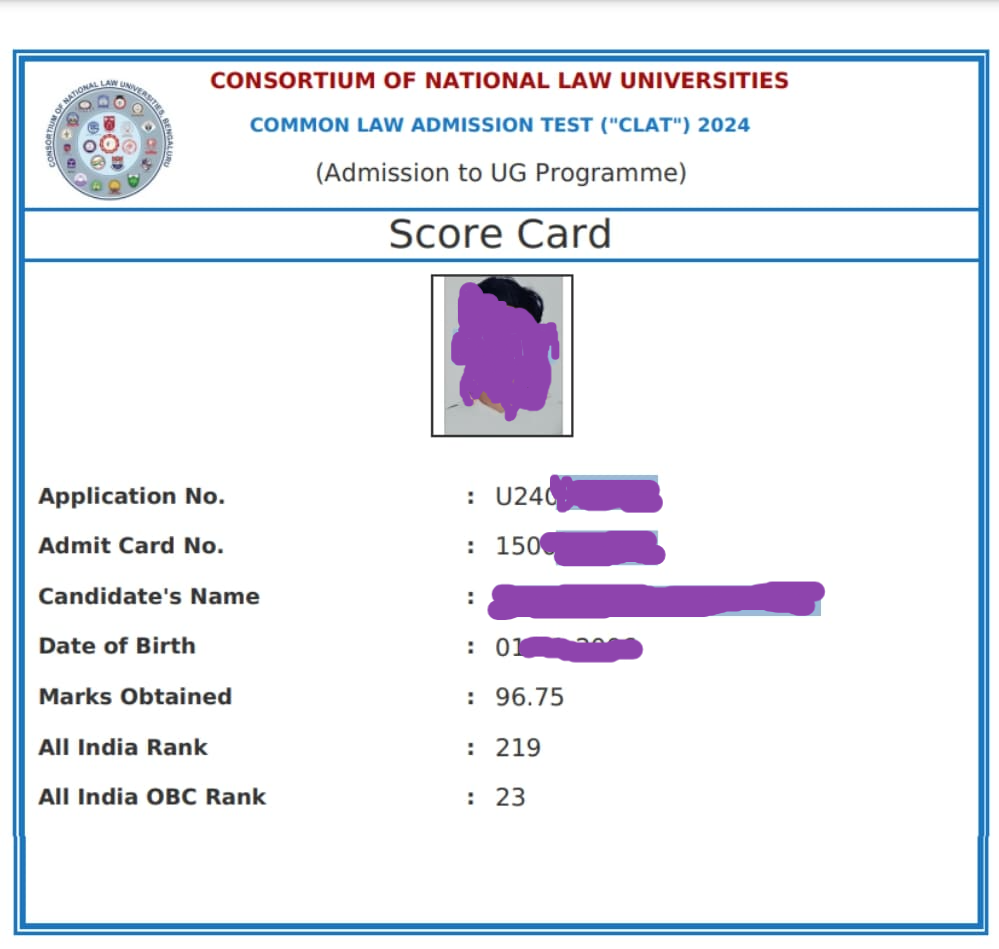
A sample scorecard of CLAT exam is given below for the reference of the candidate.

sample clat scorecard

Details included in the CLAT 2026 Scorecard

The CLAT result-cum-scorecard will include the following information:

  • Candidate’s photograph
  • Application No.
  • Admit card No.
  • Candidate’s name
  • Date of birth
  • Marks Obtained
  • All-India Rank
  • Category Rank

Also Read:

CLAT Result 2026 – Tie-breaker Policy

In case two or more candidates secure the same marks in the CLAT 2026 exam, the tie is decided based on the following rules:

ProgramCLAT 2026 Tie-breaker Policy
UGThe tie will be decided in the following sequence:

Higher marks in the legal aptitude section of CLAT 2026
Higher age
Computerized draw of lots.
PGThe tie will be decided in the following sequence:

Higher age
Computerized draw of lots

CLAT Result 2026 – Grievance Redressa

If any candidate had any reservations against the CLAT results, they were allowed to file grievances.

The step-wise CLAT 2026 result grievance submission process is described below.

  1. Login to your CLAT account
  2. Click the ‘Submit Grievance’ button
  3. State the nature of your grievance;
  4. Describe your grievance (max. 1,000 characters);
  5. Upload supporting documents;
  6. Submit the declaration form;
  7. Click the Submit button

CLAT 2025 Result (UG) – Percentile Score: Number, Gender, and State-Wise Distribution of Candidates  

PercentileTotal NumbersGender NumbersState Wise Numbers
99.9972Male-2Haryana -1
Madhya Pradesh -1
99.9951Male – 1Chattisgarh – 1
99.9931Male – 1Maharashtra – 1
99.992Female-1Delhi -1
Male – 1West Bengal- 1
99.9881Male-1Haryana -1
99.9871Male- 1Uttar Pradesh-1
99.9823Male-3Karnataka-1
Punjab- 1
Uttar Pradesh-1
99.981Female- 1Punjab -1
99. 9791Female- 1Haryana -1
99.9752Female-1Maharashtra – 1
Male – 1Uttar Pradesh -1
99.9741Female – 1Punjab – 1
99.972Male- 2Karnataka -1
Maharashtra -1
99.9672Female-1Karnataka -1
Male – 1Rajasthan- 1
99.9651Female- 1Karnataka -1
99.9547Female- 2Madhya Pradesh -1
Male – 5Maharashtra – 3
Rajasthan – 2
West Bengal -1
99.93611Female- 4Delhi -1
Male – 7Jharkhand -1
Karnataka – 3
Kerala – 2
Madhya Pradesh – 1
Maharashtra -1
Uttar Pradesh -2
99.91910Female- 6Jharkhand -1
Male – 4Kerala -2
Maharashtra -1
Rajasthan -2
Tamil Nadu- 1
Telangana -2
West Bengal – 1
99.9096Female- 1Jharkhand -2
Male – 5Punjab – 1
Rajasthan -1
Uttar Pradesh – 2
99.9043Female -3Delhi -1
Rajasthan -1
West Bengal -1

CLAT 2025 Result (PG) – Percentile Score: Number, Gender, and State-Wise Distribution of Candidates  

PercentileTotal NumbersGender wise NumbersState wise Numbers
99.9931Female – 1Odisha – 1
99.9861Female -1Uttar Pradesh -1
99.981Male -1Uttar Pradesh -1
99.9731Male -1Uttar Pradesh -1
99.9661Female -1Uttar Pradesh -1
99.9591Male -1Madhya Pradesh -1
99.9531Male -1Madhya Pradesh -1
99.9461Male -1Madhya Pradesh -1
99.9322Male- 2Bihar- 1
Karnataka -1
99.9261Female- -1Madhya Pradesh -1
99.9191Male- 1Uttar Pradesh -1
99.9052Female -1Uttar Pradesh -2
Male- 1
99.8922Male -2Punjab -1
Uttar Pradesh -1

CLAT 2025 Exam Statistics – Test Centers, Attendance, Highest Marks

ParticularsDescription
Test CenterCLAT 2025 was conducted on Sunday, December 01, 2024, from 2 to 4 pm at:

141 Test Centers in 25 States and 4 Union Territories across India.
Overall attendance96.33%
GenderMale – 57%
Female – 43%
9 candidates are Transgender
Highest marks secured in CLAT (PG) 202580
Highest marks secured in CLAT (UG) 2025103.5

CLAT Result 2026 – Counseling Process

The Consortium of NLUs will conduct the counseling for CLAT 2026 in an online, centralized mode.

Candidates who qualify in the CLAT 2026 exam are eligible to participate in the counseling process. As part of the counseling process, the candidate will have to register and fill in choices of academic institutes in the order of priority.

As part of the counseling process, candidates are required to get registered, upload NLU preferences, and pay the counseling fee.

Also Read:

What If You Fail AIBE? Career Options & Next Steps for Law Graduates

Failing the All India Bar Examination (AIBE) can feel devastating, especially for law graduates who see it as the final gateway to becoming a practising advocate. Conducted by the Bar Council of India (BCI), AIBE is a mandatory qualifying exam for obtaining the Certificate of Practice (CoP), without which a law graduate cannot practise law independently in Indian courts.

However, failing the AIBE exam is not the end of a legal career. In fact, thousands of candidates do not clear AIBE on their first attempt – and many go on to pass it later or build successful legal careers in parallel domains. Since AIBE is a qualifying exam, and not a competitive exam, the consequence of failure is less severe than commonly perceived.

This article explains what failing AIBE really means, what you can and cannot do afterward, and the practical career options and next steps available to law graduates.

Understanding What “Failing AIBE” Actually Means

Before discussing next steps, it is crucial to clarify what failure in AIBE does – and does not – imply.

If you fail AIBE:

  • You do not lose your law degree
  • You do not lose enrollment with a State Bar Council
  • You are not barred from future attempts
  • You cannot practise as an advocate independently until you pass

AIBE has:

  • No limit on the number of attempts
  • No age bar
  • No penalty for repeated attempts

You can reappear in AIBE as many times as required until you qualify.

Why Many Candidates Fail AIBE (And Why It’s Normal)

Contrary to popular belief, most AIBE failures are not due to lack of intelligence or legal ability. Common reasons include:

  • Misunderstanding the “open-book” nature of the exam
  • Poor time management
  • Carrying non-permitted material
  • Relying too heavily on bare acts without conceptual clarity
  • Underestimating qualifying marks (45% / 40%)

Since AIBE tests minimum professional competence, not excellence, failure often indicates a strategy gap, not a knowledge gap.

Immediate Next Steps After Failing AIBE

1. Do Not Panic or Rush Decisions

The first and most important step is to stay calm. AIBE results are declared only as PASS or FAIL, without marks. This means:

  • You are not “ranked poorly”
  • Your failure margin is unknown
  • Improvement is usually achievable with minor corrections

2. Check the Final Answer Key Carefully

BCI releases a final answer key before or alongside results. Reviewing it helps you:

  • Identify weak subjects
  • Understand recurring question patterns
  • Adjust preparation strategy for the next attempt

Option 1: Reappear for AIBE (Most Common Path)

Reappearing for AIBE is the most direct and practical option.

Why This Works:

  • No restriction on attempts
  • Syllabus remains largely stable
  • Many candidates clear it in their second or third attempt

What to Do Differently:

  • Practise solving questions using bare acts only
  • Focus on high-weightage subjects like:
    • Constitutional Law
    • IPC
    • CrPC
    • CPC
    • Evidence Act
    • Professional Ethics
  • Improve speed and navigation, not memorisation

For most candidates, 2–3 months of focused preparation is sufficient to clear AIBE in the next cycle.

Option 2: Work Under a Senior Advocate or Law Firm (Non-Independent Role)

Failing AIBE does not prohibit you from working in the legal field.

You can:

  • Work as a junior associate
  • Assist advocates in drafting, research, and filing
  • Join litigation teams in a support role

Important Clarification:

Without CoP, you cannot independently argue or appear as an advocate, but you can work under supervision.

This period often becomes valuable hands-on training that improves AIBE performance later.

Option 3: Corporate Legal Jobs (In-House Counsel, Compliance, Contracts)

Many corporate legal roles do not require a Certificate of Practice.

You can explore:

  • In-house legal teams
  • Contract drafting and review roles
  • Compliance and regulatory affairs
  • Legal risk management

Industries that hire law graduates without CoP include:

  • IT and technology companies
  • Banking and financial services
  • Start-ups and MNCs
  • Real estate and infrastructure firms

For candidates interested in non-litigation careers, failing AIBE does not limit growth.

Option 4: Legal Research, Policy, and Think Tanks

Law graduates can work in:

  • Legal research organisations
  • Policy think tanks
  • NGOs
  • Legislative research roles

These positions value:

  • Analytical skills
  • Legal writing
  • Subject-matter expertise

AIBE qualification is not mandatory for most research and policy roles.

Option 5: Academia, Teaching, and Higher Studies

Failing AIBE does not affect eligibility for:

  • LLM programmes
  • Teaching roles (subject to NET/PhD requirements)
  • Academic research

Many law graduates choose to:

  • Pursue LLM in India or abroad
  • Specialise in niche areas like:
    • International law
    • Intellectual property
    • Human rights
    • Corporate law

Academic pathways remain fully open.

Option 6: Judicial Services & Competitive Exams

Judicial service exams and other competitive law exams:

  • Do not require AIBE qualification
  • Test substantive and procedural law separately

You can prepare for:

  • State Judicial Services
  • Public service commissions
  • Regulatory body exams
  • Law officer roles in PSUs

In fact, judicial exam preparation often strengthens AIBE performance indirectly.

Option 7: Legal Content, Publishing & EdTech

Law graduates increasingly work in:

  • Legal publishing houses
  • Online legal education platforms
  • Content creation and editing
  • Legal journalism

These roles focus on:

  • Legal knowledge
  • Communication skills
  • Subject expertise

AIBE qualification is not a prerequisite here.

Should You Quit Law If You Fail AIBE?

In most cases, the answer is no.

Failing AIBE:

  • Does not define your competence
  • Does not block career growth
  • Does not mean you cannot become an advocate later

Many successful lawyers cleared AIBE after multiple attempts.

How to Prepare Better for the Next AIBE Attempt

If you plan to reappear:

  • Use updated bare acts only
  • Limit material to essentials
  • Practise time-bound mock tests
  • Focus on accuracy, not perfection
  • Aim for 55–60 confident attempts

AIBE rewards clarity and calmness, not over-preparation.

Mental & Emotional Aspect: Handling Setbacks

Failure can impact confidence, especially when peers clear the exam. It is important to remember:

  • AIBE is not competitive
  • Everyone’s timeline is different
  • Professional success is not linear

Seeking mentorship, discussing strategy with seniors, and staying engaged in legal work can help rebuild momentum.

Final Thoughts: AIBE Failure Is a Detour, Not a Dead End

Failing AIBE may delay independent legal practice, but it does not end a legal career. With unlimited attempts, stable syllabus, and multiple parallel career paths, law graduates have time, options, and flexibility.

Whether you choose to:

  • Reappear for AIBE
  • Work under supervision
  • Move into corporate or research roles
  • Pursue higher studies

…the legal profession offers multiple routes to success.

AIBE is just one milestone — not the destination.

AIBE Exam First-Timer Mistakes & How to Avoid Them: A Complete Guide

0

For thousands of law graduates across India, the All India Bar Examination (AIBE) is the final step before entering professional legal practice. Conducted by the Bar Council of India (BCI), the AIBE is a mandatory qualifying examination that candidates must pass to receive the Certificate of Practice (CoP).

While the AIBE exam is often described as “easy”, every year a significant number of first-time candidates fail to qualify. The reason is rarely a lack of legal knowledge. Instead, most failures stem from avoidable mistakes, poor exam-day strategy, and misunderstandings about the nature of the test.

This article breaks down the most common mistakes made by AIBE first-time candidates and explains how to avoid them, using official rules, past exam trends, and practical exam logic.

Understanding AIBE Exam: Why First-Timers Can Get It Wrong

Before diving into mistakes, it is important to understand what AIBE actually is  – and what it is not.

AIBE is:

  • A qualifying exam, not a ranking test
  • Conducted in offline (pen-and-paper) mode
  • Based on 19 law subjects
  • A 100-question, 100-mark exam
  • While AIBE is no longer an open-book exam, candidates to carry bare acts without notes or comments
  • No negative marking
  • Result declared as PASS / FAIL, not marks or rank

The AIBE qualifying criteria are:

  • 45% marks for General/OBC candidates
  • 40% marks for SC/ST/PwD candidates

Despite these seemingly relaxed conditions, first-time candidates often misjudge the exam’s demands.

Mistake 1: Assuming AIBE Is a Completely Open-Book Exam

❌ What Candidates Get Wrong

Many first-time candidates believe that AIBE is a fully open-book exam, allowing them to carry notes, guides, commentaries, or annotated study material into the examination hall. This misconception often leads candidates to depend heavily on external material rather than conceptual clarity.

However, as per instructions issued by the Bar Council of India, AIBE is not a fully open-book exam.

✅ What the Rule Actually Says

Candidates are allowed to carry only bare acts into the examination hall.
Importantly:

  • Bare acts must not contain notes, comments, case laws, or annotations
  • Highlighting and minimal underlining are generally permitted, but explanatory material is strictly prohibited
  • Guides, reference books, coaching material, and commentaries are not allowed

Invigilators are authorised to disallow or confiscate non-compliant material at the exam centre.

❌ Why This Becomes a Costly Mistake

First-time candidates who rely on notes or commentaries:

  • Face confusion when such material is not permitted
  • Lose time adjusting their strategy during the exam
  • Panic due to over-dependence on written explanations rather than understanding

In some cases, candidates are forced to appear for the exam without any usable reference material, negatively impacting performance.

✅ How to Avoid This Mistake

  • Carry only clean, updated bare acts
  • Ensure there are no handwritten notes, sticky notes, or comments
  • Practise using bare acts during preparation to locate provisions quickly
  • Focus on conceptual clarity and section familiarity, not explanatory text

Understanding this distinction early helps candidates prepare realistically and avoid unnecessary stress on exam day.

Mistake 2: Carrying Too Many Bare Acts to the Exam Centre

❌ What Candidates Get Wrong

Even after understanding that only bare acts are permitted, many first-time AIBE candidates make the mistake of carrying too many bare acts to the examination centre.

Believing that access to every subject will be useful, candidates often bring 10–15 bare acts, covering almost the entire syllabus.

❌ Why This Backfires

  • The AIBE exam duration is 3 hours for 100 questions
  • Searching through multiple bare acts consumes valuable time
  • Candidates struggle to remember which act contains which provision
  • Excess material increases anxiety and slows decision-making

As a result, candidates fail to attempt enough questions despite having reference material.

✅ What Works Better

A focused approach is far more effective.

Recommended strategy:

  • Carry 4–6 essential bare acts only
  • Prioritise high-utility laws such as:
    • Constitution of India
    • IPC
    • CrPC
    • CPC
    • Indian Evidence Act
    • Advocates Act / Professional Ethics (if applicable)
  • Use clean, indexed copies without notes or comments

✅ Why This Strategy Helps

  • Faster navigation during the exam
  • Better time management
  • Reduced confusion and panic
  • Higher attempt rate with accuracy

Remember, AIBE tests minimum professional competence, not how many books you carry.

Mistake 3: Ignoring Recent Legal Amendments

❌ The Problem

AIBE questions are framed based on current law, not outdated provisions. First-time candidates can make the mistake of relying on old bare acts or notes from college days without checking amendments.

This leads to incorrect answers, especially in:

  • Criminal law
  • Procedural laws
  • Commercial and constitutional changes

✅ How to Avoid It

Before the exam:

  • Ensure all bare acts are updated editions
  • Revise recent amendments, especially in:
    • Criminal laws
    • Evidence
    • Constitutional developments
  • Avoid relying on photocopied or old PDFs

Updated law awareness can easily fetch 10–15 safe marks.

Mistake 4: Underestimating Time Management

❌ The Problem

Many first-timers assume that since there is no negative marking, they can attempt questions casually. They spend too much time searching for answers in books, leaving several questions unattempted.

✅ How to Avoid It

Time management is critical.

Smart strategy:

  • Target 1.5–2 minutes per question
  • Attempt easy and familiar questions first
  • Avoid spending more than 3 minutes on any single question
  • Mark doubtful questions and return later

Ideally, candidates should aim to attempt 55–65 questions, which comfortably crosses the qualifying threshold.

Mistake 5: Overconfidence Due to No Negative Marking

❌ The Problem

“No negative marking” creates a false sense of security. Some candidates attempt all questions without understanding them properly, leading to careless mistakes.

✅ How to Avoid It

While guessing is allowed, it should be informed guessing.

Best practice:

  • Eliminate obviously incorrect options
  • Use bare acts to verify whenever possible
  • Avoid random marking without logic

Quality attempts matter more than quantity.

Mistake 6: Neglecting General Exam Instructions

❌ The Problem

Some first-time candidates ignore exam-day instructions, resulting in avoidable issues such as:

  • Carrying prohibited items
  • Improper marking on OMR sheets
  • Late reporting at the exam centre

✅ How to Avoid It

Before exam day:

  • Read all instructions on the admit card carefully
  • Carry only permitted items
  • Practise OMR filling accuracy
  • Reach the centre well before reporting time

Small mistakes can create unnecessary stress during the exam.

Mistake 7: Poor Subject Prioritisation

❌ The Problem

AIBE covers 19 subjects, but not all subjects carry equal practical importance. First-timers often spend equal time on all subjects, leading to inefficient preparation.

✅ How to Avoid It

Focus more on high-utility subjects, such as:

  • Constitutional Law
  • IPC
  • CrPC
  • CPC
  • Evidence Act
  • Professional Ethics

These subjects are not only frequently tested but also easier to navigate through bare acts.

Mistake 8: Misunderstanding the PASS/FAIL Nature of the Result

❌ The Problem

Many candidates panic after the exam, expecting ranks, scores, or cut-off lists. Some misinterpret the result format and assume failure due to lack of marks display.

✅ How to Avoid It

Understand clearly:

  • AIBE results show only PASS or FAIL
  • Marks and ranks are not published
  • Passing the exam directly leads to eligibility for the Certificate of Practice

Once you pass, performance beyond the cut-off does not matter.

Mistake 9: Result Anxiety & Misinformation

❌ The Problem

After the exam, first-time candidates often rely on rumours, unofficial cut-offs, and social media speculation, increasing anxiety.

✅ How to Avoid It

Follow only:

  • Official notifications
  • Final answer key releases
  • Verified education portals

BCI generally declares results 2–3 months after the exam, following the final answer key.

Mistake 10: Not Knowing What Happens After Passing AIBE

❌ The Problem

Some candidates qualify but are unsure about the next steps, delaying their professional registration.

✅ How to Avoid It

After passing:

  • Apply for the Certificate of Practice (CoP)
  • Collect it through your State Bar Council
  • Digital certificates are often issued before physical copies

Understanding the post-result process saves time and confusion.

Final Thoughts: AIBE Is About Strategy, Not Fear

AIBE 20 is not designed to fail candidates. It is designed to ensure minimum professional competence. Most first-time failures occur due to poor strategy, not lack of knowledge.

By avoiding these common mistakes and preparing smartly, candidates can clear AIBE confidently – often on the first attempt.

For first-timers, the key lies in:

  • Understanding the exam’s purpose
  • Using bare acts intelligently
  • Managing time efficiently
  • Staying calm and informed

With the right approach, AIBE is one of the most manageable qualifying exams in the legal profession.

AIBE 2025 answer key and result expected Soon: check key updates here

0

AIBE 20 result 2025 will be released anytime now, with law graduates across the country eagerly awaiting their scorecards and qualifying status from the Bar Council of India (BCI). The AIBE 2025, a mandatory qualifying exam for law graduates seeking the Certificate of Practice (CoP) to practise in Indian courts, was conducted on November 30, 2025, in offline (pen-and-paper) mode at centres nationwide. 

While the official result date has not been confirmed, multiple sources and past data indicate that BCI will likely declare the results in January or early February 2026, following the release of the final AIBE (XX) 2025 answer key. The provisional answer key was already made available on December 3, 2025, and candidates were given time to submit objections until December 10, 2025. 

Once declared, AIBE (XX) 2025 results and the final answer key will be published on the official website – allindiabarexamination.com. Candidates can check their status using their roll number and password. The result can be downloaded  in PDF format. 

Key AIBE 2025 Result Details & Timeline

EventDate / Status
AIBE 20 Exam DateNovember 30, 2025
Provisional Answer Key ReleaseDecember 3, 2025
Objection Window ClosedDecember 10, 2025
Final Answer KeyExpected Soon
AIBE 20 Result DeclarationExpected January/February 2026
Official Website for Resultallindiabarexamination.com

Note: The BCI is yet to announce exact dates for the final answer key and results. 

What the Scorecard Will Show & Passing Criteria

Unlike rank-based exams, the AIBE result indicates “PASS” or “FAIL” status. The passing criteria for AIBE 20 are expected to be:

  • General/OBC candidates: Minimum 45% marks (45 out of 100)
  • SC/ST/PwD candidates: Minimum 40% marks (40 out of 100)

There is no limit on the number of attempts; candidates who do not qualify can reappear in future editions until they achieve a pass. 

What after qualifying the AIBE 2025 exam?

Qualifying the AIBE is mandatory to obtain the Certificate of Practice (CoP), a licence that allows law graduates to practise in Indian courts. Once declared “PASS”, candidates must collect their CoP from their respective State Bar Councils, with the digital copy often issued first, followed by a hard copy. 

How to Check the AIBE (XX) 20 Result

The step-wise process to check AIBE 2025 results is given in the table below.

  1. Visit allindiabarexamination.com.
  2. Click on the AIBE 20 Result/Scorecard link.
  3. Enter your roll number and password.
  4. View and download your scorecard PDF.

Candidates are advised to keep checking the official portal regularly for the final answer key and result link.

GATE 2026 Admit Card: IIT Guwahati Postpones Hall Ticket Release, New date Awaited at gate2026.iitg.ac.in

0

The Indian Institute of Technology (IIT) Guwahati, the organising institute for GATE 2026, has postponed the release of the GATE 2026 admit card, which was earlier scheduled to be issued on January 2, 2026. As per the latest official update, no revised date has been announced yet, and candidates are advised to regularly check the official website gate2026.iitg.ac.in for fresh notifications.

The admit card has to be downloaded online at gate2026.iitg.ac.in.

Once released, candidates will be able to download the GATE 2026 hall ticket by logging in with their Enrollment ID / Email ID and Password. The GATE 2026 exam dates remain unchanged and will be conducted on February 7, 8, 14 and 15, 2026 in multiple shifts across India. Carrying the admit card along with a valid photo ID is mandatory to appear for the examination.

GATE 2026 Exam – Important Dates

EventDate / Status
GATE 2026 Admit Card Release (Earlier Date)January 2, 2026 (Postponed)
Revised Admit Card Release DateTo be announced
GATE 2026 Exam DatesFebruary 7, 8, 14 & 15, 2026

The MTech test will be held in two slots: Forenoon  – 9:30 am to 12:30 pm, and Afternoon –  2:30 pm to 5:30 pm
Conducting InstituteIIT Guwahati
Official Websitegate2026.iitg.ac.in

GATE Admit Card: Last 5 Years’ Hall Ticket Release Dates

The table shows that the GATE admit card is usually released in the first or second week of January.

YearConducting InstituteAdmit Card Release DateExam Dates
2026IIT GuwahatiTo be announcedFeb 7, 8, 14, 15
2025IIT RoorkeeJanuary 7, 2025Feb 1, 2, 15, 16
2024IISc BengaluruJanuary 4, 2024Feb 3, 4, 10, 11
2023IIT KanpurJanuary 9, 2023Feb 4, 5, 11, 12
2022IIT KharagpurJanuary 15, 2022Feb 5, 6, 12, 13

How to Download GATE 2026 Admit Card

Candidates can follow the steps below once the download link is activated:

  • Visit the official website gate2026.iitg.ac.in
  • Click on the GOAPS 2026 Candidate Login link
  • Enter Enrollment ID / Registered Email ID and Password
  • Enter the captcha code and submit
  • Click on Download GATE 2026 Admit Card
  • Save the PDF and take a clear colour printout

Details Mentioned on GATE 2026 Admit Card

The GATE 2026 hall ticket will contain the following information:

  • Candidate’s name and date of birth
  • Photograph and signature
  • Enrollment ID / Roll number
  • GATE paper code and paper name
  • Exam date, shift timing, and reporting time
  • Complete exam centre address
  • Important exam-day instructions

Candidates must verify all details carefully after downloading.

How to Fix Discrepancy in GATE 2026 Admit Card

In case of any error in personal or exam details:

  • Immediately contact the GATE 2026 helpdesk through the official email or helpline number
  • Raise the issue via the candidate portal, if applicable
  • Keep supporting documents such as application form copy and ID proof ready
  • Do not wait until the exam date to report discrepancies

GATE 2026 Exam-Day Guidelines

Candidates should reach the exam centre at least one hour before the reporting time mentioned on the admit card. The entry gates usually close 30 minutes before the exam, and late entry is not permitted under any circumstances. Carry a printed copy of the admit card, a valid original photo ID, and a passport-size photograph. Electronic gadgets such as mobile phones, smart watches, calculators, Bluetooth devices, books, and notes are strictly prohibited. Candidates must follow all instructions given by invigilators and maintain discipline inside the examination hall.

GATE 2026 Exam Pattern

GATE 2026 will be conducted as a Computer-Based Test (CBT) to assess candidates’ understanding of undergraduate-level Engineering, Science, and Humanities subjects.

ParticularsDetails
Exam ModeComputer-Based Test (CBT)
Duration3 Hours
Total Questions65
Total Marks100
Question TypesMCQs, MSQs, NATs
General Aptitude Marks15
Subject-Specific Marks85
Medium of ExamEnglish

CEED Syllabus 2026 – Section-wise Topics, Skills Evaluated, How to Complete Syllabus on Time

0

CEED Syllabus 2025 – IIT Bombay has released the detailed syllabus for CEED 2026 in the information brochure. The syllabus has been released for both Part A and Part B. 

As per the official CEED 2026 syllabus, the CEED 2026 (Part A) exam will include questions from topics like Visualization and spatial reasoning, Practical and scientific knowledge, Observation and design sensitivity, etc. CEED 2026 exam pattern mentions that Part A will include 44 questions carrying 150 marks. Meanwhile, Part B will include topics like Drawing, Creativity, Communication, and Problem identification. Part B will have 5 questions carrying 100 marks. 

Candidates can check the detailed CEED syllabus 2026 below.

According to the official exam portal, CEED 2026 is an aptitude test; hence, no specific textbook or guide is recommended for its preparation. Candidates may, however, practice their drawing, rendering and visualization skills. 

Latest Updates:

CEED Syllabus 2026 – Section-wise Topics, Skill Tested

The detailed syllabus for CEED 2026 exam is given below for both Part A and Part B. Make sure that you prepare for all the topics mentioned here to get a good score in CEED 2026.

PaperCEED Exam 2026 Syllabus
Part AVisualization and spatial reasoning: Ability to visualise and transform 2D shapes and 3D objects and their spatial relationships. 

Practical and scientific knowledge: Know-how of scientific principles and everyday objects. 

Observation and design sensitivity: The capacity to detect concealed properties in daily life and think critically about them. Attention to detail, classification, analysis, inference, and prediction. 
Environment and society: General awareness of environmental, social and cultural connections with design. 

Analytical and logical reasoning: Ability to analyse qualitative and quantitative information. 

Language: Proficiency in reading and comprehending Standard English. 

Creativity: Grasp of verbal and non-verbal analogies, metaphors, signs, and symbols. 

Art and Design knowledge: Awareness about art/artifact/product, artists/designers, art/design history, and trends. 

Design methods and practices: Knowledge of media, materials, production processes, and ergonomics. 
Part BDrawing: Ability to draw products, people or scenes in proportion with good line quality, composition, proportion, perspective, and shading. 

Creativity: Ability to think out-of-the-box and come up with unique as well as diverse solutions. 16 CEED 2025 Information Brochure 

Communication: Skills to communicate concepts and ideas clearly with the help of text and visuals. 

Problem identification: Skills to understand the user and the context, knowledge of properties of materials and their appropriate use in design. 

Also Read:

CEED Syllabus 2026 – How to Complete All The Topics

It is important that the candidate completes the entire topic to ensure that they get a good score in the CEED 2026 exam. Here is how you can complete the CEED Syllabus.

  1. Make a Study Plan – Without any study plan, you will be lost in the wilderness, i.e., unless you are a genius. The CEED syllabus 2026 will help you keep your preparation on track and evaluate your progress. Just make sure that the study plan takes into account your current abilities.
  2. Focus on difficult and important topics – While some topics given in the CEED 2025 syllabus may turn out to be a cakewalk, there will also be topics that will give you a hard time. You need to account for these topics. If need be, take help of a peer, expert, or teacher. If none is available, check out youtube tutorials. Likewise, some topics carry more weightage than others; pay special attention to these topics.
  3. Solve sample papers – To ensure that you muster a topic, after understanding the theoretical concepts, solve related problems. You can use previous years’ CEED papers and also CEED sample papers. The sample papers will have a good number of practice questions, which will help you test your understanding of various concepts and whether you are able to use that understanding to solve problems.
  4. Take notes during study – This habit will help you stay focused when you are studying. Also, as you gain experience, you will learn to jot down all the important points. A good notebook will ensure you can quickly complete revision of completed topics. On the contrary, just imagine having to go through large blocks of text everytime you want to go through some important point.
  5. Do timely revision – You will also have to do timely revision of topics so that they remain fresh.

CEED Exam Pattern 2026

After you are familiar with the topics given in the CEED syllabus 2026, also quickly go through the CEED 2026 exam pattern.

The exam pattern will help you determine your study plan. For instance, the Part A paper will include three types of questions – MCQ, MSQ, and NAT. You will have to make different plans for each question type. 

Take note that Part B will be a subjective paper. So, you need to approach both parts differently for effective exam preparation.

Read More:

CEED Exam Pattern 2026 – Section-wise Questions, Marking Scheme, What’s new?

0

CEED Exam Pattern 2026 – IIT Bombay has released the exam pattern for CEED 2026 in its information brochure. The CEED 2026 exam pattern remains the same as in the previous edition.

For instance, the CEED 2026 exam will continue to have two parts:

1) computer-based Part A, and
2) an offline-based Part B.

Part A will include 44 questions carrying 150 marks that the candidate has to attempt in 1 hour. Questions types will be NAT, MSQ, and MCQ. Meanwhile, Part B will be of 2 hours duration and include 5 questions carrying 100 marks. Note that Part B will be evaluated only if the candidate qualifies or meets CEED 2026 (Part A) cut-off.

The detailed CEED 2026 exam pattern is provided here, along with key insights to help candidates better understand the test structure and prepare effectively. Refer to the CEED 2026 syllabus to prepare for the exam.

Latest Updates:

CEED Exam Pattern 2026 – Highlights

The important highlights of the CEED exam pattern 2026 are given in the table below.

ParticularsPart APart B
Mode Computer-based Test (CBT)Offline
Part B questions will be displayed on the computer screen. However, the candidate has to enter their answers in the answer booklet provided by the invigilator.

Further, the candidate must tick the appropriate box on the computer to indicate you have answered the question.
The answer booklet has to be submitted at the end of the exam.
Skill TestedThe objective CEED is to assess the candidate’s aptitude for design involving visual perception ability, drawing skills, logical reasoning, creativity, communication, and problem solving skills. 
Type and Number of Questions AskedMCQ – 26
MSQ – 10
NAT – 8
Sketching – 1
Creativity – 1
Form Sensitivity – 1
Visual Sensitivity – 1
Problem Identification – 1
Total number of questions445
Duration1 hour2 hours
Total marks150100
Language of question paperEnglishEnglish

CEED Exam Pattern 2026 (Part A) – Description of the Paper

CEED (Part A) SectionQuestion Type, Marking Scheme
Section 1: NAT (Numerical Answer Type8 questions (4 marks each; no negative marks). 

For these questions, the answer is a number that needs to be entered using a virtual keyboard on the computer screen. No choices will be shown for these questions. 
Section 2: MSQ (Multiple Select Question)10 questions. Each MSQ may have one or more than one correct choice(s) out of the four given. The following is the marking scheme: 

Full Marks: + 4 If only (all) the correct option(s) is(are) chosen and NONE of the incorrect options is chosen. Partial Marks: + 3 If all the four options are correct but ONLY three options are chosen. 

Partial Marks: + 2 If three or more options are correct but ONLY two options are chosen, both of which are correct and NONE of the incorrect options is chosen. 

Partial Marks: + 1 If two or more options are correct but ONLY one option is chosen and it is a correct option and NONE of the incorrect options is chosen. 

Zero Marks: 0 If NONE of the options is chosen (i.e., the question is unanswered). 

Negative Marks: -1 In all other cases.
Section 3: MCQ (Multiple Choice Question)26 questions (3 marks each for the correct answer; 0.5 negative marks for an incorrect answer). Each MCQ will have four choices, of which only one is the correct answer

Also Read:

UCEED 2026 – Application Form, Exam Date, Syllabus, Pattern, Admission Process
Best Books to Prepare for Design Entrance Exams – NIFT, NID DAT, UCEED, and more

CEED Exam Pattern 2026 (Part A) – Section-wise questions, Marking Scheme

SectionNumber of Questions Question NumberMarks for each correct answerMarks for each wrong answerMarks for each question not attemptedTotal Marks
NAT81-840032
MSQ109-18Partial Marking-1040
MCQ2619-443-0.5078
Total441-44150

CEED Exam Pattern 2026 (Part B) 

As per the official CEED exam pattern 2026, Part-B will consist of five questions to test design, drawing and writing skills

The questions in Part-B will be displayed on the computer screen, and the answers should be written in the answer book provided by the invigilator (NOT into the Computer). 

However, the candidate must tick the appropriate box on the computer screen to indicate that they have answered the same. In the case of PwD candidates availing the use of a scribe, assistance in attempting Part-B is not permitted, as the question is aimed at evaluating their drawing skill. 

  • Part-B answer booklets will be collected at the end of the examination. 
  • Part-B questions are mandatory. 
  • The entire paper (Part-A and Part-B) must be finished within the stipulated time for each part. 

CEED Exam Pattern 2026 (Part B) – Section-wise Questions, Marking Scheme

SectionNumber of QuestionsQuestion NumberPartial MarksNegative MarksMarks
Sketching11YesNo20
Creativity12YesNo20
Form Sensitivity13YesNo20
Visual Sensitivity14YesNo20
Problem Identification15YesNo20
Total51-5100

CEED Exam Syllabus 2026

Along with the CEED exam pattern 2026, the candidate is also recommended to refer to the CEED exam syllabus.

PaperCEED 2026 Syllabus
Part AVisualization and spatial reasoning: Ability to visualise and transform 2D shapes and 3D objects and their spatial relationships. 
Practical and scientific knowledge: Know-how of scientific principles and everyday objects. 
Observation and design sensitivity: The capacity to detect concealed properties in daily life and think critically about them. Attention to detail, classification, analysis, inference, and prediction. 
Environment and society: General awareness of environmental, social and cultural connections with design. 
Analytical and logical reasoning: Ability to analyse qualitative and quantitative information. 
Language: Proficiency in reading and comprehending Standard English. 
Creativity: Grasp of verbal and non-verbal analogies, metaphors, signs, and symbols. 
Art and Design knowledge: Awareness about art/artifact/product, artists/designers, art/design history, and trends. 
Design methods and practices: Knowledge of media, materials, production processes, and ergonomics. 
Part BDrawing: Ability to draw products, people or scenes in proportion with good line quality, composition, proportion, perspective, and shading. 
Creativity: Ability to think out-of-the-box and come up with unique as well as diverse solutions. 16 CEED 2025 Information Brochure 
Communication: Skills to communicate concepts and ideas clearly with the help of text and visuals. 
Problem identification: Skills to understand the user and the context, knowledge of properties of materials and their appropriate use in design. 

Read More:

CEED Exam Pattern 2026 – When to start exam preparation

With the CEED 2026 exam scheduled to be held on January 18, 2026, you mustn’t delay your preparation any longer. You need to follow the exam syllabus and the CEED exam pattern 2026, make a study time table, solve CEED sample papers and previous years’ papers to prepare for the exam. Also, do timely revision.