CAT 2025 Exam-day Guidelines: Reporting Time, Dress Code, Items to Carry

CAT Exam-Day GuidelinesCAT 2025 exam was held on November 30.

The exam was held in three sessions: 8:30 to 10:30 AM, 12:30 to 2:30 PM, and 4:30 to 6:30 PM. CAT 2025 exam admit cards are OUT.

As per an official notification (released by CAT officials on Nov. 4), 2.95 lakh candidates registered for exam. To succeed in such a competitive exam, high intensity preparation is a must. But you must not overlook common mistakes that happen on exam day that can derail a well-laid out preparation ritual. For instance, if you get stuck in traffic and arrive late at the exam center, it can spike stress levels and unnecessary create tension, which is not conducive for D-day.

That is why we bring you CAT exam-day guidelines for a smooth and hassle-free exam-day experience. Like reach the CAT 2025 test center at least 90 minutes before the exam starts to complete security checks, document verification, and biometric authentication. Carry a printout of the CAT 2025 admit card and photo ID proof

Biometric verification will be conducted to confirm identity, and all candidates must cooperate with the invigilators and follow instructions within the exam premises. Items such as mobile phones, watches, or study materials are barred inside the CAT 2025 center.

To avoid last-minute stress, familiarize yourself with the test venue and reporting procedures in advance. 

Latest Updates:

CAT Exam-Day Guidelines 2025 — Quick Reference

The following quick-reference table highlights everything you need to know for a smooth CAT 2025 exam-day experience — from what to carry and when to arrive, to conduct rules inside the hall.

CategoryKey Information / Instructions
Exam DateNovember 30, 2025 (Sunday)
Exam SlotsThe exam will be conducted in THREE sessions:

Slot 1: 8:30 – 10:30 AM
Slot 2: 12:30 – 2:30 PM
Slot 3: 4:30 – 6:30 PM
Reporting TimeReport to the exam center at least 90 minutes before your slot (as per admit card)
Last Entry15 minutes before the exam starts (e.g., 8:15 AM / 12:15 PM / 4:15 PM)
Documents RequiredBring the following documents:

1. CAT 2025 Admit Card (2 color printouts)
2. Valid Govt. Photo ID (Aadhaar / PAN / Passport / Voter ID / DL)
3. PwD certificate / scribe affidavit (if applicable)
4. Two passport-size photos
StationeryNot required. Pen and rough sheet will be provided at the test center.
Allowed ItemsTransparent water bottle, transparent-body pen, admit card, valid ID, and required medical aids (with declaration).
Barred ItemsMobile phones, watches, wallets, notes, calculators, food, jewellery, metallic items, or electronic gadgets.
Dress CodePlain, light-colored, comfortable clothes. Avoid metallic buttons, belts, jackets, or printed attire. Simple footwear like sandals/slippers allowed.
Religious AttireAllowed (e.g., hijab, turban, kada, kirpan, burqa) — but must be declared at entry. Additional frisking/verification may be done respectfully. 

Arrive early for extra screening.
Biometric VerificationMandatory. Must cooperate for fingerprint and photo verification before entry.
Toilet BreaksNot permitted during the test. Use the washroom before entry. 
If allowed for medical reasons, re-frisking and biometric re-verification will be done.
Rough WorkTo be done only on the rough sheet provided.

Return it before leaving.
During the ExamRead instructions carefully, sit in the assigned seat, and begin only after the invigilator’s signal. 

Follow all directions calmly.
If LateEntry not allowed after last entry time. Plan to reach at least 30–45 minutes before reporting time.
If Technical Issue OccursRaise your hand immediately — do not try to fix it yourself. Staff will assist or move you to another system.
If Feeling Unwell/NervousInform invigilators immediately; stay seated and await assistance. Do not leave the hall without permission.
Post-ExamWait for the invigilator’s announcement before logging out. Submit rough sheets and exit in an orderly manner.
Baggage CounterNot available at exam centers. Avoid bringing bags or valuables.

Latest Updates on the CAT 2025 Exam

The admit cards of the CAT 2025 has been released – You can download it between November 12-30, 2025. However, to avoid last-minute issues, make sure to download the hall ticked as soon as possible. Importantly, after downloading the admit card, check that all the details in the admit card are correct. For instance, check if the name is correctly spelled, no information is missing or blurred. If there are any issues, contact exam officials immediately and get it rectified.

Upcoming – The CAT 2025 exam will be conducted on November 30, 2025.

Reporting Time, Exam Time & Last Entry for CAT 2025

The slot-wise breakdown of timings you must keep in mind for CAT 2025 is given below. Arrive early, adhere strictly to the cut-off for entry as your exam slot (will be mentioned on CAT 2025 admit card).

SlotExam TimeReporting Time (Approx.)Last Entry Allowed
Slot 18:30 AM to 10:30 AM7:00 AM8:15 AM
Slot 212:30 PM to 2:30 PM11:00 AM12:15 PM 
Slot 34:30 PM to 6:30 PM3:00 PM4:15 PM 

What if I reach the exam centre after the reporting time?

If you reach the exam centre after the reporting time but before the gate closes, you will still be allowed entry after completing security checks – but it’s strongly discouraged as it can cause delays and stress. However, if you arrive after the last entry time, you will not be permitted to enter the exam hall under any circumstances, regardless of the reason.

Tip: Plan to arrive at least 30 – 45 minutes before the reporting time to avoid last-minute issues due to traffic, document checks, or biometric verification.

CAT Exam-day Guidelines 2025 – Allowed and Prohibited Items 

CategoryAllowed ItemsBarred/Prohibited Items
DocumentsCAT admit card (two colored printouts, unsigned before exam day)
Valid Government Photo ID (Aadhaar, PAN, Passport, Voter ID, etc.) 
PwD medical certificate and scribe affidavit if applicable
Two passport-size photographs (same as the one used for filling CAT 2025 application)
Name Change Document, if applicable
All other documents like marksheets, notes, or printed materials are barred inside the exam center.
StationeryNone required — pen and rough sheet will be provided at the test centerPersonal pens, pencils, erasers, rulers, geometry boxes, calculators, log tables
Personal BelongingsTransparent water bottle (if permitted)Bags, wallets, purses, notes, books, papers, food items
ElectronicsNoneMobile phones, smartwatches, Bluetooth devices, earphones, electronic gadgets, fitness bands
Clothing & AccessoriesPlain, comfortable clothing without metallic elements or large pocketsJackets, hoodies, caps, shoes with metal parts, heavy jewellery, watches, belts with metal buckles

Will there be a baggage counter at the CAT 2025 exam center venue?

There will be no baggage counter, nor will arrangement be made for depositing bags and valuables inside the CAT 2025 test centre premises. Nor will CAT 2025 exam officials at the exam centre take any responsibility for any items lost or damaged.

So, make sure that you don’t carry any unnecessary stuff, or valuables, to the exam venue. Or else, you will have to ask somebody to accompany you who can look after your belongings when you are inside the exam hall.

Dress Code for CAT 2025

Here’s a clear and well-organised breakdown of the dress-code guidelines for CAT 2025 — what you should wear and what you must avoid — so you’re fully prepared on exam day.

CategoryAllowedProhibited
Clothing (General)Plain, comfortable clothes such as a simple T-shirt, kurti, shirt and trousers, or jeans (preferably without many pockets). Garments with multiple pockets, large/metal buttons, heavy prints, jackets/hoodies with drawstrings/attachments. 
FootwearSandals, slippers or other simple shoes with thin soles. Shoes with thick soles, boots or footwear with metal parts or large buckles. 
Accessories & JewelleryMinimal or no jewellery; if religious articles required, ensure they are minimal and declared.Rings, bracelets, necklaces, earrings, watches (including smartwatches), belts with metal buckles, heavy metallic accessories. 
Headgear & Other WearablesPlain hair-styles, typical spectacles (if needed). Caps, hats, hoodies, veils, goggles with tinted lenses, heavy makeup, visible fresh mehndi/henna on palms, visible tattoos on hands/arms. 
Clothing & AccessoriesPlain, comfortable clothing without metallic elements or large pocketsJackets, hoodies, caps, shoes with metal parts, heavy jewellery, watches, belts with metal buckles
Religious AttireReligious clothing and articles of faith (e.g., hijab, turban, burqa, kada, kirpan) are permitted, provided they are declared during security checks
Additional frisking may be conducted respectfully.
Concealing prohibited items within religious wear is strictly forbidden; failure to cooperate during verification may lead to denial of entry.

Special Information on Religious Attire:

Candidates wearing religious attire — such as hijab, turban, burqa, kirpan, or kada — are fully permitted to do so under CAT 2025 guidelines. However, they must follow a few additional procedures for security reasons:

  • Reporting Time: Such candidates are advised to arrive at least 90 minutes before their reporting time to allow sufficient time for proper security screening.
  • Additional Frisking: The security team may conduct extra frisking in a private area, following gender-sensitive and respectful protocols. This is a standard process to ensure no prohibited items are concealed.
  • Declaration at Entry: Candidates should inform the security staff proactively about any religious items they are wearing or carrying to avoid confusion or delay.
  • Respectful Verification: All religious wear and articles of faith are checked in a manner that maintains privacy and dignity. Cooperation during this process helps ensure smooth entry.

Guidelines to Be Followed Inside the Exam Hall / During the Exam

Once you enter the CAT 2025 exam hall, it’s crucial to maintain discipline and follow all instructions given by the invigilators to ensure a fair and smooth testing process. Candidates are expected to adhere to the following rules throughout the exam:

  • Read all on-screen instructions carefully before beginning the test. These include navigation rules, marking procedures, and the time limits for each section.
  • Take your assigned seat immediately upon entry. Sitting in a seat other than the one allocated to you is strictly prohibited and may lead to disqualification.
  • Do not break the seal of your workstation or start the test until permitted by the invigilator. The exam will begin only after an official announcement.
  • Rough work must be done only on the rough sheet provided inside the exam hall. Using any other surface for rough work is not allowed. You must return the rough sheet to the invigilator before leaving the hall.
  • Toilet breaks are generally not permitted during the test. Candidates are therefore advised to use the washroom before entering the exam hall. Leaving the hall mid-exam without permission will not be allowed. In the event that a break is allowed (for genuine medical reasons), the candidate may be required to undergo re-frisking and biometric verification upon re-entry to the hall.
  • Do not attempt to cheat, communicate, or exchange gestures with other candidates. Any form of malpractice will result in immediate cancellation of candidature.
  • Follow all instructions given by the invigilators throughout the exam. Non-compliance, argument, or disruption of the examination environment will lead to strict disciplinary action.

By following these guidelines and maintaining composure, candidates can ensure a fair and disturbance-free testing experience for themselves and others.

CAT 2025 – Post-Exam Guidelines

After the CAT 2025 examination concludes, remain seated and follow the instructions provided by the invigilators to ensure orderly exit and proper verification. 

  • Do not leave your seat immediately once the timer ends. Wait for the invigilator’s announcement before logging out or moving from your assigned computer terminal.
  • After the exam ends, submit the rough sheet(s) provided to you. Ensure your name and registration number are written clearly on them before handing them over.
  • Do not attempt to take screenshots, photos, or notes from the computer screen. Such actions are treated as serious misconduct and can lead to disqualification.
  • Exit the exam hall in an orderly manner only when instructed. Avoid rushing, crowding, or discussing the paper within the premises.
  • Refrain from talking to other candidates or using mobile phones until you have exited the exam center completely.
  • Do not forget to collect your personal belongings, if any were deposited at the entry point, before leaving the venue.
  • In case of any technical or procedural issues during the test, report them immediately to the invigilator – do not attempt to fix or reset the system yourself.

How to Attempt the CAT 2025 Exam Paper

Approaching the CAT 2025 exam strategically and calmly can make a big difference to your performance. Here are some essential pointers to help you handle different situations confidently inside the exam hall:

  • Start with the easier questions: Begin with questions you find simple and are confident about. This helps you build momentum and boosts confidence early on. You can come back to tougher questions later using the on-screen navigation.
  • If you get stuck: Don’t spend too much time on a single question. Mark it for review and move on. CAT is a time-bound test — managing every minute wisely matters more than attempting all questions.
  • In case of a technical issue: If your computer freezes, the screen goes blank, or the mouse/keyboard stops responding, stay seated and immediately raise your hand to alert the invigilator. The technical staff will resolve it or shift you to another system — do not attempt to fix it yourself.
  • If the paper feels easy or difficult: Remember, CAT is a percentile-based test, not a raw-score-based one. Your performance is evaluated relative to others. So, focus on accuracy and composure rather than worrying about the difficulty level.
  • If a question seems wrong or unclear: Attempt it only if you can, and move on. The examination authorities later review and make corrections for any erroneous questions — you will receive due credit automatically if needed.
  • If you feel unwell or nervous: Stay calm and raise your hand to inform the invigilator immediately. Assistance will be provided — don’t leave your seat or the hall without permission. Use deep breathing to settle nerves before restarting.
  • If you need to use the washroom: Try to use the restroom before the exam starts, as toilet breaks are generally not allowed during the test. If there’s an emergency, inform the invigilator; permission is rarely granted and will be accompanied by supervision.

In short: Stay calm, manage time wisely, avoid panic, and follow invigilators’ directions. Presence of mind and composure often matter more than prior preparation during the two-hour test.

CAT Exam Pattern 2025

A brief outline of CAT 2025 exam pattern is given below for quick reference (click on the link for detailed insights).

ParticularsDescription
ModeComputer Based Test (CBT)
Exam SlotsThe CAT 2025 exam will be held in THREE sessions:

Morning: 8:30 AM to 10:30 AM
Afternoon: 12:30 PM to 2:30 PM
Evening: 4:30 PM to 6:30 PM
Duration of exam120 minutes (40 minutes for each session).

You can’t switch from one section to another while answering questions in a section.
SectionsThe CAT 2025 question paper will have three sections:

Section I: Verbal Ability and Reading Comprehension
Section II: Data Interpretation and Logical Reasoning
Section III: Quantitative Ability
Number of questions68
Question TypeMCQ and non-MCQ
Total marks204
Marking scheme+3 marks for correct answer
-1 mark for an incorrect answer

There is no negative marking for TITA-type questions.
MediumEnglish

CAT Mock Test 2025 – Direct Link, Why and How Many to Take, Step-wise Process

0

CAT Exam Mock Test 2025 – Exam officials STARTED the CAT mock test 2025 at the iimcat.ac.in website on November 12. The link to take the mock test is given below.

No specific log-in credentials are required to take the mocks.

Simply click on the mock test link to START the test.

The mocks are designed to help candidates get familiar with the format and interface of the computer-based CAT 2025 exam. By taking the mock test you will learn the navigation process, how the interface looks and works, how to mark and submit your answers, etc. Importantly, the mock test will contain sample CAT questions, so you will get a first hand experience of the types of questions asked, difficulty level, and the scope of questions. So, you must take the CAT 2025 mock tests without fail and evaluate your exam readiness and fix last-minute gaps. 

What about unofficial mock tests? Definitely take them as well, because the official mock will have a limited number of questions, not enough for proper CAT exam preparation. You can take online mock tests offered by leading coaching institutes or education websites. The other option is to buy mock papers from offline stores.

The CAT 2025 exam was held on November 30, 2025.

Latest Updates:

CAT Mock Test 2025 – Key Highlights

CategoryDetails
Mock Test NameCAT 2025 Mock Test
CAT 2025 Exam Conducting BodyIndian Institutes of Management Kozhikode (IIM Kozhikode)
Release TimingNovember 12, 225
Where to take CAT 2025 mock testsThe candidate can take the official CAT 2025 mock tests online at iimcat.ac.in.
To take the CAT 2025 mock test – Click Here
Credentials required to take the mock testsYou don’t need any credentials to take the mock tests. 
Simply click on the “Sign In” button to start the mock test.
PurposeTo familiarise candidates with the actual exam interface, pattern, time limits, question types and to build exam-day readiness. 
Mock Duration120 minutes (2 hours) 
Sections CoveredThree sections:
Verbal Ability & Reading Comprehension (VARC) 
Data Interpretation & Logical Reasoning (DILR)
Quantitative Ability (QA) 
Question TypesMCQs (Multiple Choice Questions) + TITA (Type In The Answer/non-MCQ) formats. 

Read – CAT 2025 exam pattern
Why It’s ImportantHelps identify strengths & weaknesses 
Builds speed & accuracy under timed conditions
Simulates real test experience, reducing anxiety 
Helps in strategy formulation (which questions to attempt, time management)
Free vs Paid AccessThe official mock test available on CAT website is free.
However, many paid/sectional test-series and full-length mocks are also offered by many coaching platforms. 
When to Start Taking MocksExperts recommend starting section-wise/topic-wise mocks once basics are done, and full-length mocks around a month or so before the exam date. 
Additional Tips for Mock Test Use
Attempt full-length mocks in real conditions (no interruptions) 
After each mock, analyse errors: where you lost time, what types you missed 
Track progress (accuracy, speed, attempted questions) 
Vary difficulty of mocks (easy→ moderate → hard) 
Use both official and third-party mocks for wider exposure. 

How to take CAT Mock Test 2025

The official mock tests for the CAT 2025 exam were released online at iimcat.ac.in. The mock test can be attempted for free. To take the test, no unique login ID is required.

The step-wise process to take the CAT 2025 mock test is given below:

  1. Go to the CAT 2025 exam portal – Click Here
  2. If the mock test is live, the mock page link will be activated. Click on it.
  3. You will be redirected to a log-in window
  4. Simply click on “Sign In” option
  5. An “Instructions” page will open. Carefully go through the guidelines.
  6. Finally, accept the “Terms and conditions” to START the mock test.

Take CAT 2025 Mock Tests

CAT 2025 ExamMock Test Link
Mock Test LinkTake Mock Here
Mock Test Link – For PwD CandidatesTake Mock Here
Mock Test Link – For PwD Candidates (Blindness and Low Vision)Take Mock Test

Take Previous Years’ CAT Mock Tests

CAT Exam EditionMock Test Link
CAT 2024Take Mock Here
CAT 2023Take Mock Here

Best Books to Prepare for CAT 2026 – Section-wise Study Material, How and What to Study

0

Best books for CAT preparation 2026 – The admission process for the IIMs for the academic session 2025-26 is ongoing.

CAT 2025 exam was conducted on November 30, 2025. So, you can START preparations for the next edition of the exam.

If you are preparing for CAT 2026, having the best combination of books is important. However, with the market flooded with all types of books with each claiming to be the best, it can be a bit confusing as to which one to pick. So, to make your life easier, we have shortlisted the section-wise best books for CAT 2026 exam preparation. 

The CAT books listed here have been recommended by toppers and experts. 

Note that comprehensive CAT 2026 exam preparation is not just limited to reading the regular textbooks, but rather extends to reading newspapers and magazines as well. Here we will also tell you which newspapers and magazines you must read.

So, keep reading.

Latest Updates:

About CAT 2025

The application form of CAT 2025 is now closed. Candidates who have duly filled out the form can download their admit cards from November 12, 2025. The CAT 2025 exam was conducted on November 30, 2025.

The CAT exam was attempted by around 2.5 lakh candidates.

So, if you want to get a good score and rank, your preparation must be full-proof. Here good study material can help immensely to achieve this objective.

Salient features of CAT Best Books

A pertinent question can be – How do we decide whether a book is good or bad?

Here we explain what differentiates a good book from a bad one.

  • Good books will be written per the CAT exam syllabus; or at the least, it will cover a majority of the syllabus’
  • If the book is good, it will be crisp, concise, and explain the concepts lucidly without wandering around aimlessly.
  • Will contain problem sets for practice
  • Explain the concepts with examples, infographics, etc.
  • Contain few to no errors.
  • Are typically written or published by well-known publishers/ authors.

Also Read:

Best Books to Prepare for CAT 2026 – Data Interpretation & Logical Reasoning (DILR)

This section may seem difficult, but if you can handle the early jitters and keep trying, the section will get you hooked. On top of it, DILR could be a heavy scoring section if you put in enough practice.

Typical questions can include puzzles, reading and interpreting graphs, etc.

While a math background could be helpful, if you have an analytical bent of mind, you are going to do well in the section.

CAT Books for DILRAuthor/Publisher Name
A Modern Approach to Logical ReasoningR.S Agarwal
Logical Reasoning and Data Interpretation for CATNishit K. Sinha
Data Interpretation & Data SufficiencyAnanta Ashisha
How to Prepare for Data Interpretation for CATArun Sharma

Best Books to Prepare for CAT 2026 – Verbal Ability & Reading Comprehension (VARC)

The Verbal Ability and Reading Comprehension (VARC) will include RC passages and para jumbles. 

If your comprehension skills are good, the section could be a cakewalk. If it is not, nothing to worry about. Because here we have listed some books that could help you master the subject. Make sure you read these books thoroughly and do enough practice.

Note: The CAT paper will not include any grammar and vocabulary questions, so you may skip those topics. 

Check the list of best books for CAT VARC:

CAT Books for VARCAuthor/Publisher Name
Word Power Made EasyNorman Lewis
High School English Grammar and CompositionWren and Martin
How to Prepare for Verbal Ability and Reading Comprehension for CATArun Sharma and Meenakshi Upadhyay
Verbal Ability and Reading Comprehension for CATNishit K. Sinha

Best Books to Prepare for CAT 2026 – Quantitative Aptitude

Quantitative Aptitude (QA) is the last section of the CAT question paper. 

The Quants section will include questions from topics like Algebra, Number Theory, Modern Math, Geometry, Mensuration, and Arithmetic.

To master the section, you not only need to understand the concepts, but also do a lot of practice, like solving problem sets and sample papers.

CAT Books for Quantitative AptitudeAuthor/Publisher Name
How to Prepare for Quantitative Aptitude for CATArun Sharma
Quantitative Aptitude Quantum CATSarvesh Verma
Quantitative Aptitude for CATNishit Sinha
Quantitative AptitudeRS Aggarwal
NCERT Mathematics books (Class 9-10)NCERT

Do I need to read newspapers and magazines for CAT Preparation?

Reading newspapers and magazines could help the candidate develop their reading comprehension and vocabulary. 

When reading, focus on the reading speed. 

Also, remember staying consistent is crucial. If you make reading newspapers and magazines a daily habit, it will bring long-term benefits.

Newspapers and magazines suggestions for CAT 2026 preparation:

  • The Hindu
  • The Indian Express
  • Business Standard
  • The Times of India
  • Business Week
  • Frontline
  • The Week
  • National Geographic
  • Fortune
  • Business World

CAT 2024 Toppers

The list of CAT 2024 toppers is given below.

S.NoName of CAT 2024 ToppersCAT Percentile
1Vagish Nangia100
2Mani Praneeth Chilukuri100
3Vedant Chandewar99.98
4Sarthak Jaiswal99.97
5Swaraj Pal Kesari99.95
6Aniruddh Singh99.89
7Shree Ahuja99.88
8Rounak Tikamani99.69
9Dhruv Mittal99.69

Learn more about CAT Toppers

CAT Toppers List 2023

S.NoNameCAT Score
1Kumar Sai Vishnu100
2Soham Katkar100
3Viraj Modi100
4Alamuri Kumar100
5Souradeep99.95
6Pallav Goyal99.95
7Rounak Tikmani99.90

CAT Admit Card 2025 – Download Link, What to Check, Fixing Discrepancy, Preserve the Admit Card

0

CAT Admit Card 2025 – The CAT 2025 was conducted on November 30, 2025.

The exam was held in THREE slots. When reporting for the exam, bring the CAT 2025 admit card along with a photo ID proof. Also, preserve the printout if the admit card (the one used for appearing in the exam) until the admission process is over. Read here CAT 2025 exam-day guidelines.

The hall ticket for CAT 2025 was released (on November 12) online at iimcat.ac.in. The direct link to download the CAT 2025 admit card is provided here.

Log-in using your CAT login ID and password to download the admit card. 

CAT officials notified that the admit card is issued to over 2.95 lakh eligible candidates; this suggests around 3 lakh candidates have filled out the CAT 2025 application form. The admit card will carry information like name and address of CAT 2025 exam center, roll number, date and time of the exam, exam center reporting time, and guidelines to be followed inside the exam center.

On the day of the exam, bring the admit card and a valid photo ID proof. Without these documents, entry will not be allowed inside the exam center. Keep reading to learn the full details of the CAT 2025 admit card.

Latest Updates:

CAT Admit Card 2026 – Important Dates & Features

Event Dates
Start of application formAugust 1, 2025
Last date to register for the examSeptember 20, 2025
Date for Issue of CAT 2025 admit cardsNovember 12, 2025

November 5, 2025
Deadline to download the admit cardNovember 30, 2025
Number of CandidatesThe exam conducting body has notified that the admit card will be issued for 2.95 lakh eligible candidates.

ReadOfficial Notification
Correction in particulars of the admit cardTo be notified
CAT 2025 Test DayNovember 30, 2025

The exam will be conducted in THREE sessions.

Session 1: 8:30 am to 10:30 am
Session 2: 12:30 pm to 2:30 pm
Session 3: 4:30 pm to 6:30 pm

The exam session allocated to the candidate will be mentioned on the CAT 2025 admit card.
Where to download the admit card?The admit card will be released online at CAT 2025 exam portal

The download link will be activated once the admit card is live.
Useful ResourceCAT Answer Key 2025 + Candidate Response(OUT)– Objection Window, Calculate Probable Score

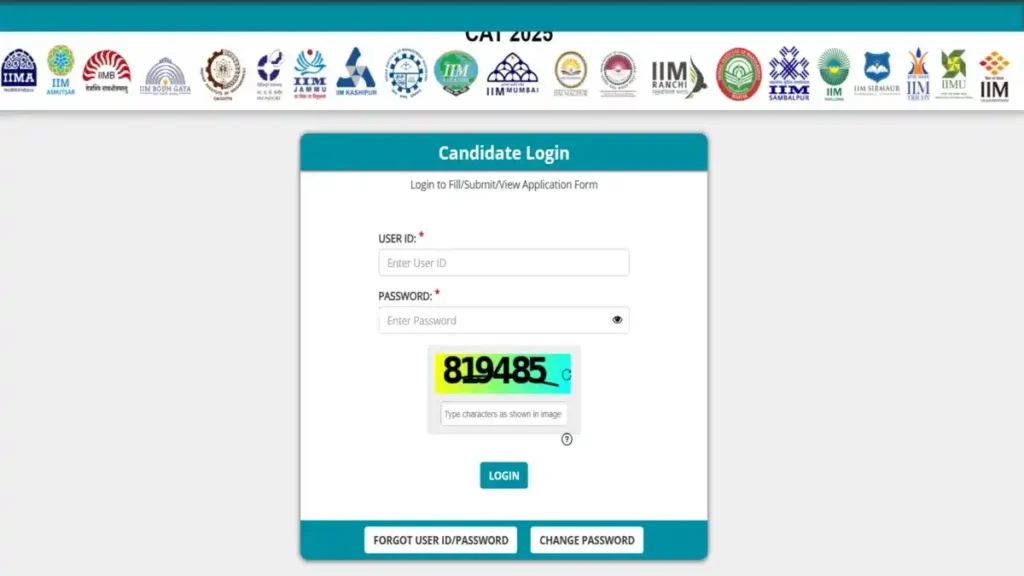
CAT 2025 Admit Card Download Window

This is what the CAT admit card 2025 download window looks like.

CAT 2025 Admit Card Download Portal

How to download the CAT Admit Card 2025

The hall ticket-cum-admit card for CAT 2025 will be released online at iimcat.ac.in. To download the admit card, follow these steps.

  1. Go to the CAT exam portal – Click Here
  2. If the admit card is OUT, the download link will be activated
  3. Click on the admit card download link
  4. In the log-in window that opens, enter your registration ID and password
  5. On log-in, the admit card will open in downloadable PDF format
  6. Download and take a printout of the admit card

Note that hardcopies of the CAT 2025 admit card will not be sent to the candidate.

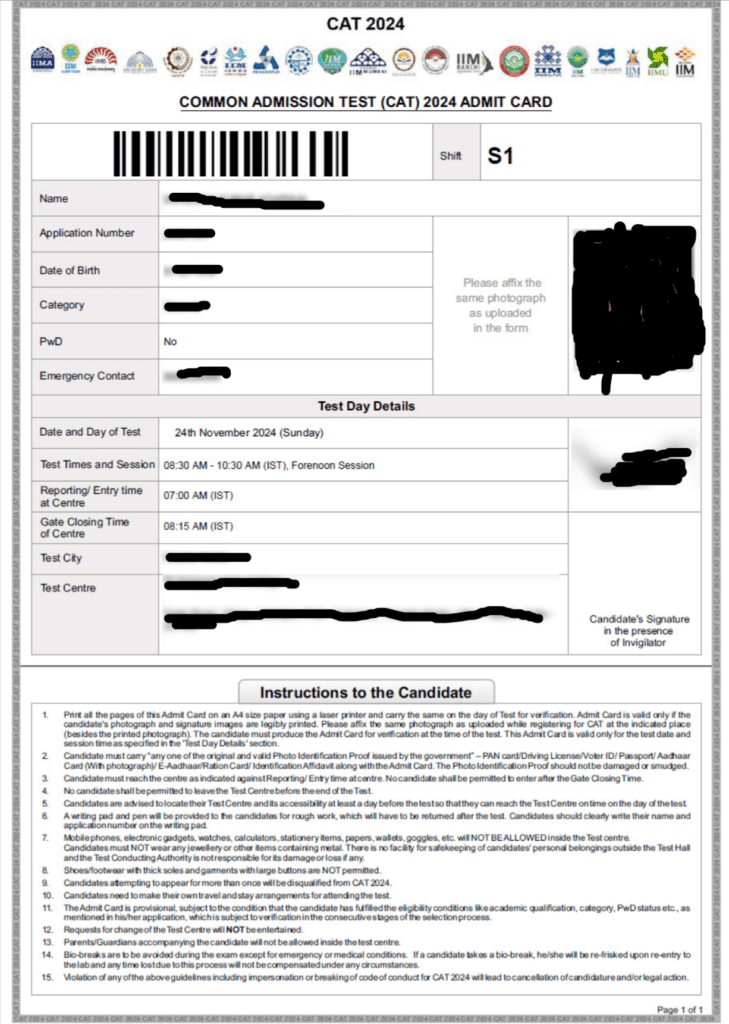
Sample CAT Admit Card

This is what the CAT admit card looks like:

Sample CAT Admit Card

Also Read:

Details mentioned on CAT Admit Card 2025

The admit card of CLAT 2025 will contain the following information.

  • Name of the candidate
  • Application number
  • Date of birth
  • Category
  • PwD status
  • Emergency contact number
  • Date and day of the test
  • Test Times and Session
  • Reporting/ Entry Time at Center
  • Gate closing Time of Center
  • Test City
  • Test Center
  • Candidate’s signature and photograph
  • CAT 2025 exam-day guidelines

Difficulty in downloading the CAT Admit Card 2025

The candidate may face difficulty in downloading the admit card for any of the following or similar circumstances:

  • The exam server is not responding – If there are some technical issues with the server or there is heavy traffic, the website may not respond. In such cases you need to try after some time.
  • Wrong password – If you enter the wrong password, you can’t log-in. So, ensure that you are using the correct log-in credentials.
  • Slow internet connections – If your internet connection is slow or disconnected, you can’t assess the server. Fix the connection and try again.

If the issue is still unresolved, the candidate needs to contact exam officials without any delay and get the necessary help.

Also Read:

CAT Admit Card Issue – Helpline Numbers

The candidate can contact CAT exam officials at the following address:

CAT helpline: 1-800-210-0175(Toll Free)
Email at cathelpdesk@iimcat.ac.in

Mistakes in the CAT Admit Card 2025

The admit card of CAT may have any of the following or similar issues:

  • The name of the candidate is incorrectly spelled
  • Some information is blurred
  • The wrong exam center has been allocated
  • Missing information, for instance, the application number or parts of it are missing.

In any of the above or similar issues, contact the CAT helpline given above.

CAT 2025 – Documents Required on Exam Day

On the day of the CAT 2025 exam, you need to bring the following documents:

  • CAT Admit Card 2025
  • Photo ID proof – PAN card, Aadhaar card, Voter ID, Passport, Driving license, or College/university ID card.
  • PwD Scribe Affidavit (if applicable)
  • Name change certificate (if applicable)
  • Medical certificate – There will be no bio-breaks during the CAT 2025 exam, unless there is a medical emergency. Exceptions are only applicable to candidates with a medical condition (e.g., diabetic candidates). Further, candidates with medical issues much carry a medical certificate issued by an MBBS doctor to avail bio-breaks.

Further, the candidate must sign a Test-day “Exception Form” in case there is an emergency during the examination. The CAT exam center stuff will help the candidate fill out the form.

CAT Admit Card 2025 – Exam Center Reporting, Gate Closing Time

EventSession 1Session 2Session 3
CAT 2025 Test Time8.30 – 10.30 am12.30 – 2.30 pm (Afternoon Slot)4.30 – 6.30 pm (Evening Slot)
Reporting/ Entry Time at Center7 am11 am3 pm
Gate Closing Time8.15 am12.15 am4.15 am

Key Highlights:

  • The candidate is recommended to reach the exam center at least 1 hrs 30 minutes before the test start time
  • Entry gates will close 15 minutes before the test starts.
  • The test log-in will START around 15 minutes before the exam. After logging in, the candidate must verify and confirm their profile and other information entered when filling the application form. Read and agree to the declaration.
  • The candidate must complete these formalities before the test starts. The duration of the CAT 2025 exam is 120 minutes.

Preserve the CAT Admit Card 2026 until the admission process is over

You must preserve the CAT 2026 admit card until the admission process is over.

Note that exam officials may ask for the admit card at the time of counseling. If you fail to display it, you may be disqualified.

Also, note that the exam officials may put the seal of the exam center and signature of the invigilator on the CAT 2026 admit card. So, you can’t use any printouts of the admit card.

Last-minute tips to organize and get ready for CAT 2025 exam

  • Safely store your login credentials for quick access.
  • Download and print your admit card well in advance to prevent last-minute issues.
  • Use a laser printer on plain white paper for sharp, smudge-free prints.
  • Visit your exam centre a day earlier if you’re not familiar with the location.
  • Carry backups of all essentials—pens, notebooks, and even an extra phone if possible.
  • Eat light before the exam to stay focused and energized.

Following these simple habits can ease anxiety and help you remain calm on test day.

CAT Admit Card 2025 – FAQs

Q: Can I change my exam centre after the admit card is issued?

A. Once the admit card has been released, no requests for any change will be entertained, including the exam center.

The candidate, however, can use the CAT application form correction window to change their exam center preference.

Q: How many copies of the CAT 2025 admit card should I carry on exam day?

A. It is recommended that you carry two printouts of the admit card, the 2nd once can act as a backup in case you lose or damage the first.

Q. Will exam officials accept digital copies of the CAT 2025 admit card?

A. No, it is mandatory to carry hard copies of the admit card. If you don’t carry any printout of the admit card, you will not be allowed inside the exam venue.

Q: Who do I contact if there is an issue downloading the admit card?

A. If you are unable to download the admit card, or there are any anomalies in the admit card, contact CAT 2025 helpdesk. You can contact the help desk at: 1800 210 0175.

CAT website: https://iimcat.ac.in

Q: What items are allowed/prohibited at the CAT 2025 exam center?

Allowed: Admit card, photo ID, transparent water bottle (no label), pen/pencil and scribble pad (provided at center). You must return these items at the end of the exam. Bringing your own stationery is prohibited

Prohibited: Electronic gadgets (phones/calculators/smartwatches), bags, wallets, food items, or any study material.

Arrive 60 minutes early for frisking and biometrics (photo + fingerprints). PwD candidates get 20 extra minutes per section and a scribe if needed (apply during registration).

Q. What documents are mandatory to carry to the CAT 2025 exam center?

You must bring a printed admit card (downloaded from iimcat.ac.in) and a valid photo ID (original, not photocopy). Acceptable IDs include Aadhaar, PAN, passport, driver’s license, voter ID, or college ID with photo. Ensure the name on the ID matches the admit card exactly. PwD candidates need a PwD certificate if claiming accommodations.

Q. What happens if I face technical issues during the CAT 2025 exam?

If you encounter glitches (e.g., computer freeze, power failure), inform the invigilator immediately. Test centers have backup systems, and IIMs ensure minimal disruption. Your exam timer pauses during resolution, and you’ll get the full 120 minutes (or 160 for PwD). Report issues calmly to avoid panic.

XAT 2026 Admit Card OUT soon; download @xatonline.in

0

The Xavier Aptitude Test (XAT) 2026 admit card will be released anytime now; the admit card was scheduled to be released on December 20, 2025 (but has been delayed). XAT 2026 exam officials haven’t given any specific reason for the delay nor a new date.

The admit card will be released on the official website xatonline.in. Candidates who have registered for the exam can download their hall tickets ahead of the national-level management entrance exam using their candidate credentials.

The XAT 2026 eczema will be held on January 4, 2026 (2 pm – 5 pm). 

The admit card is a mandatory document that candidates must carry in printed form to their exam centre. Photo copy or digital copy of the XAT hall ticket 2026 will not be accepted.

On the day of the exam, you need to bring the admit card and a photo ID proof. 

Latest Updates:

How to download the XAT 2026 admit card

Candidates planning to appear for XAT 2026 should follow these steps to access their admit card once the download link is active:

  1. Visit the official XAT website: xatonline.in.
  2. Click on the Login link on the homepage.
  3. Enter your XAT ID and password or date of birth.
  4. Navigate to the Admit Card / Hall Ticket section.
  5. Download the PDF and save it to your device.
  6. Take a print out of the admit card.

Digital screenshots or soft copies of the admit card will not be accepted at the exam hall.

Information Included in the Admit Card

The XAT admit card will contain vital details that candidates must verify immediately after downloading: 

  • Candidate’s name and registration/roll number
  • Exam date and reporting time
  • Exam centre name and address
  • Photograph and signature
  • Important exam-day instructions
  • Any discrepancies should be reported to the test authority well before the exam.

Exam-Day Checklist

Make sure to carry the following to the test centre:

  • Printed admit card (original)
  • Valid photo ID proof (Aadhaar card, PAN card, passport, voter ID, etc.)
  • Passport-size photographs
  • Face mask, hand sanitizer (if permitted)

Candidates should reach the exam centre well before the reporting time and follow all instructions printed on the admit card to ensure smooth entry and compliance with exam protocols.

UK Universities Open Campuses in India – What You Need to Know

0

India’s higher education ecosystem is entering a significant transition phase as leading universities from the United Kingdom prepare to establish full-fledged campuses in India. This development, enabled by recent regulatory reforms and strengthened bilateral cooperation, marks a decisive shift from traditional international education models and is being viewed as a structural change rather than a symbolic one.

Announced at PM Modi-Keir Starmer summit (October 2025) with UK’s largest education delegation, advancing Vision 2030 goals.

The move has been made possible under reforms aligned with India’s National Education Policy, which opened the door for top-ranked foreign universities to operate independently in the country. Approvals and oversight are being facilitated by the University Grants Commission”, which has laid down eligibility and quality norms for foreign institutions seeking entry.

From Offshore Degrees to Onshore Campuses

Until now, international education for Indian students largely meant travelling abroad or enrolling in twinning and exchange programmes run in partnership with Indian institutions. UK universities opening independent campuses in India represent a departure from these limited models. These campuses will be able to offer complete degree programmes, follow their own academic frameworks, and award qualifications that carry the same recognition as degrees conferred in the UK.

This shift is expected to bring global academic standards directly into India’s domestic education space, rather than exporting students overseas. For policymakers, it is also a step toward positioning India as an international education hub rather than only a source country for outbound students.

Lowering the Cost Barrier for Global Degrees

One of the most immediate impacts will be financial. Studying in the UK involves high tuition fees, living expenses, and currency fluctuations, making overseas education inaccessible for many otherwise qualified students. With UK campuses operating in India, students can access comparable academic programmes at a significantly reduced cost, particularly by eliminating international travel and accommodation expenses.

This change is especially relevant for students from middle-income families and those based in Tier-2 and Tier-3 cities, where aspirations for global education are rising but affordability remains a constraint. By bringing international degrees closer to home, the new campuses could broaden participation in globally benchmarked education.

Impact on Student Mobility and Foreign Exchange Outflow

India has consistently ranked among the largest source countries for international students in the UK. The establishment of UK campuses in India may gradually rebalance this trend. While outbound mobility will continue for students seeking full overseas exposure, a segment of students is expected to opt for domestic UK campuses instead.

From an economic perspective, this could help reduce foreign exchange outflow linked to education while retaining academic value within the country. Over time, India may also attract students from neighbouring regions to these campuses, reversing the traditional flow and strengthening its position in the global education market.

Implications for Indian Universities

The entry of UK universities introduces direct competition into India’s higher education sector. Indian private and public universities may face increased pressure to upgrade infrastructure, improve curriculum relevance, and strengthen research output to remain competitive.

At the same time, this development could act as a catalyst rather than a threat. Collaboration opportunities such as joint research projects, faculty exchanges, and shared innovation initiatives are expected to expand. Exposure to global academic practices may also contribute to institutional capacity building across Indian universities.

Faculty, Research, and Knowledge Transfer

Beyond teaching, UK campuses are expected to play a role in strengthening India’s research ecosystem. Many UK universities have strong global research profiles, and their presence in India could support collaborative research in areas such as technology, sustainability, health sciences, and social sciences.

For faculty, this creates new career pathways within India, including opportunities to work under international academic frameworks without relocating abroad. Over time, this may also help reduce academic brain drain by providing competitive research environments domestically.

Quality Control and Regulatory Safeguards

Indian regulators have emphasised that only top-ranked and reputed foreign universities are eligible to establish campuses. The regulatory framework requires compliance with Indian laws while allowing academic autonomy in curriculum design, assessment, and faculty recruitment.

Degrees awarded by these campuses must meet the same standards as those offered at the home campuses abroad. This safeguard is crucial to ensuring that internationalisation does not come at the cost of academic quality or student protection.

Employment Outcomes and Industry Alignment

Graduates from UK campuses in India are expected to benefit from enhanced employability due to the global recognition of their degrees. Employers, particularly multinational companies operating in India, may view such qualifications as aligned with international skill standards.

Additionally, UK universities are expected to design programmes that reflect emerging industry needs, including interdisciplinary studies, digital skills, and applied research. This alignment could help address long-standing concerns about the gap between higher education and job market requirements.

A Strategic Step in India–UK Relations

The expansion of UK universities into India also reflects deepening education ties between the two countries. Education has emerged as a central pillar of India–UK cooperation, alongside trade, technology, and research collaboration.

This partnership is not limited to student enrolment alone. It includes broader goals such as joint innovation, skill development, and long-term academic engagement, reinforcing education as a soft-power bridge between the two nations.

Campuses, Fee Structure, Program Offered

Nine UK universities received UGC approvals or Letters of Intent by October 2025. University of Southampton launched in Gurugram (July 2025, first cohort enrolled); others like University of Bristol, York, Aberdeen (Mumbai, 2026); University of Liverpool, Lancaster (Bengaluru); University of Surrey, Coventry (GIFT City, Gujarat, 2026-27).

Campuses deliver full bachelor’s/master’s degrees mirroring UK curricula in AI, finance, cybersecurity, tech, health, and sustainability. Degrees hold identical recognition under UGC 2023 regulations.

Annual fees range ₹10-25 lakhs, 40-60% lower than UK (£20,000+ plus living costs), eliminating travel/accommodation expenses.

Campuses, Fee Structure, Program Offered

UniversityLocationStatus/LaunchKey ProgramsEst. Fees (₹/year)
University of Southampton, Delhi GurugramOpen (Jul 2025)Tech, Health15-25 lakhs ​
BristolMumbai2026AI, Finance12-20 lakhs ​
YorkMumbai2026Sustainability10-18 lakhs ​
AberdeenMumbai2026Business, Energy12-22 lakhs ​
LiverpoolBengaluru2026-27Engineering, Social Sciences10-20 lakhs ​
LancasterBengaluru2026-27Management, Research12-25 lakhs ​
SurreyGIFT City2026-27Cybersecurity15-25 lakhs ​
CoventryGIFT City2026-27Digital Skills10-20 lakhs ​
Queen’s BelfastTBD2026+Health Sciences12-22 lakhs ​

Enrollment Projections and Research Initiatives

Southampton enrolled its first batch in 2025; overall, 5,000+ students expected across campuses by 2027.

UK-India partnerships include £3M British Council grants for 100+ joint projects via UKIERI, plus Delhi hubs for faculty exchanges and innovation.

What Lies Ahead

As UK universities prepare to admit their first cohorts in India, the focus will shift to implementation, quality assurance, and long-term outcomes. The success of these campuses will depend on how effectively they integrate global standards with local relevance.

If executed well, the presence of UK universities in India could redefine access to international education, elevate academic competition, and strengthen India’s position in the global knowledge economy. Rather than merely replicating foreign campuses, this initiative has the potential to reshape how international education is delivered, experienced, and valued in India.

In that sense, UK universities opening campuses in India is not just an expansion strategy—it is a structural change that could influence the future direction of higher education in the country.

Key Challenges – Regulatory hurdles involve land acquisition, tax compliance, infrastructure delays, and national security clauses limiting full autonomy.

SBI Clerk 2025 Mains Results to Be Declared Soon

0

The State Bank of India (SBI) is expected to declare the SBI Clerk 2025 Mains examination results shortly on its official recruitment portal. 

Candidates who appeared for the Mains exam for the post of Junior Associate (Customer Support and Sales) are advised to regularly check official updates for the release of the result, scorecard, and cut-off marks.

The SBI Clerk 2025 Mains examination was conducted on November 21, 2025, following the successful completion of the preliminary examination stage. This recruitment drive aims to fill 6,589 Junior Associate vacancies across various SBI branches nationwide. 

The bank has not released official figures regarding the total number of applicants or the number of candidates who appeared for the Mains exam.

The SBI Clerk selection process consists of Preliminary Examination, Mains Examination, and a Language Proficiency Test (LPT) where applicable. 

Latest Updates:

How to Download SBI Clerk 2025 Mains Result

Candidates can follow the steps below to download their SBI Clerk 2025 Mains result once it is announced:

  1. Visit the official SBI careers website.
  2. Go to the “Careers” or “Recruitment Results” section.
  3. Click on the link for SBI Clerk 2025 Mains Result.
  4. Open the result PDF and search for your roll number, or log in using registration credentials to view the scorecard.
  5. Download and save the result for future reference.

Candidates are advised to keep a printed copy of the scorecard for documentation purposes.

Information Included on the SBI Clerk 2025 Mains Scorecard

Once released, the SBI Clerk 2025 Mains scorecard is expected to include the following details:

  • Candidate’s name
  • Roll number and registration number
  • Category and sub-category
  • Section-wise marks obtained
  • Overall marks
  • Qualifying status
  • Cut-off marks (category-wise)

Initially, SBI may release the result in PDF format listing the roll numbers of shortlisted candidates, followed by individual scorecards made available through candidate login.

What Next After SBI Clerk 2025 Mains Result?

Candidates who qualify in the Mains examination will be required to appear for the Language Proficiency Test (LPT), wherever applicable. The LPT is qualifying in nature and assesses the candidate’s ability to read, write, and speak the local language of the selected state or union territory.

Candidates who clear all stages of the recruitment process will be considered for final appointment as Junior Associates. Successful candidates will receive job offers and posting details from SBI based on merit, availability of vacancies, and reservation norms.

The SBI Clerk position offers a secure banking career with fixed pay, allowances, and long-term growth opportunities, making it one of the most sought-after government bank jobs in India.

Telangana SSC 2026 Application Form Edit Window Extended Till December 30

0

The Board of Secondary Education, Telangana has extended the application edit window for the SSC Public Examinations 2026, giving schools additional time to correct student details submitted through the online system. As per the latest notification, the edit option is now available from December 22 to December 30, 2025.

Latest Updates:

  • To edit the Telangana SSC 2026 Application Form – Click Here

The extension applies to corrections in the e-Nominal Rolls (e-NR), which contain crucial student information required for the conduct of the Class 10 board examinations. These details include the student’s name, date of birth, subjects opted, medium of instruction, and other personal and academic particulars. The e-Nominal Roll forms the official database used for generating hall tickets, examination records, and results, making accuracy essential.

Only school authorities are authorised to make corrections during this period by logging into the official SSC portal. Students themselves cannot directly edit the data. Candidates who notice any discrepancies in their submitted information are advised to immediately inform their respective school administrations so that necessary changes can be made within the stipulated time frame.

The Board has clarified that no further opportunity for corrections will be provided after December 30, 2025. Any errors left uncorrected after the closure of the edit window may lead to complications during the issuance of hall tickets or in the declaration of results.

The Telangana SSC examinations are conducted annually and are among the most significant board examinations in the state, with a large number of Class 10 students appearing each year. The extension of the edit window is aimed at reducing errors and ensuring a smooth examination process.

Students are advised to stay in regular contact with their schools and keep track of official announcements related to the SSC Public Examinations 2026, including updates on exam schedules, hall ticket release dates, and other procedural guidelines issued by the Board.

NCERT to Introduce Artificial Intelligence Textbooks for Classes 11 and 12

Artificial intelligence is increasingly influencing how students are taught, assessed and eventually selected for higher education and jobs. From automated evaluation tools and adaptive learning platforms to screening systems used by universities and employers, AI is becoming embedded in the very structures that shape students’ academic and professional futures. Yet for most school students, these systems remain largely invisible – encountered in practice, but rarely understood in principle.

This gap between exposure and understanding has prompted a rethink of what schools should be teaching. As technology begins to play a decisive role in learning outcomes and career pathways, policymakers argue that students must develop foundational knowledge of how AI systems work, where they can fail, and how their use raises ethical and social questions. Such understanding, they say, cannot be left to informal exposure or post-school training.

It is this shift in thinking that now finds reflection in the school curriculum.

In a move aimed at making school education future-ready, the NCERT has constituted a dedicated team to develop textbooks and syllabi on Artificial Intelligence for Classes 11 and 12. The initiative seeks to align classroom learning with the technological realities students will encounter in higher education and the workplace, in line with the National Education Policy (NEP) 2020 and the NCF-SE 2023.

Why NCERT Is Introducing AI Textbooks Now

The introduction of AI textbooks comes at a moment when India’s education system is undergoing wide-ranging reform under the National Education Policy (NEP) 2020 and the National Curriculum Framework for School Education (NCF-SE) 2023. Both frameworks emphasise experiential learning, interdisciplinary thinking, and the integration of emerging technologies into classrooms.

Artificial intelligence occupies a central place in this vision. AI is no longer confined to specialised engineering courses; it now influences fields as diverse as agriculture, finance, medicine, media, and governance. For students approaching higher education and employment, early exposure to AI concepts is increasingly seen as essential rather than optional.

Until now, AI learning in schools has largely been fragmented – limited to optional modules, short-term projects, or vocational add-ons. NCERT’s move signals an attempt to standardise AI education and make it accessible to a wider cohort of students across school boards that follow NCERT curricula.

Also Read:

Who Is Developing the AI Textbooks

To ensure academic rigour and pedagogical relevance, NCERT has constituted a dedicated expert team tasked with developing AI textbooks and syllabi. While detailed composition of the team has not been publicly itemised, NCERT’s curriculum development process typically involves subject experts, educationists, curriculum designers, and pedagogical specialists.

The creation of a dedicated team – rather than assigning AI content as an extension of existing subjects – suggests an acknowledgment of the subject’s complexity and interdisciplinary nature. AI intersects with mathematics, computer science, ethics, social sciences, and even psychology. Developing textbooks that reflect this breadth requires careful planning and specialised expertise.

NCERT’s role as the national curriculum-setting body also means that these textbooks are likely to influence teaching not just in Central Board of Secondary Education (CBSE) schools, but also in several state boards that adapt NCERT materials.

What Students Are Expected to Learn: A Student-Centric Approach

One of the most significant aspects of NCERT’s AI initiative is its focus on conceptual understanding rather than narrow technical training. The intent is not to turn school students into AI engineers but to help them grasp how intelligent systems work, where they are used, and what their implications are.

Students are expected to be introduced to foundational AI concepts in age-appropriate language. This includes understanding how machines process data, identify patterns, and make decisions, as well as recognising where AI is already present in everyday tools and services.

Rather than emphasising coding alone, the curriculum is expected to focus on problem-solving, logic, and analytical thinking. This approach aligns with NEP 2020’s emphasis on reducing rote learning and encouraging critical engagement with subject matter.

For students, this means AI will be framed not as a distant or intimidating technology but as something familiar, relevant, and open to questioning.

Classes and Academic Stages Covered

According to official communication, the AI textbooks being developed by NCERT are intended for Classes 11 and 12. This places AI learning at the senior secondary level, where students begin to engage with more specialised subjects and prepare for higher education or vocational pathways.

At the same time, elements of AI exposure are already being introduced earlier in the school system. NCERT has included a project using AI tools in a vocational education textbook for Class 6, offering younger students a practical, hands-on introduction without overwhelming them with technical detail.

This layered approach – early exposure followed by deeper engagement at the senior secondary stage – reflects an effort to build familiarity gradually rather than introducing complex concepts abruptly.

Ethics, Bias, and Responsible Use of AI

Beyond technical understanding, NCERT’s AI initiative places importance on ethical awareness and responsible use of technology. As AI systems increasingly influence decisions related to employment, credit, surveillance, and information access, understanding their ethical implications has become critical.

Students are expected to learn about issues such as algorithmic bias, data privacy, and the social impact of automation. Introducing these themes at the school level aims to encourage informed and responsible digital citizenship.

Rather than presenting AI as an unquestioned force for progress, the curriculum is expected to encourage students to ask critical questions: Who designs these systems? What data do they rely on? Who benefits, and who may be excluded?

This approach aligns with global education trends that stress ethics alongside innovation.

Supporting Teachers in the AI Transition

Introducing AI textbooks into classrooms also raises important questions about teacher preparedness. Many teachers currently working in schools may not have formal training in artificial intelligence or related technologies.

Recognising this, NCERT’s curriculum reforms are expected to be accompanied by teacher training and capacity-building initiatives. Without adequate support, even the best-designed textbooks risk being underutilised or poorly implemented.

Teacher readiness is particularly important to ensure that AI education does not become a superficial exercise limited to textbook definitions, but instead fosters meaningful discussion and engagement.

Assessment and Learning Outcomes

Another key consideration is how AI learning will be assessed. Traditional examination models focused on memorisation may not be well-suited to evaluating understanding of AI concepts.

While detailed assessment frameworks have not yet been outlined, the broader curriculum reform agenda under NEP 2020 emphasises competency-based evaluation, project work, and application-oriented learning.

For students, this could mean assessments that reward understanding, reasoning, and real-world application rather than rote recall of technical terms.

Accessibility and Equity Concerns

As with any technology-focused reform, the introduction of AI textbooks raises questions of access and equity. Schools vary widely in terms of infrastructure, teacher availability, and digital resources.

NCERT’s standardized curriculum aims to reduce disparities by ensuring that all students following its textbooks are introduced to AI concepts, regardless of school location. However, effective implementation will depend on parallel investments in teacher training and learning resources, particularly in government and rural schools.

Ensuring that AI education does not deepen existing educational inequalities remains a key challenge.

What This Means for Students’ Futures

For students, the introduction of AI textbooks represents more than the addition of a new subject. It signals a shift in how education views technology – not as an external skill acquired after schooling, but as a core area of literacy.

Understanding AI can help students navigate future workplaces, make informed career choices, and engage critically with the technologies shaping society. Importantly, AI education is relevant across disciplines, not only for students pursuing science or engineering.

By embedding AI within the school curriculum, NCERT aims to equip students with conceptual tools that remain valuable even as specific technologies evolve.

The Road Ahead

While NCERT’s decision marks a significant step, the full impact of AI textbooks will depend on how they are designed, taught, and updated over time. Artificial intelligence is a rapidly evolving field, and educational content must keep pace without sacrificing clarity or depth.

As textbooks are developed and rolled out, educators, students, and parents will be watching closely to see how effectively AI is translated from a complex technological domain into accessible classroom learning.

For now, NCERT’s move reflects a broader acknowledgment: the future is already here, and classrooms must prepare students not just to live in it, but to understand it.

Shift in Business Education: MBA Demand Slows, Specialized Degrees Grow

0

Global enrolment trends in graduate business education are evolving rapidly, with traditional Master of Business Administration (MBA) program experiencing a noticeable slowdown while specialized master’s degrees gain traction among students worldwide. Recent data and expert reports underscore that this shift isn’t just a temporary blip – it reflects deeper changes in how students and employers view business education.

According to a major global analysis of business school enrollments, MBA enrollment has declined by about 6% over the past five years, even as total applications to graduate business programmes have increased. During that same period, specialist master’s programmes grew by around 11%, and generalist master’s degrees grew even faster at about 17%, suggesting a rebalancing of student preferences at the master’s level.

Specialized programs – including degrees focused on data analytics, finance, marketing, and other targeted business disciplines – are now reported to make up more than half of all master’s-level enrollments worldwide. This shift indicates that students are increasingly prioritizing career-aligned skill sets and sector-specific expertise over the broad, generalist training offered by traditional MBAs.

Why Is This Shift Happening? Emerging Causes

A few key factors help explain why MBA programs are seeing reduced enrolment relative to specialized alternatives:

1. Evolving Employer Preferences 

Employers increasingly seek candidates with deep, discipline-specific skills -for example, expertise in data analytics, strategic finance, or digital marketing – rather than generalist leadership training alone. This encourages students to choose specialized master’s degrees closely aligned with industry demand.

2. Student Focus on ROI and Career Clarity

Students are evaluating return on investment (ROI) more critically. Many perceive specialized degrees as offering clearer career pathways and faster alignment with specific job roles, compared to the broader MBA route. Programs that tie directly to emerging fields – such as business analytics or finance – are particularly appealing.

3. Flexibility and Delivery Formats

Specialized programs often come in more flexible formats – including part-time, online, or short-duration options – making them attractive for working professionals and international students juggling career and study.

Is This a Long-Term Shift or a Short-Term Fluctuation?

Experts who analyse business education trends suggest that the change is not a short-term anomaly but reflects a broader transformation in business education:

  • The shift toward specialist programs has been underway for several years, with enrolment in these programs steadily rising even as MBAs plateau or decline. 
  • MBA enrolment decreases, while modest, are consistent across multiple regions and over multiple years – suggesting a longer-term rebalancing rather than a transient dip

At the same time, total master’s level enrollment in business education has grown modestly, indicating that demand for postgraduate business study remains strong overall – it is the distribution across degree types that is changing.

Discipline Patterns: Where Enrollment Is Changing Most

While general MBA programs have slowed, several specialized areas are seeing strong interest:

  • Business analytics and data science are among the fastest-growing disciplines globally, as data-driven decision-making becomes central to business strategy. 
  • Finance and financial analytics remain in demand, linking closely to roles in investment banking, corporate finance, and FinTech.
  • Digital marketing and marketing analytics attract students with interests in consumer behavior, digital platforms, and brand strategy – sectors with rapid growth in both India and abroad.
  • Human resource management and operations specializations continue to be relevant as companies emphasize organizational effectiveness and supply chain resilience. 

In contrast, while MBAs in generalized management still provide broad leadership education, they are increasingly seen as less directly tied to specific job functions – especially in early career stages. 

Source – Which MBA Specialisation is in Demand/Trending in India?

India is home to one of the world’s largest pools of MBA graduates, with hundreds of thousands completing management programs annually.

Unlike global declines, data from India show a more mixed but resilient pattern:

  • Domestic full-time MBA applications have shown growth, with some surveys reporting increases in two-year MBA
applications even as enrollment formats diversify.
  • India’s top business schools remain competitive and continue to attract large applicant pools – and Indian institutes are increasingly featured in global rankings, reflecting strong placement and international recognition.
  • Many Indian students still pursue traditional MBA paths – particularly in leading institutes – but there is also growing interest in specialized master’s programs and sector-specific courses, particularly in analytics, digital business, and finance. 

While India’s trend does not yet mirror the global decline in MBA enrollment exactly, the global shift toward specialization appears to be influencing student choices within the Indian market as well, especially among those seeking targeted skills for specific industries.

What Experts Are Saying

Thought leaders in business education emphasize that this shift does not mean the MBA is obsolete – rather, business education is diversifying:

  • Some analysts describe the trend as business education transforming, not declining, meaning that students are redistributing themselves across program types based on personal career goals and market signals.
  • Enrollment data also show that although MBA numbers are declining relative to specialized programs, total interest in graduate business education remains robust – just more varied by program type. 

This evolution suggests that business schools and students alike are adapting to new realities: employers seeking specific skill sets, students prioritizing return on investment, and institutions offering more targeted business master’s degrees that align directly with career paths.

What It Means for Students Today

For students planning postgraduate business education, these trends offer several practical insights:

1. Choose With Clarity Around Career Goals

MBAs provide broad leadership and managerial exposure – ideal if you seek general business leadership roles. Specialized degrees help build in-depth expertise for targeted career paths (e.g., analytics, finance, marketing). Align your choice with your desired job role and industry.

2. Consider ROI and Skills Demand

Specialized programs often equip you with specific skills employers are actively seeking, which can enhance employability in niches like data science, digital marketing, and FinTech – sectors with notable growth prospects. 

3. Look at Delivery Format and Flexibility

Many business programs now offer part-time, hybrid, or online options, making them suitable for working professionals or students balancing work and study.  

4. Research Program Strengths and Networks

Top MBA programs – especially those with strong global recognition and alumni networks – still offer significant value, particularly for leadership careers and long-term growth. 

Conclusion

The landscape of business education is shifting. Traditional MBA programs are experiencing modest declines, while specialized business master’s degrees are gaining ground globally. Rather than signaling the end of the MBA, this trend reflects a broader reconfiguration of student priorities and market needs, with students increasingly gravitating toward programs that promise clear career alignment and measurable skills development.

For Indian students navigating this changing terrain, the key lies in examining your career objectives, skill gaps, and industry demands – and choosing the path, whether MBA or specialist, that best supports your long-term goals.