CEED Exam Center 2026 – IIT Bombay has released the list of CEED 2026 exam cities on its admission portal. You can check the list in the CEED 2026 information brochure. The CEED exam will be conducted in 27 cities.
You can select your choice of exam city when filling out the CEED 2026 application form. You must select THREE exam cities in the order of priority. The name and address of the allotted exam center will be mentioned on the CEED admit card 2026.
The admit card will carry details like roll number, CEED 2026 exam schedule, and CEED 2026 exam center reporting and registration time. You must reach the exam center as per the reporting time. Exam officials will verify both the documents and identity of the candidate before allowing the candidate to take the CEED 2026 exam, which will be conducted on January 18, 2025.
Keep reading to learn more about the CEED 2026 exam center.
IIT Bombay will not release the names of specific exam centers. It will only release the list of exam cities.
The name and address of the exam center allocated to the candidate will be mentioned on the CEED 2026 admit card.
Also, an exam city may have one or more exam centers.
How can I select a CEED 2026 exam center?
The selection of an exam center (city) must be done at the time of filling out the CEED 2026 application form.
The candidate must select THREE exam cities in the order of priority,
How can I check the name and address of the exam city allotted to me?
The name and address of the exam city allotted to the candidate will be mentioned on the admit card.
So, after downloading the admit card, check the details. If there is any discrepancy, you must contact exam officials.
CEED exam center 2026 reporting time
7:00 am
CEED 2026 exam timings
9 am – 12 noon
Request for a change in CEED exam center 2026
Requests for a change in the exam center will not be entertained once the application form closes.
List of CEED Exam Center 2025
IIT Bombay will conduct the CEED 2026 exam in the following cities. You must select THREE cities (in the order of priority) when filling out the application form. The list of CEEED 2026 exam centers is given below.
The selection of exam city is allowed at the time of filling out the CEED 2026 application form.
Further, the candidate can’t select any specific exam center for CEED 2026. Instead, the candidate has to select THREE exam cities from the drop down menu.
The selection must be in the order of preference.
The allotment of CEED exam center 2026 will be based on factors like the address of the candidate, number of candidates in that exam city, etc. The name and address of the exam center allotted to the candidate will be mentioned on the CEED admit card 2026.
Note that an exam city can have one or more exam centers.
CEED Admit Card 2026
The admit card of CEED 2026 will be released on January 2, 2025. IIT Bombay will conduct the CEED 2026 exam on January 18, 2026.
Admit cards will be released to candidates who have duly completed the CEED 2026 application process, including payment of fees.
The admit card will carry details like roll number, exam schedule, and also CEED 2026 exam center reporting and registration times. The candidate must report to the exam center on time, as late comers may not be allowed inside the exam venue.
CEED Question Paper 2026 – Candidates appearing in the CEED 2026 exam must make it a point to solve previous years’ CEED question papers.
Previous years’ papers will provide insights into the entrance exam, like the types of questions asked, difficulty level, weightage, and specific trends.
The candidate can download previous years’ question papers of CEED following the link given below. Simply click on the question paper you want to download. The corresponding CEED answer keys are also available for download.
Along with previous years’ question papers, also solve CEED sample papers. This exercise will help the candidate develop their problem-solving and time-management skills.
When will the CEED question paper 2026 be released?
IIT Bombay will release the question paper of CEED 2026 within 2-3 days of the exam. The question paper will be released alongside the provisional CEED 2026 answer key.
The candidate can download the question paper in PDF format at ceed.iitb.ac.in. No log-in is required to download the question paper.
Previous years’ CEED Question Paper – Download Here
IIT Bombay will release the answer keys of CEED 2026 in TWO phases.
It will first release a provisional CEED 2026 answer key. The provisional key will contain the official keys to questions asked in the entrance exam.
The candidate can use the keys to calculate the number of correct and incorrect attempts. Then using the marking scheme given in the CEED 2026 exam pattern, the candidate can calculate the probable score.
This score will give the candidate a fair idea about their chances of admission.
The candidate will also be given the opportunity to challenge the provisional key. The final answer key of CEED 2026 will be released after considering candidate feedback.
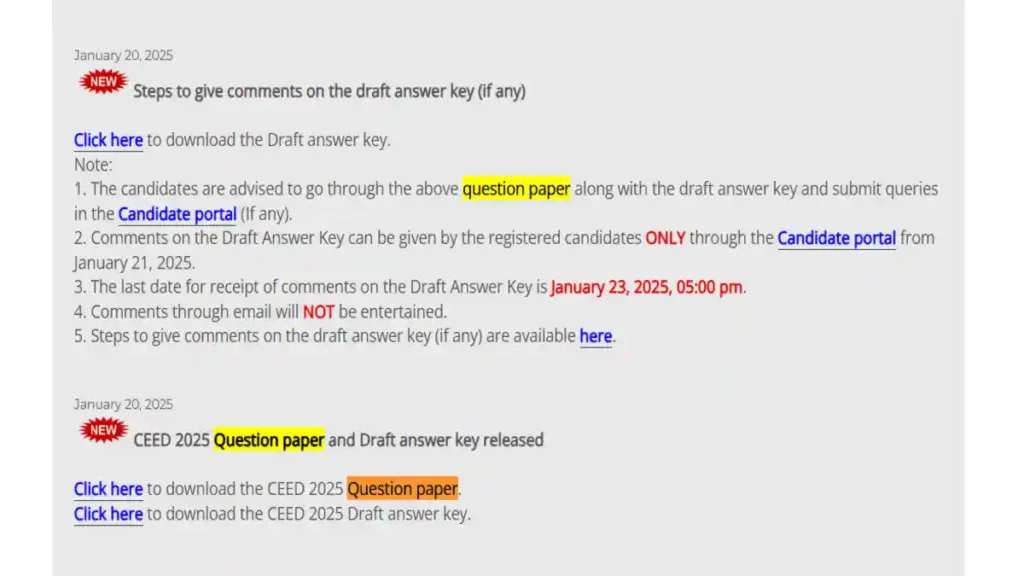
CEED Question Paper Release Notification
Here is a notification about the release of the CEED question paper.
NID DAT Sample Papers 2026 – The National Institute of Design (NID) has released the sample papers for NID DAT 2026 on its admission portal – admissions.nid.edu. The link to download the sample paper PDFs are also provided here. You can also download previous years’ sample papers for practice.
BY consulting the NID DAT sample papers, you will get insights into the question paper structure, type and specific questions asked, marking scheme, weightage, etc. Importantly, you can drastically improve your problem-solving and time-management skills by solving sample papers.
If you haven’t already, start using sample papers for NID DAT exam preparation.
Like, after you have completed a few topics given in the NID DAT syllabus, solve the relevant questions given in the sample papers. Initially, you will only be able to solve a few sample questions. However, once you move deep into NID DAT 2026 exam preparation, you should be able to solve majority of the questions given in the NID DAT sample papers.
The direct link to download the sample papers and previous years’ question papers of NID DAT exam has been given below. Download the relevant sample paper clicking on the corresponding link. No log-in is required to download the sample papers.
You can either download the sample papers by following the link given above, or visit the NID DAT 2026 exam portal. The step-wise process to download the NID DAT 2026 sample papers from the official portal is given below.
The program-wise sample papers will be displayed on the right-hand corner
Click on the sample paper you want to download.
The sample paper will open in PDF format
Download and save the sample paper for practice.
Benefits of solving NID DAT Sample Papers 2026
There are multiple benefits of solving sample papers for NID DAT 2026 exam preparation.
To start with, sample papers will give you a clear idea as to where you preparation stands. For instance, if you manage to solve only a handful of questions, chances are you are at a very early stage of exam readiness. On the other hand, if you manage to solve most of the sample papers, it signifies a good level of progress.
But note that the above statement will only hold true if you base your assessment on multiple sample papers. Assessments made after solving a solitary or very few sample papers can be misleading.
Sample papers contain questions similar to the ones asked in the actual exam. So, solving NID DAT sample papers can help you get insights into the exam like the topics covered, difficulty level, what exactly is asked, and how are questions framed. These insights can be vert useful in devising a study plan.
If you solve sample questions after completing a topic or chapter, it will help you better understand the underlying concepts and also learn how to use these concepts for problem-solving.
In fact, there are hardly any better tools that NID DAT sample papers to develop problem-solving and time-management skills.
To develop your time-management skills, use a timer as this way you will be mindful of the time you have for solving a question.
FAQs on NID DAT 2026 Sample Papers
Q. What is the best time to solve NID DAT Sample Papers?
The candidate can start solving sample papers any time they want. However, it is recommended not to be too late to start.
Start solving the sample papers after you have completed a few topics.
Check the sample the sample papers for relevant questions and solve them.
Q. Are previous years NID DAT question papers same as sample papers?
Consulting the NID DAT question papers will help the candidate understand the exam better. Like the candidate will get to know not only about the types of questions, but the specific question asked.
Also, the question paper will showcase how the question paper is structured, the marking scheme, the topics covered, etc.
By consulting previous years’ papers, the candidate will also be able to figure out whether there is any specific trend.
Sample papers, as the terminology indicates, are sample questions. These are kind of probable questions and so can help you prepare for the exam better.
How many NID DAT sample papers should I solve?
There is no specific number as such, but you need to solve as many as possible.
The more sample paper you solve, the more confident you will get in your abilities. Try around 10+.
What about NID DAT mock tests?
The candidate can take NID DAT mock tests a few days before the exam. Leading coaching institutes offer online mock test for NID DAT.
However, note that 3rd part mock tests are subscription-based. So, you will have to pay a fee to take these mock exams.
Mock tests are intended to help you check your exam readiness and get accustomed to the exam-ambience.
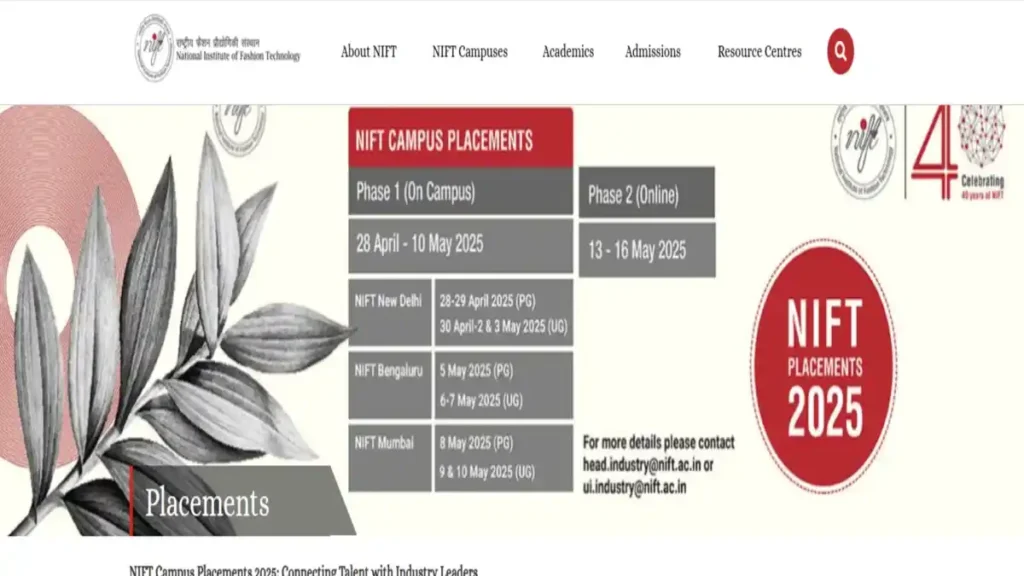
NIFT Placement 2026 – The placement process for NIFTs will commence in April-May and will be conducted in THREE phases. Phase 1 (On Campus) will be held around April; meanwhile, Phase 2 (Online) will be conducted in May 2026. A Pre-Placement Offers (PPO) may also be held allowing candidates to companies can extend PPOs based on internships, training, or projects.
The official information related to the placement process, including the schedule, can be checked at nift.ac.in/placements.
The National Institute of Fashion Technology (NIFT) will have a centralized placement process allowing companies to recruit talent from any of its campuses and programs. NIFT 2026 placement will START with the NIFTs releasing a placement schedule. Based on this schedule, the companies have to register for the placement process.
On-campus placement is the most common route, while PPO allows companies to extend job offers before the On-campus placement based on internships, projects undertaken, etc.
In this article, we discuss the NIFT 2026 placement process in detail. So, keep reading.
Admission to design courses at NIFTs is conducted through the NIFT entrance exam.
NTA conducted NIFT 2025 written exams on Feb 9, 2025. The NIFT 2025 results are expected to be declared anytime now. The scores of the written exam will be used to shortlist candidates for a Situation Test/ Personal Interview.
The NIFT participating institutes have a combined intake of 4837 seats, including 4392 All-India and 445 state domicile seats. The NIFT 2025 answer keys are available now.
NIFT Placement 2026 – Key Highlights
Particulars
Description
Conducting Body
The counseling at the NIFTs is conducted in a Centralized Process.
Phases
The placement process is conducted in THREE phases:
Phase 1 – On-Campus will be held 1st. Phase 2 – Following on-campus placements, NIFT facilitates online off-campus placements for registered companies.
Pre-Placement Offers (PPO): Companies can also extend pre-placement offers to students before on-campus placement.
Mode of counseling
Centralized counseling.
Will include both on-campus (offline) and off-campus modes.
When is NIFT placement conducted?
Phase 1 (On Campus) placement can start in April or May Phase 2 (Online) conducted in May
The NIFT 2025 placement will include the following phases:
Pre-Placement Offers (PPO)
On-Campus Placement (Phase 1)
Off Campus Placement (Phase 2)
Pre-Placement Offers (PPO) – Companies can extend a pre-placement offer to students before the on-campus placement, which is considered as a job offer.
PPO is typically offered based on internships, training, or projects undertaken by the students at the company offering the job offer.
To ensure that all candidates get a fair opportunity through PPO, companies are recommended to inform NIFT of such offers by filling up the details in the CMS with the link provided to the industry mentor by NIFT.
NOTE that students offered PPO are not allowed to participate in the further placement process.
On-Campus Placement (Phase 1)
The On-Campus placement is the most common and popular route for candidates to get a job offer.
Companies are required to register for campus placements as per the given schedule.
The company then can visit the campus for the campus placement.
Off Campus Placement (Phase 2)
The Off-Campus placement is conducted after the completion of the On-Campus placement.
Candidates who fail to get job offers through PPO and On-Campus placement may apply in the off-campus placement.
The Off-Campus placement will be administered online and is open to those registered companies that were not taken on board for the On-Campus Placement.
NIFT Placement Calendar
The important dates for NIFT placement will be updated at nift.ac.in/placements. Additionally, the calendar will also be given on the NIFT Placement Brochure.
The placement calendar as shown on the placement portal (Homepage) is shown below.
Companies need to Register with NIFT for Placements
Any company that wishes to participate in the NIFT placement process is required to register their company for placement.
What makes NIFT placement a success? – It is Industry Engagement
The new curriculum of NIFT is designed to give students a rich repertoire of experience and understanding and inculcate a desire and a capability for lifelong learning and will stand him or her in good stead to face any situation.
Industry engagement provides students exposure to a real-life working environment as part of an academic curriculum, helps them to develop and enhance academic, personal, and professional competencies coupled with a deeper understanding of the ethics and values that distinguish a good professional.
A significant part of the engagement program is based on the regulated exposure of the students to the industry environment as part of the course curriculum under the guidance of both academia and industry.
The revised curriculum of NIFT, which is arrived at through deliberations, workshops, and interactions involving internal experts, eminent academicians, industrialists, and alumni, is robust with enhanced industry engagement through:
Interaction with industry leaders and alumni in the classroom
Sponsored classroom projects
Industry visits and craft sensitization
Exposure to exhibitions and fairs
Internships
Joint research endeavours
Hands-on, practical learning experience in an industry environment
In a media release on the CAT 2025 exam portal, the exam conducting body has notified that admit cards for 2.95 lakh eligible candidates have been generated. Now, if we bargain for a few applications being rejected, we can safely presume that the number of applicants will not cross 3 lakhs.
This is significantly lower than the number of candidates who registered for the exam in the last edition – 3.29 lakh candidates. So, what exactly has led to the decline in the number of applicants. Here we take a quick look.
The CAT 2025 exam will be conducted on November 30, 2025.
≈ 3 lakh IIM Kozhikode has notified that admit cards will be released for 2,95,000 candidates. So, considering a few applications will get rejected, it is safe to estimate that around 3 lakh candidates have applied for the exam.
The data will be updated once the exam is over.
2024
3,29,000
2,88,000
2023
3,28,000
2,88,000
2022
2,55,501
2,22,184
2021
2,29,969
1,91,660
2020
2,27,835
1,90,144
2019
2,44,169
2,09,926
2018
2,40,338
2,09,405
2017
2,31,067
1,99,632
2016
2,32,434
1,95,679
CAT 2025 Sees Fewer Registrations — What Does This Indicate?
A drop in registration for CAT 2025 is a seasonal fluctuation, or there is some hidden message about the evolving MBA landscape. Here we try to decode.
Demand-adjustment in MBA market: The reduction may reflect a recalibration of interest among aspirants — either fewer new candidates entering the pool, or some existing aspirants opting for alternatives.
The Director of IIM Ahmedabad recently remarked that the slight dip in CAT 2025 registrations “doesn’t matter,” describing it as more of a seasonal fluctuation than a worrying trend. He suggested that the change could partly reflect an uncertain job market, where many potential candidates — especially working professionals — may have chosen to stay in stable roles rather than pursue new opportunities through an MBA. The director further emphasized that a significant proportion of CAT aspirants already possess work experience, and their decision-making often aligns with broader economic cycles. Ultimately, he downplayed any long-term concern, noting that the IIMs primarily focus on attracting the top 15,000 to 20,000 serious candidates, a segment that continues to show consistent interest despite short-term fluctuations in overall registration numbers..
Shift in aspirant behaviour: Some candidates may defer CAT or consider alternate exams (e.g., other MBA entrance tests or direct management programmes) given changing job-market perceptions.
Market and macro factors: A slowing economy, evolving job profiles (e.g., FinTech, analytics) and rising relevance of fresh hybrid or domain-specific programmes could make traditional MBA pathways less compelling for certain segments.
Implications for aspirants: While fewer registrations might suggest reduced competition in absolute numbers, for a committed bracket — especially those targeting top IIMs — competition remains intense.
For B-schools and ecosystem: Colleges may need to double-down on value-proposition (placements, specialisations, ROI) to attract aspirants. Courses less differentiated might face pressure.
In short, the dip should not be viewed as an alarm for the MBA ecosystem, but rather a hint of evolving dynamics. For serious candidates, it underscores the importance of clarity in goals, preparation and choice of institution.
If you’re gearing up for JEE Main 2026, it’s time to get moving — the application window is open, and the Session 1 exam dates are out.
This year’s game-changing twist: for the first time ever, you’ll have access to an on-screen calculator during the Computer-Based Testhas turned OUT to be a DUD! In a clarification issued on November 2, the NTA has notified that candidates will not be allowed to use calculators during the JEE Main 2026 exam. NTA has also released a revised JEE Main 2026 information Bulletin. While the calculator surprise has flopped, elsewhere, NTA has increased the number of JEE Main 2025 exam cities to 308 (from 300 in the last edition).
That’s not just all!
The National Testing Agency (NTA) has also released a detailed information brochure, confirming key details about the exam pattern, syllabus, JEE Main 2026 application process and fees, exam cities, and how the merit list will be prepared. Some things have stayed steady, but a few finer updates might just influence how you approach your preparation this year.
So, before you fill out that form or fine-tune your study plan, here’s a quick, clear look at what’s new in JEE Main 2026 — and what every aspirant should know right now.
Here’s a quick overview of all the key updates, changes, and continuations announced for JEE Main 2026.
Big news for JEE aspirants! The JEE Main exam will not feature an on-screen calculator after all — putting a dampener on speculations and the accompanying excitement. The NTA has withdrawn its previous notification where it had announced the introduction of an on-screen calculator that candidates could use for quick computations during the Computer-Based Test (CBT). If implemented, this move would have marked a significant shift in how students approach numerical and calculation-heavy questions in the exam.
The exam will once again be held in two sessions — January and April 2026, continuing the same annual schedule followed in 2025.
There is no change in the overall exam pattern. Paper 1 (B.E./B.Tech), Paper 2A (B.Arch), and Paper 2B (B.Planning) remain identical in format and marking.
Each subject still features 20 multiple-choice questions and 10 numerical value questions, with any five numerical questions to be attempted.
Negative marking for both MCQs and numerical questions, introduced in 2025, continues in 2026.
The marking scheme and duration stay the same: +4 for correct answers, –1 for incorrect, and 0 for unanswered, with a 3-hour exam time (3 hours 30 minutes for combined papers).
The JEE Main 2026 syllabus is unchanged, matching 2025 word-for-word. Previously deleted topics such as Communication Systems, Environmental Chemistry, and Mathematical Induction remain excluded.
The application fee structure and payment options are identical to last year, with no revisions in category-wise charges.
NEW Test Cities Added – JEE Main 2026 just got a little closer to home — with 308 Indian cities now slated to host the exam (up from 300 last year). The 15 international centers remain the same, and you’ll still get to select four cities of your choice.
The merit list preparation method is unchanged, continuing to rely on NTA percentile scores with the same normalization, tie-breaking order, and “best of two sessions” rule.
In short: The on-screen calculator is the headline update for JEE Main 2026 — everything else, from pattern to syllabus, stays exactly as it was in 2025.
JEE Main 2026 Application Fee – What’s New?
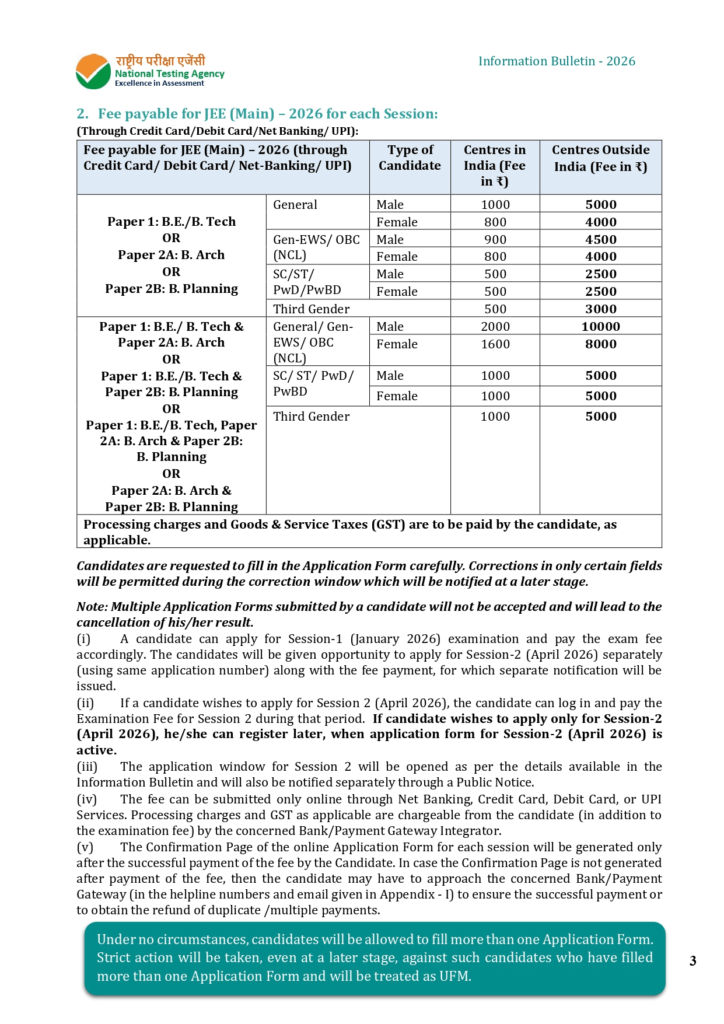
The JEE Main 2026 application fee remains the same as 2025, with no changes in category-wise charges or payment process.
Paper 1: B.E./B. Tech OR Paper 2A: B. Arch OR Paper 2B: B. Planning
General
Male
1000
5000
Female
800
4000
Gen-EWS/ OBC (NCL)
Male
900
4500
Female
800
4000
SC/ST/ PwD/PwBD
Male
500
2500
Female
500
2500
Third Gender
500
3000
Paper 1: B.E./ B. Tech & Paper 2A: B. Arch OR Paper 1: B.E./B. Tech & Paper 2B: B. Planning OR Paper 1: B.E./B. Tech, Paper 2A: B. Arch & Paper 2B: B. Planning OR Paper 2A: B. Arch & Paper 2B: B. Planning
General/ Gen- EWS/ OBC (NCL)
Male
2000
10000
Female
1600
8000
SC/ ST/ PwD/ PwBD
Male
1000
5000
Female
1000
5000
Third Gender
1000
5000
Processing charges and Goods & Service Taxes (GST) are to be paid by the candidate, as applicable.
To download JEE Main 2026 Application Fee (Official PDF copy) – Click Here
Check (official) – JEE Main 2026 Application Fee
JEE Main Exam Pattern 2026 – What’s New?
The JEE Main 2026 exam pattern remains largely unchanged from 2025, maintaining the same paper structure, marking scheme, and number of questions across all subjects.
The only notable update was supposed to be the introduction of an on-screen calculator, designed to help candidates perform quick computations during the Computer-Based Test (CBT). However, the NTA has since clarified (and released a fresh Information Bulletin) saying the “no-Calculator” policy will be followed in the upcoming exam (JEE Main 2026) as well.
So, most of the core aspects—such as the two-session format, question distribution, and negative marking for both MCQs and Numerical Value Questions—remain exactly the same as in 2025.
JEE Main 2026 vs. 2025 Exam Pattern
Feature
JEE Main 2025
JEE Main 2026
Difference
Mode of Exam
Computer-Based Test (CBT) for all papers except Drawing Test (offline) for Paper 2A.
Same — CBT mode; Drawing Test remains offline.
No change
Papers Conducted
Paper 1 (B.E./B.Tech), Paper 2A (B.Arch), Paper 2B (B.Planning)
Same.
No change
Exam Sessions
Two sessions (January & April 2025)
Same.
No change
Question Types
Section A: MCQs; Section B: Numerical Value Questions.
Same format retained.
No change
Section B (Numerical) Attempt Rule
10 numerical questions given per subject — any 5 to be attempted.
10 numerical questions given per subject — any 5 to be attempted.
No change
Negative Marking
Negative marking for MCQs continued; introduced for NVQs in 2025 (–1 for incorrect answers in both types).
Continues unchanged in 2026.
No change
Total Marks (Paper 1)
300 marks (Physics, Chemistry, Mathematics = 100 each).
Same.
No change
Paper 2A (B.Arch)
400 marks (Math 100 + Aptitude 200 + Drawing 100).
Same.
No change
Paper 2B (B.Planning)
400 marks (Math 100 + Aptitude 200 + Planning 100).
Same.
No change
Duration
3 hours for one paper; 3 h 30 min if attempting both 2A and 2B together.
Both PDFs have identical structure, subject breakdown, topic listing, and formatting, confirming that the NTA has not introduced any syllabus changes for JEE Main 2026.
The JEE Main syllabus for 2026 remains unchanged from 2025, which means that the topics removed during the 2024 revision continue to be excluded. These deletions were part of NTA’s effort to align the exam with the updated NCERT Class 11 and 12 textbooks.
Students should avoid spending time on these older, non-exam topics.
Physics – Removed Topics
Communication Systems (entire unit removed)
From Kinematics:
Scalars and Vectors
Vector Addition and Subtraction
Scalar and Vector Products
Resolution of Vectors
Unit Vectors
Redundant derivations and examples trimmed for brevity
Chemistry – Removed Topics
Environmental Chemistry
Polymers (no longer a full chapter)
Chemistry in Everyday Life
Minor reductions in Surface Chemistry and General Principles and Processes of Isolation of Elements
Mathematics – Removed Topics
Mathematical Induction
Certain advanced portions of Three-Dimensional Geometry
Redundant examples in Statistics and Probability
JEE Main 2025 – Exam Pattern and Syllabus Revised
The National Testing Agency (NTA) revised both the JEE Main 2025 syllabus and exam pattern to further align with the updated NCERT curriculum.
While the syllabus largely continued the 2024 reductions with minor topic removals, the exam pattern introduced key changes—most notably, all numerical questions were made compulsory and negative marking applied to them. These updates were made with an aim to promote accuracy and conceptual clarity among aspirants.
JEE Main 2024 vs. 2025 exam pattern
Feature
JEE Main 2024
JEE Main 2024
Section B Questions (Numerical) – Paper 1
10 questions, of which 5 were mandatory to attempt.
5 questions, all of which are mandatory to attempt.
Total Questions per Subject – Paper 1
Each subject (Mathematics, Physics, Chemistry) had 30 questions (20 MCQs + 10 numerical-value) but from those 10 NVQs only 5 needed to be attempted → effectively 25 to be answered per subject.
25 (20 MCQs + 5 compulsory numerical questions)
Negative Marking
-1 for incorrect MCQ answers.
-1 for incorrect MCQ answers and -1 for incorrect numerical value answer questions.
Drawing Test Weightage (Paper 2A)
25%
30%
JEE Main 2024 vs. 2025 Syllabus
Subject
JEE Main 2024
JEE Main 2025
Physics
The syllabus was reduced significantly in 2024 (overall units dropped from 64 to ~53 across all 3 subjects) to align with NCERT.
Some specific topics removed: e.g., “Communication Systems” (in Electronics devices unit) from Physics. No major additions were announced; the focus was on pruning less-core topics.
For 2025, the syllabus shows further minor deletions in Physics: topics from Kinematics such as “Scalars & Vectors”, “Vector Addition & Subtraction”, “Scalar & Vector Products”, “Unit Vectors”, and “Resolution of a Vector” were removed.
Otherwise, the Physics syllabus remains largely the same structure as in 2024.
Chemistry
2024 saw major syllabus reduction: many chapters removed (such as from Polymers, Environmental Chemistry) to align with NCERT.
Students needed to note the reduced number of units.
For 2025, no major additions; the reductions from previous years continue. Chemistry syllabus remains mostly unchanged compared to 2024.
Mathematics
Significant reduction. For example, topics like “Mathematical Induction” and parts of “Three-Dimensional Geometry” were removed.
For 2025, very minor changes: the maths syllabus is largely the same as 2024. There is no major new topic addition in Maths for 2025.
JEE Main 2026 Exam Cities – What’s New?
The exam city list for JEE Main 2026 remains identical to 2025, with no additions, deletions, or code changes. Candidates can still choose up to four preferred cities during registration, and the NTA retains the same allocation policy based on availability and administrative convenience.
Format: State prefix + two-digit code (e.g., AP01, UP16)
Same format and same codes
No change
City Names (International)
15 cities (e.g., Abu Dhabi, Doha, Dubai, Singapore, Riyadh)
Same
No change
City Codes (International)
Format: ZZ01 – ZZ24
Same
No change
Choice of Cities allowed when filling JEE Main 2026 application
Up to 4 preferences
Up to 4 preferences
No change
Allocation Policy
Based on availability; final decision by NTA
Same
No change
Notes / Instructions
NTA may add or remove cities as needed
Same note with updated year
No change
JEE Main Merit List 2026 (Preparation) – What’s New?
The method for preparing the JEE Main 2026 merit list remains unchanged from 2025. Rankings continue to be based on NTA Scores (percentiles), with the same normalization process, tie-breaking rules, and the “best of two sessions” policy for determining the All India Rank.
JEE Main Merit List & Result Preparation – 2025 vs 2026
Aspect
JEE Main 2025
JEE Main 2026
Change / Remarks
Basis of Merit List
Based on NTA Scores (percentile) obtained in Paper 1, not raw marks.
Same — NTA Scores used for ranking; raw marks not considered.
No change
Normalization Process
Normalization across sessions using standard NTA formula: percentile calculated for each session, then combined for final score.
Same normalization formula and explanation.
No change
Tie-Breaking Criteria (Paper 1)
Mathematics scorePhysics scoreChemistry scoreThe older candidate will be given preference.If tie persists, the merit will be decided by a random draw.
Same
No change
Tie-Breaking (Paper 2A & 2B)
Based on scores in Aptitude, Drawing/Planning, then Mathematics; followed by age and random draw.
The same sequence will be followed.
No change
Separate Merit Lists
Separate lists for B.E./B.Tech, B.Arch, and B.Planning.
Same – separate merit lists maintained.
No change
All India Rank (AIR)
Will be prepared using NTA scores of both sessions (best of two considered).
Same method – best of two sessions used for AIR.
No change
Result Display Format
Will be available on NTA website; scorecard will show subject-wise and total NTA score.
CLAT vs AILET – The All India Law Entrance Test (AILET) and the Common Law Admission Test (CLAT) are two of India’s most prominent national-level entrance exams for aspiring law students. Both serve as gateways to prestigious National Law Universities (NLUs) but differ in their scope and structure.
AILET, conducted exclusively by National Law University, Delhi (NLU Delhi), is held annually for admission to its B.A. LL.B (Hons.), LL.M., and Ph.D. programs. Since NLU Delhi does not accept CLAT scores, AILET exam is the only route for candidates seeking admission there. On the other hand, CLAT is organized by the Consortium of NLUs and is accepted by 26 NLUs across India (excluding NLU Delhi). It covers both undergraduate and postgraduate law programs and is also widely accepted by several private universities.
In essence, while CLAT exam has a wider reach, AILET exam is specialized, catering solely to one premier institution.
Here we discuss in detail the differences between CLAT and AILET, explaining the key differences, and also the nuances. So, keep reading.
The Common Law Admission Test (CLAT) is a national-level entrance exam conducted by the Consortium of National Law Universities (NLUs) for admission to undergraduate (BA LLB) and postgraduate (LLM) law programs offered by 26 NLUs across India (or CLAT participating institutes), except NLU Delhi. It tests candidates on English, Current Affairs, Legal Reasoning, Logical Reasoning, and Quantitative Techniques.
Key Difference: CLAT is a common test accepted by almost all NLUs except NLU Delhi, making it the broader gateway to national law universities.
What is AILET?
The All India Law Entrance Test (AILET) is an independent entrance exam conducted by National Law University, Delhi (NLU Delhi) exclusively for admission to its BA LLB (Hons.), LLM, and PhD programs. AILET primarily evaluates candidates’ proficiency in English, Current Affairs, and Logical Reasoning.
Key Difference: Unlike CLAT, AILET is meant solely for NLU Delhi, making it a highly focused and competitive single-institution exam.
CLAT vs AILET – Admission Calendar
Event
CLAT 2026
AILET 2026
Application form START Date
August 1, 2025
August 7, 2025
Last date to apply
November 7, 2025
October 31, 2025
November 10, 2025
Exam date
December 7, 2025
December 14, 2025
Declaration of results
To be notified
To be notified
CLAT vs AILET 2026 – Eligibility Criteria (UG & PG)
Before applying for either law entrance exam, candidates must understand the basic eligibility conditions such as educational qualifications, minimum marks, and age requirements. While CLAT serves as the gateway to 24 National Law Universities across India, AILET is conducted exclusively by NLU Delhi. Both exams follow similar academic prerequisites but differ slightly in category-wise marks and provisions for foreign nationals. The tables below present a clear comparison of the UG and PG eligibility criteria for CLAT and AILET.
CLAT vs AILET Eligibility Criteria – UG (Undergraduate) Program
Exam
Qualification Required
Minimum Marks
Age Limit
Notes
CLAT UG
10+2 or equivalent
45% for general; 40% for SC/ST/PwD.
No upper age limit.
Candidates appearing in the qualifying exam (March/April 2026) are eligible.
AILET UG
Higher Secondary (10+2) or equivalent
45% for general; 42% for OBC; 40% for SC/ST/PwD.
Not explicitly mentioned for Indian nationals.
Foreign Nationals require 65% in 10+2.
CLAT vs AILET Eligibility Criteria – PG (Postgraduate) Program
Exam
Qualification Required
Minimum Marks
Age Limit
Notes
CLAT PG
LL.B. (or equivalent)
50% for general; 45% for SC/ST/PwD.
No upper age limit.
Candidates appearing in the qualifying exam (March/April 2026) are also eligible.
AILET PG (LL.M)
LL.B. (or equivalent)
50% for general; 45% for SC/ST/PwD.
Not explicitly mentioned for Indian nationals.
For Foreign Nationals: 55% required along with interview/English aptitude.
Key Take-aways
Both exams do not impose an upper age limit (at least explicitly for CLAT; for AILET Indian nationals, age limit isn’t specified).
The minimum qualifying marks are very similar (45% general for UG at both, 50% general for PG at both) with slight differences for reserved categories or foreign nationals.
AILET adds extra provisions for Foreign Nationals and OCI/PIO categories that CLAT does not specify in the same way.
CLAT allows candidates yet to pass the qualifying exam (10+2 or LL.B.) to apply, provided they produce proof by a later date. The same is also allowed in AILET for UG/PG levels.
CLAT vs AILET – Which to choose and why?
CLAT – If you want to have multiple NLU or college options, then CLAT is the best fit.
AILET – If you are only interested in admission to NLU Delhi, take the AILET exam. Both – The best option, however, is to take both the exams. If you are preparing for the CLAT, you will only need to make a few adjustments and prepare a few extra topics to get ready for the AILET exam as well. Note that at the foundation level, both AILET and CLAT will cover more or less the same topics.
CLAT Participating Universities 2026 – The Consortium of National Law Universities (NLUs) has released the list of NLUs that will participate in the CLAT 2026 admission process. TWO new participating institutes have been added for CLAT 2026 – IIULER Goa and RPNLUP Prayagraj. This takes the number of NLUs that will participate in the CLAT 2026 to 26.
The CLAT 2026 entrance exam will be conducted on December 7, 2027. The scores of exam will be used by participating universities to provide admission to their UG and PG law courses. The application form of CLAT 2026 is currently open; eligible candidates can apply till November 7.
The scores of CLAT 2026 will be used to shortlist candidates for counseling and seat allotment.
The consortium will conduct centralized counseling for the participating NLUs. All candidates who have qualified in the CLAT 2026 exam can participate in the CLAT counseling-cum-seat allotment process. The allotment of seats to the participating NLUs will be on the basis of CLAT merit rank.
Note that in addition to the participating colleges, there are also a few other institutes that have signed a MOU with the Consortium of NLU to use CLAT 2025 scores. These institutes are called Affiliates. Keep reading to learn more about CLAT 2026 participating colleges.
In addition to 60 seats, 6 seats are reserved for EWS Category of Kerala, 2 seats are reserved for Transgenders (Kerala), 2 seats for J&K migrants as Supernumerary seats.
60
In addition to 60 seats, 6 seats are reserved for EWS Category of Kerala, 2 seats are reserved for Transgenders (Kerala), 2 seats for J&K migrants as Supernumerary seats.
CLAT Counseling 2026 – Admission to participating colleges
The Consortium of NLUs will conduct the counselling for CLAT 2026 soon after the declaration of results. The counseling will be conducted online as a centralized system separately for UG and PG programs. There will be five or more seat allotment rounds.
CLAT Colleges 2024 – Fee Structure for UG & PG Courses
The fee structure for UG & PG courses offered by CLAT participating institutes is given below.
CLAT Participating Institute
UG Courses
LLM
NLSIU Bengaluru
4.55 Lakhs pa
4.55 Lakhs pa
NALSAR Hyderabad
2.62 Lakhs pa
Rs.1.65 Lakhs pa
NLIU Bhopal
2.79 Lakhs pa
Rs. 2.44 Lakhs pa
WBNUJS Kolkata
3.06 Lakhs pa
2.72 Lakhs pa
NLU Jodhpur
1.44 Lakhs per semester
Rs.0.96 Lakhs per semester
HNLU Raipur
2.10 Lakhs pa
Rs. 1.60 Lakhs pa
GNLU Gandhinagar
2.58 Lakhs pa
Rs. 2.62 Lakhs pa
GNLU Silvassa Campus
2.58 Lakhs pa
Rs.2.62 Lakhs pa
RMLNLU Lucknow
1.68 Lakhs pa
Rs.1.03 Lakhs pa
RGNUL Patiala
Rs.2.54 Lakhs pa
Rs. 2.16 Lakhs pa
CNLU Patna
Rs.1.87 Lakhs pa
Rs. 1.60 Lakhs pa
NUALS Kochi
Rs.2.24 Lakhs pa
Rs. 1.63 Lakhs pa
NLUO, Odisha, Cuttack
Rs. 2.56 Lakhs pa
Rs. 1.96 Lakhs pa
NUSRL Ranchi
Rs.2.45 Lakhs pa
Rs.1.48 Lakhs pa
NLUJA Assam, Guwahati
Rs. 2.44 Lakhs pa
Rs.2.11 Lakhs pa
DSNLU Visakhapatnam
Rs. 2.09 Lakhs pa
1.89 Lakhs pa
TNNLU Tiruchirapalli
Rs.1.17 Lakhs pa (TN SC/ST) Rs.1.23 Lakhs pa (TN first generation graduate) Rs.2.17 pa (All India SC/ST) Rs.2.23 Lakhs pa (Others) Nil (TN Govt. schools quota)
Rs.1.13 Lakhs pa (TN SC/ST)
Rs. 1.68 Lakhs pa (All India SC/ST)
Rs.1.74 Lakhs pa (Others)
MNLU Mumbai
BA LLB (Hons): Rs.3.23 Lakhs pa (Maharashtra domiciled students) Rs.3.56 Lakhs pa (Others)
Rs.2.60 pa
MNLU Aurangabad
Rs.2. 57 Lakhs pa (Maharashtra students) Rs.2.74 Lakhs pa (Others)
Rs.1.72 Lakhs pa (Maharashtra students)
Rs. 1.97 Lakhs pa (Others)
HPNLU Shimla
Rs.2.35 Lakhs pa
Rs. 1.86 Lakhs pa
DNLU Jabalpur
Rs.2.81 Lakhs pa
Rs.2.81 Lakhs pa
DBRANLU, Sonipat, Haryana
Rs.1.87 Lakhs pa
Rs.1.87 Lakhs pa
MNLU Nagpur
BA LLB (Hons): Rs.3.65 Lakhs pa BBA LLB (Hons): Rs.3.13 Lakhs pa
Rs.3.13 Lakhs pa
NLUT Agartala
Rs.1.81 Lakhs pa
Rs. 1.51 Lakhs pa
CLAT Colleges 2026 – Affiliates
In addition to the participating institutes, there is another group of private institutes that will also use CLAT 2026 scores for admission to the UG and PG courses.
These institutes are called Affiliates.
The Affiliate colleges have signed a MOU with the Consortium of NLU to use the CLAT 2026 scores.
Please note that the affiliate colleges will not participate in the centralized counseling conducted by the NLU Consortium. Instead, each of these institutes will conduct counseling at an institute-level based on CLAT scores.
CLAT 2025 Participating Institutes – List of Affiliate Colleges
The list of affiliate colleges for CLAT 2025 (CLAT 2026 list is awaited) is given below.
The CAT 2025 admit card will be released on November 5, 2025. It will be released online at the official CAT 2025 exam portal – iimcat.ac.in.
Candidates who have successfully registered for CAT 2025 can download their admit card -cum- hall tickets using their login credentials. The admit card will contain vital details including the candidate’s name, roll/application number, test date and slot, CAT 2025 exam center name and address, and general instructions.
The CAT 2025 examination is slated for November 30, 2025, and will be conducted in THREE slots (morning, afternoon and evening). Download the admit cards as soon as the link goes live to avoid last-minute login or server issues.
Also, after downloading the admit card, verify all details carefully. In case of any discrepancy (for example name, date of birth, category status or assigned centre), contact exam authority without delay to get it resolved.
On exam day, bring the printed admit card along with a valid photo ID proof; without these documents entry to the exam centre will be denied.
CAT Admit Card 2025 – Important details & check-list
Release date & time: 5 November 2025 (exam officials haven’t given any specific time for the release of the admit card).
Last date for download: Usually until the exam day or just before; candidates should not wait until the last minute.
Things to verify on admit card:
Your name, roll/application number, photograph & signature.
Exam centre address, slot/time, reporting time.
Category (SC/ST/OBC/PwD) status, if applicable.
That no spelling mistake or wrong photo appears — if any error, contact the exam authority immediately.
What to carry on exam day:
Printouts of the CAT 2025 admit card.
A valid photo ID proof (Aadhaar card, PAN card, passport, etc.).
If PwD or special‐scribe is involved: the relevant certificate or authorization form.
What not to bring:
Electronic gadgets (mobile phones, calculators unless specified), bags, etc.
JEE Main Question Paper 2026 – NTA will release the question papers of JEE Main 2026 for the January and April session exams soon after the exam concludes. The JEE Main 2026 exam for January session will be conducted from January 21-30, 2025.
The JEE Main question paper will be released alongside the provisional JEE Main answer key and response sheets. Log-in to the answer key portal using your application number and password to download the question paper.
The candidate can also download the previous years’ JEE Main question papers from nta.ac.in/Downloads. The previous years’ question papers are great JEE Main 2026 exam preparation material and can be used alongside JEE Main question/ sample papers.
The JEE Main 2026 exam will be conducted in an online mode and will be of 180 minutes duration. Keep reading to learn more about JEE Main 2026 question papers.
Latest Updates:
JEE Main Application Form 2026 (OUT) – Register Here
JEE Main Question Paper 2026 – Highlights
Particulars
Description
Where can I download JEE Main question papers?
NTA will release the question papers of JEE Main 2026 along with the recorded response sheet and provisional answer keys.
The question paper had to be downloaded by logging in using one’s JEE Main application number and password.
Alternatively, you can download the JEE Main question papers at: nta.ac.in/Downloads
Credentials required to download JEE Main question papers
JEE Main application number Password
In what format will be question paper be released
The question paper will be released in downloadable pdf format.
Are previous years’ JEE Main question papers useful?
To prepare for the JEE Main 2026 exam, you must use previous years question papers to understand/ improve:
The types of questions asked Specific questions asked Emerging trends Weightage of topics Problem solving and time-management abilities
Where to download current and previous years’ JEE Main Question Papers
The JEE Main 2026 question papers can be downloaded at: jeemain.nta.nic.in
Download previous years’ JEE Main question papers:
Follow the links given below, or Visit: nta.ac.in/Downloads
How can I download JEE Main 2026 question papers
The JEE Main 2026 question papers will be released alongside the provisional JEE Main 2026 answer key.
To download the question papers, follow these steps:
Go to the JEE Main exam portal – jeemain.nta.nic.in
Click on the download link
You will be redirected to a log-in window
Enter your application number and password
On successful log-in, you can download the JEE Main 2026 question paper for your session and shift.
Where can I download previous years’ JEE Main question papers
The direct link to download previous years’ JEE Mains question papers are given below. Click on the answer key link you want to download; no log-in is required.
Or else, you can visit nta.ac.in/Downloads. Here you can download previous years question papers of JEE Main. Select the exam year, exam type, and paper.
Do I also need to solve JEE Main sample papers
Yes, it is very much recommended that along with the previous years’ question papers, you also solve a good number of JEE Main 2025 sample papers.
This exercise will help you assess your progress, and aid in improving your problem-solving and time-management skills.
To derive the maximum out of sample papers, you can start solving them after you complete some portion of the syllabus, rather than waiting to complete the syllabus and start the sample paper solving exercise.
For instance, once you complete some parts of the syllabus, you can solve related problems in the sample papers.
JEE Main Question Paper 2024
Exam Session
Question Paper
JEE Main 2024 Question Paper April 4 Shift 1 – B.Tech