The CAT 2025 admit card will be released on November 5, 2025. It will be released online at the official CAT 2025 exam portal – iimcat.ac.in.
Candidates who have successfully registered for CAT 2025 can download their admit card -cum- hall tickets using their login credentials. The admit card will contain vital details including the candidate’s name, roll/application number, test date and slot, CAT 2025 exam center name and address, and general instructions.
The CAT 2025 examination is slated for November 30, 2025, and will be conducted in THREE slots (morning, afternoon and evening). Download the admit cards as soon as the link goes live to avoid last-minute login or server issues.
Also, after downloading the admit card, verify all details carefully. In case of any discrepancy (for example name, date of birth, category status or assigned centre), contact exam authority without delay to get it resolved.
On exam day, bring the printed admit card along with a valid photo ID proof; without these documents entry to the exam centre will be denied.
CAT Admit Card 2025 – Important details & check-list
Release date & time: 5 November 2025 (exam officials haven’t given any specific time for the release of the admit card).
Last date for download: Usually until the exam day or just before; candidates should not wait until the last minute.
Things to verify on admit card:
Your name, roll/application number, photograph & signature.
Exam centre address, slot/time, reporting time.
Category (SC/ST/OBC/PwD) status, if applicable.
That no spelling mistake or wrong photo appears — if any error, contact the exam authority immediately.
What to carry on exam day:
Printouts of the CAT 2025 admit card.
A valid photo ID proof (Aadhaar card, PAN card, passport, etc.).
If PwD or special‐scribe is involved: the relevant certificate or authorization form.
What not to bring:
Electronic gadgets (mobile phones, calculators unless specified), bags, etc.
JEE Main Question Paper 2026 – NTA will release the question papers of JEE Main 2026 for the January and April session exams soon after the exam concludes. The JEE Main 2026 exam for January session will be conducted from January 21-30, 2025.
The JEE Main question paper will be released alongside the provisional JEE Main answer key and response sheets. Log-in to the answer key portal using your application number and password to download the question paper.
The candidate can also download the previous years’ JEE Main question papers from nta.ac.in/Downloads. The previous years’ question papers are great JEE Main 2026 exam preparation material and can be used alongside JEE Main question/ sample papers.
The JEE Main 2026 exam will be conducted in an online mode and will be of 180 minutes duration. Keep reading to learn more about JEE Main 2026 question papers.
Latest Updates:
JEE Main Application Form 2026 (OUT) – Register Here
JEE Main Question Paper 2026 – Highlights
Particulars
Description
Where can I download JEE Main question papers?
NTA will release the question papers of JEE Main 2026 along with the recorded response sheet and provisional answer keys.
The question paper had to be downloaded by logging in using one’s JEE Main application number and password.
Alternatively, you can download the JEE Main question papers at: nta.ac.in/Downloads
Credentials required to download JEE Main question papers
JEE Main application number Password
In what format will be question paper be released
The question paper will be released in downloadable pdf format.
Are previous years’ JEE Main question papers useful?
To prepare for the JEE Main 2026 exam, you must use previous years question papers to understand/ improve:
The types of questions asked Specific questions asked Emerging trends Weightage of topics Problem solving and time-management abilities
Where to download current and previous years’ JEE Main Question Papers
The JEE Main 2026 question papers can be downloaded at: jeemain.nta.nic.in
Download previous years’ JEE Main question papers:
Follow the links given below, or Visit: nta.ac.in/Downloads
How can I download JEE Main 2026 question papers
The JEE Main 2026 question papers will be released alongside the provisional JEE Main 2026 answer key.
To download the question papers, follow these steps:
Go to the JEE Main exam portal – jeemain.nta.nic.in
Click on the download link
You will be redirected to a log-in window
Enter your application number and password
On successful log-in, you can download the JEE Main 2026 question paper for your session and shift.
Where can I download previous years’ JEE Main question papers
The direct link to download previous years’ JEE Mains question papers are given below. Click on the answer key link you want to download; no log-in is required.
Or else, you can visit nta.ac.in/Downloads. Here you can download previous years question papers of JEE Main. Select the exam year, exam type, and paper.
Do I also need to solve JEE Main sample papers
Yes, it is very much recommended that along with the previous years’ question papers, you also solve a good number of JEE Main 2025 sample papers.
This exercise will help you assess your progress, and aid in improving your problem-solving and time-management skills.
To derive the maximum out of sample papers, you can start solving them after you complete some portion of the syllabus, rather than waiting to complete the syllabus and start the sample paper solving exercise.
For instance, once you complete some parts of the syllabus, you can solve related problems in the sample papers.
JEE Main Question Paper 2024
Exam Session
Question Paper
JEE Main 2024 Question Paper April 4 Shift 1 – B.Tech
JEE Main 2025 Exam Statistics – NTA has released the statistics for the JEE Main 2025 exam. The statistics have been released for both Session 1 and Session 2.
As per the official JEE Main 2025 exam and results statistics, 15,39,848 unique candidates registered for JEE Main 2025 exam in both Sessions (January/April). The total number of unique candidates that appeared in both sessions is 14,75,103.
8,33,536 candidates registered for both January and April sessions, out of which 7,75,383 candidates appeared in each session.
The NTA has also released the category-wise cut-off of JEE Main 2025 to become eligible for JEE Advanced 2025. 97,321 candidates in the general category, 67,614 candidates from the OBC category, 37,519 candidates from the SC category, 18,823 candidates in the ST category, and 25,009 candidates from the EWS category qualified for JEE Advanced.
Keep reading to learn the full details about JEE Main 2025 exam statistics.
JEE (Main) 2025 Session-1 exam was conducted in ten shifts and Session-2 was conducted in nine shifts.
Languages
13 languages (Assamese, Bengali, English, Gujarati, Hindi, Kannada, Malayalam, Marathi, Odia, Punjabi, Tamil, Telugu, and Urdu)
JEE Main 2025 exam centers
The JEE (Main)–2025 Session 2 was conducted at 531 unique examination centres in 300 Cities [including 15 cities outside India in Manama, Doha City, Dubai, Muscat, Riyadh, Sharjah, Singapore, Kuwait, Kuala Lumpur, Kathmandu, Abu Dhabi, West Java, Washington, Lagos and Munich].
Total Registered Candidates
Session 2 – 10,61,840
Session 1 – 13,11,544
Total number of Unique Candidates Registered in both Sessions (January & April): 15,39,848
Total Appeared Candidates
Session 2 – 9,92,350
Session 1 – 12,58,136
Total number of Unique Candidates Appeared in both Sessions (January & April): 14,75,103
Category-wise Cut-off of NTA Score for JEE Advanced 2025
UR: 100 – 93.1023262 percentile UR-PwBD: 93.0950208 to 0.0079349 percentile EWS: 93.0950208 to 80.3830119 OBC: 93.0950208 to 79.4313582 SC: 93.0950208 to 61.1526933 ST: 93.0950208 to 47.9026465
JEE Main 2025 Exam Statististics – Registered, Appeared
Gender/Category-wise distribution of candidates REGISTERED in Session 2 (April 2025), Paper 1 (B.E/ B. Tech)
Category
General
EWS
SC
ST
OBC
Total
Male
2,68,418
83,492
74,793
25,918
2,73,584
7,26,205
Female
1,32,278
34,090
32,083
11,766
1,25,418
3,35,635
Total
4,00,696
1,17,582
1,06,876
37,684
3,99,002
10,61,840
Gender/Category-wise distribution of candidates APPEARED in Session 2 (April 2025), Paper 1 (B.E/ B. Tech)
Category
General
EWS
SC
ST
OBC
Total
Male
2,50,849
80,200
68,872
23,676
2,58,274
6,81,871
Female
1,21,826
32,590
29,015
10,462
1,16,586
3,10,479
Total
3,72,675
1,12,790
97,887
34,138
3,74,860
9,92,350
Details of PwBD Candidates registered/ appeared in Session 2 (April 2025), Paper 1 (B.E/ B. Tech)
Category
PwBD (Registered)
PwBD (Appeared)
Male
2,651
2,428
Female
768
712
Total
3,419
3,140
Gender/Category-wise distribution of candidates registered in Session 1 (April 2025), Paper 1 (B.E/ B. Tech)
Category
General
EWS
SC
ST
OBC
Total
Male
167790
45,627
42,407
13,833
173668
443622
Female
321419
96,159
87,550
28,778
334014
867920
Third Gender
1
0
0
0
1
2
Total
489210
141786
130254
42,611
507683
1311544
JEE Main 2025 Exam Stats – Shift-wise Attendance
Attendance for Paper 1 (B.E./B.Tech.) in the JEE (Main) – 2025 Session 2
Day
Date of Examination
Shift
Registered Candidates
Appeared Candidates
% age
Day 1
02 April 2025
Shift 1
1,17,677
1,08,420
92.13
Day 1
02 April 2025
Shift 2
1,17,734
1,09,135
92.7
Day 2
03 April 2025
Shift 1
1,17,809
1,09,209
92.7
Day 2
03 April 2025
Shift 2
1,17,753
1,10,090
93.49
Day 3
04 April 2025
Shift 1
1,17,851
1,10,373
93.65
Day 3
04 April 2025
Shift 2
1,18,326
1,11,496
94.23
Day 4
07 April 2025
Shift 1
1,18,100
1,10,723
93.75
Day 4
07 April 2025
Shift 2
1,18,677
1,11,826
94.23
Day 5
08 April 2025
Shift 2
1,17,913
1,11,078
94.2
Category-wise Cut-off of NTA Score for JEE (Advanced) 2025
The Category-wise Cut-off of NTA Score for candidates to become eligible for JEE (Advanced) 2025 for Paper 1 (B.E./B.Tech.) is given below
S. No.
Category
Percentile
Candidates
From
To
1
UR-ALL
100
93.1023262
97,321
2
UR-PwBD
93.0950208
0.0079349
3,950
3
EWS-ALL
93.0950208
80.3830119
25,009
4
OBC-ALL
93.0950208
79.4313582
67,614
5
SC-ALL
93.0950208
61.1526933
37,519
6
ST-ALL
93.0950208
47.9026465
18,823
State-wise toppers & their NTA Scores in JEE (Main) 2025 Paper 1 (B.E./B.Tech.):
S. No.
Application No.
State of Eligibility (State of passing/ appearing 12th Class)
Name of Candidate
NTA Score
1
250310048742
ANDAMAN AND NICOBAR ISLANDS
MOUSAM DAS
99.0622707
2
250310564942
ANDHRA PRADESH
SAI MANOGNA GUTHIKONDA
100
3
250310666429
ARUNACHAL PRADESH
PRANAY KUMAR ROY
99.3840245
4
250310016427
ASSAM
PRANJAL KUMAR SINGH
99.9837952
5
250310763965
BIHAR
ABDULLAH
99.9945499
6
250310524809
CHANDIGARH
ARNAV JINDAL
99.9991058
7
250310272791
CHHATTISGARH
SUVIGYA DEWANGAN
99.990837
8
250310451582
DADRA AND NAGAR HAVELI
AHRAN RAWAL
99.9856921
9
250310561005
DAMAN AND DIU
JAYESH VASAN
98.4181971
10
250310133572
DELHI
DAKSH
100
11
250310143408
DELHI
HARSH JHA
100
12
250310335084
GOA
NAVINYA DEVANAND DESAI
99.9801306
13
250310391420
GUJARAT
SHIVEN VIKAS TOSHNIWAL
100
14
250310090488
GUJARAT
AADIT PRAKASH BHAGADE
100
15
250310292034
HARYANA
AMOGH BANSAL
99.9992065
16
250310151645
HIMACHAL PRADESH
DHERYA SHARMA
99.9918249
17
250310543590
JAMMU AND KASHMIR
TOIYEB ASHIQ AHANGAR
99.9936579
18
250310386607
JHARKHAND
ARYAN MISHRA
99.9990968
19
250310034720
KARNATAKA
KUSHAGRA GUPTA
100
20
250310128502
KERALA
AKSHAY BIJU B N
99.9960501
21
250310628173
LADAKH
BASHIR AHMAD
96.1934877
22
250310288342
LAKSHADWEEP
MOHAMMED SAYEED P
87.5187263
23
250310429117
MADHYA PRADESH
MAJID MUJAHID HUSAIN
99.9992043
24
250310017038
MAHARASHTRA
AAYUSH RAVI CHAUDHARI
100
25
250310296087
MAHARASHTRA
SANIDHYA SARAF
100
26
250310299968
MAHARASHTRA
VISHAD JAIN
100
27
250310113058
MANIPUR
LOYANGANBA LEIMAPOKPAM
98.6999897
28
250310617130
MEGHALAYA
NISTHA GAUTAM
99.5899678
29
250310098102
MIZORAM
ISHANT VERMA
99.7209462
30
250310392465
NAGALAND
SAMIR KUMAR
95.6017969
31
250310246400
ODISHA
NABANEET PRIYADARSHI
99.9896407
32
250310340859
OUTSIDE INDIA
SABYASACHI CHOUDHURY
99.8928681
33
250310309986
PUDUCHERRY
JOTHIRAM S
99.9056854
34
250310058717
PUNJAB
PIUSA DAS
99.9968364
35
250310569571
RAJASTHAN
OM PRAKASH BEHERA
100
36
250310236696
RAJASTHAN
SAKSHAM JINDAL
100
37
250310312145
RAJASTHAN
ARNAV SINGH
100
38
250310150634
RAJASTHAN
RAJIT GUPTA
100
39
250310002966
RAJASTHAN
MD ANAS
100
40
250310009213
RAJASTHAN
AYUSH SINGHAL
100
41
250310034153
RAJASTHAN
LAKSHYA SHARMA
100
42
250310183132
SIKKIM
RAJAT KUMAR SINGH
99.3585197
43
250310788252
TAMIL NADU
PRADISH GANDHI S
99.9991058
44
250310255592
TELANGANA
VANGALA AJAY REDDY
100
45
250310746461
TELANGANA
BANI BRATA MAJEE
100
46
250310070785
TELANGANA
HARSSH A GUPTA
100
47
250310158664
TRIPURA
ARGHADEEP DEB
99.9807578
48
250310210195
UTTAR PRADESH
SHREYAS LOHIYA
100
49
250310469257
UTTAR PRADESH
KUSHAGRA BAINGAHA
100
50
250310254844
UTTAR PRADESH
SAURAV
100
51
250310468132
UTTARAKHAND
VIVEK PANDEY
99.9936507
52
250310016185
WEST BENGAL
DEVDUTTA MAJHI
100
53
250310013515
WEST BENGAL
ARCHISMAN NANDY
100
General Category toppers (in ascending order of Application No.) in JEE (Main) 2025 Paper 1 (B.E. / B.Tech.):
Are you looking to download the official question papers for the JEE Main exam?
The official question papers for the JEE Main exam are great resources to prepare for the exam; the official question paper is released on the official website – https://jeemain.nta.ac.in.
NTA releases the session-wise JEE Main answer keys and question papers for the exam.
To download the JEE Main 2026 question papers, you need to log-in to the portal using your JEE Main 2026 application number and password.
Also Read:
JEE Main 2026 Application Form (OUT) – Download Here
JEE Main Result 2026 – NTA will declare the results of JEE Main 2026 (Session 1) on February 12, 2026. The direct link to check the results will be provided here. Or, the candidate may visit the JEE Mains 2026 exam portal – jeemain.nta.nic.in.
To check your result, log-in to the JEE Mains 2025 result portal using your application number and password. NTA will also release the JEE Main 2026 toppers list along with the results.
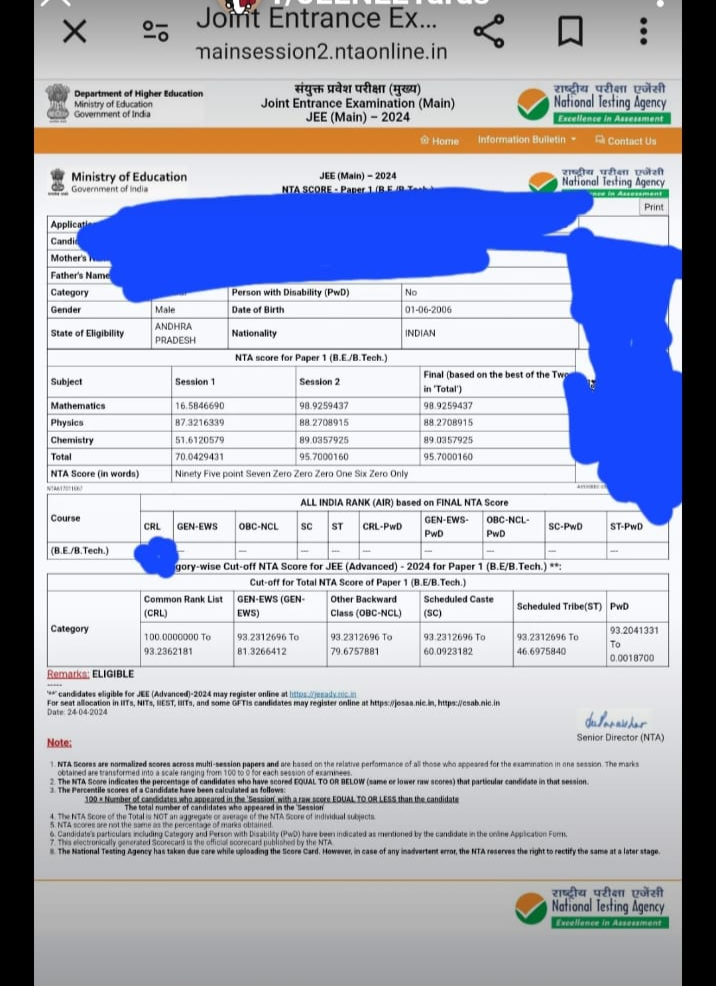
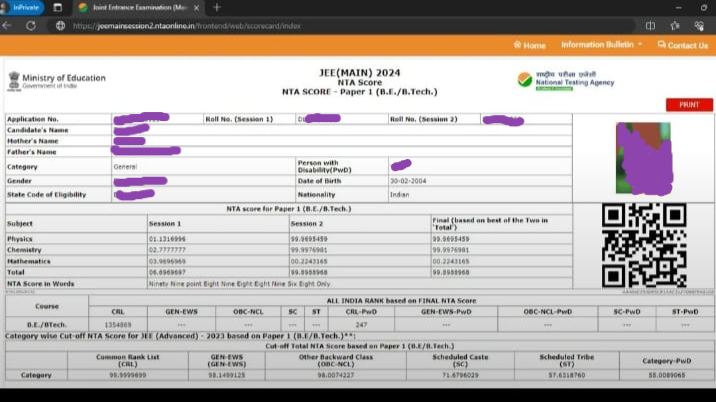
Prior to the release of the results, NTA will release the Recorded Responses and JEE Main 2026 answer key. The JEE Main 2025 scorecard will include details like the normalized percentile score in PCM, and aggregate percentile score in all three subjects. Candidates must meet the JEE Main 2025 cut-off score to be eligible for JEE Advanced 2025 exam for admission to IITs.
Session 1 results of JEE Main 2026 will be declared by February 12, 2026. The NTA will release the results online at jeemain.nta.nic.in. To check the results, follow the steps given below.
This is what a sample JEE Main scorecard looks like:
JEE Mains 2026 Expected Cutoff
NTA will release the JEE Main 2026 cut-off for the JEE Advanced 2026 exam with the result of the session 2 (April ) exam. Only such candidates who meet the cut-off will be eligible to appear in the JEE Advance exam for admission to the IITs.
Meanwhile, the JEE Mains Cutoff 2026 for institutes like the National Institutes of Technology (NITs), Indian Institutes of Information Technology (IIITs) or Government Funded Technical Institutes (GFTIs) will be released at the time of JEE Main 2026 counseling.
Allotment of seats to these institutes will be based on All India Rank in JEE Main 2026.
Expected Cut off of JEE Mains 2025 (To get shortlisted for JEE Advanced 2026)
Category
Expected Cutoff 2026
Unreserved (UR)
100.0000000 to 92.3362181
Gen-EWS
93.1312650 to 79.6467818
OBC-NCL
92.2312696 to 79.6457881
SC
92.2312696 to 62.0923182
ST
92.2312696 to 47.6975840
UR-PwD
92.2041331 to 0.0015700
JEE Main Cutoff Previous Year
Category
JEE Main 2024
2023
2022
2021
General
100.0000000 to 93.2362181
90.7788642
88.4121383
87.8992241
OBC-NCL
93.2312696 to 79.6757881
75.6229025
67.0090297
68.0234447
SC
93.2312696 to 60.0923182
73.6114227
43.0820954
46.8825338
ST
93.2312696 to 46.6975840
51.9776027
26.7771328
34.6728999
Gen-EWS
93.2312696 to 81.3266412
37.2348772
63.1114141
66.2214845
PwD
93.2041331 to 0.0018700
0.0013527
0.0031029
0.0096375
JEE Main 2025 Toppers List
NTA has released the JEE Main 2025 (Session 1) toppers list along with the result. The JEE Mains 2025 session 1 toppers list is available country, state, and gender-wise.
JEE Main Toppers 2025 – Session 1
S.No
Name
State
NTA Score (Percentile)
1
Ayush Singhal
Rajasthan
100
2
Kushagra Gupta
Karnataka
100
3
Daksh
Delhi (NCT)
100
4
Harsh Jha
Delhi (NCT)
100
5
Rait Gupta
Rajasthan
100
6
Shreyas Lohiya
Uttar Pradesh
100
7
Saksham Jindal
Rajasthan
100
8
Saurav
Uttar Pradesh
100
9
Vishad Jain
Maharashtra
100
10
Arnav Singh
Rajasthan
100
11
Shiven Vikas Toshniwal
Gujarat
100
12
Sai Manogna Guthikonda
Andhra Pradesh
100
13
S.M. Prakash Behera
Rajasthan
100
14
Bani Brata Majee
Telangana
100
What is NTA JEE Main Percentile Score?
The percentile score evaluates the relative performance of the candidate with regard to other candidates. The score is obtained by converting the raw scores into a scale ranging from 100 to 0 for each session.
The official website explains, “The Percentile Score indicates the percentage of candidates that have scored EQUAL TO OR BELOW (same or lower raw scores) that particular Percentile in that examination. Therefore the topper (highest score) of each session gets the same Percentile of 100 which is desirable. The marks obtained in between the highest and lowest scores are also converted to appropriate Percentiles.
Difference between Percentage and Percentile
There are some key differences between the percentage and the percentage score. Consult the table below to understand what each entity means and what differentiates them.
Percentage
Percentile
Percentage is a number or ratio expressed in terms of 100.
The percentile score of a candidate tells how many candidates have scored below that candidate in an exam.
Percentage is based on individual performance.
Percentile is based on relative performance.
Percentage can’t be used for comparison of performance.
Percentile can be used to compare the given value with the rest of the data.
JEE Mains Result 2026 – How is NTA Percentile Score Calculated?
The NTA uses a normalization process to convert raw scores into percentile form.
Considering the JEE Mains exam is held on multiple days and sessions, there is a chance that the difficulty level of the JEE Main question paper may vary. Now this may disadvantage some candidates.
To address this problem, the normalization process is adopted to prepare JEE Main results.
The following formula will be used to calculate the JEE Main percentile score.
Formula to normalize JEE Main Scores
JEE Mains Result 2026 – Tie-Breaker Rule
In case two or more candidates score the same marks in the JEE Main 2026 exam, the following tie-breaker rules will be adopted to decide the merit rank.
JEE Main Result 2026 Tiebreaker for Paper 1(BTech)
NTA score in Mathematics
NTA score in Physics
NTA score in Chemistry
Candidate with less proportion of a number of attempted incorrect answers and correct answers in all the subjects in the Test, followed by;
Candidate with less proportion of a number of attempted incorrect answers and correct answers in Mathematics in the Test, followed by;
Candidate with less proportion of a number of attempted incorrect answers and correct answers in Physics in the Test, followed by;
Candidate with less proportion of a number of attempted incorrect answers and correct answers in Chemistry in the Test followed by;
If there is a tie even after this, candidates will be assigned the same rank.
JEE Main 2026 Result Tiebreaker for Paper 2A (BArch)
The tie between candidates obtaining the same Total NTA scores will be resolved in the following manner:
NTA score in Mathematics, followed by;
NTA score in Aptitude Test, followed by;
NTA score in Drawing Test, followed by;
Candidate with less proportion of a number of attempted incorrect answers and correct answers in all the subjects in the Test, followed by;
Candidate with less proportion of a number of attempted incorrect answers and correct answers in Mathematics (Part-I) in the Test, followed by;
Candidate with less proportion of a number of attempted incorrect answers and correct answers in Aptitude Test (Part-II) in the Test followed by;
If there is a tie even after this, candidates will be assigned the same rank.
Once revered as one of the most prestigious professions in India, medicine is today undergoing a profound identity shift. The white coat, once a symbol of selfless service and intellectual excellence, now also represents debt, burnout, and a struggle for balance in an increasingly commercial and competitive ecosystem.
Over the last two decades, India has witnessed an unprecedented expansion of its medical education pipeline – more colleges, more seats, and more graduates than ever before. Yet beneath the surface of this growth lies a more complex story: the privatisation of medical education, the strain on young doctors, and the changing meaning of being a doctor in the digital age.
From capitation fees to telemedicine, from NEET exam to burnout, this article traces the evolving landscape of India’s medical profession – how it has grown, where it faltered, and what the future might hold for the next generation of healers.
Selling the Stethoscope: The Rabbit Hole of Medical Profession
Traditionally seen as a calling dedicated to healing and public good – honourable, stable and socially esteemed – the medical profession in India is increasingly being seen through a commercial lens.
What once drew the brightest students to medicine is now losing its luster: ever-rising fees in private medical colleges, the increasing dominance of profit-oriented institutions, and a mismatch between the ideal of caring for human lives and the reality of “meeting financial targets”
Key dynamics at play include:
Privatisation of medical education: Since the early 1990s, many new private and deemed medical colleges have emerged with high fees and capitation-based admissions, eroding merit-based access. The liberalisation of higher education opened the floodgates for private investment in the medical sector. Most private medical colleges were established with the primary aim of profit rather than service. Some of these institutions went on to acquire the coveted status of Deemed Universities, granting them wide autonomy over curricula, fee structures, and admissions. This autonomy, however, often translated into a badly compromised system – one where seats were increasingly sold through capitation fees rather than earned through academic merit.
Many of these institutions also appeared to enjoy political patronage, further eroding transparency. The reputation of the Medical Council of India (MCI) – once the statutory guardian of quality and ethics in medical education – has been sullied. Over time, the malaise deepened: medical education became a commodity, and college seats – both undergraduate and postgraduate – effectively became reserved for the rich.
Cost vs return imbalance: With tuition fees soaring, many students take on heavy debt expecting professional security and social status – but face low salaries and delayed career progression, reducing medicine’s pull for top performers.
Commercial pressures in practice: Some private hospitals and clinics now set revenue or procedure quotas for doctors, shifting the focus from patient-care to profitability. This trend undermines the altruistic dimension of the profession.
Changing student aspirations: The brightest students, once eager to enter medicine for its prestige and service, are increasingly considering alternative fields (tech, data science, business) where early returns, flexibility and innovation seem more rewarding.
In short, the transformation is not just about more seats or more doctors – it’s about the very motivations for entering medicine, and whether the system still delivers on the promise of honour, service and social mobility.
Growth of Medical Colleges, MBBS Seats, & Graduates in India: 2005 vs 2025
~112,000–118,000 (MOHFW / NMC published seat matrices for AY 2024–25 give ~1.12 lakh; later Oct-2025 approvals add seats to ~137,600 in some reports). Typical cited figure for 2024–25: ~1.12–1.18 lakh MBBS seats. (Ministry of Health and Family Welfare)
~ +200–290% (from ~30–40k → ~112–118k; or ~ +118% if measured from the 51,348 (pre-2014) baseline → ~1.12 lakh). (Ministry of Health and Family Welfare)
Estimated MBBS graduates per year
~20,000–35,000 (mid-2000s — lower because total seats then were much fewer). (Indiastat)
~70,000–92,000+ graduates/year (estimates vary with intake vs vacancies; recent studies/reviews cite ~70k–92k graduates from several hundred colleges; seat-based capacity suggests ~1.1–1.2 lakh intake → eventual graduates approaching that level within a few years if seats fill). (Knya)
Large increase — severalfold growth in annual graduates (estimates vary because of seat-fill rates and lag between intake and graduation).
Government vs private composition (colleges & seats)
Private expansion already underway by 2005; in 2005 govt and private colleges were of similar count (~131 each). (Lippincott Journals)
By 2014 private sector had grown larger than govt (private > government colleges). (Lippincott Journals)
Large share of new colleges/seats are private & deemed but recent government programmes (new medical colleges attached to district hospitals and Centrally Sponsored Scheme) have also added many government seats. Net effect: both sectors expanded; private share substantial. (Ministry of Health and Family Welfare)
Shift toward many more private colleges earlier, with strong government push post-2014 to add government colleges as well.
Postgraduate (PG) seats (MD/MS etc.)
Much smaller in mid-2000s (PG seats were limited vs UG). (Lippincott Journals)
~67,000–73,000 PG seats (various MOHFW / NMC numbers: e.g., ~72,627 or ~70–73k depending on cut-off date), with ongoing approvals adding more. (Ministry of Health and Family Welfare)
~ +100–130% increase since 2014 baseline
Doctor : population ratio and distribution
Doctor density low and highly uneven (urban concentration). (Mid-2000s WHO and studies noted shortages in rural areas). (BioMed Central)
Improvement efforts began (2014 onwards) but maldistribution persisted. (Press Information Bureau)
Overall doctor-population ratio reported to have improved (government cites 1:834), but maldistribution (urban vs rural) and registration/data inconsistencies remain major issues. (The Tribune)
Improved overall numbers, but distribution & registration quality issues persist.
Key Takeaways:
Huge capacity expansion — India’s medical education infrastructure grew dramatically since the mid-2000s, with the steepest growth after 2014 (government programs + private growth) resulting in roughly 3× the number of colleges and 2–3× the MBBS seats compared with mid-2000s levels.
More graduates, but not uniformly distributed – annual MBBS graduates have increased substantially (estimates vary ~70k–92k+), yet urban concentration of doctors and state-wise disparities persist.
PG capacity is also increasing – but postgraduate seats have lagged UG growth historically; a recent push aims to expand PG seats to absorb more graduates.
MBBS Intake has Skyrocketed, while PG Capacity Lagged
In 2005, India had around 260 medical colleges with about 30,000–35,000 MBBS seats. Fast-forward to 2025, and there are now over 780 medical colleges offering around 1.1–1.2 lakh MBBS seats. That’s nearly a threefold increase in two decades – an incredible expansion that has taken medical education to smaller cities and districts.
But there’s a catch: postgraduate (PG) seats haven’t kept pace. While MBBS seats have grown explosively, PG courses (MD/MS and diplomas) have risen from about 30,000 in 2014 to 70,000+ today – not nearly enough to absorb the surge of new graduates.
The result? Every year, thousands of MBBS doctors find themselves in limbo – underemployed, preparing endlessly for NEET-PG, or working long shifts for modest pay. The system produces more doctors than it can currently train to specialist levels.
National Entrance Reforms (NEET/NEXT): Equalising Access or Intensifying Pressure?
The introduction of NEET (National Eligibility cum Entrance Test) promised a fairer and more transparent admission process. Gone were the days of multiple state and private exams – one test for all, based on merit.
However, this “one nation, one exam” policy has also created a high-stakes, all-or-nothing environment. Students from disadvantaged backgrounds, non-English medium schools, or rural areas often find it harder to compete in this national pool. Coaching centres have mushroomed, making entry into medicine heavily dependent on the ability to afford years of test prep.
With NEXT (National Exit Test) on the horizon, the stress extends even further – now tying MBBS graduation, medical licensing, and PG admission to a single exam. The playing field may be level, but it’s also far steeper.
Fresh MBBS Graduates’ Remuneration vs. Inflation & Skill: A Falling Real-Wage Scenario
Medicine is still seen as noble, but it’s no longer necessarily lucrative – at least not in the early years. A freshly minted MBBS doctor working in a hospital or rural posting often earns ₹25,000–₹40,000 a month, barely higher than stipends from a decade ago. Adjusted for inflation, real earnings have dropped, even as the workload and training costs have skyrocketed.
In contrast, graduates from other fields – IT, consulting, even design – often start with higher pay and better work-life balance. The mismatch between skill, responsibility, and compensation has eroded morale, with many young doctors reconsidering long-term practice or moving abroad.
When Medicine Meets Technology: The New Reality for Doctors
The medical profession is no longer insulated from technology’s march. The rise of teleconsultations, AI-based diagnostics, and health-tech platforms has redefined what it means to “practice medicine.”
Today, algorithms can read X-rays, detect diabetic retinopathy, and assist in triage – sometimes more accurately than a human junior doctor. Start-ups and corporate hospital chains are reshaping healthcare delivery, shifting value toward data, digital access, and convenience, rather than pure clinical experience.
For young MBBS graduates, this creates both opportunity and anxiety – the chance to innovate, but also the fear of being replaced or underutilized in a tech-driven ecosystem.
New-Age Doctors: Work-Life Balance, Global Mobility, & Career
The old dream – “become a specialist, open a clinic, settle down” – no longer appeals to everyone. Today’s medical students increasingly talk about lifestyle, flexibility, and financial freedom. Many aspire to global careers, pursue non-clinical roles in public health, research, management, or policy, or even transition to tech and start-ups.
Indian doctors are also migrating in large numbers: by some estimates, over 20% of the NHS doctor workforce in the UK is of Indian origin. The new generation values impact and recognition – but also boundaries, something the older medical hierarchy rarely offered.
Private Medical College Boom: Market Saturation, Capitation, Quality and Access Issues
Private medical education has exploded. From just over 130 private colleges in 2005, India now has nearly 400+ private medical institutions, many charging ₹60 lakh to ₹1 crore for an MBBS seat.
While this expansion improved access geographically, it also raised concerns about training quality, faculty shortages, and commercialisation. The high cost of entry pushes students toward debt – and, in some cases, toward careers that prioritise return on investment over service.
Government initiatives, like new colleges attached to district hospitals, aim to rebalance this, but the gap in standards remains wide.
From Revered to Real: The Changing Face of MBBS Life
In 2025, a survey (published in the Indian Journal of Psychiatry) found that about 27.9 % of medical faculty across four tertiary-care teaching hospitals in North India were at risk of burnout — with ~11.9 % at very high risk. Lippincott Journals
Meanwhile, earlier research reported that up to ~45 % of doctors in India scored high on emotional exhaustion and ~66 % on depersonalisation. The Times of India
These figures mirror the growing burden of the profession: long hours, high emotional load of caring for patients (often in under-resourced settings), administrative paperwork, intense competition for PG seats, and declining work-life balance. For example, a LinkedIn article by Dr Subhajit Biswas (2025) states that junior doctors in private hospitals are earning as low as ₹35,000–₹50,000/month, despite working 60-plus hours weekly and facing fierce job competition.
This shift—from being a profession of prestige and relative stability to one of constant strain and real-life stress—is increasingly visible, especially via social media and blogs where doctors candidly describe “doing MBBS and then feeling like I’m a 12-hour duty machine” or “sacrificing my 20s for a specialty I may never get” Reddit
The Government of Assam has launched the Global Language Skills Initiative, a flagship program aimed at preparing the state’s youth for international careers through advanced foreign language and skill development training.
Phase I of the initiative commenced in October 2025, beginning with Japanese language training for the first batch of 180 candidates at the North East Skill Centre in Guwahati.
This phase marks the start of Assam’s participation in Japan’s Specified Skilled Worker (SSW) program, enabling young Assamese professionals to qualify for overseas employment opportunities.
Implemented under the Chief Minister’s vision of developing “global human talent,” the initiative is supported by substantial state subsidies and partnerships with accredited Japanese training and placement organizations. By providing accessible, high-quality language education, Assam aims to empower its youth to compete in global markets and transform the state into a hub for internationally skilled professionals.
Assam Global Language Skills Initiative – What’s it?
As part of the Global Language Skills Initiative, the Government of Assam aims to link language learning directly with international employment opportunities, beginning with Japan under the Specified Skilled Worker (SSW) program. The initiative seeks to prepare Assamese youth not only to learn a new language but also to access stable, well-paid jobs abroad in sectors where Japan faces acute workforce shortages.
The SSW program will allow students to work in 14 designated sectors – for up to five years, with the possibility of extension or transition to a higher skill category. To qualify, candidates must clear Japanese language proficiency tests (such as JLPT N4 or JFT Basic) and a sector-specific skills examination. Assam’s trainees will receive structured preparation for both, alongside cultural orientation and workplace readiness modules.
Job placement support will be provided through approved Japanese partner organizations collaborating with the Assam government, such as ASEAN ONE Co. Ltd. and Meiko Career Partners Co. Ltd. These partners will help match certified candidates with verified Japanese employers, ensuring that recruitment follows ethical and transparent standards. Candidates who complete training and meet language and skill criteria will then proceed for visa processing under the SSW (i) category.
To ensure focused implementation, the initiative began with a pilot batch of 180 trainees in Phase I (Japanese language), with plans to scale up to 50,000 candidates under future phases across Assam.
Type
Intake
Additional Info
Pilot / first cohort
180 candidates
First-phase Japanese training
Government-stated target
50,000 youth
Multi-year/ambitious target announced
Assam Global Language Skills Initiative – Jobs & Salary
In terms of salary, foreign workers under Japan’s SSW scheme earn between ¥160,000 and ¥280,000 per month (approximately ₹94,000–₹164,000) depending on the sector, region, and experience. This is significantly higher than the average entry-level salary in India, which ranges around ₹19,000–₹20,000 per month, offering a strong incentive for globally mobile youth. While living costs in Japan are higher, participants also benefit from social insurance coverage, regulated working hours, and the opportunity to build international work experience that can enhance long-term career prospects both abroad and back home in Assam.
Here’s a table tailored for students completing the CM‑FLIGHT program by the Assam Government (studying Japanese, eligible for jobs in Japan) – job roles, approximate salaries. These are indicative ranges based on available reports.
Assam Global Japanese Skills Initiative – Jobs Type, Salary
Reported range in scheme: ~ ₹1.8 lakh – ₹2.2 lakh/month (INR)
—
Specific to CM-FLIGHT scheme report for driving. (Ne Career)
General overseas placement via CM-FLIGHT (all-industry)
Up to ~ ₹2 lakh/month (INR)
—
Assam Government stated up-to figure. (NewKerala.com)
While the Assam Government’s CM-FLIGHT Japanese-language programme primarily targets vocational overseas placements (in caregiving, construction, food service, etc.), students completing advanced Japanese proficiency (N3–N2 and beyond) can also pursue language-based professional jobs:
Assam Global Japanese Skills Initiative – Language-based Jobs Type, Salary
Job Role
Typical Salary in Japan (¥/month)
Approx Salary in India (₹/month)
Description / Notes / Sources
Japanese Language Teacher / Trainer
¥250,000 – ¥400,000
₹30,000 – ₹80,000
Teaching Japanese in India (schools, universities, private institutes) or teaching English in Japan through exchange programmes. Japan Foundation, India runs similar recruitments.
Translator (Japanese ⇄ English)
¥250,000 – ¥500,000
₹40,000 – ₹1 lakh
Translating documents, manuals, websites, and technical texts. In India, it is used heavily in automotive, manufacturing & IT. AmbitionBox shows ₹3.5 – ₹14.5 lakh/yr.
Interpreter (Spoken Translation)
¥300,000 – ¥600,000
₹50,000 – ₹1.5 lakh
Real-time interpreting for Japanese executives or technical teams in India/Japan. Highly paid if JLPT N2–N1 and technical vocabulary known.
Bilingual Coordinator / Liaison Officer
¥280,000 – ¥500,000
₹60,000 – ₹1 lakh
Working with Japanese companies in India (Honda, Toyota, Denso, etc.) to coordinate between Japanese and local teams.
Japanese Process Associate / BPO Executive
—
₹25,000 – ₹60,000
Japanese-language roles in multinational BPOs (Accenture, Wipro, TCS, Genpact). Requires at least JLPT N3.
Japanese Content Reviewer / QA Analyst
—
₹35,000 – ₹80,000
Reviewing online content or translations for Japanese accuracy in tech firms (Google, Amazon).
Tour Guide / Travel Coordinator
¥200,000 – ¥350,000
₹20,000 – ₹60,000
For inbound Japanese tourists in India or Indian tourists visiting Japan. Needs good conversational fluency (N3+).
Freelance Translator / Online Tutor
Variable (¥2 – ¥10 per character)
₹500 – ₹2,000 per hour
Remote freelance translation, subtitling, or online Japanese teaching. Rates depend on experience.
Reference: The following are salary details for the Indian market a student can expect to earn after completing a Japanese language course.
Role
Annual Salary (INR)
Monthly Approximation
Source & Notes
Japanese Language Teacher (entry-level)
~ ₹2 Lakh to ₹4 Lakh
~ ₹16,000 to ₹33,000
Based on data: range ~ ₹2 Lakh to ₹7.5 Lakh per annum. (AmbitionBox)
Assam Foreign Language Skills Program – Eligibility, How to Apply
Interested candidates can apply to the Assam Global Language Skills Program through the official Assam Skill Development Mission (ASDM) portal or designated training centres once registration for each phase opens. The program is currently being implemented under the Chief Minister’s Foreign Languages Initiative for Global Human Talent (CM-FLIGHT), with Phase I focusing on Japanese language training.
Eligibility Criteria:
Applicants must be residents of Assam,
Age Limit: To be eligible for the “Chief Minister’s Foreign Language Initiative for Global Human Talent (CM-FLIGHT)”, the applicant must be between 18 to 45 years of age.
Academic Qualification – The candidate must possess the necessary educational qualifications relevant to the domain, sector, or trade they wish to pursue employment.
English language requirement – The candidate must have a basic understanding of English.
The candidate must hold an Aadhaar Card.
Application Process:
Online Registration: Visit the official ASDM website (https://asdm.assam.gov.in) or follow notifications on the Skill, Employment & Entrepreneurship Department’s social media channels.
Document Submission: Upload essential documents such as ID proof, educational certificates, and passport-size photographs.
Screening & Counselling: Shortlisted candidates may be invited for a counselling session or interview to confirm readiness for language training and overseas placement.
Fee Payment: After selection, candidates must pay their share of the training cost (currently around ₹30,000, with the state government subsidizing up to ₹1.5 lakh per candidate).
Training Commencement: Enrolled participants begin full-time language training (e.g., Japanese in Phase I) at approved centres such as the North East Skill Centre, Guwahati.
Certification & Placement: Upon completing language proficiency and skills certification, successful candidates will be guided toward job placement and visa processing through approved international partners.
Assam Global Language Skills Initiative – Program Cost, Govt Subsidy
To make international language training accessible, the Government of Assam has adopted a cost-sharing model under the Global Language Skills Initiative, providing substantial subsidies that cover the majority of program expenses for each candidate.
Financial Support Under the Scheme – What Official Notification Says
Under the scheme, financial assistance will be extended as follows:
i) For Foreign Language Training cum Implementation Partner – A training support cost of ₹1,00,000 per candidate will be provided. The training support cost will be paid out per candidate as follows:
Tranche
Milestone
% of Amount
Amount (INR)
1
On successful certification of Foreign Language Proficiency Test (eg. JLPT N2 or equivalent) of the candidates
50%
₹50,000
2
On Candidate producing – a) Certificate of Eligibility, b) Confirmed offer of appointment, c) Visa and d) Confirmed Air Ticket
50%
₹50,000
ii) For Candidates: On Candidate producing a) Certificate of Eligibility, b) Confirmed offer of appointment, c) Visa and d) Confirmed Air Ticket, the candidate will receive an amount of ₹50,000 as post-placement assistance from the Government of Assam to support initial settlement and relocation needs in the destination country.
Assam Foreign Language Training Program – Fees to be Paid by Candidates
As per estimates given by the government, for a 10 – 12 months long Foreign Language Proficiency Training, the fees to be paid by candidates may range approx. ₹ 3,00,000 to ₹ 4,00,000, which covers:
Entrance Exam Fee
Admission
Training & Materials Fee
Tuition Fee and
Exam Fee.
Indicative Costs to be borne by the candidates (other than fees)
As per estimates given by the government, apart from the training-related fees, candidates will be responsible for covering additional expenses amounting to around ₹ 1,00,000 – ₹ 1,80,000 towards:
a) One-way Travel (Flight Tickets)
b) Medical Check-up Cost
c) Lodging & Boarding during training (If required)
d) Commutation during training (If required) and
e) Visa Fees etc.
Important:
Admission notices and phase-wise updates will be published only through official ASDM and Government of Assam channels – applicants should avoid unofficial agents or intermediaries.
Candidates are encouraged to maintain a valid passport and stay updated on test dates for JLPT or JFT-Basic (for Japan) where applicable.
Artificial Intelligence (AI) is no longer a distant concept of science fiction – it’s already shaping how we learn, teach, and even think about education. From intelligent tutoring systems and auto-grading tools to personalized learning paths and campus analytics, AI promises to make higher education smarter, faster, and more efficient. In India, the conversation is gaining momentum: policies like NITI Aayog’s National AI Strategy and updates from AICTE and UGC signal that AI is moving from buzzword to classroom reality.
But as exciting as this sounds, questions abound. Are our universities ready to handle AI responsibly? Will students truly benefit, or will technology create new inequalities? How can educators and parents navigate the ethical, practical, and social challenges that come with it?
This article explores the readiness, challenges, and opportunities of integrating AI in Indian higher education – breaking it down in a student-friendly, relatable way while highlighting what it means for everyone involved in shaping the future of learning.
Table of Contents
AI in the Classroom: Hype or Game Changer?
The promise of artificial intelligence in education has captured imaginations: imagine a tutor that adapts to your pace, an auto-grading system that frees your professor from repetitive tasks, or a learning path that guides you exactly where you need help. But before we call it a game changer, we must ask: is this hype or real transformation? Across the world – and in India – some institutions are piloting adaptive platforms and analytics tools, but success depends on how thoughtfully they are implemented. If used well, AI can sharpen learning; if used poorly, it becomes a flashy gimmick. The key for Indian campuses is: pick the right tools, train the right people, and use AI to teach better, not just to seem modern.
Is India Ready for an AI-Driven Campus?
India has the policy momentum. National strategy documents emphasise the role of AI in development and education, suggesting that the country is gearing up. Yet readiness at the institutional level is uneven: top universities may be experimenting, but many smaller colleges are still catching up. For example, a review of Indian universities found that while demographic advantage and policy frameworks exist, actual institutional practices vary widely. Before we roll out AI campus-wide, we must ask: is the infrastructure in place? Are faculty trained? Are budgets provisioned? Without these pieces, many campuses may fall behind.
Smarter Syllabuses: Bringing AI into Every Subject
When people hear “AI,” they often think “computer science”. But the future of AI in higher education is far broader. In India, regulators such as the All India Council for Technical Education (AICTE) have published model curricula for AI and robotics, encouraging colleges to integrate AI into engineering, business, humanities – even social sciences. This opens fresh opportunities for students: you could study AI-enabled finance, AI in healthcare, or AI for the environment. The shift means curricula are no longer static – students graduating five years from now need to be ready for an AI-rich world.
Teachers vs Tech: Who’s Teaching Whom?
Here’s a little twist: yes, AI tools are advancing fast – but teachers still matter. In fact, AI is only as good as the person guiding its use. Many educators in India are still used to traditional lecture-assessment styles, and implementing AI demands new skills: data literacy, ability to design adaptive lessons, comfort with mixed modes of teaching. Without training and support, even the best tech may gather dust. The message? Faculty development is the high-impact, low-cost move that can turn an AI pilot into a sustainable change.
From Students to Skill-Seekers: AI and the New Job World
For students and parents, the big question is: “Will I get a job?” The answer: yes — if you build the right skills. Recent reports show Indian graduates have a 46.1% employability rate in AI and ML-related roles, the highest among technical domains.
But – and it’s a big but—overall graduate employability dipped slightly in 2024, reflecting rising expectations for both technical and non-technical skills.What this means: to succeed you’ll need AI-skills and human skills – creativity, critical thinking, adaptability. For educators and parents, this points to higher education not just delivering degrees, but preparing students for a changing job world.
Generative AI is no longer sci-fi: students are using it to write essays, solve programming problems, even craft lab reports. That’s opened a can of worms in assessment and integrity. If AI can do the work, how do we ensure students learn rather than just delegate? Some studies abroad have shown AI-written answers can fool markers. In India the same risks apply: plagiarism, loss of learning, bias in algorithmic tools. Institutions must rethink assessments (open-book exams, project work, portfolios) and create clear guidelines about how AI tools can be used. For students and parents alike, the message is: use AI as help, not as a shortcut to pass.
Mind the Gap: Digital Divide in Indian Education
Access matters. India’s digital infrastructure is improving fast – yet still has gaps. At the start of 2025, there were about 806 million internet users in India, representing roughly 55.3% of the population.
But that leaves approximately 45% offline. Many of these are rural students, or those in small towns with limited devices and weaker broadband. One result: AI-tools (which often need stable connectivity and devices) may help some students hugely – but others risk being left further behind. Equity must be built in: blended models, low-bandwidth versions, regional language content. Parents of rural students and policymakers must ask: will AI widen the gap, or help bridge it?
Who Owns Your Data? Privacy in the Age of AI Learning
Personalised learning asks for personal data: what you’ve learned, how you learn, how fast you process information. That means campuses need strong data governance. In India, while the Digital Personal Data Protection Act, 2023 is a start, its full implementation and campus-level rules are still emerging. Students (and parents!) should ask: how is my learning data stored? Who can see it? Can it be used for marketing, or worse, by bias-ridden algorithms? Institutions must publish student-friendly policies around consent, retention, algorithm transparency, and appeal mechanisms. This builds trust and makes AI adoption sustainable.
Powering the Future: Building AI-Ready Universities
Hardware, software, partnerships with industry and research labs – these are the nuts and bolts of an “AI-ready” campus. But rhetoric is easier than reality. Many Indian institutions cite infrastructure and budget as bottlenecks. Yet with fast-improving connectivity (95% plus of Indian villages had 3G/4G mobile connectivity by March 2024) the time is right to invest. For students and parents this means checking: does my college offer AI electives, labs, external partnerships? For faculty it means advocating for better labs, cloud credits, industry exposure. For policymakers it means targeted funding and enabling ecosystem change.
The Road Ahead: Making Indian Education Future-Proof
India stands at a crossroads. On one hand: strong demographic advantage, ambitious policies, an emerging AI ecosystem. On the other: uneven access, skills gaps, infrastructure constraints and ethical/data governance questions. If Indian higher education gets the foundations right—teacher training, equitable access, updated curriculum, data ethics—then AI can become an opportunity. If not, we risk deepening divides and producing graduates un-aligned with jobs. For students, parents and educators alike, the message is clear: The future won’t wait. Embrace AI wisely. Learn the tools, ask the right questions, demand accountability. That’s how we make Indian education not just AI-enabled, but future-proof.
Quick Reference: AI in Indian Higher Education (2025)
Category
Data Point
Source
AI in Education Market Size
Projected to reach $2.06 billion by 2030, growing at a 36.5% CAGR from 2025 to 2030.
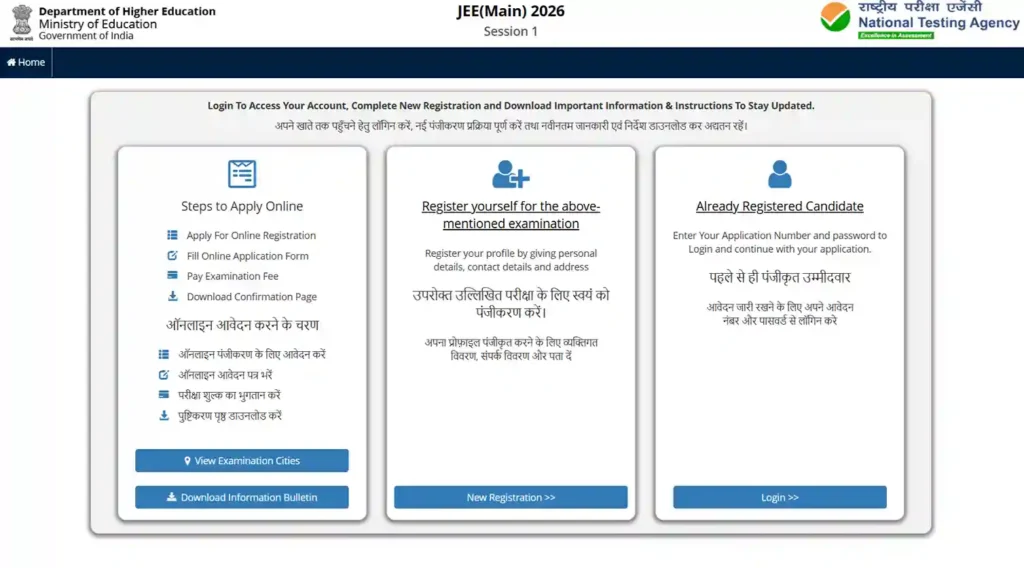
JEE Main Registration Demo Link 2026 – The National Testing Agency (NTA) had opened the JEE Main 2026 demo registration process at demo.nta.nic.in.
The JEE Main 2026 demo registration process was meant to enable aspirants practice the online application process ahead of the official window. JEE Main 2026 application is expected to open anytime now; NTA released an advisory on Oct 19, stating that application will START in October 2025..
The demo registration process replicates the Online Application Processing System, enabling candidates to practice entering personal details, uploading documents like Aadhaar or category certificates, and simulating fee payments. The demo can thus help candidates minimize errors, enhance confidence, and streamline the JEE Main 2026 application form submission process.
With a high-level panel reviewing JEE Main’s difficulty to ensure fairness, this tool is critical for error-free applications amid rising competition. By familiarizing users with the process, NTA aims to streamline submissions and reduce last-minute stress. Candidates are urged to use this opportunity to prepare for a seamless registration experience, ensuring they meet all requirements before the deadline.
NTA will conduct the JEE Main 2026 exam in TWO sessions – January and April. More than 15 lakh candidates are expected to register for the national-level entrance exam. JEE Main 2026 is the gateway to NITs, IIITs, and a stepping stone to JEE Advanced for IIT admissions.
Familiarizes candidates with GOAPS portal for form-filling, uploads, and payments.
Fee Simulation
Trial run for payments (e.g., ₹1,000 General/OBC/EWS).
Helpline/Support
24×7 Query Redressal System (QRS) at NTA; contact via jeemain.nta.nic.in for tracking issues.
Do I need to meet any specific JEE Main 2026 eligibility criteria to use demo registration?
No specific eligibility criteria are required to use the JEE Main 2026 demo registration at demo.nta.nic.in. The demo portal is open to all aspiring candidates to practice the application process, including form-filling, document uploads, and fee simulation. It’s designed to familiarize users with the GOAPS system, requiring only a stable internet connection and basic details for practice, regardless of academic or personal qualifications.
To use the JEE Main 2026 demo registration link, follow these steps to practice the application process effectively:
Access the Demo Portal: Visit demo.nta.nic.in using a stable internet connection and any standard browser (e.g., Chrome, Firefox). The demo link was activated on October 7, 2025.
Navigate the Interface: Explore the mock version of the GOAPS portal, which mirrors the official site (jeemain.nta.nic.in). No login credentials are required for demo access; select the “New Registration” tab.
Practice Form-Filling: Enter dummy personal and academic details (e.g., name, date of birth, Class 12 marks) to simulate the registration process. The demo provides sample fields to mimic the actual form.
Simulate Document Uploads: Upload sample files for required documents like a passport-sized photo (10-300 KB, JPG), signature (10-50 KB, JPG), Aadhaar, or category certificates (EWS/SC/ST/OBC-NCL). Follow on-screen guidelines for format and size.
Test Fee Payment Process: Practice the payment simulation (no real transaction occurs) using dummy credit/debit card or net banking details. The demo reflects expected fees (e.g., ₹1,000 for General/OBC/EWS, ₹500 for SC/ST/PwD/Female for one session, per 2025 norms).
Review and Submit: Preview the mock application, check for errors, and simulate submission to understand the confirmation process.
Seek Help if Needed: For demo-related issues, use NTA’s 24×7 Query Redressal System (QRS) at nta.ac.in/qrs or contact jeemain@nta.ac.in or 011-40759000.
Note: The demo is for practice only; no data is saved, and it’s accessible to all without eligibility criteria. Use it to prepare for the official registration at jeemain.nta.nic.in.
This is what the JEE Main 2026 Demo Portal Looks Like:
JEE Main 2026 Application Form
The official JEE Main 2026 application form will open anytime now. In an earlier notification, the NTA had notified that it will release the JEE Main 2026 application form in October 2026.
Candidates who meet the JEE Main 2026 eligibility criteria must fill out the form before the last date.
JEE Main 2026 Application Form Fee
Course(s) / Paper(s)
Category/ PwD/PwBD
Gender
Fee Per Session for Candidates appearing in India (In Rs.)
Fee Per Session for Candidates appearing from Outside India (In Rs.)
Paper 1: B.E./B. Tech or Paper 2A: B. Arch or Paper 2B: B.Planning
General
Male
1000
5000
Female
800
4000
Gen-EWS/ OBC(NCL)
Male
900
4500
Female
800
4000
SC/ST/PwD/PwBD
Male
500
2500
Female
500
2500
Paper 1: B.E./B. Tech & Paper 2A: B. Arch or Paper 1: B.E./B. Tech & Paper 2B: B. Planning or Paper 1: B.E./B.Tech, Paper 2A: B. Arch & Paper 2B : B.Planning
As a student or parent diving into the world of JEE Main exam preparation, the journey to crack one of India’s toughest exams can feel overwhelming. With over 10 lakh aspirants competing for a spot in top engineering colleges like NITs and IIITs, standing out requires smart strategies. That’s where Artificial Intelligence (AI) steps in, offering tools that act like personal tutors, tailoring study plans, solving doubts instantly, and boosting confidence.
After exploring reliable sources like Times of India, ResearchGate, NTA’s Abhyas app, and IIT-backed platforms, we’ve put together this guide to share practical ways students can use AI for JEE Main 2026 prep.
From personalized practice to managing stress, this article covers specific tips, top AI tools, their pros and cons, and a quick look at how India’s AI edge shapes your prep. Let’s make sense of how AI can simplify your journey to success!
Table of Contents
Concrete Tips: Integrating AI into Your Daily JEE Routine
Before we delve deeper, let this be made clear.
AI isn’t a substitute for foundational learning tools like NCERT textbooks or mock tests — it serves as a catalyst to enhance and accelerate the learning process.
Here are five proven tips, each with real-world examples, to embed AI seamlessly into your prep. These are derived from success stories shared on platforms like Achieve.ai and Humanli.ai, where users reported 20-30% score improvements in mock tests.
1. Personalized Study Planning with Adaptive Algorithms
Start by inputting your syllabus coverage and weak areas into an AI planner. It generates a customized timetable, adjusting for your pace.
2. Instant Doubt Resolution for Conceptual Clarity
Snap a photo of a tricky problem or type a query – AI breaks it down step-by-step, linking to JEE patterns. This saves hours lost in coaching queues.
Example: You can upload, for example, a JEE Advanced-level integral from Calculus. The AI not only will solve it but cross-reference it to previous years’ JEE question, explaining substitution techniques. This can help solve doubts within minutes, reducing study frustration.
3. Adaptive Practice and Mock Test Analysis
AI curates questions escalating in difficulty, then dissects your performance to highlight patterns like time traps in Mathematics.
Example: Let us consider, you are weak in Organic Chemistry section of the JEE Main paper. Post-test, the tool will flag the missteps in reaction mechanisms, and could recommend targeted MCQs from, say NCERT Chapter 12. This way you can improve accuracy substantially in revisions, aligning with the tool’s real-time feedback loop.
4. Predictive Analytics for Weak Spot Targeting
Track progress via AI dashboards that forecast exam-day scores based on trends, urging focus on high-yield topics.
Example: Humanli.ai’s analytics can predict a user’s low Thermodynamics score based on mocks. It will also prescribe video summaries and practice questions. This can help gradually improve your mock scores substantially, validating the tool’s machine learning accuracy for JEE 2025 patterns.
5. Stress Management and Motivation Boosts
AI chatbots offer tailored relaxation tips or motivational nudges, analyzing study logs for burnout signs.
Top AI Tools for JEE Main Preparation: Features and Usage
The landscape in 2025 boasts specialized tools from IIT alumni and NTA-backed apps. Here’s a curated list of the most reliable ones, selected for their alignment with JEE Main syllabus, user ratings (4.5+ on app stores), and endorsements from sources like India Today and ResearchGate. Each excels in adaptive learning, with free tiers for accessibility.
Input a Thermodynamics doubt for instant solutions; use revision scheduler for weak chapters like Coordinate Geometry.
Free trial; Full ₹799/year.
Doubt clearing and revision.
StudentAI JEE Solver
Step-by-step problem guidance, precise answers with explanations, adaptive to user queries.
Solve a complex Electrostatics problem; get breakdowns and similar JEE past questions.
Free basic; Pro ₹299/month.
Problem-solving mastery.
JEE Genius
Past JEE database (decades of questions), trend analysis, custom practice sets, motivational tips.
Query “Thermodynamics trends 2020-2025” for patterned questions and solutions.
Free.
Exam pattern insights.
NTA Abhyas App
Official NTA mocks, chapter-wise tests, personalized feedback.
Simulate full JEE Main sessions; analyze errors in real-time.
Free.
Authentic NTA practice.
The Flip Side: Disadvantages of AI in JEE Prep
While AI amplifies efficiency, it’s not flawless. From Springer Publishing and Turnitin analyses, over-reliance can hinder deep learning – AI excels at patterns but falters on novel twists in JEE Advanced. Key drawbacks include:
Accuracy Gaps: AI may err on nuanced topics (e.g., ambiguous Physics derivations), requiring cross-verification with textbooks. A Quora expert noted ChatGPT’s unreliability for JEE math proofs.
Over-Dependence Risk: Undermines critical thinking; students might skip manual solving, leading to exam-day panic. ResearchGate reports 15-20% retention drop without human guidance.
Data Privacy Concerns: Tools collect study habits; ensure GDPR-compliant platforms like Humanli.ai to avoid leaks.
Digital Fatigue: Screen-heavy use causes burnout; balance with offline sessions, as advised in Times of India guides.
Limited Creativity: AI sticks to trained data, missing innovative shortcuts JEE toppers devise.
Mitigate by limiting AI to 20-40% of prep time and verifying outputs.
AI for JEE Main Success: A Quick Reference Table
Aspect
Do’s
Don’ts
Daily Integration
Use AI for 1-hour targeted practice post-NCERT reading.
Rely solely on AI without solving problems manually first.
Tool Selection
Pick 2-3 tools based on needs (e.g., Achieve for mocks, Doubt.ai for queries).
Overload with multiple apps—leads to fragmented focus.
Performance Tracking
Review AI analytics weekly; adjust plans accordingly.
Ignore offline mocks; AI simulations aren’t identical to NTA’s.
Balance & Ethics
Combine with group study; cite AI aids in notes.
Copy AI solutions verbatim—builds no retention.
Long-Term Mindset
Treat AI as a coach, not a crutch; aim for conceptual ownership.
Panic if AI predicts low scores – use it as motivation, not defeat.
AI in Exam Prep: India’s Edge and Implications
India’s AI integration in exam prep outpaces many nations, with adaptive platforms like Embibe serving millions for JEE/NEET—far beyond the U.S.’s Khan Academy focus on K-12 or China’s curriculum-embedded AI ethics training. Per ResearchGate’s 2025 analysis, India’s edtech boom (₹500 crore AI education budget) enables hyper-personalized, affordable tools, contrasting Europe’s regulatory-heavy approach (e.g., EU’s AI Act delays). For Indian students, this means equitable access in a high-stakes ecosystem, boosting rank predictability by 40% via predictive analytics. However, it demands digital literacy to avoid biases in AI datasets, positioning our youth as global AI-savvy innovators—if balanced with human mentorship.
In closing, AI isn’t magic – it’s your multiplier. Commit to consistent, verified use, and JEE Main 2026 could be your triumph. For tailored advice, explore these tools today. Your IIT dream awaits.