NMAT Registration 2025 closing on October 18; Apply Here

0

New Delhi, October 16, 2025 – Aspiring MBA candidates have just two days left to register for the NMAT by GMAC 2025 exam, as the Graduate Management Admission Council (GMAC) has extended the application window until October 18, 2025. This last-minute extension from the original October 10 deadline provides a crucial opportunity for students aiming to secure admissions to over 50 prestigious B-schools, including NMIMS Mumbai, TAPMI Manipal, XIM University Bhubaneswar, and KJ Somaiya Institute of Management.

The NMAT, known for its candidate-friendly format, offers a flexible testing window from November 5 to December 19, 2025, allowing up to three attempts with 15-day gaps between retakes. Unofficial scores are available immediately post-exam, making it an ideal choice for those seeking quick feedback. With the exam spanning 44 days and conducted as a computer-based test at over 86 centers across 79 Indian cities – or via online proctored mode internationally – applicants can now schedule their slots until October 25, 2025.

NMAT Registration 2025 – Important Dates

EventDate
Registration StartAugust 1, 2025
Registration ClosesOctober 18, 2025
Exam Scheduling ClosesOctober 25, 2025
Exam WindowNovember 5 – December 19, 2025
Admit Card ReleaseFrom October 28, 2025 (7 days prior to exam)
Results DeclarationFrom November 5 – December 21, 2025
Rescheduling WindowUntil December 16, 2025

NMAT 2025 Eligibility Criteria

Candidates need a bachelor’s degree (or equivalent) with at least 50% aggregate marks from a recognized university. Final-year students and those awaiting results can apply provisionally, but they must verify specific criteria for participating institutes.

NMAT Application Form 2025 – How to Apply

  1. Create an Applicant Account: Visit the official NMAT exam portal – nmat.org.in or mba.com/exams/nmat and register with your name, email, and mobile number.
  2. Fill the Form: Provide personal, educational, and work experience details. Upload a recent passport-size photo (JPEG/JPG) and select up to five preferred B-schools for score reports.
  3. Choose the NMAT 2025 exam mode and schedule: Opt for test center or online proctored mode, then book your preferred date and time.
  4. Pay the Fee: The registration fee is INR 3,000 plus applicable taxes. Payments are accepted via credit/debit cards, net banking, or wallets.

Confirm and Download: Post-payment, access your dashboard for confirmation, admit card (from October 28), and future updates.

NEET Counseling 2025 – Round III Allotment (October 18), Seat Matrix, Fee Payment & Reporting

NEET Counseling 2025 – MCC will declare the NEET 2025 seat allotment for Round III on October 18, 2025 (postponed from Oct. 8). The direct link to check the check the seat allotment status will be provided here.

Candidates who are allotted seats will have to report to the allotted institute between October 19 and October 27, 2025. When reporting to the institute, bring the NEET 2025 admit card, NEET 2025 scorecard, seat allotment letter, Class X and XII marksheets and pass certificates, Photo ID, Category Certificate (if applicable), PwD certificate (if applicable), and other necessary documents.

The counselling registration for Round III was conducted from Sept. 30 to October 5, 2025 (12 noon); payment of fee was accepted till 3 pm, Oct, 5, 2025. Choice filling and locking was open till October 16, 2025 (4 pm). NEET 2025 results were declared on June 14, 2025. The scores of the exam are used to shortlist candidates for the counseling process. 

The NEET 2025 seat allotment result for Round II was declared on September 17, 2025.

The NEET 2025 counselling is conducted in TWO parts.

Counseling for 15% All India Quota (AIQ) seats will be organized by the MCC. Meanwhile, the State Counselling authorities will conduct the NEET State Counselling for the remaining 85% State Quota seats. 

The Medical Counselling Committee (MCC) will conduct counseling for 15% AIQ seats in online mode. However, if seats remain vacant after the last round of regular counseling, a physical round of counseling will be conducted at respective participating institutes. Note that NEET 2025 may have around five to six seat allotment rounds.

The NEET UG counseling is held for admission to MBBS, BDS, and B.Sc Nursing seats offered by all government and private medical, dental and certain nursing colleges.. 

Candidates who have qualified in the NEET 2025 exam are eligible to participate in the counseling process, which will be conducted online. Currently, there are 1,09,170 MBBS and 27,868 BDS seats that will be offered through NEET counseling.

NTA conducted the NEET 2025 exam on May 4, 2025.

Latest Updates:

NEET Counseling 2025 – Key Highlights

ParticularsDescription
NEET 2025 counseling START dateOngoing
Mode of NEET 2025 CounsellingOnline
Who will conduct the NEET 2025 counseling15% All India Quota (AIQ) seatsMedical Counselling Committee (MCC)

85% State quota seats – Respective State Government counselling authority
Types of Counseling Conducted by MCC1. UG Counseling
2. PG Counseling
3. Super Specialty Counseling
NEET 2025 counseling participating institutesAll government and private medical, dental and certain nursing colleges
Who can participate in NEET 2025 counseling?The NEET 2025 counseling eligibility criteria is mentioned below:

The candidate must have qualified in the NEET 2025 exam (so, make sure that you meet the category-wise NEET 2025 qualifying cut-off)

The candidate must also meet other criteria like age limit, qualifying exam marks, etc.
Basis of NEET 2025 seat allotmentThe allotment of seats will be based on:

NEET 2025 merit rank of the candidate
Category
Availability of seats
HelplineContact Details:
MCC CALL CENTRE
Phone No. : 0120-4073500
TOLL FREE NUMBER :1800 102 7637
E-mail : financemcc[at]lifecarehll[dot]com (Only for Refund related matters of online counselling)
Useful ResourceNEET 2025 Counseling Portal – Click Here

MCC Current Event & Seat Matrix Portal

NEET UG 2025 Counseling Schedule

NEET Seat Allotment 2025

NEET Counseling 2025Seat Allotment PDF
Round IDownload Here
Round IIDownload Here
Round III (OUT Soon)Download Here

NEET 2025 – Types of Counseling Conducted by MCC

MCC of DGHS will conduct counselling for UG, PG, SS programs as under:

UG Counseling

  • 15% All India Quota seats MBBS/ BDS Seats of States (participation of the Union Territory of J&K is subject to their contribution of seats),
  • 100% MBBS/ BDS Seats of BHU,
  • 100% MBBS Seats of AIIMS across India,
  • 100% JIPMER seats (Puducherry/ Karaikal),
  • 100% AMU seats
  • 85% of State Quota seats of DU/ I.P University (VMMC/ ABVIMS/ESIC Dental),
  • 100% – Faculty of Dentistry (Jamia Milia Islamia) along with 5% internal Quota of Jamia students
  • 15% IP quota seats of ESIC.

PG Counseling

MCC will conduct NEET 2025 counselling for the following Institutions/Universities:

  • 50% All India Quota seats of all states (participation of the Union Territory of J&K is subject to their contribution of seats).
  • 100% seats (All India Quota seats + Institutional Quota seats) of Central Universities (Aligarh Muslim University/ Banaras Hindu University/ University of Delhi/ Central Institutes as per eligibility conditions as provided by the respective college/institute.
  • 100% seats of Deemed Universities.
  • 50% AIQ P.G seats of colleges under Employee State Insurance Corporation (wards of ESIC insured persons).
  • Armed Forces Medical Services Institutions (only Registration part).

Super Specialty Counselling

The MCC will conduct counselling for 100% seats of the contributing states, for the course of DM/Mch across country for State/ Private College & Deemed Universities, except INI (Institute of National Importance) institutes.

UG, PG, MDS, Super Specialty – NEET 2025 Counseling Portal

The official links for the various NEET 2025 counseling types are given below.

Type of CounselingOfficial MCC Counseling Page
UG Medical CounsellingClick Here
MDS CounsellingClick Here
PG Medical CounsellingClick Here
Super Speciality CounsellingClick Here
MCC portalClick Here

Step-wise NEET Counseling Process

Candidates who qualify in the NEET entrance exam can participate in the counseling process for AIQ seats in Deemed, Central Universities, and ESIC colleges.

Once the counseling process gets underway, the registration link will be activated on the MCC admission portal – mcc.nic.in.

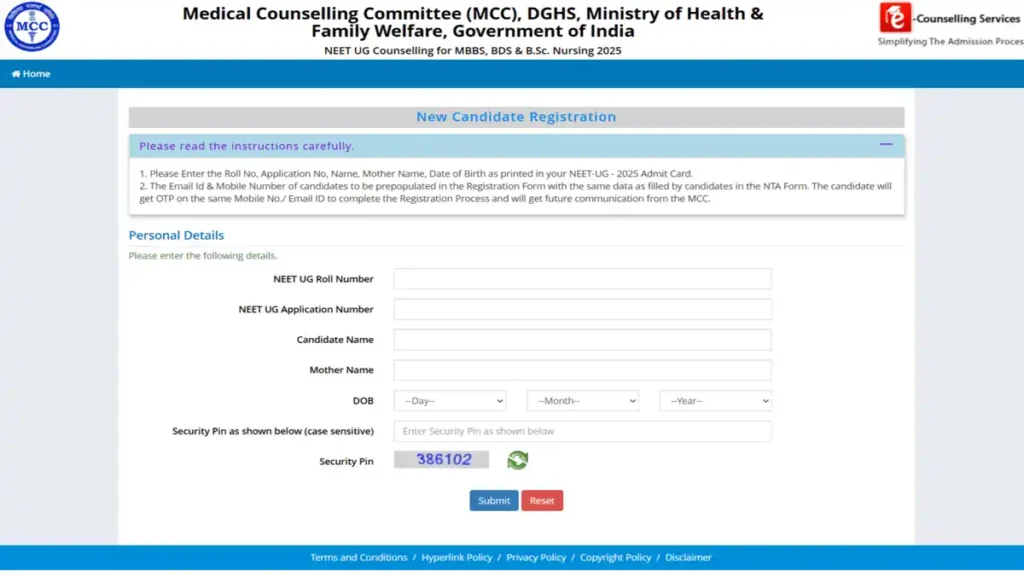
This is what the NEET 2025 counseling registration portal looks like:

NEET Online Counselling Registration Portal

Here is how you can participate in the NEET counseling process:

Get Registered

The seat allotment for NEET may be conducted in multiple rounds. And for each round, fresh registration will be conducted. The registration process will be held online.

So, once the registration for a Round starts, go to the MCC portal and get registered and pay the counseling fee.

Also Read:

Fill in and Lock Choices

You will be able to proceed for choice filling only after successful registration and payment of the NEET counseling fee. 

There is no restriction on the number of choices of Institution (College) (and courses i.e. MBBS, BDS and B.Sc. Nursing) you can fill. 

However, ensure that the choices are in the order of priority.

Also, mandatory choice filling will be conducted in Round 2. If a candidate doesn’t fill choices, the candidate will not be considered for seat allotment.

After entering the choices, lock the entered choices. If you don’t lock the choices you have entered, it will be automatically locked as per schedule. 

Verification by Universities and Processing of Seat Allotment

The universities and colleges will verify the registration details and choices submitted by candidates. 

If there is any anomaly in the entered details, the candidate may be disqualified. So, make sure that you 

Accordingly, they will release the seat allotment result.

Allotment of seats

The seat allotment of NEET will be based on the choice entered and the merit rank of the candidate.

The result of NEET seat allotment will be published online at mcc.nic.in. 

The seat allotment result will be released in the form of a downloadable pdf. Note that no log-in is required to download the seat allotment result.

The NEET seat allotment pdf will contain the following details:

  • The merit rank of the candidate who has been allotted a seat
  • Allotted quota
  • Name of the allotted institute
  • Course
  • Allotted category
  • Candidate category
  • Remarks 

Also Read:

Best Books to prepare for NEET 2026 – Physics, Chemistry, Biology
NIRF Ranking 2024 – Check domain-wise Rankings

NIFT Seat Allotment 2025

The seat matrix for the NEET 2025 for each round of counseling is given below.

CategorySeat Matrix
Notice for Addition of seats in Round 3Download Here
Notice for additions of Newly added seatDownload Here
Clear Vacancy Round 3 (MBBS BDS B.SC NURSING) – UG Counselling 2025Download Here
Virtual Vacancy Round 3 (MBBS BDS B.SC NURSING) – UG Counselling 2025Download Here
Virtual Vacancy Round 2 (MBBS BDS B.SC NURSING) – UG Counselling 2025Download Here
Clear Vacancy Round 2 (MBBS BDS B.SC NURSING) – UG Counselling 2025Download Here
Newly Added Seats Round 2 (MBBS BDS) – UG Counselling 2025Download Here
FINAL SEAT MATRIX FOR B.SC NURSING ROUND 1 UG 2025Download Here
FINAL SEAT MATRIX FOR ESIC IP ROUND 1 UG 2025 (MBBS & BDS)Download Here
FINAL SEAT MATRIX FOR DEEMED UNIVERSITIES ROUND 1 UG 2025 (MBBS & BDS)Download Here
FINAL SEAT MATRIX FOR CENTRAL UNIVERSITIES (DU/IP/BHU/JAMIA/AMU) ROUND 1 UG 2025 (MBBS & BDS)Download Here
FINAL SEAT MATRIX FOR ALL INDIA QUOTA EXCEPT CENTRAL UNIVERSITY ROUND 1 UG 2025 (MBBS & BDS)Download Here
FINAL SEAT MATRIX FOR AIIMS/BHU/JIMPER ROUND 1 UG 2025 (MBBS & BDS)Download Here
Seat Matrix sent by NMC for UG Counselling 2025Download Here

NIFT Seat Matrix 2024

CategorySeat Matrix
Final Seat Matrix for AIQ except Central University Round 1 UG 2024 (MBBS)Download Here
Final Seat Matrix for AIQ except Central University Round 1 UG 2024 (BDS)Download Here
Final Seat Matrix for Central University 1 UG 2024 (MBBS)Download Here
Final Seat Matrix for Deemed 1 UG 2024 (BDS)Download Here
Final Seat Matrix for BSc Nursing Round 1 UG 2024 Download Here
Final Seat Matrix for AIIMS Round 1 UG 2024 (MBBS)Download Here
Final Seat Matrix for Central University 1 UG 2024 (BDS)Download Here
Final Seat Matrix for Employees State Insurance Scheme Round 1 UG 2024 (MBBS & BDS)Download Here
Final Seat Matrix for JIPMER Round 1 UG 2024 (MBBS)Download Here
Final Seat Matrix for Deemed Round 1 UG 2024 (MBBS)Download Here

NEET PG 2025 Counselling Likely to Begin Tomorrow; Legal Delays Cause Frustration

0

New Delhi, October 16, 2025 – In a much-awaited development for aspiring postgraduate medical students across India, the Medical Counselling Committee (MCC) is set to kick off the NEET PG 2025 counselling process tomorrow, October 17, 2025. 

The information was shared by Dr. Lakshya Mittal, Chairperson & National President, on his X profile. 

The news comes after months of anticipation and persistent legal hurdles. The announcement comes as the Supreme Court prepares to hear a key petition on exam transparency, adding a layer of uncertainty to the already delayed admissions cycle.

The NEET PG 2025 exam, conducted on August 3, saw its results declared on August 19, but the NEET PG 2025 counselling timeline has been repeatedly pushed back due to pending seat matrix approvals from the National Medical Commission (NMC) and ongoing litigation. According to the Federation of All India Medical Associations (FAIMA), interactions with the Health Ministry confirmed the mid-October start, with registration expected to open via the official MCC portal at mcc.nic.in. This aligns with expert predictions and last year’s trends, where the process typically unfolds in the third or fourth week of the month.

The Supreme Court hearing, scheduled for October 28 before Justices J.B. Pardiwala and K.V. Viswanathan, stems from a petition challenging the National Board of Examinations in Medical Sciences (NBEMS) for releasing only question IDs and answer keys instead of full question papers. Petitioners argue this lacks transparency and could impact merit lists, potentially leading to further disruptions if the court intervenes. 

Read here – NEET PG Counseling 2025: Delays, Data Leak Allegations, and SC Hearings Leave Aspirants in Limbo

The NEET 2025 PG counselling will cover 50% All India Quota (AIQ) seats in government medical colleges, along with 100% seats in Deemed Universities, Central Universities, ESIC, and AFMS institutions. Eligible candidates—those who qualified NEET PG 2025, completed internships, and hold MCI/State Medical Council registration—must register online using their roll number and password, pay the requisite fee, and participate in choice filling. Multiple rounds are anticipated, including Round 1 (mid-October), with seat allotment based on ranks, preferences, and reservations.

State quota seats (50%) will be handled separately by respective authorities, with extensions already noted in places like Telangana (registration till October 16) and Karnataka (till October 15). As of today, MCC has not uploaded the exact schedule, but sources indicate it could drop imminently under the “PG Medical” section on their site.

For over 2 lakh candidates, this marks a critical step toward securing spots in top institutions like AIIMS Delhi and Saveetha Institute. However, with 13 candidates’ results recently cancelled by NBEMS and whispers of potential re-exams, the process remains fraught. FAIMA has urged swift action to avoid spillover into 2026.

Students are advised to monitor mcc.nic.in for live updates and prepare documents, including NEET PG admit cards, mark sheets, and category certificates. As the nation grapples with healthcare talent shortages, tomorrow’s launch could finally turn the page on a tumultuous year for medical aspirants. Stay tuned for real-time developments.

MAT Exam 2025 – September Exam Result, MAT December Registration (OUT Soon), Pattern, Syllabus, Cut-off

0

MAT Exam 2025 – All India Management Association (AIMA) will make available MAT result 2025 for September phase through candidate login. To check your result, log-in to the result portal using your registration number and email ID.

The MAT CBT exam (September session) was held on September 28, while MAT PBT was conducted on September 21. 

The MAT exam is being conducted FOUR times every year (Feb, May, Sept, Dec) in PBT and CBT modes. If the candidate appears multiple attempts, then the best of the scores will be considered.

The MAT 2025 application form is now closed for September attempt. MAT December 2025 registration is expected to START soon. Eligible candidates has to apply for MAT CBT at AIMA website. MAT application fee is INR 2200. When preparing for the exam, consult MAT 2025 best books.

Keep reading to learn more about the MAT 2025 exam.

Latest News:

MAT Exam 2025 – Highlights

ParticularsDescription
Exam NameManagement Aptitude Test (MAT)
Conducting BodyAll India Management Association (AIMA)
Official Exam WebsiteClick Here
Download MAT 2025 – Prospectus
Exam LevelNational-level MBA/PGDM entrance test
Mode of ExamCBT, , PBT (IBT – Discontinued) 
Status of application formClosed

Application Fee (One session): INR 2200
Application Fee (TWO sessions): INR 3,800
Frequency4 times a year (Feb, May, Sept, Dec)
MAT 2025 Exam DateSept 21, 2025 (PBT)
Sept 28, 2025 (CBT)
Test CitiesPBT Mode – 28
CBT Mode – 35
Duration150 minutes (2 hours 30 minutes)
LanguageEnglish
Sections5 – Language Comprehension, Mathematical Skills, Data Analysis & Sufficiency, Intelligence & Critical Reasoning, Economic & Business Environment
Total Questions200 (40 per section)
Type of QuestionsMultiple Choice Questions (MCQs)
Marking Scheme+1 for correct answer, -0.25 for wrong answer
Accepted By800+ B-Schools across India
Exam Helpdesk No.011 – 24645100 / 011 – 24617354 / 011 – 43128100

Also Read:

MAT December 2025 – Expected Dates

EventDates
DETAILED SCHEDULE – PBT (PAPER BASED TEST)
LAST DATE FOR PBT ONLINE REGISTRATION4th/ Last week of October 2025
AVAILABILITY OF PBT ADMIT CARD2/3 days before the exam
PBT TEST DATE21 September 2025 (Sunday)
DETAILED SCHEDULE – CBT (COMPUTER BASED TEST)2nd week of December 2025
LAST DATE FOR CBT ONLINE REGISTRATION22 September 2025 (Monday)
AVAILABILITY OF CBT ADMIT CARD2/3 days before the exam
CBT TEST DATE3rd week of December 2025
MAT 2025 RESULTAvailability of MAT December’ 25 Score on MAT Website: By Last week of January 2025

MAT September 2025 – Important Dates

EventDates
DETAILED SCHEDULE – PBT (PAPER BASED TEST)
LAST DATE FOR PBT ONLINE REGISTRATION15 September 2025 (Monday)
AVAILABILITY OF PBT ADMIT CARD18 September 2025 (5.00 PM Onwards)
PBT TEST DATE21 September 2025 (Sunday)
DETAILED SCHEDULE – CBT (COMPUTER BASED TEST)
LAST DATE FOR CBT ONLINE REGISTRATION22 September 2025 (Monday)
AVAILABILITY OF CBT ADMIT CARD25 September 2025 (5.00 PM Onwards)
CBT TEST DATE28 September 2025 (Sunday)
MAT 2025 RESULTAvailability of MAT September’ 25 Score on MAT Website: By 2nd week of October 2025

What is the MAT Exam?

Management Aptitude Test (MAT) is a national-level entrance exam conducted by the All India Management Association (AIMA) for admissions to MBA/PGDM courses at 800+ B-schools in India. 

The exam is conducted in Paper-Based Test (PBT) and Computer-Based Test (CBT) modes.

Candidates can choose the exam mode as per their convenience. 

MAT exam is conducted in multiple phases, with the candidate having the option to any phase of their choice and improve their score for MBA/ PGDM admission. They can also appear multiple times to improve their score. MAT scores are accepted by over 800 MBA colleges in India. 

Key Features of MAT Exam 2025

  • National Level Test for admissions into MBA/ PGDM Programs
  • You can take the MAT multiple times.
  • Administered four times a year – February, May, September and December
  • You can choose the examination phase, date and mode as per your preference.
  • For every attempt, fresh MAT registration will be required.
  • When filling out the MAT application form, you can select 5 college options. AIMA will share your scores with these institutes once the MAT result is declared.
  • To apply to more than 5 MAT colleges, you must apply separately.
  • Score validity of one year 
  • Best of the score is accepted from multiple attempts

MAT Exam 2025 – Admit Card

MAT admit card 2025 can be downloaded from the AIMA MAT website – mat.aima.in. Admit cards will be released to all candidates who successfully complete the application process.

The step-wise process to download the MAT 2025 admit card is given below.

  1. Go to the AIMA MAT 2025 exam portal – Click Here
  2. Click on the admit card download link
  3. In the log-in window, enter email ID, password and date of birth
  4. The MAT 2025 admit card will be displayed in pdf format
  5. Download and take a printout of the admit card.

MAT Exam Registration Process 2025

The MAT 2025 application form is now closed for the September edition. The application form for December session will open soon online at mat.aima.in.

The candidate could select the exam mode – CBT or PBT – at the time of filling out the application form.

The step-wise process to apply for MAT 2025 is given below:

  1. Go to AIMA-MAT website: https://mat.aima.in/ 
  2. Click on ‘register’ option
  3. Enter your name, date of birth, email ID, mobile phone number, state, city, and password. 
  4. Select the test mode (CBT or PBT) 
  5. Select a Test City
  6. Next, enter five preferred B-Schools
  7. Pay the application fee
  8. Fill in personal and contact details
  9. Upload documents – a recent passport size photo and scanned signature
  10. Submit the application form

MAT Exam Pattern 2025

MAT has multiple exam modes but the question paper pattern is the same for all. 

The MAT question paper has five sections, with 30 MCQs asked from each section. The total number of questions is 150. 

The duration of the exam is 2 hours. There is no sectional time limit, so you can attempt the test in any chronological order. 

MAT 2025 Exam Pattern – Quick Highlights

ParticularsDescription
Exam modesThe exam will be available in the following modes:

Paper Based Test (PBT) or
Computer Based Test (CBT) or
Paper Based Test and Computer Based Test (PBT+CBT)
Exam duration120 minutes 
MAT sectionsLanguage Comprehension
Intelligence & Critical Reasoning
Mathematical Skills
Data Analysis & Sufficiency
Economic and Business Environment
Number of questions section-wise30
Number of questions150
Total marks150
Marking scheme+1 for each correct answer
0.25 will be deducted for each incorrect entry

Read More:

MAT 2025 December Registration to start soon at mat.aima.in; Gear Up for MBA Admissions at Over 600 B-Schools

0

New Delhi, October 14, 2025 – The All India Management Association (AIMA) is set to open registrations for the Management Aptitude Test (MAT) December 2025 session imminently.

As the September 2025 session wraps up with exams on September 21 (Paper-Based Test) and September 28 (Computer-Based Test), AIMA’s official portal hints at “details available soon” for the year-end cycle. This comes amid a surge in MBA applications, with MAT scores accepted by over 600 B-schools, unlocking access to 20,000+ seats in premier institutes like Amity Business School, PSG Institute of Management, and Alliance School of Business.

MAT 2025 exam scores will be considered for admission in top MBA and PGDM programs across India. 

Conducted quarterly since 1988 and approved by the Ministry of Education, GoI, MAT remains a flexible, low-pressure gateway to business education

“With its new-age format and multiple modes, MAT empowers candidates to choose what suits their schedule,” said an AIMA spokesperson in a recent update. 

MAT scores are valid for one year, allowing multiple attempts – with the best score considered – making the December session ideal for those targeting 2026 intakes. 

MAT 2025 registrations for December are expected to start within the next two weeks, mirroring the September timeline where applications closed mid-month.

Expected MAT 2025 Registration Timeline: When & How to Register

AIMA typically announces December details about two months prior, with the exam slated for mid-to-late December 2025 (PBT around December 14–21, CBT December 21–28, based on patterns). Registrations will run online-only via mat.aima.in, closing roughly a week before each mode’s test date. 

EventExpected Date
MAT 2025 December Registration START DateLate October 2025 (within 1–2 weeks)
Last Date for PBT RegistrationEarly December 2025
Last Date for CBT RegistrationMid-December 2025
MAT 2025 PBT Exam DateDecember 14–21, 2025 (Sunday)
MAT 2025 CBT Exam DateDecember 21–28, 2025 (Sunday)
Admit Card Release (PBT)2–3 days before exam
Admit Card Release (CBT)3–4 days before exam
Declaration of MAT 2025 Results Last week of January 2026

Note: Exact dates will be confirmed on mat.aima.in; bookmark the site for notifications. Unlike the GATE or CAT exam, MAT allows dual-mode attempts (PBT + CBT) for broader practice.

MAT 2025 Eligibility Criteria: Who Can Apply?

Open to all – no age bar or work experience required. Key criteria:

  • Bachelor’s degree in any discipline (minimum 50% aggregate; 45% for reserved categories).
  • Final-year undergraduates eligible.
  • Appearances unlimited across sessions; international candidates welcome with equivalent qualifications.

MAT Registration 2025 – Step-by-Step Process

The process is straightforward and digital, taking 30–45 minutes. Follow these steps on mat.aima.in (use Chrome/IE 9+/Firefox for best compatibility):

  1. Go to the official Registration Portal: Head to mat.aima.in > Click “Register” under the December session (once live). Enter name (as per ID proof), email, mobile, state/city, and create a password. Verify via OTP.
  2. Fill Application Form: Log in to your dashboard. Input personal details (DOB, address, category), educational qualifications (10th/12th/graduation marks), and select exam mode (PBT, CBT, or both).
  3. Choose Institutes: Pick up to 5 B-schools for free score dispatch (7 if opting for PBT+CBT). 
  4. Upload Documents: Scanned passport-size photo (10–50 KB, JPG) and signature (5–20 KB, JPG). Ensure clear, recent images to avoid rejection.
  5. Pay Fees Online: Via debit/credit card, net banking, UPI, or Paytm. Breakdown: Single Mode (PBT or CBT): ₹2,200. Dual Mode (PBT + CBT): ₹3,800 (includes concession for add-ons). No category-based waivers, but fees are GST-inclusive.

Submit and Download Confirmation: Preview, submit, and save the confirmation PDF. Edits allowed pre-submission; post-payment changes limited to contact details.

IIT Kanpur Launches Flexible Online M.Tech, M.Sc., and PG Diploma Programs for Working Professionals

Kanpur, October 14, 2025 – In a bold step towards democratizing elite technical education, the Indian Institute of Technology Kanpur (IIT Kanpur) has unveiled a suite of fully online postgraduate programs, including M.Tech, M.Sc., and Postgraduate Diploma (PG Diploma) offerings. 

Announced on October 13, 2025, this initiative aims to bridge the gap between rigorous academic training and real-world demands, allowing professionals and fresh graduates to upskill without pausing their careers

The programs, delivered through a cutting-edge digital platform, promise IIT Kanpur’s hallmark blend of innovation, flexibility, and global alumni access, positioning the institute as a frontrunner in India’s evolving edtech landscape.

The launch expands IIT Kanpur’s e-learning portfolio, building on its successful eMasters series that began in 2023. 

“These programs are designed for the modern learner – those balancing work, ambition, and lifelong learning,” said Prof. Manindra Agrawal, Director of IIT Kanpur, in an official statement. “By leveraging technology, we ensure our world-class faculty reaches far beyond campus walls, fostering a new generation of leaders in high-demand fields like AI, cybersecurity, and sustainable energy.” 

This move aligns with the National Education Policy (NEP) 2020’s emphasis on accessible, multidisciplinary education, and comes at a time when India’s online education market is projected to grow to $10 billion by 2026, per industry reports.

A Suite of Programs Tailored for Emerging Tech Domains

The new offerings span engineering, sciences, and interdisciplinary areas, with curricula co-developed by IIT Kanpur’s renowned faculty and industry experts. Key highlights include:

  • M.Tech Programs (2-4 Years): Focused on advanced engineering skills, these include specializations in Wireless Networks & Machine Learning, RF Engineering, and Microelectronics & VLSI. Ideal for electronics and communication professionals, the programs emphasize hands-on projects and elective flexibility, allowing learners to customize their path with optional campus immersions.
  • M.Sc. Programs (2-4 Years): Geared towards analytical and economic expertise, options cover Economics and Data Analytics. These are particularly suited for finance and data science aspirants, incorporating real-world case studies and tools like Python and econometric modeling. Graduates can leverage the degree for PhD admissions at IIT Kanpur or equivalent institutions.
  • PG Diploma Programs (1-2 Years): Shorter, credit-based diplomas target mid-career upskilling in Artificial Intelligence & Machine Learning, Cyber Security, and Renewable Energy Technologies. These act as standalone credentials or stepping stones – completers can upgrade to full M.Tech or M.Sc. within three years, with credits transferable.

All programs feature live interactive sessions, recorded lectures, mentorship, and small class sizes (30-100 students) for personalized engagement. 

Successful participants earn Senate-approved degrees/diplomas conferred at IIT Kanpur’s convocation, unlocking access to its 40,000+ strong global alumni network – a community boasting leaders at Google, Microsoft, and ISRO.

Admission: Accessible and Merit-Based

Breaking from tradition, these programs do not mandate GATE scores, making them inclusive for diverse applicants. Eligibility requires a bachelor’s/master’s degree with at least 55% marks (or 5.5 CPI on a 10-point scale). Admission pathways include:

  • Valid scores in national exams like GATE, JAM, CEED exam, CAT exam, GMAT, or GRE (program-specific cutoffs apply).
  • An institute-conducted online proctored entrance test for those without prior scores.

Applications are open now via the official portal at online.iitk.ac.in. IIT Kanpur’s online ecosystem has already enrolled thousands since 2023, with high completion rates due to its executive-friendly scheduling. The next intake begins in January 2026, with rolling deadlines – early applicants can secure spots through a simple online form.

Investment in Your Future: Fees, Scholarships, and ROI

Affordability meets excellence here. Program fees are structured per credit:

  • Engineering Disciplines: ₹3,500 – 5,000 per credit (M.Tech/PG Diploma). 

To visit the official fee portal for the M.Tech program – Click Here. To visit official fee portal for M.Tech program program – Click Here

  • Science Disciplines: ₹2,500–₹4,500 per credit (M.Sc./PG Diploma). 

To visit the official fee portal for the online M.Sc program – Click Here

Total costs range from ₹5+ lakhs for diplomas to ₹8-12 lakhs for full master’s, inclusive of a one-time ₹15,000 application fee. Continuation fees (₹5,000 per inactive trimester) ensure flexibility for part-time learners. IIT Kanpur offers fee waivers for SC/ST/PwD candidates and corporate sponsorships, with up to 20% concessions for strategic partners.

The ROI is compelling: Alumni from similar IIT Kanpur eMasters programs report 20-30% salary hikes, with placements in top firms like Deloitte, KPMG, and Reliance. The institute’s Incubation Centre also facilitates startups, providing seed funding and mentorship for diploma completers eyeing entrepreneurship.

Why Now? A Timely Boost for India’s Tech Talent Pool

As India races towards a $1 trillion digital economy by 2028, the demand for skilled professionals in AI, cybersecurity, and green tech surges. IIT Kanpur’s launch addresses a critical talent crunch – a 2025 NASSCOM report estimates 1.5 million unfilled jobs in these sectors. By offering asynchronous content, weekend classes, and hybrid options, these programs cater to the 70% of Indian professionals seeking upskilling, per LinkedIn data.
This isn’t just education; it is empowerment. With NIRF 2025 ranking IIT Kanpur #4 in Engineering, these programs promise not just credentials, but catalysts for innovation.

Study in the USA – How will Trump’s 15% Cap Change Things, How to Apply, Fees and Expenses, Admission Process

0

Study in the USA – The United States has been one of the most popular academic destinations for Indian students.

According to USCIS (US Citizenship and Immigration Services), in the year 2022, 1,99,812 students from India went to the USA for higher studies. This is an increase of 19% from the previous year. Of the total enrollment, girls account for 37%.

The major reasons why students opt to study in the US are manifold – it has a higher number of top universities, is safe, offers a flexible academic curriculum, offers internship opportunities and good job prospects. 

Most campuses in America offer a multicultural environment that is accommodating and safe.

The United States, a beacon for Indian students seeking world-class education, however, faces a pivotal shift in 2025. With 331,000 Indians enrolled in 2023-24, contributing $15 billion, the U.S. has been a launchpad for STEM and global careers. Trump’s October 2025 memo proposes a 15% cap on international undergrads at elite universities, limiting any country, including India, to 5%. Coupled with a 44.5% drop in Indian student visas and H-1B restrictions, this policy clouds aspirations, pushing families toward Canada and Australia as alternatives.

Learn all about studying in the USA – English language tests required – IELTS Exam, the GRE Test, or TOEFL exam; academic qualification, application process and dates, etc.

Study in USA – Academic Highlights

ParticularsDescription
International Students Studying in USA (2022-23 data)4,65,791
The number of international students is projected to increase by 8 – 9% every year.
Total Universities in USA4,000+
Admission CriteriaUG Courses: High school certificate/mark sheets + SAT / ACT scores (not mandatory if optional) + ELP test scores of TOEFL / IELTS / Duolingo
PG Courses: Bachelor’s mark sheet + GRE / GMAT + ELP test scores + SOP + LOR + Resume
Financial Aids available for candidatesNeed-Based, Merit-Based and External Scholarships
Average Scholarship USD 74,808
Part-Time Working Hours20 hours a week
US F-1 Visa FeeUSD 185
Procedure for Obtaining US Study VisaObtain the I-20 Form upon acceptance at US university, pay the SEVIS fee, apply for a visa interview, attend the interview and obtain a study visa.
Post Study Stay Back Time Period1 year | 3 years (for STEM Courses Applicants)
Average Pay Per Hour in USAUSD 28.81
Also ReadStudy in Germany – How and when to Apply, Documents, Accommodation, Cost of Living

Trump’s 15% Cap Proposal vs. Existing US Policy on International Students

AspectExisting PolicyProposed 15% Cap (October 2025 Memo)
Enrollment LimitsNo federal caps on international undergraduate enrollment; universities set their own policies. Overall international students: ~1.2 million (2024-25), ~20-30% at many elites (e.g., Harvard ~25%).Caps international undergrads at 15% of total undergrad population via Student Visa Exchange Program (F-1/J-1 visas); no more than 5% from any single country (e.g., India). Applies to incoming classes if over limit.
ScopeNationwide, applies to all accredited institutions; no restrictions on country-specific shares.Voluntary “Compact for Academic Excellence” sent to 9 elite universities (e.g., MIT, Harvard, Penn); tied to preferential federal funding access. Non-signatories risk losing grants/loans priority.
Incentives/PenaltiesNo conditions for federal funding based on enrollment; funding based on merit/research needs.Signatories gain “preferential access” to billions in grants; refusal may sideline schools. Includes self-audits and potential repayment of funds for non-compliance.
Additional RequirementsNo mandates for ideological screening or data sharing; privacy protected under FERPA. Admissions can consider diversity factors.Requires screening students/staff for “alignment with American/Western values”; share disciplinary records with DHS; ban race/sex in admissions/hiring; freeze tuition 5 years; require SAT/ACT.
Impact on IndiansIndians: 331,000 enrollees (2023-24), ~27% of internationals; no country caps, but visa scrutiny exists.Disproportionate hit: Limits to ~5% spots; exacerbates 44% visa drop (Aug 2025); chills applications amid H-1B/OPT restrictions.

Why study in the USA?

Here are a few reasons why you must choose the US for your higher studies.

  • Largest number of Top Universities: In the QS World University Rankings 2025, there are 7 US Universities inside the top 20.
  • Diverse Educational Opportunities: The US is home to 4,000+ higher education institutions, which include large research universities to small liberal arts colleges. So, the student has a wide spectrum of courses and academic disciplines to choose from.
  • Research and Innovation: The top universities in the US are known for their emphasis on research, technology, and innovation. So, if you get admission to any of these institutes, you will not only get the opportunity to get the best education, but bring about revolutionary and worthwhile changes in society.
  • Cultural Diversity: Most of the university campuses in the US are teaming with international students; this has been made possible by the liberal policy adopted by the US government. It is estimated that there are around 1 million foreign students currently studying in the US.
  • Career Opportunities: One major reason why many students choose to study in the US is that most of the top universities have industry-university linkages, meaning the students learn the skills set that are in demand in the market while they are still in college. So, by the time the candidate completes his or her course, they are job ready. Note that internships and training sessions are available for students in leading industries.
  • Flexible Curriculum: Unlike in India, where we more or less follow a very rigid academic curriculum, the trend is just the reverse in the academic colleges in the US. These institutes offer very fluid curriculums with many combinations, which the candidate can choose to match their skills and career goals.
  • Support Services for International Students: To help international students, universities in the US have services like orientation programs and English language classes. Assistance is also provided for visa status and employment opportunities. These services make adjusting to the US academic lifestyle easier and more smooth.

Top University Ranking Agencies:

Here are the three most influential and widely accepted global university ranking agencies:

  1. Quacquarelli Symonds (QS)
  2. Times Higher Education (THE) 
  3. Shanghai Ranking Consultancy (the Academic Ranking of World Universities; ARWU).

Top universities to study in the USA (QS Ranking 2025)

Here are the top 10 universities in the US per QS Ranking 2025

S.No.InstitutionQS Ranking 2025
1Massachusetts Institute of Technology (MIT)1
2Harvard University4
3Stanford University6
4California Institute of Technology (Caltech)10
5University of Pennsylvania11
6University of California, Berkeley (UCB)12
7Cornell University16
8University of Chicago21
9Princeton University22
10Yale University23

When to Apply for Study in the USA – Type of Intakes

Admission in US universities is done in THREE  intakes (or semesters). 

Fall intake in the US 2025: It is the main intake and STARTS in August. The application submission deadline is December or January of the previous year.

Spring intake in the US 2025: Starts in January. You need to apply for the intake by September or October of the previous year.

Summer Intake in the US 2025: The Summer Intake is the least popular of the three intakes and is offered by a few handful colleges and courses. The intake STARTs around May.

Cost of studying in the USA

Program of StudyTuition fees in USD (approx)
English language studies$700 to $2,000 per month
Community colleges$6,000 to $20,000 per year
Undergraduate $16,000 to $30,000 per year
Graduate $20,000 to $38,000 per year
Doctoral $25,000 to $45,000 per year

Other monthly expenses:

  • Rent – $500 – $1500
  • Transport – $100
  • Entertainment – $200
  • Food – $500

Entrance exam to study in the USA:

Here are English language exams you need to take to study in the US:

Study in the USA – Frequently asked questions (FAQs)

Q: What is the academic calendar followed by US universities?

A: The academic year in US universities usually runs from August through May with breaks for holidays. Most universities use either the semester system (two terms), the quarter system (students attend three out of four total terms), or the trimester system (three terms).

Q: What is the age limit to attend U.S. universities?

A: In general, the candidate must have completed high school and must be at least 17 years of age.

Q: What is the difference between “Undergraduate” and “Graduate” degrees?

A: Undergraduate programs can be pursued after completing high school and lead to an associate (two-year) degree or a bachelor (four-year) degree. Bachelor degree holders can take Graduate programs which lead to a master’s or doctoral degree.

Q: What are the different types of undergraduate degrees?

A: Undergraduate programs can be pursued after completing high school and lead to an associate (two-year) degree or a bachelor (four-year) degree. Bachelor degree holders can take Graduate programs which lead to a master’s or doctoral degree.

Q: What are the different types of graduate degrees?

A: Masters: two-year degree providing additional specialization. Doctorate: five to eight-year program certifying the student as a trained research scholar and/or professor.

Q: Can I take a professional degree program in the US without first earning a bachelor’s degree?

A: Yes, but they are highly selective and require a heavy course load across a total of six years of study.

Q: Can I obtain a bachelor’s degree and a master’s degree simultaneously?

A: If the candidate pursues a joint-degree program, they will begin a graduate program in their fourth year of college, earning both degrees upon graduation.

Q: What is the duration of an MBA program in the U.S.?

A: The duration of an MBA program in the US is typically one to two years.

Q: Can I work while studying in the United States?

A: With permission of the International Student Office, international students are allowed to work on campus up to 20 hours/week in their first year and can apply to work off-campus in subsequent years.

NEET PG Counseling 2025: Delays, Data Leak Allegations, and SC Hearings Leave Aspirants in Limbo

As the academic year 2025-26 looms, thousands of medical graduates across India are caught in a web of uncertainty surrounding the NEET PG 2025 counseling process. What was expected to be a streamlined pathway to postgraduate seats in MD, MS, and diploma courses has devolved into a saga of delays, allegations of a massive data leak, and protracted legal battles in the Supreme Court. With the next hearing slated for October 28, aspirants are voicing frustration over stalled admissions, potential career disruptions, and eroding trust in the system. 

The National Eligibility cum Entrance Test for Postgraduate (NEET PG) 2025, conducted by the National Board of Examinations in Medical Sciences (NBEMS), saw its results declared on August 19 – over a month ago. Yet, the Medical Counselling Committee (MCC), responsible for the 50% All India Quota (AIQ) seats, has yet to release the official schedule on mcc.nic.in. 

The Federation of All India Medical Association (FAIMA) had anticipated a mid-October start, but as of today, silence prevails, pushing the timeline beyond last year’s pace and heightening anxiety among over 2 lakh candidates. 

Roots of the Delay: Courtroom Stalemate and Administrative Hurdles

The primary culprit? A series of Supreme Court petitions demanding greater transparency in the exam process. Aspirants have challenged NBEMS’s decision to release only question IDs alongside answer keys and response sheets, arguing it renders verification “meaningless” and violates constitutional rights under Articles 14 (equality) and 21 (right to life and liberty). 

“Answers without questions hold no value,” petitioners contended during an early September hearing, where the bench—comprising Justices JB Pardiwala and KV Viswanathan – questioned the motives: “Why do you think there is no transparency? Is it because you got less marks?” 

Subsequent hearings have been a game of musical dates. Initially slated for early September, the matter was deferred multiple times – first to September 12, then September 23, September 26, and now October 28 – granting NBEMS extensions to file comprehensive responses. 

The court has also rejected pleas to halt counseling outright, emphasizing urgency due to the impending admissions cycle. 

Compounding this is the National Medical Commission’s (NMC) pending approval of the seat matrix – a critical step for finalizing available spots across government and private institutions. 

 “The delay stems from continuous postponements of SC hearings and the ongoing tussle between NBE and students,” NMC sources told Shiksha.com, leaving MCC in a holding pattern. 

Meanwhile, some states like Telangana (via KNRUHS), Gujarat, Tamil Nadu, Kerala, Andhra Pradesh, and Karnataka have kicked off their quota counseling, creating a patchwork of progress that only amplifies the national limbo. 

Also Read:

The Data Leak Bombshell: Aspirants in ‘Shock’

Just as hopes flickered for a mid-October MCC announcement, a fresh controversy erupted: allegations of a widespread data leak exposing sensitive details of NEET PG aspirants. Doctors and candidates claim personal information—including contact details, scores, and application data – has been circulating on social media and WhatsApp groups, potentially compromising privacy and enabling fraud. 

NBEMS has pushed back, stating the breach likely occurred “beyond its reach” after data was shared with state counseling committees for admissions. 

 “We share information as required, but security post-transfer is out of our control,” an NBEMS spokesperson remarked, adding that the board is investigating while urging candidates to report suspicious activity. Aspirants, however, are unconvinced. “This is the final straw – first opacity in results, now our data in the wild,” fumed Dr. Priya Sharma, a Delhi-based candidate, in a viral social media post. FAIMA has demanded immediate accountability, including a forensic audit and compensation for affected students. 

The leak has broader implications in an era of rising cyber threats to education systems. Experts warn it could deter future applicants and invite scams, with one analyst estimating risks to thousands of profiles harvested for phishing or identity theft.

Aspirants’ Plight: Careers on Hold, Calls for Reform

For the 2.4 lakh who appeared in the August exam, the wait is excruciating. “We’ve invested years, lakhs in coaching—now our futures dangle on court dates,” shared aspirant Rahul Mehta from Mumbai. The ripple effects are stark: delayed internships, financial strain from prolonged preparations, and mental health tolls amid burnout. Student groups like the United Doctors Front (UDF) have escalated protests, urging the government to intervene with interim guidelines. 

Legal voices echo this urgency. “Timely adjudication is vital to uphold the exam’s credibility; further delays could cascade into a disrupted admissions cycle affecting national healthcare training,” noted a senior advocate familiar with the case. 

Amid this, positive notes include NBEMS’s release of withheld results in batches (Lot 2 in late September) and the Union Cabinet’s approval for expanding PG seats, signaling long-term growth. 

Looking Ahead: October 28 as a Turning Point?

As the Supreme Court reconvenes on October 28, all eyes are on whether it will mandate full question paper disclosure, fast-track counseling, or address the data breach. MCC has hinted at a schedule “soon,” but without judicial clarity, skepticism lingers. 

For now, aspirants are advised to monitor mcc.nic.in and nbems.edu.in, prepare documents (provisional allotment letters, ID proofs, category certificates), and explore state quotas as backups. FAIMA’s plea to the Health Ministry underscores a broader cry: “Prioritize students over procedure.” 

In the high-stakes world of medical education, where every day counts toward saving lives, this impasse isn’t just administrative – it’s a test of the system’s resilience. Will October 28 bring relief, or more deferrals? For India’s future doctors, the clock is ticking louder than ever.

The 15% Cap: How Trump’s New Policy Could Reshape the American Dream for Indian Students

In the bustling coaching centers of Kota and the high-rise apartments of Mumbai’s Bandra, the United States has long symbolized opportunity- a golden ticket to world-class education, high-paying jobs, and perhaps even a slice of the Silicon Valley dream. For over 331,000 Indian students who flocked to American campuses in the 2023-24 academic year, the U.S. wasn’t just a destination; it was a launchpad. 

But as President Donald Trump’s administration rolls out a sweeping memo targeting elite universities, that dream is flickering. The “Compact for Academic Excellence in Higher Education,” circulated on October 1, 2025, proposes a stark 15% cap on international undergraduate enrollment at participating institutions, with no more than 5% from any single country

For Indian aspirants, who dominate the international student pool, this isn’t just policy – it’s a potential roadblock to the future.

The Proposal: A “Compact” with Strings Attached

The nine-page memo, sent to nine prestigious universities including MIT, Harvard, the University of Pennsylvania, and Brown, isn’t an outright ban but a moral compromise. Sign on, and these schools gain “preferential access” to billions in federal research grants and funding- essential lifelines for STEM powerhouses that rely on government dollars for everything from AI labs to quantum computing projects. 

Refuse, and risk being sidelined in the funding race. 

At its core, the compact demands demographic “balance”: international undergrads limited to 15% of total enrollment, capped at 5% per nation. It also mandates screening students for “alignment with American and Western values,” sharing disciplinary records with federal agencies, and ditching race- or gender-based preferences in admissions and hiring. 

Trump, speaking at a rally in Ohio last week, framed it bluntly: “We need more spots for American kids, not ruckus-makers from abroad.” 

The administration ties this to national security and economic protectionism, echoing concerns from the White House Office of Science and Technology Policy about over-reliance on foreign talent in STEM fields dominated by India and China. 

This isn’t Trump’s first rodeo. His first term saw H-1B visa denials spike to 18% – up from 3% under Obama – and proposals to slash Optional Practical Training (OPT), the post-grad work program that keeps many Indian students in the U.S. after commencement. 

Now, with a $100,000 annual fee slapped on H-1B renewals and whispers of fixed four-year student visa tenures, the cap feels like the latest salvo in a broader immigration crackdown. 

Also Read:

Indian Students: From Record Highs to Sudden Dips

India’s love affair with U.S. higher ed is no secret. In 2023-24, Indian enrollments surged 23% to 331,602—the first time overtaking China since 2009—fueled by booming demand for STEM degrees (over 67% of Indian students pursue math/computer science or engineering). 

These students pumped $15 billion into the U.S. economy last year alone, subsidizing tuition for domestic peers and filling critical gaps in tech and research. 

But cracks are showing. Preliminary 2025 data paints a grim picture: Indian student visa arrivals plummeted 44% in August (from 74,825 to 41,540), part of a 19% overall international drop. 

Active Indian student counts dipped 28% year-over-year to around 255,000 by March 2025, reversing a three-year CAGR of 25.5%. 

Visa denials for Indians spiked 45% in early 2025, amid suspended interviews and heightened scrutiny. 

The cap exacerbates this. While graduate programs—where 80% of Indians enroll—escape direct limits, undergrads (a growing 6% segment) face the brunt. 

At a hypothetical 10,000-student undergrad body, that’s just 500 spots for Indians—trimming offers early in the admissions cycle for schools already hovering near the threshold. 

Institutions like Northeastern and NYU, with international shares exceeding 15%, could see revenues tank; DePaul University already slashed budgets after a 30% enrollment drop this fall. 

Ripple Effects: Admissions Squeeze, Economic Shifts, and Personal Toll

The human cost is immediate. Vishvanath Reddy, a Hyderabad master’s student, called it “deeply unfair,” as peers scramble for spots at costlier, less-capped schools like UC Berkeley or Rice. 

Scholarships dwindle, per a doctor’s X post: “Admissions tougher, especially for high-applicant countries like India.” 

Families, who’ve sunk $50,000-$100,000 per child, face sunk costs and shattered plans – echoing broader anxieties over H-1B fees that could price out post-grad jobs. 

Economically, it’s a double-edged sword. Proponents argue it prioritizes American youth amid an “enrollment cliff” (fewer college-age U.S. students, leading to 56% tuition discounts). 

Critics, including the American Immigration Lawyers Association, warn of a brain drain: Hospitals short on doctors, startups starved of talent, and a $40 billion annual hit to universities. 

For India, it’s a pivot point. Enrollments in Canada (up 20% for Indians) and Australia are surging, with post-study work visas luring talent home or elsewhere. 

“The U.S. risks hollowing out its college towns,” notes a Times of India analysis. 

Socially, the cap stirs unease. It dovetails with H-1B reforms that have chilled Indian marriages – families wary of tying knots to U.S.-based NRIs facing deportation risks. 

One Atlanta-based Indian told Hindustan Times: “It’s not just visas; it’s unpredictability.” 

Beyond the Cap: A Wake-Up Call for Global Mobility?

As the memo awaits university responses – some, like Harvard, already suing over frozen funds – the policy’s fate hinges on legal battles and midterm politics. 

Yet, for Indian students, adaptation is key. Experts like Sripal Jain of Simandhar Education urge diversification: Target non-signatory publics like Michigan or explore Europe’s tuition-free gems. 

“Proportionality matters,” Jain adds, decrying the cap’s sweep on 6,800+ internationals. 

Trump’s vision of “America First” academia may safeguard domestic spots, but at what cost? As one X user quipped: “After H-1B, now this – turns out America’s fear is MBAs and techies from India and China.” 

For the next generation of Indian scholars, the U.S. remains alluring, but the path is narrower, the stakes higher. In a world of fluid talent, will this cap fortify borders or fracture bridges? Only time – and the next enrollment cycle – will tell.

Also Read:

How to Prepare for GATE 2026 in 3 Months – Easy and Effective Tips

0

How to Prepare for GATE 2026 in 3 Months – Preparing for the Graduate Aptitude Test in Engineering (GATE) 2026 in just 3 months is challenging but doable if you have a solid foundation in your core subjects and prioritize high-yield topics

GATE 2026 exam will be conducted on February 7, 8, 14, and 15, 2026, and cover 30 papers with a mix of Multiple Choice Questions (MCQs), Multiple Select Questions (MSQs), and Numerical Answer Type (NAT) questions. It lasts 3 hours, with 15% weightage to General Aptitude, 13-15% to Engineering Mathematics (varies by paper), and the rest to core subjects. Negative marking applies (1/3 for 1-mark MCQs, 2/3 for 2-mark MCQs).

This guide assumes you’re dedicating 6-8 hours daily (adjust if working). Focus on revision, practice, and mocks rather than learning from scratch. Download the official syllabus from gate2026.iitg.ac.in once released (expected soon; it typically mirrors previous years with minor tweaks). Track progress weekly and adapt based on mocks.

Here we bring you the step-wise process to prepare for the GATE 2026 exam in 3 months.

Latest Updates:

Step 1: Assess and Plan Your Preparation

  • Week 0 (1-2 days): Take a full-length mock test (from previous years) to identify strengths/weaknesses. Aim for 60-70% in strong areas; prioritize weak ones (e.g., if low in Math, allocate 20% time).
  • Overall 3-Month Breakdown:

Use this phased approach to build momentum:

PhaseDurationFocusDaily Hours Breakdown
Phase 1: Intensive RevisionMonth 1 (Weeks 1-4)Cover syllabus via notes/books; solve topic-wise questions.Core Subjects: 4 hrs
Math + Aptitude: 2 hrs
Revision: 1 hr
Phase 2: Practice & AnalysisMonth 2 (Weeks 5-8)PYQs + sectional tests; fix errors.Practice: 4 hrs
Analysis/Revision: 2 hrs
Mocks: 1-2/week
Phase 3: Mock & PolishMonth 3 (Weeks 9-12)Full mocks + weak area drills; simulate exam conditions.Mocks: 3/week
Revision: 3 hrs
Weak Topics: 2 hrs
  • Daily Routine Template: Wake early; study in 2-hour blocks with 10-min breaks (Pomodoro). End with a 30-min review. Include 7-8 hours sleep, exercise (30-min walk/yoga), and balanced meals for focus.

Step 2: Subject-Wise Preparation Tips

Tailor to your paper (e.g., CSE, ECE, ME). General rule: 70% time on core, 20% Math, 10% Aptitude. Use concise notes/flashcards for formulas/concepts.

  • General Aptitude (15% weightage): Quick wins—verbal (reading comprehension, synonyms), numerical (data interpretation, ratios). Practice 20 questions daily.Tips: Identify patterns in 2D/3D shapes, paper folding. Revise daily for 30 mins.
  • Engineering Mathematics (13-15%): Universal across papers; focus on Linear Algebra, Calculus, Probability.Tips: Solve 50 problems/day. Use for quick scoring (aim 10-12/15 marks).
  • Core Subjects (70% weightage): Prioritize high-weight topics (e.g., for CSE: Algorithms, OS; for ME: Thermodynamics, SOM; for ECE: Networks, Signals).

Subject-Wise Strategy:

Subject Example (Adapt to Your Paper)Key Topics (High-Yield)Tips
CSE/ITDSA, DBMS, OS, NetworksCode snippets daily; focus on time complexity.
METhermodynamics, Fluid Mechanics, ManufacturingDiagram-based problems; apply formulas in mocks.
ECEAnalog/Digital Circuits, CommunicationsSolve circuit analysis; memorize theorems.
CEStructural Analysis, GeotechNumerical-heavy; practice derivations.
EEPower Systems, MachinesFormula sheets; error analysis in calculations.

Step 3: Practice and Mock Tests

  • PYQs: Solve GATE previous year’s question papers (2015-2025) daily (1 paper = 2-3 hours). Analyze: Why wrong? (Concept gap or calculation error?)
  • Mocks: Start with 1/week in Month 1, ramp to 3/week in Month 3. Time yourself; review the same day. Goal: Improve from 40-50 marks to 70+ (AIR <1000 threshold). Post-Mock: Spend 2x time analyzing (e.g., redo wrong questions).

Step 4: Revision and Error Management

  • Weekly: Revise notes (1 day/subject); flashcards for formulas.
  • Monthly: Full syllabus scan; track errors in a journal (e.g., “Weak in Probability—revise 2x”).
  • Last 2 Weeks: Only mocks + light revision. No new topics.

Step 5: Health, Motivation, and Common Pitfalls

  • Stay Healthy: 6-8 hours sleep; omega-3 rich diet (nuts, fish); meditate 10 mins/day (Headspace app). Avoid burnout—reward milestones (e.g., movie after mock).
  • Motivation: Join Reddit (r/GATEtard) or Telegram groups for peer support. Track progress in a journal.
  • Pitfalls to Avoid: Procrastination; ignoring Aptitude/Math; skipping analysis; over-relying on coaching without self-practice.