A public interest litigation (PIL) has been filed in the Supreme Court of India challenging the lowering of the NEET-PG 2025 eligibility criteria – including the controversial zero percentile and eligibility for candidates scoring as low as –40 marks.
The PIL, submitted by a group of doctors and medical activists, contends that reducing the qualifying cut-off to zero percentile undermines the very purpose of a competitive exam that determines admission into postgraduate medical programmes such as MD/MS and DNB. According to the petitioners, allowing candidates with minimal or negative scores to enter postgraduate training threatens the quality of medical education and could have long-term consequences for patient care and public health.
In January 2026, the National Board of Examinations in Medical Sciences (NBEMS), acting on directives from the Ministry of Health and Family Welfare, revised the NEET-PG qualifying percentiles for counselling.
For the General/EWS category, the eligibility criterion was reduced from the 50th to the 7th percentile; for General PwBD, to the 5th percentile; and for SC/ST/OBC categories, to a zero percentile — meaning candidates with scores as low as –40 out of 800 could participate in the counselling rounds.
Supporters of the move argue it aims to fill over 18,000 vacant postgraduate medical seats left after earlier rounds of counselling and to address doctor shortages nationwide.
However, professional bodies and critics assert that this sets a “dangerous precedent” by lowering academic standards and diluting meritocracy in medical admissions. The PIL seeks judicial review of the policy, asserting it adversely affects the integrity of medical training and ultimately the quality of healthcare services. The Supreme Court’s next hearing date is awaited.
The Karnataka Examinations Authority (KEA) will open KCET/UGCET 2026 online registration on January 17, 2026 (tomorrow). Candidates seeking admission to professional undergraduate courses in Karnataka will be able to apply on the official KEA portal: cetonline.karnataka.gov.in/kea.
KEA has already released the KCET 2026 notification schedule dated January 2, 2026, and the exam dates are also out. As per the published schedule, the Kannada language test (for eligible candidates such as Horanadu/Gadinadu Kannadiga categories, as applicable) is scheduled on April 22, 2026, and the main KCET papers will be held on April 23 and April 24, 2026.
Candidates are advised to keep their basic documents and scanned images ready, check eligibility carefully, and apply early to avoid last-minute payment or upload issues.
Latest Updates:
KCET 2026 application form (Opens on Jan 17) – Apply Here
KCET 2026 Key highlights
Here are the key KCET 2026 basics students should know before starting the application.
Exam name: Karnataka Common Entrance Test (KCET/UGCET) 2026
Total applicants: KEA has not yet released KCET 2026 registration/appearance statistics at the time registration opens. For context, KCET 2025 recorded 3,30,787 registrations and 3,11,996 appearances.
KCET 2026 Important Dates
KEA’s schedule is now out. Refer to the table below for application and exam dates. The remaining schedule will be released shortly.
Event
Date
KCET 2026 notification release
January 2, 2026
Online application start
January 17, 2026
Last date to apply
February 2026
Release of admit cards
First week of April 2026
Kannada language test
April 22, 2026
KCET 2026 main exam
April 23 & 24, 2026
KCET 2026 Answer Key Release
April/May 2026
KCET 2026 Result Declaration
May 2026
How to apply for KCET 2026
The KCET 2026 application process will be held online. Students should use the same official KEA portal for registration, fee payment, and form submission.
A simple step-wise process is given below:
Visit the official KEA KCET portal at cetonline.karnataka.gov.in/kea and open the UGCET/KCET 2026 application link once it goes live on January 17.
Register using your mobile number and email ID, and complete verification (OTP-based verification is commonly mentioned in application guidance).
Log in using the credentials created during registration.
Fill the application form with personal, academic and communication details as required.
Upload scanned images/documents as per the required format and size. (
Pay the application fee through the available payment modes on the portal.
Submit the form and download/print the confirmation page for records.
Category-wise KCET 2026 Application Fee
The KCET fee depends on category and residency status. Candidates should pay the exact amount applicable to them as shown on the portal.
Category
Application fee
General / OBC (GM, 2A, 2B, 3A, 3B)
₹500
SC / ST / Category-1 (Karnataka only)
₹250
Female candidates (Karnataka only)
₹250
Candidates from outside Karnataka
₹750
Foreign / international candidates
₹5,000
KCET 2026 Registration – Documents Required
Candidates should keep original academic documents handy for reference while filling the form, and also keep scanned images ready for upload.
The list of mandatory documents, and their format and size are given in the table below.
Item (upload)
Format
Maximum size
Candidate photograph
JPG
50 KB
Candidate signature
JPG
50 KB
Left-hand thumb impression (where applicable as per Shiksha)
JPG
50 KB
In addition to uploads, candidates may need document numbers/details while filling the form (for example, SSLC/Class 10 details; Aadhaar; and reservation-related certificate numbers where applicable).
KCET 2026 Correction Window
KEA typically provides an application correction facility, but candidates should rely on KEA’s final notice for the exact dates and editable fields.
The correction facility will open soon after the application form closes.
Using the correction facility, you can edit some of the particulars in the application form.
Further, it is recommended that you avoid depending on correction opportunities and try to enter details carefully the first time, especially category, name spelling, and academic identifiers.
KCET 2026 Eligibility Criteria
KCET eligibility can vary by course and category, and includes academic requirements and (in many cases) domicile-related rules. Candidates should read the course-wise eligibility section before applying.
For B.Tech, Careers360’s eligibility notes include:
Candidates should have passed Class 12/2nd PUC with Physics, Chemistry, and Mathematics/Biology/Biotechnology (as applicable), and English as a language; qualifying marks requirements differ for general and reserved categories as listed.
The requirements also highlight domicile/study conditions in Karnataka for certain eligibility routes and categories, and note the Kannada language test schedule for applicable candidates.
Because eligibility conditions can be course- and category-specific, candidates should cross-check the exact requirement for their target program(s) on the KEA portal notices and the official information bulletin once updated for 2026.
KCET 2026 Exam pattern
KCET is conducted in offline (pen-and-paper/OMR) mode and uses objective MCQs. Students should understand the paper-wise structure because KCET is conducted as separate papers by subject.
Questions: 60 questions per subject paper (as described in Careers360 pattern coverage)
Duration: 80 minutes per paper
Marking scheme: +1 for each correct answer; no negative marking
Total marks (for the three main subject papers): 180 (60 per subject)
KEA has also issued the KCET 2026 subject-wise timetable indicating exam days and shift timings for papers across April 23–24, 2026, and the Kannada language test on April 22, 2026.
The Symbiosis Law Admission Test (SLAT) 2026 results for Test 1 and Test 2 have been officially declared on January 15, 2026, by Symbiosis International (Deemed University). Candidates who appeared for the national-level undergraduate law entrance examination can now access and download their SLAT 2026 scorecards from the official website, slat-test.org.
Log-in using your SLAT ID and password.
The declaration of results marks the beginning of the second and decisive phase of the SLAT 2026 admission process, which includes shortlisting for Personal Interaction (PI) rounds, followed by the release of campus-wise merit lists by the Symbiosis Law Schools (SLS). Over the next few weeks, candidates can expect updates related to PI call letters, slot booking, merit lists, and admission confirmation schedules.
SLAT 2026 was conducted in two separate test windows—Test 1 on December 20, 2025, and Test 2 on December 28, 2025. As per official policy, the best score obtained by a candidate out of the two tests will be considered for shortlisting and merit preparation. The exam is the gateway to admission into five-year integrated BA LLB and BBA LLB programmes offered by Symbiosis Law Schools located in Pune, Noida, Hyderabad, and Nagpur.
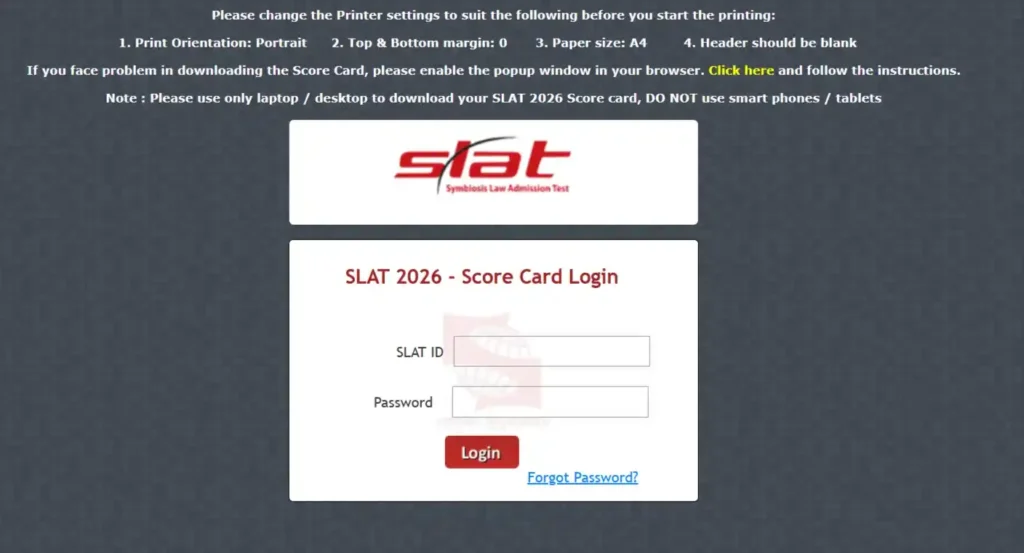
This is what the scorecard download window looks like:
How to Download SLAT 2026 Result
Candidates are required to follow a simple online process to access their SLAT 2026 scorecard. The result is not sent via post or email and must be downloaded from the official website.
To download the SLAT 2026 result:
Visit the official SLAT website at slat-test.org
Click on the link titled “SLAT 2026 Scorecard / Result”
Log in using your SLAT ID (SET ID) and password
The SLAT 2026 scorecard will appear on the screen
Download and save the scorecard for future reference
Candidates are advised to keep multiple copies of the scorecard, as it will be required during Personal Interaction rounds, merit list verification, and admission confirmation.
Information Included in the SLAT 2026 Scorecard
The SLAT 2026 scorecard contains all the essential performance and identification details of the candidate. It serves as the official record of a candidate’s performance in the entrance examination.
Details mentioned on the SLAT 2026 scorecard include:
Candidate’s name and SLAT/SET ID
Roll number and test details (Test 1 / Test 2)
Total marks obtained (out of 60)
All India Rank (AIR)
Category rank (if applicable)
Qualification status for further admission rounds
Candidates should carefully verify all the information printed on the scorecard and immediately report discrepancies, if any, through official channels.
SLAT 2026 Cut-off: Institute-wise Qualifying Marks (Expected)
The official SLAT 2026 cut-off marks will be released by individual Symbiosis Law Schools along with or after the announcement of PI shortlists and merit lists. Cut-offs vary depending on the campus, category, number of applicants, and seat availability.
Based on previous years’ admission trends, the expected institute-wise cut-off ranges (out of 60 marks) are as follows:
Symbiosis Law School, Pune: 45–50
Symbiosis Law School, Noida: 42–47
Symbiosis Law School, Hyderabad: 38–43
Symbiosis Law School, Nagpur: 36–41
These figures are indicative only. The final qualifying cut-offs will be determined after evaluating overall performance and PI results.
What Next After the SLAT 2026 Result?
With the result now declared, candidates who meet the qualifying criteria will move forward to the next stages of the admission process, which are equally important for final selection.
The next steps include:
Personal Interaction (PI) Shortlisting: Eligible candidates will receive PI call letters through the SLAT portal.
PI Rounds: Conducted by individual Symbiosis Law Schools, either online or offline.
Merit List Release: Campus-wise merit lists are expected to be released in February 2026.
Admission Confirmation: Selected candidates must complete fee payment and document verification within stipulated timelines.
It is important to note that clearing SLAT alone does not guarantee admission. Final selection is based on a combined evaluation of SLAT score and PI performance.
SLAT 2026 Merit List – Release Date
SLAT 2026 merit list date is different for the participating institutes as shown in the table below:
Campus
First Merit List Date
SLS Pune
12-February-2026
SLS Noida
12-February-2026
SLS Nagpur
10-February-2026
SLS Hyderabad
16-February-2026
SLAT 2026 Exam Pattern
Understanding the exam pattern helps candidates contextualize their performance and expected cut-offs. SLAT 2026 was conducted as a computer-based test (CBT) with a focus on aptitude and reasoning skills relevant to legal education.
Key highlights of the SLAT 2026 exam pattern are:
Mode of examination: Computer-Based Test (CBT)
Total number of questions: 60
Duration: 60 minutes
Marking scheme: +1 mark for each correct answer
Negative marking: None
The question paper consisted of five sections with equal weightage:
Logical Reasoning
Legal Reasoning
Analytical Reasoning
Reading Comprehension
General Knowledge
Candidates were allowed to appear for both Test 1 and Test 2, with the higher score considered for ranking and admissions.
The Xavier Aptitude Test (XAT) 2026 result has been officially declared by XLRI Jamshedpur on January 16, 2026, on the official XAT portal at xatonline.in. Candidates who appeared for the national-level management entrance examination — held for admission to MBA and PGDM programmes — can now download their scorecards online using their XAT ID and password.
The XAT exam was conducted as a computer-based test (CBT) across India on January 4, 2026 in a single shift. Alongside releasing the results, XLRI administered the response sheet and provisional answer key earlier in January, allowing candidates to estimate their scores before the result announcement.
The XAT scorecard contains sectional scores, overall score, percentile and qualifying status, which will be used by participating management institutes nationwide for shortlisting candidates for admission rounds such as GD/PI. The XAT score is widely accepted by 200+ MBA and PGDM colleges across India.
Candidates must follow the official process to access their XAT 2026 scorecards. This is an entirely online process, and the scorecard PDF can be downloaded immediately after logging in.
Visit the official XAT website — xatonline.in.
Click on the “XAT 2026 Scorecard / Result” link on the homepage.
Enter your XAT ID and Password (registered during application).
The scorecard will appear on the screen.
Download and save the PDF for future admission procedures.
Note: It is recommended to take multiple printouts for use in subsequent stages of the admission process and counselling.
Details Mentioned on the Scorecard
The XAT 2026 scorecard presents essential performance and identification information required for admissions and counselling. This includes:
Candidate’s name and registration details
XAT ID and roll number
Sectional scores (e.g., Quantitative Ability, Verbal & Logical Ability, Decision Making, General Knowledge where applicable)
Overall score and percentile
Qualifying status for shortlisting
These details help institutes determine candidate eligibility for the next rounds of the selection process, including Group Discussion (GD), Personal Interview (PI) and Writing Ability Test (WAT) where applicable.
Expected Cut-off: XAT 2026 (Based on Last Year Trends)
While XLRI will release final cut-offs in the coming days.
XAT 2026 cut-offs are expected to be similar to last year’s trends. The table below gives an indicative idea based on prior patterns and common cut-off percentiles used by top participating institutes:
Institute / Category
Expected XAT 2026 Cut-off (Percentile)
XLRI Jamshedpur – BM
95+
XLRI Jamshedpur – HRM
90+
SPJIMR Mumbai
85–90
IMT Ghaziabad
80–85
XIM Bhubaneswar
80–85
MICA Ahmedabad
85–90
Other Good MBA Colleges
70–80
XAT Result Dates: Previous Years’ Trend
The XAT 2026 results were declared on January 16, 2026. Here we bring you past years’ result trends for reference.
XAT 2025 result date: January 17
XAT 2024 result date: January 20
XAT 2023 result date: January 28
XAT 2022 result date: January 17
XAT 2021 result date: January 18
XAT 2026 Result: Percentile-Wise MBA Colleges & Fees
Candidates often use their XAT percentile to gauge admission chances at various MBA/PGDM colleges. While exact fee structures vary yearly, the following table provides a generalised idea of fee ranges associated with approximate XAT percentiles based on last year’s trends:
Percentile
Representative Colleges
Approx. Fee (Annual)
95+
XLRI Jamshedpur
₹15–23 lakh
90–95
SPJIMR Mumbai, MICA Ahmedabad
₹17–28 lakh
85–90
IMT Ghaziabad
₹20–24 lakh
80–85
XIM Bhubaneswar
₹18–24 lakh
XAT 2026 Topper List (OUT)
Over 1 lakh candidates appeared for the XAT 2026 exam, which was held on January 4, 2026. The XAT toppers list is not typically released.
So, it is no surprise that XLRI Jamshedpur, the XAT conducting institute hasn’t released any XAT toppers list 2026.
However, students securing 95 to 99 percentile can safely be called star performers. Check below names of some of the XAT 2026 toppers.
XAT 2026 Toppers Name
XAT 2026 Toppers Score (Percentile)
Aishiki Sen
97.47
Vishesh Mittal
98.42
Pranay Gangele
97.06
Radhika Arora
96.26
Debodatta Lala
97.34
Nivedha Rajkumar
99.51
Tejaswi Razdan
96.02
Anshika Bhagat
96.58
Abhishek Kumar
99.81
Aditya Narwania
99.1
Aman Pandey
98.13
Saurabh Jaiswal
99.12
XAT 2026 Result Statistics
XLRI Jamshedpur has not released any official XAT 2026 result statistics such as the number of candidates registered, appeared, or shortlisted for admission. The XAT scorecard issued to candidates reflects individual performance only, including sectional and overall percentiles.
In previous years, XLRI has followed a similar approach, where detailed participation or qualification data was either released at a later stage or not disclosed publicly. Shortlisting for Group Discussion (GD), Personal Interview (PI), and Writing Ability Test (WAT) is carried out independently by participating institutes, based on their respective admission criteria and cut-off requirements.
Candidates are advised to rely only on official updates published on xatonline.in for any information related to XAT result data and to avoid unverified claims regarding the number of qualifiers or percentile distributions circulating on unofficial platforms.
What Next?
With the XAT 2026 results declared, candidates should focus on the post-result stages of the management admission cycle:
Download Scorecard and Check Percentile — Essential for shortlisting eligibility.
Cut-off and Shortlist Announcements — Institutes will release their own cut-offs and interview lists soon.
Interview / GD / WAT Rounds — Scheduled by individual business schools typically between February and April.
Final Selection & Admission Offers — Based on composite scores (XAT + GD/PI + Academics).
Aspirants should monitor xatonline.in and participating institute portals regularly for personalised information and counselling schedules.
XAT 2026 Result OUT – Next, How to Shortlist Colleges
After the declaration of the XAT 2026 result, shortlisting the right MBA colleges is a critical step in the admission process. Candidates should approach this exercise strategically, keeping in mind that XAT scores are accepted by 200+ management institutes, each with its own cut-offs, selection criteria, and programme focus.
The first step is to assess your XAT percentile realistically. Compare your overall and sectional percentiles with the previous years’ cut-offs of target colleges. Many top institutes, including XLRI Jamshedpur, apply sectional cut-offs, so candidates must ensure they meet both overall and sectional eligibility requirements.
Next, candidates should evaluate programme fit and specialization. Some institutes are known for specific domains such as Human Resource Management, Business Analytics, or Marketing. Reviewing curriculum structure, pedagogy, and industry exposure can help identify colleges that align with career goals.
Another important factor is selection criteria beyond XAT score. Most B-schools use a composite score that includes XAT percentile, academic background, work experience, diversity factors, and performance in GD/PI rounds. Candidates with moderate XAT scores but strong academic or professional profiles may still be competitive at certain institutes.
Candidates should also consider fees, return on investment (ROI), location, and placement records. Comparing average placement packages against total programme cost provides a clearer picture of long-term value.
Finally, aspirants should track application deadlines and interview shortlists on official institute websites and apply only to colleges where they meet the eligibility criteria. A balanced shortlist should include aspirational, realistic, and safe options to maximise admission chances.
How to Apply to MBA/PGDM Courses After XAT 2026
After the declaration of the XAT 2026 result, eligible candidates can begin applying to MBA and PGDM programs offered by XLRI Jamshedpur and other participating management institutes that accept XAT scores. The application process is institute-specific, and candidates must apply separately to each B-school of their choice.
The first step is to check eligibility criteria on the official websites of the shortlisted institutes. Eligibility generally includes a valid XAT 2026 score, minimum graduation marks, and in some cases, meeting sectional cut-offs.
Below is a step-wise guide to applying for MBA/PGDM admissions through XAT:
Step 1: Visit the Institute’s Official Website Go to the official admission portal of the MBA/PGDM college you wish to apply to. Look for the admissions or MBA/PGDM application section.
Step 2: Register for Admission Create a new login using your email ID and mobile number. You will receive login credentials to access the application form.
Step 3: Fill the Application Form Enter personal details, academic qualifications, work experience (if applicable), and upload required documents. You will need to provide your XAT 2026 score and percentile as part of the form.
Step 4: Pay the Application Fee Pay the institute-specific application fee online using debit card, credit card, or net banking.
Step 5: Submit and Download Confirmation Submit the form and download the application confirmation page for reference. After applications close, institutes will release shortlists for GD/PI/WAT rounds. Candidates who clear these stages will receive final admission offers based on composite scores. Aspirants are advised to regularly track official websites and registered email IDs for updates and interview schedules.
The National Testing Agency (NTA) is expected to release the JEE Main 2026 Session 1 admit cards in the third week of January 2026, just days before the start of the examination. Aspirants planning to appear in this year’s Joint Entrance Examination (Main) are advised to keep checking the official portal – jeemain.nta.nic.in – for the download link and latest updates.
The JEE Main Session 1 exam is scheduled to be conducted between January 21 and January 29, 2026, across various cities in India and abroad. The test will be held in multiple shifts for Paper 1 (BE/BTech) and on a separate day for Paper 2A (BArch) and Paper 2B (BPlanning).
JEE Main 2026 City intimation slips – which inform candidates about their allotted exam city — have already been issued on the official portal. Candidates must download these slips and follow instructions for the admit card release.
With just days to go for the start of the JEE Main 2026 Session 1 exam, thousands of engineering aspirants are preparing to access their hall tickets as soon as they are released. By logging in with their registration details, candidates will be able to download and print their admit cards ahead of the exam dates.
The JEE Main 2026 Session 1 admit card is expected to be released 3–4 days before the commencement of the exam, which places the likely release window in mid-January 2026. These timelines align with previous years, where NTA issues hall tickets shortly before the exam.
The official admit card download link will appear on NTA’s JEE Main official website — jeemain.nta.nic.in. Candidates should access the portal regularly as updates and official notifications are published at short notice.
How to Download the JEE Main 2026 Admit Card
To access the JEE Main Session 1 admit card once it is released, candidates need to:
Visit the official JEE Main portal at jeemain.nta.nic.in.
Click on the JEE Main 2026 Admit Card link visible on the homepage.
Enter your application number and password/date of birth in the login section.
View the admit card on the screen.
Download and print the hall ticket for use on the exam day.
The admit card will contain important details such as the candidate’s name, roll number, exam centre address, exam date and shift timing, reporting time, and exam day instructions, which students must follow carefully.
Important Details on the JEE Main 2026 Admit Card
Once released, the JEE Main 2026 admit card will include essential information that every candidate must verify. This typically includes:
Ensure that all personal details on the admit card are correct. Any discrepancy should be reported to NTA authorities immediately.
Schedule & Next Steps
The JEE Main 2026 Session 1 exam will be held from January 21 to January 29, 2026, covering multiple shifts and papers for various courses. Aspirants who successfully download their admit cards should plan travel and logistics to reach exam centres well before reporting time on their scheduled day.
After the exams, NTA will release provisional answer keys and then final results, with the Session 1 result expected in February 2026. Candidates can then plan for Session 2, scheduled for April 2–9, 2026, if they wish to improve scores. Stay tuned to jeemain.nta.nic.in for the official admit card release and further updates on exam changes or additional notifications from the National Testing Agency.
In a major update for medical aspirants and healthcare institutions, the National Board of Examinations in Medical Sciences (NBEMS), under guidance from the Ministry of Health and Family Welfare, has reduced the qualifying NEET-PG 2025 cut-off after two rounds of counselling left tens of thousands of postgraduate medical seats vacant across India. The revised eligibility criteria now allow general and EWS category candidates to qualify at a much lower percentile than before, and reserved category candidates are eligible at a zero percentile – including those with markedly low or even negative scores – to participate in Round-3 counselling and mop-up rounds of the postgraduate admission process.
This shift has triggered intense debate among medical professionals, educators, and the public over its implications for healthcare quality and medical education standards.
The official reason cited for the cut-off revision is: to utilise vacant postgraduate seats that remained unfilled even after the first two counselling rounds.
Reports show that over 18,000 MD/MS seats – spread across government and private colleges – were yet to be allotted, largely because many candidates with higher scores preferred certain specialities and institutions, leaving others unclaimed. Lowering the qualifying criterion expands the pool of eligible candidates for subsequent counselling rounds, thereby reducing the number of vacant seats at a time when the country is tackling shortages of medical professionals.
Officials emphasise that this move is a pragmatic response to recurring seat vacancies and is intended to ensure that education and healthcare delivery systems are not disrupted by unfilled postgraduate training positions.
Revision Does Not Dilute Academic Standards – How True Is It?
Government sources have maintained that the reduction in qualifying cut-off does not dilute academic standards, because every candidate eligible for NEET-PG has already completed an MBBS degree and internship, which itself is a rigorous academic and clinical training programme.
They argue that NEET-PG functions primarily as a ranking mechanism to allocate seats through centralised counselling rather than a subsequent competency test. According to this perspective, admitting more MBBS-qualified doctors into postgraduate training does not in itself lower the quality of future specialists, since admissions are still governed strictly by merit-based rank lists and preferences chosen by candidates.
However, medical bodies such as the Federation of All India Medical Associations (FAIMA) have countered this view, warning that repeatedly lowering cut-offs could gradually weaken expectations for postgraduate performance and long-term quality of medical training and patient care. Critics argue that while expanding eligibility brings more candidates into the counselling process, it does not address deeper issues of systemic shortages, uneven distribution of doctors, or the root causes behind seat vacancies.
Official Say Candidates Selected From Eligible Pool — Are Negative-Score Candidates Really Eligible?
Under the revised criteria, candidates who scored as low as near-negative marks (reported around -40 out of 800) can now qualify for counselling, particularly in SC, ST, and OBC categories where the cut-off has been set at zero percentile. For general and EWS categories, the qualifying percentile was moved down to around the 7th percentile, equivalent to a much lower mark threshold than in previous years.
Officials clarify that this does not guarantee admission for these candidates; rather, it makes them eligible to participate in the counselling process. Actual seat allotment will continue to favour candidates with higher ranks once choices and preferences are submitted and processed. This distinction is critical: eligibility simply means a candidate’s name is present in the list from which seats are allotted, but rank and choice still determine whether a seat is actually offered.
Lowered Cut-Off Invites Social Media Backlash!
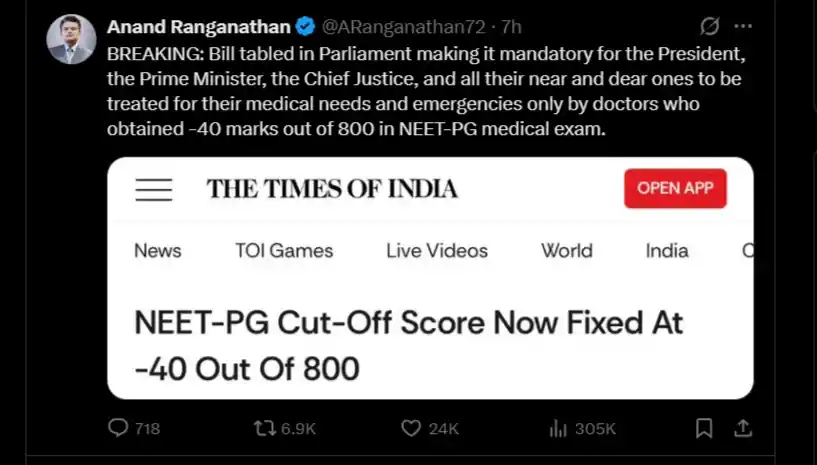
The cut-off change has sparked widespread reaction on social media and professional forums. Many voices – including students, doctors, and medical educators -have expressed outrage that the qualifying bar has been set so low, to the point that individuals with minimal or even negative scores can enter postgraduate counselling. Critics argue this undermines the competitive edge and reputation of India’s medical entrance processes, which are known for their high difficulty and rigorous standards.
Some commentators link the policy shift to mounting public frustration over long wait lists for specialist care and chronic shortages of trained doctors in rural and under-served regions. Others warn that frequent lowering of eligibility criteria could erode trust in medical education benchmarks and disadvantage future generations of students who invest years of intensive study to achieve higher ranks.
Reaction 1:
Reaction 2:
Reaction 3:
Reaction 4:
Is Cut-Off Reduction a Solution or a Symptom?
The debate over cut-off reduction is not just about whether it works to fill seats — it’s increasingly being seen as a symptom of deeper structural challenges facing postgraduate medical education in India. Persistent seat vacancies point to a mismatch between the number of MBBS graduates, specialty preferences, distribution of colleges, clinical exposure quality, and the attractiveness of certain specialities or regions. Simply lowering eligibility gives a short-term boost to counselling figures but may not address why seats go unclaimed in the first place.
Educational analysts and practitioners argue that unless factors such as workload pressures, resource constraints in smaller hospitals, and career incentives for postgraduate training are addressed, the mere expansion of the eligible pool may continue to be a cycle repeated each year.
Filling Seats at Any Cost: Is This the Underlying Objective?
The official stance is that lowering the cut-off is a pragmatic step to make the most of available educational infrastructure and ensure that healthcare systems are staffed adequately – especially in regions with acute shortages of specialists. However, sceptics contend that this expedient may signal a broader shift toward treating seat utilisation numbers as a policy objective in itself, rather than focusing on improving conditions that naturally attract high-quality aspirants to less popular courses and locations.
Some doctors worry that private colleges with poor infrastructure and limited clinical exposure benefit disproportionately from such policies, as seats that were avoided by top-ranked candidates suddenly become fillable without improving the underlying training environment. Others view frequent threshold changes as a reactive policy rather than part of a proactive strategy to strengthen medical education and bridge quantitative shortages with qualitative improvements. In summary, while the cut-off reduction has immediate practical utility in reducing vacant postgraduate medical seats and broadening the counselling pool, its implications for medical standards, healthcare delivery, and the future of medical education continue to fuel debate among policymakers, doctors, and students alike. Whether this measure serves as a one-off adjustment or heralds more systemic reforms remains a subject of ongoing discussion and scrutiny.
The National Board of Examinations in Medical Sciences (NBEMS) released the Foreign Medical Graduate Examination (FMGE) December 2025–26 admit card on January 14, 2026, on its official website – natboard.edu.in.
Candidates who have successfully registered for the exam can download their admit cards by logging in using their User ID and password.
The FMGE December session examination will be conducted on January 17, 2026, in computer-based test (CBT) mode at designated examination centres across the country. Candidates must carry a printed copy of the admit card along with a valid photo identity proof to the exam centre, as entry without these documents will not be permitted.
FMGE is a national-level screening test conducted for Indian citizens and Overseas Citizens of India who have obtained their primary medical qualification from institutions outside India and wish to practise medicine in the country. With the release of the admit card, candidates can now check key details such as their exam centre, reporting time and exam-day instructions.
Latest Updates:
FMGE December Admit Card 2026 (OUT) – Download Here
How to download the FMGE December 2026 admit card
Candidates can download the admit card by following these steps:
Visit the official NBEMS website
Click on the FMGE December 2025–26 admit card link under the examinations section
Enter your User ID, password and captcha code
The admit card will appear on the screen
Download and print the admit card for future reference
Candidates are advised to print multiple copies of the admit card and keep them safely until the completion of the examination process.
Details mentioned on the admit card
After downloading the admit card, candidates should carefully verify the following details:
Candidate’s name
Roll number or registration number
Exam date and day
Reporting time and gate closing time
Examination centre name and address
Candidate’s photograph and signature
Important exam-day instructions
In case of any discrepancy, such as incorrect personal details or exam centre information, candidates must immediately contact NBEMS for rectification before the exam date.
Documents required on the exam day
Candidates must carry the following documents to the exam centre:
Printed copy of the FMGE admit card
A valid photo identity proof such as Aadhaar card, passport, voter ID or driving licence
Passport-size photograph, if specified in the admit card instructions
Candidates without the required documents will not be allowed to appear for the examination.
FMGE exam-day guidelines
Candidates appearing for the FMGE December 2025–26 examination should take note of the following instructions:
Report to the exam centre well before the time mentioned on the admit card
Entry will be strictly prohibited after the gate closing time
Electronic devices, mobile phones, smart watches, calculators, notes and bags are not allowed inside the exam hall
Follow instructions given by invigilators and exam centre staff
Carry admit card and ID proof for multiple rounds of verification
Candidates are advised to familiarise themselves with the exam centre location in advance to avoid last-minute delays.
FMGE December 2026 exam pattern
The FMGE December session will be conducted in a single day and will consist of two papers. Paper I will be held in the morning session. Paper II will be held in the afternoon session:
Duration: 2.5 hours (150 mins) for each part (5 hours total).
Structure: Two parts (Part A & Part B), 150 questions each, on the same day.
The examination will include a total of 300 multiple-choice questions
Each paper will test candidates on subjects covered during the MBBS course
The exact timings for both papers are mentioned on the admit card
Passing Score: 150/300 (50%).
Marking Scheme: +1 mark for each correct answer: there is no negative marking
Language: English.
Syllabus: Covers MBBS curriculum subjects.
What Next?
With the admit card now available, candidates should focus on final revision and exam preparedness. After the examination is conducted, NBEMS will evaluate the answer sheets and announce the FMGE December 2025–26 results in the coming weeks.
Candidates are advised to regularly check the official NBEMS website for updates related to results, qualifying status and further instructions.
CLAT Exam 2026 – The Consortium of NLUs will declare CLAT 2026 seat allotment for Round I on January 22, 2026 (10 am).
Seat allotment for Round I was announced on January 7. The allotment has been based on merit rank and college options selected by the candidate. The deadline to pay the seat-confirmation fee for Round I is January 15, 2026 (1 pm).
CLAT 2026 counseling registration was conducted from December 17-27, 2025. The counseling-cum-seat allotment process has FIVE rounds.
CLAT 2026 result was released alongside the final CLAT 2026 answer key on December 16; the provisional key was released on December 10. The key has been released for all FOUR paper series (A, B, C, and D). It contains the official answers (or keys) to all questions asked in the exam. The CLAT 2026 question paper was released alongside the answer key.
The Consortium of NLUs released the CLAT 2026 admit card-cum-hall ticket on November 22, 2025.
The candidate must bring the CLAT admit card and a valid photo ID proof on the day of the exam. No candidate will be allowed to enter the exam hall without these documents. The admit card contains details like the name and address of the CLAT 2026 exam center, roll number, exam timings, reporting time, and exam-day guidelines.
CLAT Exam 2026 – Reporting & Gate Closing Time, Bell Type
Understanding CLAT exam-day bell timings is recommended for an event-free exam experience. As explained in the table below, each bell type has a specific significance.
Timing
Bell Type
Event
1.30 pm
Long Bell
Entry of Candidates inside the Exam Hall
1.50 pm
Short Bell
Distribution of the sealed Envelopes and announcement of Instructions by the Invigilators
2 pm
Long Bell
Exam begins and candidates can open the seal of QB
The exam pattern has insights into the question paper structure, including the mode and duration of the exam, types and number of questions asked, and marking scheme.
The candidate needs to refer to the exam pattern to orient their exam preparation strategy.
Category
UG program
PG program
Duration
120 minutes
120 minutes
Mode
Offline mode
Offline mode
Type of Questions
Multiple-Choice Questions
Multiple-Choice Questions
Number of Questions
120 question
120
Subjects
English Language Current Affairs, including GK Legal Reasoning Logical Reasoning Quantitative Techniques
Constitutional Law Other areas of law such as Jurisprudence, Administrative Law, Law of Contract, Torts, Family Law, Criminal Law, Property Law, Company Law, Public International Law, Tax Law, Environmental Law, and Labour & Industrial Law
Total Marks
120 marks
120 marks
Marking scheme
+1 mark for a correct answer. -0.25 marks for an incorrect answer.
+1 mark for a correct answer. -0.25 marks for an incorrect answer.
CLAT Syllabus 2026
Candidates appearing in the CLAT 2026 exam are urged to strictly follow the official exam syllabus.
CLAT 2026 Syllabus (UG Courses): Subjects and Weightage
Subjects
Number of Questions
Approx Weightage (%)
English Language
22-26
20%
Current Affairs, including GK
28-32
25%
Logical Reasoning
28-32
25%
Legal Reasoning
22-26
20%
Quantitative Techniques
10-14
10%
Total
120 questions
120 marks
CLAT LLM 2026 syllabus
The official exam pattern for CLAT LLM 2026 is given below:
Constitutional Law
Other areas of law such as Jurisprudence, Administrative Law, Law of Contract, Torts, Family Law, Criminal Law, Property Law, Company Law, Public International Law, Tax Law, Environmental Law, and Labour & Industrial Law
Best Books to Prepare for CLAT Exam
Here are some of the best books for CLAT exam recommended by experts and toppers to prepare for the entrance exam.
Subject
Book Recommendation for CLAT Preparation
Logical Reasoning
A Modern Approach to Logical Reasoning by RS Aggarwal
Verbal Reasoning by RS Aggarwal Analytical Reasoning (English) by MK Pandey A New Approach to Verbal and Analytical Reasoning by Arihant
Legal Reasoning
Legal Awareness and Legal Reasoning by Pearson Legal Aptitude and Legal Reasoning by AP Bhardwaj Objective Legal Aptitude by RS Aggarwal
Quantitative Techniques
Fast Track Objective Arithmetic by Arihant Publications 30 days wonder for Math by S Chand Quantitative Aptitude for Competitive Examinations by Pearson’s Quantitative Aptitude by RS Aggarwal
GK & Current Affairs
General Knowledge by Arihant Publications Current Affairs Yearly by Arihant Publications Manorama Year Book by Manorama Publications General Knowledge by Lucent’sGeneral Knowledge by Tarun Goyal
English
Objective General English by SP Bakshi Objective General English by RS Aggarwal The Pearson Guide to the CLAT by Pearson’s Word Power Made Easy by Norman LewisCLAT Guide by Tata McGraw-Hill
In the previous edition of the CLAT exam (CLAT 2026), the question paper that was earlier released on December 2 was revised. 4 questions were dropped, which reduced the total number of questions were reduced to 116 from 120. So, the question paper was evaluated out of 116 marks.
The candidate must make it a point to solve previous years’ CLAT question papers as well as sample papers to prepare for the exam. The question papers will provide insights into the types of questions asked, the difficulty level, marking scheme, scope of the syllabus, etc.
Meanwhile, by solving the sample papers, one can build one’s problem-solving and time-management skills.
CLAT Exam Answer Key 2026
The Consortium of NLUs released the provisional answer key of CLAT 2026 on December 10, 2025. The keys have been uploaded on the admission portal of the consortium in downloadable pdf format.
To download the keys, click on the “CLAT 2026 answer key” download tab. No log-in is required.
The provisional key contains the official answers to all the questions asked in the entrance exam. Using the keys, you can calculate probable scores. Follow the marking scheme outlined in exam pattern to assign marks.
The probable score will give you a fair idea about your chances of admission even before CLAT 2026 results are declared.
Objections against provisional CLAT answer key
The consortium also allowed candidates the provision to challenge the provisional key. The objection window was available from December 10 (5 pm) till December 12 (5 pm), 2025.
To make challenges, the candidate had to pay INR 1000 per challenge.
Also, each challenge has to be accompanied by supporting documents.
Release of FINAL key
The final answer key of CLAT will be prepared by considering feedback given by the candidate. There will be no provision to challenge the final CLAT 2026 answer key.
CLAT Exam Results 2026
The Consortium of NLUs will declare the CLAT 2026 results around the 2nd week of December 2026. The link to check the results will be provided here.
To check your results, log in to the result portal using the following details:
CLAT 2026 application number / Admit card number
Date of birth
Download and take a printout of the result. The CLAT 2026 scorecard will contain details like the roll number, sectional and overall score, category and AIR.
Note that hard copies of the scorecard will not be available.
CLAT Exam Counseling 2026
The consortium conduct CLAT 2026 counseling registration from December 17-27, 2025. The counseling process will be held online as a centralized seat-allotment process.
As part of the counseling process, eligible candidates have to register and participate in choice filling (combination of academic program and institute).
The CLAT 2026 allotment will be merit-based and depend on the following factors:
The category of the candidate
Category-wise and OPEN merit rank
Academic option selected by the candidate
Seats available
Once an allotment is made, the candidate may have options like freeze, float, and exit. To confirm a seat, the candidate will have to pay the seat-acceptance fee before the deadline.
The 1st round of seat allotment was announced on January 22, 2026. Candidates who have been allotted seats need to pay the seat-acceptance fee by January 15, 2026 1 (1 pm).
The seat allotment for Round II will be declared on January 22, 2026 (10 am).
CLAT Counseling 2026 – The Consortium of NLUs will release the 2nd round of CLAT 2026 seat allotment on January 22 (10 am). The allotment will be published online at consortiumofnlus.ac.in and based on NLU preferences opted by the candidate, CLAT 2026 merit rank, category, and available seats. The direct link to check the seat allotment result will be provided below.
1st round of seat allotment was announced on January 7, 2026.
CLAT 2026 counselling registration was conducted from December 17-27, 2025 (10 pm).
Candidates who are allotted seats in Round I have to pay the seat-confirmation fee by January 17, 2026 (1 pm). The seat allotment for Round II will be declared on January 22, 2025. CLAT 2026 counseling has have FIVE seat allotment rounds.
The 2nd round of seat allotment will be announced on January 22 (10 am).
CLAT exam counseling registration was conducted from May 17-21 in an online, as a centralized process. Candidates who qualified CLAT 2025 exam can participate. As part of counseling registration, the candidate had to register, pay the CLAT 2025 counseling fee, and lock choices (select colleges in the order of priority). The CLAT 2025 counseling registration fee is INR 30, 000 (SC, ST, OBC, and PwD candidates had to pay only INR 20,000).
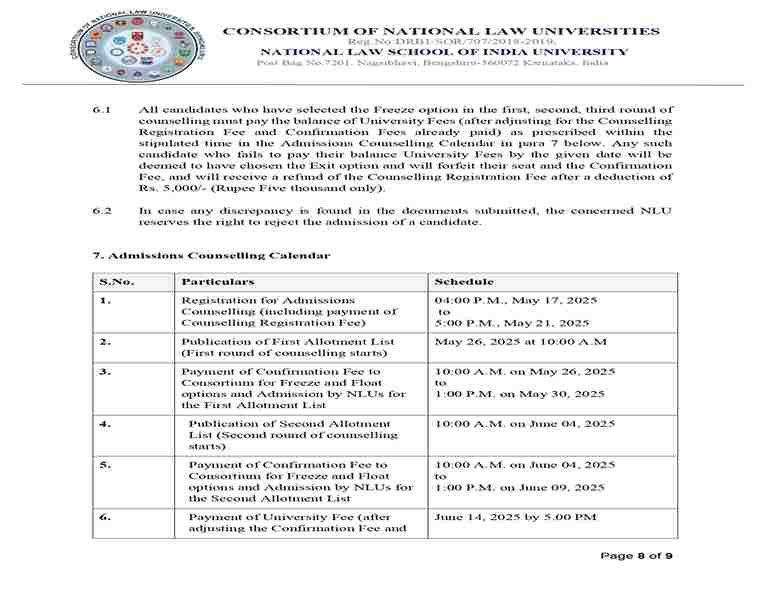
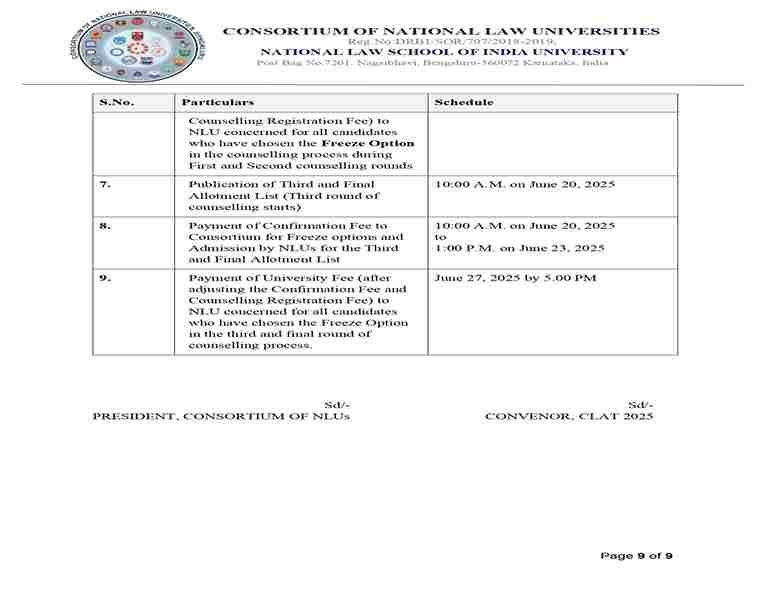
The detailed counseling schedule of CLAT 2025 is given below.
CLAT Counseling 2025 – Eligibility Criteria for Participation
To participate in the CLAT 2025 counseling, the candidate must have passed the CLAT 2025 exam and secured a rank.
Additionally, the candidate must meet the following conditions:
The candidate must have passed 10+2 or an equivalent exam with a minimum of 45% (SC/ST/PwD categories) marks or its equivalent in grade.
Candidates appearing for the qualifying exam in March/ April, 2025 are also eligible to apply. However, they must produce evidence of their passing the qualifying examination at the time of admission, failing which they may be disqualified.
The counseling for CLAT 2025 was conducted online. The Consortium of NLUs conducted centralized counseling for the participating CLAT 2025 institutes.
In the current edition of the exam, the 5-year LLB program is offered by 25 NLUs, while the one-year LLM program is available at 21 NLUs.
Step-wise CLAT 2025 Counseling process
Register for Counseling – The candidate needs to log-in to the candidate account using their mobile number and password. Next click on the counseling link.
Enter NLU preferences – Depending on the program opted for admission, the candidate has to select their NLU preferences. The entries must be in the order of priority.
Pay the counseling fee – Next, pay the CLAT 2025 counseling fee
Publication of CLAT 2025 Invite List – Based on the options entered by the candidate and other factors like merit rank, category, and seat available, the consortium will publish an invite list. The invite list will be sent via email/ SMS. The candidate can also check the status by logging into the candidate portal.
How to Register for CLAT Counseling
The candidate can register for CLAT counseling following the steps mentioned below. The registration process will be conducted online.
Eligibility and Invitation for CLAT Counseling
Eligibility criteria to participate in counseling
Eligible candidates will be invited to participate in the CLAT 2025 admissions counselling process in accordance with the CLAT 2025 rank list and the admissions matrixprovided by each NLU.
Invitations for counseling
Eligible candidates will receive:
An email invitation to participate in the admissions counselling process at their registered email address
an SMS at their registered mobile number; and
an invitation on their CLAT 2025 portal
Candidate’s validation for participation in CLAT Counseling 2025 – Mandatory
Login to the CLAT 2025 applicant account and validate that you have been invited for counselling during each round.
The consortium will not take responsibility for any undelivered emails/SMSs.
So, make sure that you check your emails, sms’s, and CLAT 2025 accounts for any invitation from the consortium.
Register for CLAT Counseling 2025
Follow these steps to register for CLAT Counseling 2025
Update NLU Preference – Log-in to your CLAT 2025 account. If you have been invited for counselling, you will see a “Update NLU Preferences” button. The consortium recommends that you provide a minimum of 15 preferences. Note that if you don’t select an NLU as one of the preferences, you won’t be considered for allotment in that institute even if vacancies are available. You can update the preferences as many times you want until the closure of the counselling registration. Also, you can only move up to the higher preferences and can not go down in the preferences given.
Pay the Counseling Registration Fee – The candidate has to next pay the counseling fee (refundable) through the CLAT 2025 candidate account. Don’t wait till the last minute to make payments to avoid payment related issues.
CLAT Seat Allotment 2025 – Freeze, Float, and Exit Options
Candidates who have been allotted a seat at any NLU must exercise any of the ‘Freeze’, ‘Float’, or ‘Exit’ options.
If the candidate doesn’t choose any of these options, then they will lose the currently allocated seat. Further, they can’t participate in subsequent CLAT 2025 counseling processes.
CLAT Seat Allotment 2025 – Freeze Option
Particulars
Description
When to use the freeze option?
If the candidate is satisfied with the allotted seat, accepts it, and is not interested in participating in further rounds of seat allocation/ counselling, they may ‘Freeze’ the seat allocation
How to freeze a seat?
To ‘Freeze’ a seat in the 1st, 2nd, 3rd, 4th, and 5th round of counselling, you must pay the CLAT 2025 seat confirmation fee of INR 20,000 (Twenty thousand) within the stipulated time.
Will I be considered for subsequent rounds if I opt for the freeze option?
A candidate who selects the Freeze Option and pays the confirmation fee will NOT be considered in subsequent rounds of counselling.
Availability of the freeze option
The ‘Freeze’ option will be available for all the five rounds of counselling.
However, the ‘Float’ option is available only till the Fourth round (explained in detail below).
CLAT Seat Allotment 2025 – Float Option
Particulars
Description
When to use the float option?
If the candidate has not been allotted their first preference NLU and chooses to leave ‘open’ the possibility of getting a higher preference NLU seat they may choose the ‘Float’ Option.
How to opt for the float option?
To exercise the Float Option in the 1st, 2nd, 3rd, 4th, or 5th round of counselling, you must pay the confirmation fee of Rs. 20,000 (Twenty thousand) within the time stipulated.
Will I be considered for subsequent rounds if I opt for the freeze option?
Under the Float Option, you may hold the seat allotted to you, and if you are allotted a higher preference NLU seat in a subsequent counselling round, you can move to that more preferred NLU.
Further, if you select a higher preference seat, the previous allocation will automatically get cancelled.
Availability of the float option
The ‘Float’ option will be available till the Fourth round of counselling
CLAT Seat Allotment 2025 – Exit Option
Particulars
Description
When to use the Exit option?
If at any time after completing the registration, you don’t want to participate in the counselling process, you can choose the ‘Exit’ option.
If you have chosen a Float or Freeze Option prior to the Exit option, the seat allocated to you will be reallocated to some other candidate and the confirmation fee will be forfeited.
No candidate will be allotted a seat after choosing the Exit option.
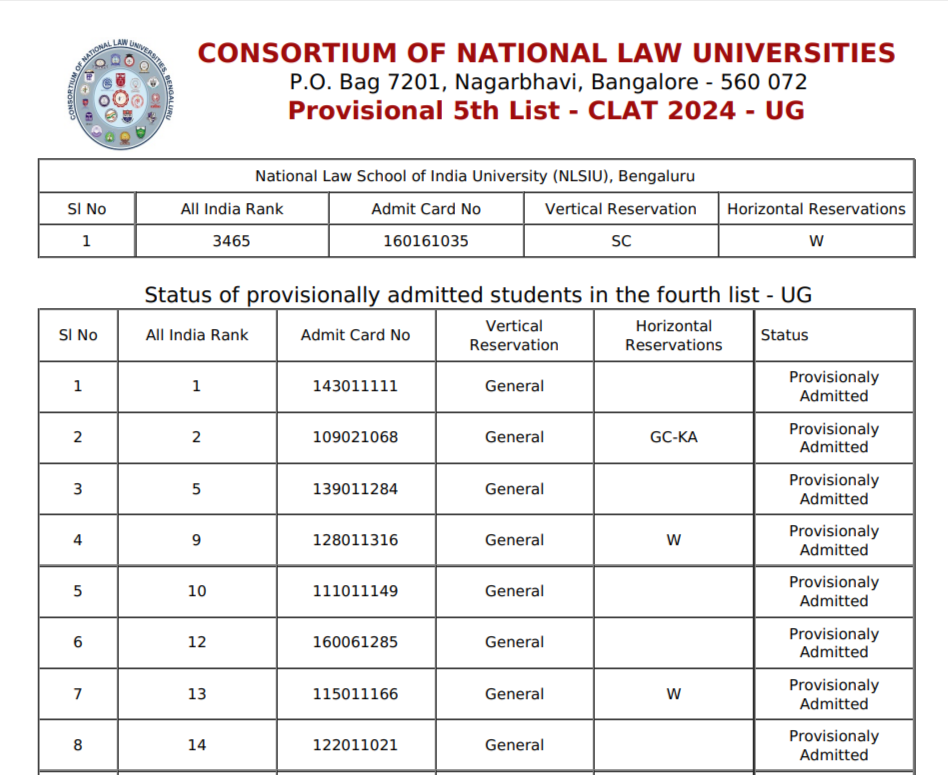
Sample CLAT Seat Allotment or Merit List
A sample seat allotment for CLAT exam is given below for the reference of the candidate.
CLAT Result 2025
The Consortium of NLUs declared the revised results of CLAT 2025 on May 17, 2025. The results, which were earlier declared December 7, were withdrawn,
The candidate can check their results by logging into the portal using their CLAT application number/ Admit Card Number and Date of Birth.
The CLAT results include details like sectional and overall score, merit rank, and qualifying status.
The Joint Entrance Examination Council Uttar Pradesh opened the JEECUP 2026 registration process on January 15, 2026.
The application form is for admission to diploma and polytechnic courses offered by government and private institutes across Uttar Pradesh. Eligible candidates can submit the online application form through the official website, jeecup.admissions.nic.in. The registration window will close on April 30, 2026.
Applicants are required to register online, upload prescribed documents, and pay the application fee within the deadline to be considered for the entrance examination. The JEECUP 2026 exam will be conducted in computer-based test (CBT) mode between May 15 and May 22, 2026. Candidates must have a valid email ID and mobile number to complete the registration process, as these credentials will be used for communication and future login. The application process is completely online, and no offline forms are accepted.
Candidates can follow the steps below to complete the JEECUP 2026 registration successfully:
Visit the official website and click on the JEECUP 2026 registration link
Read the instructions and eligibility criteria carefully
Enter basic personal details such as name, date of birth, mobile number, and email ID
Create login credentials (application number and password)
Fill in academic and communication details
Select the relevant exam group(s)
Upload scanned copies of the required documents
Pay the application fee through the available online payment modes
Review the application form and submit it
Download and save the confirmation page for future reference
Candidates are advised to verify all details before final submission, as incorrect or incomplete information may lead to rejection of the application.
Category-wise JEECUP 2026 Registration Fee
The JEECUP 2026 application fee varies by category and must be paid online during form submission. The prescribed fee structure is as follows:
General / OBC candidates: ₹300 per group
SC / ST candidates: ₹200 per group
The fee can be paid using debit card, credit card, net banking, or UPI. Applications without successful fee payment will not be accepted.
JEECUP 2026 Registration – Documents Required
Candidates must keep the following documents ready in scanned format before filling out the JEECUP 2026 application form:
Recent passport-size photograph in JPEG format
Candidate’s signature in JPEG format
Class 10 or equivalent mark sheet/certificate
Valid photo identity proof (Aadhaar card or equivalent)
Category certificate, if applicable
Domicile certificate, where required
The uploaded images must meet the size and format specifications mentioned in the official guidelines. Improper uploads may result in application rejection.
Will There Be a Correction Window?
Yes, the examination authority will provide a correction window after the conclusion of the registration process. During this period, candidates will be allowed to edit selected details in their application form.
Editable fields generally include:
Personal details
Academic information
Contact details
Uploaded photograph or signature
However, changes to critical fields such as exam group selection may not be permitted. Candidates are therefore advised to fill in all details carefully during initial registration.
JEECUP 2026 Exam Pattern
The JEECUP 2026 examination will be conducted as a computer-based test. The key features of the exam pattern are outlined below:
Mode of examination: Computer-Based Test (CBT)
Type of questions: Multiple Choice Questions (MCQs)
Total questions: 100
Duration of exam: 2 hours 30 minutes
Medium of paper: English and Hindi
Marking scheme: +4 marks for a correct answer; 1 mark will be deducted for every wrong answer
Important Instructions for Candidates
JEECUP 2026 registration marks the first step toward securing admission to diploma and polytechnic programmes in Uttar Pradesh. Candidates should complete the application process well before the deadline to avoid last-minute technical issues. It is recommended to keep copies of the submitted application form, fee receipt, and uploaded documents for future reference.
Applicants must regularly check the official website for updates related to admit card release, exam schedule changes, and counselling details. Only information published on the official portal will be considered valid.