There are 19 NIFTs with a combined intake of 4,837 seats. Here we bring you the NIFT seat acceptance rates, so that you get an idea how difficult, or easy, it is to get admission. A hint – older NIFTs have very low acceptance rates. Keep reading for more.
NIFT Acceptance Rate 2025 – The National Institute of Fashion Technology (NIFT) will release the year-wise NIFT acceptance rate on its admission portal. The information will be available once the NIFT 2025 counseling process concludes in June-July.
The NIFT admission process commences in November-December.
By consulting the NIFT 2025 acceptance rate, the candidate will get to know how difficult or easy it is to get admission to a NIFT.
The seat acceptance notification will include details like the number of candidates who registered for, appeared in, and were accepted to the NIFTs.
The NIFT acceptance rate is the ratio of candidates who applied for admission / number of candidates accepted.
The acceptance rate can signal the following things:
Low acceptance rate – If the acceptance rate is low, it is a sign that getting admission to the institute is tough. Typically, the older and higher-ranked NIFTs are much in demand. Consequently, for every available seat, there is a large number of applicants. This pushes up the cut-off. So, unless you get a good score in NIFT 2025, your chances of getting admission to one of the top NIFTs could be dim.
High acceptance rate – A higher acceptance rate can mean that admission is easy. The lowly-rated or the new NIFTs are typically the second or last preference of candidates. Consequently, there are seats available for grabs. So, even if you get a decent enough NIFT merit rank 2025, you are in contention for a seat in these institutes.
Acceptance rate is neither high nor low – The mid-rung NIFTs fall in this category. The cut-off for these institutes are not very high, so they are in reach for the average students.
Are NIFT seat acceptance rate and cut-off same?
The NIFT cut-off and seat-acceptance rate in a sense are TWO sides of the same coin.
For instance, a high cut-off can mean high competition and a difficult admission process. A low acceptance rate signifies the same thing.
In other words:
Low acceptance and High cut-off, Low cut-off and high acceptance rates are complimentary.
That being said, NIFT cut-off is much more detailed, easily available and gives a specific opening or closing rank.
On the other hand, the acceptance rate gives an overall picture.
Here are some important inferences that can be derived from NIFT acceptance rate.
The acceptance rate was the highest in the 2020-21 academic session. As we can see from the table above, it was due to the fewer number of applicants. For instance, there were 20242 applications against 3777 seats that were filled.
The acceptance rate in 2018-19 and 2014-15 was 10.4%. This was the lowest acceptance rate for the period.
Data suggests that the acceptance rate is not fixed, and can alternate between low to high.
The acceptance rate is influenced by multiple factors, like:
Number of applicants appearing in the NIFT exam
Total number of candidates who qualify in the exam
Seat intake
Category of the candidate, etc.
If any of the above factors change, the acceptance rate may also change.
Year-wise NIFT Seat Acceptance Rate
The acceptance rate is one of the best tools to gauge how difficult or competitive the NIFT exam is.
Take for instance, the NIFT acceptance rate hovers in the 10-19% range.
That means, for every seat, there are around 5-7 applicants.
Now if you throw in the top NIFTs, including NIFT Bangalore and NIFT Delhi, the acceptance rate will look even more lopsided.
NIFT Acceptance Rate 2021
The NIFTs recorded one of the best acceptance rates for the academic session 2021.
The acceptance rate of NIFT for the session 2021-22 was 18.7%.
NIFT 2021 Acceptance Rate
Category
Seats
Total seats filled
Regular
3901
3427
State Domicile Seats
334
161
NRI seats
458
189
Total
4693
3777
NIFT Acceptance Rate 2020
The break-up of acceptance rate for the academic session 2020-21 is given in the table below for reference.
Category
Seats
Total seats filled
Regular
3442
3160
State Domicile Seats
313
152
NRI seats
444
191
Total
4517
3810
NIFT Admission Process 2025
To get admission to the NIFTs, the candidate needs to crack the NIFT entrance exam 2025.
The NIFT exam has the following STAGES:
Written exams, comprising CAT and GAT
Situation Test/ Personal Interview
B.Des and M.Des candidates need to appear in both CAT and GAT. Meanwhile, B.F.Tech, M.F.Tech, and M.F.M candidates only need to take the GAT exam.
According to the official NIFT 2025 exam pattern, GAT will be an online exam, while CAT will be offline-based.
The FINAL result of NIFT 2025 will be prepared by giving weighatge to: GAT, CAT, and Situation Test/ Interview.
NIFT Seat Matrix 2025
There are 18 NIFTs that are participating in the NIFT 2025 admission process.
These institutes have a combined seat intake of 3,289 seats.
Refer to the table below to check program-wise NIFT 2025 seat intake.
If you’re preparing for the NIFT 2026 exam, make sure that the study material is top notch.
Good books have the following qualities – they are well written, easy to follow, contain few to no errors, cover the NIFT 2026 syllabus, contain practice sets, and are typically published by a well-known publisher. In simple words, good books are reliable. Consequently, if you use the best books for NIFT 2026 exam preparation, you start with one foot inside the door!
On the other hand, if the study material is poor, no matter how hard you try, the output will not do justice to the amount of hard work you put in.
So, make sure that you have in place the best books for NIFT 2026 exam preparation.
If you are not sure which are the best books for NIFT 2026, we have it ready. Keep reading to learn about subject-wise and general NIFT 2026 exam preparation books.
NTA will next declare the NIFT 2026 final results.
General NIFT Preparation Books
Here are some books that the candidate can use to prepare for all the sections of the NIF 2026 entrance exam.
NIFT Entrance Exam Guide by Dr. R. P. Datason – A comprehensive guide covering all sections of the NIFT exam. Includes solved papers, mock tests, and practice questions.
NIFT Exam Guide by Verma – Covers all sections of the exam, including General Knowledge, Quantitative Ability, and Communication Ability. Provides previous years’ question papers and practice exercises.
NIFT Entrance Exam by Arihant Experts – A popular book for NIFT aspirants. Includes theory, practice questions, and mock tests.
NIFT/NID/IIFT Entrance Exam by R. Gupta – Focuses on all sections of the exam, including the Creative Ability Test (CAT) and General Ability Test (GAT). Includes solved papers and practice sets.
Here are the best books for NIFT 2026 exam preparation recommended by toppers and experts.
1. General Knowledge and Current Affairs
Manorama Yearbook (Latest Edition) – A reliable source for current affairs and general knowledge.
Lucent’s General Knowledge – Covers a wide range of topics, including history, geography, science, and current affairs.
2. Quantitative Ability and Analytical Ability
Quantitative Aptitude by R.S. Aggarwal – A must-have book for mastering quantitative and mathematical skills.
Fast Track Objective Arithmetic by Rajesh Verma – Great for quick revision and practice.
3. English Comprehension and Communication Ability
High School English Grammar and Composition by Wren & Martin – A classic book for improving grammar and communication skills.
Word Power Made Easy by Norman Lewis – Helps improve vocabulary and language skills.
4. Creative Ability Test (CAT)
How to Draw for NIFT/NID by Pradeep Jain – Focuses on improving drawing and creative skills.
NIFT/NID/IIFT Entrance Exam Guide by R. Gupta – Includes tips and techniques for the Creative Ability Test.
5. Logical Reasoning and Analytical Ability
A Modern Approach to Logical Reasoning by R.S. Aggarwal – Covers all types of logical reasoning questions.
Analytical Reasoning by M.K. Pandey – Focuses on analytical and logical reasoning skills.
Section-wise Best Books to Prepare for NIFT 2026
The best books to prepare for the NIFT 2025 exam recommended by toppers and experts are given in the table below for quick reference.
Category/ Section
NIFT 2026 Study Material
General NIFT Books
NIFT Entrance Exam Guide by Dr. R. P. Datason NIFT Exam Guide by Verma NIFT Entrance Exam by Arihant Experts NIFT/NID/IIFT Entrance Exam by R. Gupta
General Knowledge and Current Affairs
Manorama Yearbook (Latest Edition) Lucent’s General Knowledge
Quantitative Ability and Analytical Ability
Quantitative Aptitude by R.S. Aggarwal Fast Track Objective Arithmetic by Rajesh Verma
English Comprehension and Communication Ability
High School English Grammar and Composition by Wren & Martin Word Power Made Easy by Norman Lewis
Logical Reasoning and Analytical Ability
A Modern Approach to Logical Reasoning by R.S. Aggarwal Analytical Reasoning by M.K. Pandey
Books for Creative Ability Test (CAT)
How to Draw for NIFT/NID by Pradeep Jain NIFT/NID/IIFT Entrance Exam Guide by R. Gupta
Important Topics for NIFT CAT 2026
Design Theory
Colour Terminology
Inspiration & Design Development
Colour Psychology & Optical Illusions
Elements & Principles Of Design
Mood, Theme & Colour Inter-relationship
Design Awareness
Innovation in Design
Drawing Fundamentals
Creative thinking & writing
Optical Illusion
Understanding Light & Shade
Visual Logic
Form & Function
Natural & Geometrical Form
Memory Drawing
Expression & Emotion
Picture Analysis
Colour, Pattern & Texture
Inspiration & Creativity
Ornaments & motifs
Use of Measurements, Scale & proportions
Optical Illusion
Foreshortening & Perspective
Developing Themes & Colour Associations
Usage of Colour in Compositions
Imagination & Doodling
3D Visualisation
Presentation Techniques
Graphics & Pictograms
Exercises on imagination
Lateral Thinking
Story Pictures
Principles of Composition
Innovation & Creation
Theme Development
Take Mock Tests & Solve Previous Years’ NIFT Question Papers
NIFT Previous Years’ Solved Papers – Previous years’ papers will help you understand about the types of questions asked, exam pattern, difficulty level, weightage, and specific questions asked. Books by Arihant, R. Gupta, or other publishers can be purchased online.
Online Mock Tests – There are many online coaching and third-party portals that offer NIFT-specific mock tests. But note that to take these tests, you will have to pay a certain fee.
Additional Tips to ace NIFT 2026
Practice Drawing Daily: For the Creative Ability Test, practice sketching, doodling, and designing regularly.
Stay Updated: Read newspapers like The Hindu or Indian Express for current affairs and improve your English comprehension.
Time Management: Practice solving questions within the time limit to improve speed and accuracy.
Draw a lot – Practice drawing regularly—sketch whatever you see around you. Start with simple exercises like drawing straight lines and circles to improve your pencil control and stroke precision. Then, move on to sketching everyday objects—a cup, a chair, a pet, or anything in your surroundings. The more you draw, the better you’ll get!”
Read newspapers – Importantly, don’t restrict yourself only to fashion or design related stuff, rather read about as many things you can, especially about topics that impact the general public, be it culture, history, even science. This way you will have a broader vision to let you imagination loose!
By combining these books with consistent practice and mock tests, you can ace the NIFT entrance exam. Good luck!
NIFT Fee Structure 2025 – The NIFTs are among the top destinations for studying fashion design courses. So, it attracts candidates from all across the country. Admission to the NIFTs is done on the basis of the NIFT entrance exam. But do you have any idea about the NIFT fee structure?
If you don’t, you must.
Knowing beforehand how much the B.Des, M.Des, B.F.Tech, M.F.Tech, or for that matter the M.F.M program costs can help you budget better.
Also, the program fee can also help you get a better understanding of the ROI.
In this article we bring you the NIFT 2025 fee structure for the UG, PG, and PhD courses at various NIFT campuses. So, keep reading.
Academic Fee Annually For NRI (Per Year – Consisting of Two Semesters) (In Rupees) at NIFT Bengaluru, Chennai, Delhi, Gandhinagar, Hyderabad, Kolkata & Mumbai
2025-26
2026-27
2027-28
2028-29
Tuition fee (non refundable)
907000
952000
1000000
1050000
Library fee (per year) (non refundable)
52500
55100
57900
60800
Mediclaim & student development fee (per year) (non refundable)
33600
35300
37100
39000
Exam fee (per year)
4900
5100
5400
5700
Total
998000
1047500
1100400
1155500
One time payments
Security deposit (one time) (refundable)
12600
0
0
0
Alumni association membership fee (one time) (Non refundable)*
Alumni association membership fee(One time) (non refundable)
0
0
0
0
6200
0
Registration fee (One time)
9300
0
0
0
0
0
Total
21900
0
0
0
6200
0
Grand total
191700
150000
178700
158000
194000
166000
NIFT Fee Structure 2025 – NLEA NRI
Academic Fee Annually For NRI (Per Year – Consisting Of Two Semesters) (In Rupees) at Nift Bengaluru, Chennai, Delhi, Gandhinagar, Hyderabad, Kolkata & Mumbai
2025-26
2026-27
2027-28
Tuition fee ( non refundable)
907000
952000
1000000
Library fee (per year) (non refundable)
52500
55100
57900
Mediclaim & student development fee (per year) (non refundable)
33600
35300
37100
Exam fee (per year)
4900
5100
5400
Total
998000
1047500
1100400
One time payments
Security deposit (one time) (refundable)
12600
0
0
Alumni association membership fee (one time) (Non refundable)*
VITEEE Cut-off 2025 – Vellore Institute of Technology (VIT) will release the VITEEE 2025 cut-off at the time of VITEEE 2025 counseling and seat allotment. However, the institute may not make the cut-off public
The VITEEE 2025 cut-off will be prepared for each participating institute and will be category-specific. Candidates who meet the cut-off for a seat allotment round will be considered for admission in that round. However, if the candidate misses the cut-off, then he or she may be considered for seat allotment in subsequent rounds (if available).
However, if the candidate misses the VITEEE cut-off for the last round of seat allotment, the candidate is effectively out of the admission process.
The VITEEE 2025 cut-off will be available in the form of opening and closing ranks, and will depend on factors like the number of applicants, merit ranks of these applicants, seat intake, etc.
VITEEE 2025 exam was conducted from April 20-27, 2025. Keep reading to learn more about VITEEE 2025 cut-off.
Table of Contents
VITEEE Cut-off 2025
The cut-off of VITEEE 2025 will depend on the following factors:
Total number of applicants
Merit rank of applicants in VITEEE 2025
Seat intake
Campus opted for admission
Difficulty level of the exam.
VITEEE 2025 – Expected Cut-off
The expected cut-off marks for VITEEE 2025 are given in the table below.
The counseling for VITEEE 2025 is conducted online. The counseling process includes steps like choice filling and locking, payment of counseling and seat-acceptance fee, and verification of documents.
The seat allotment of VITEEE 2025 will be based on factors like the VITEEE 2025 merit rank of applicants, availability of seats, and choices opted.
The VITEEE counseling process is conducted in multiple pounds based on merit ranks of candidates.
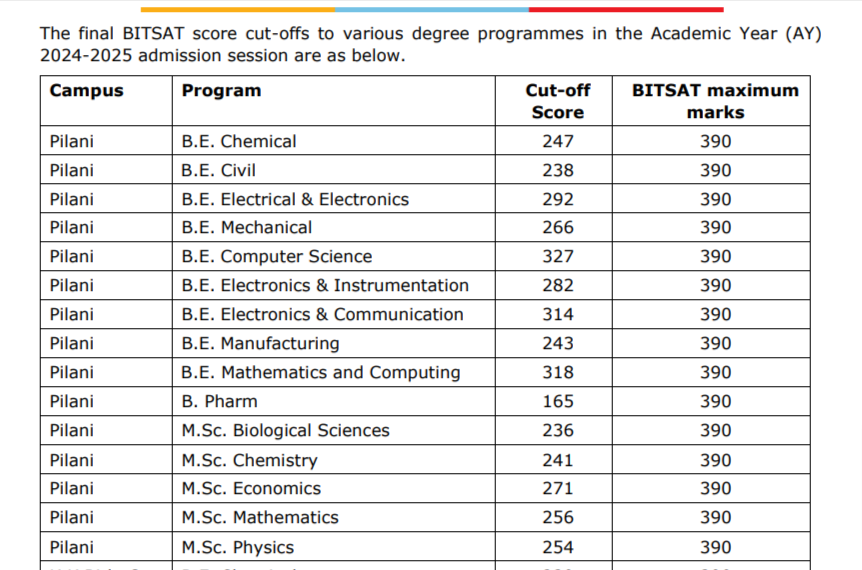
BITSAT Cut-off 2025 – BITS Pilani will release the campus-wise cut-off scores for the current academic session during BITSAT 2025 counseling. The direct links to download the cut-offs will be provided here. No log-in is required to download the BITSAT Cutoff 2025. Simply click on the relevant link to download the cut-off.
The BITSAT cut-offs will be available in downloadable PDF format.
The cut-off will include details like the campus, program, and the corresponding cut-off score and BITSAT 2025 maximum marks. BITSAT 2025 2025 applicants who meet the cut-off will only be eligible for admission.
The cut-off for BITSAT 2025 will be prepared by considering factors like seat intake, total test takers, number of applicants for the program, etc.
BITSAT 2025 exam for Session 1 is conducted from May 26-30, 2025. Session 2 exam will be conducted from June 22-26, 2025. The results of BITSAT 2025 will be displayed on the test window immediately after the exam.
When will the cut-off for BITSAT 2025 be released?
BITS Pilani will release the cut-offs during BITSAT 2025 counseling.
Typically, they are released soon after completion of the seat-allotment process. So, the candidate can in the meantime consult previous years’ cut-off data to check what is a good score to have a good chance of admission to their chosen campus.
What is the significance of BITSAT Cut-off?
The BITSAT cutoff 2025 is one of the most eagerly awaited events for prospective applicants.
Here is why:
The cut-off will indicate the degree of competition and difficulty in getting admission to BITS campuses.
If the cut-off is very high, then candidates will have to score heavily to have any chance of admission.
Academic programs like B.E. Mathematics and Computing tend to have the stiffest cut-offs owing to high demand.
B.E. Civil may have comparatively lower cut-offs.
The candidate can use the cut-off as yardstick and plan their exam preparation accordingly.
Without a cut-off, the candidate will not be able to gauge how competitive the exam is. So, in a way the BITSAT cut-off can be a reality check!
CUET 2025 Exam Day Guidelines and Dos & Don’ts – Exam day is probably the most important day for the CUET UG 2025 aspirant. It is because if you can go through the day unscathed, it can mean you have significantly increased your chances of getting a good score in the CUET UG 2025 exam.
The CUET (UG) 2025 exam was conducted from 13 May 2025 to 03 June 2025 in Computer Based Test (CBT) mode.
Funnily, it is not always enough to have a decent exam preparation, because if you make silly mistakes on the day of the exam, it can ruin everything.
Just imagine a scenario where you arrive late at the CUET 2025 exam center. It can increase your blood pressure, make you sweat, and dampen your spirit. Again, CUET (UG) 2025 also has a dress code in place. So, if you wear the wrong items, you may find yourself in a very tricky situation.
Interestingly, following the CUET 2025 exam-day guidelines is not very difficult. All you need to do is carefully go through each point that we have illustrated here for you. Or, you may consult the official NTA website and the CUET 2025 exam information booklet for the relevant information.
Table of Contents
CUET Exam 2025 – Overview
The overview of the CUET UG exam 2025 is given below.
Particulars
Description
Name of the exam
Common University Entrance Test (CUET) 2025
Important Dates to Remember
CUET 2025 Exam Dates: May 08 to June 01, 2025 CUET Admit Card 2025: Released 4 days before the scheduled CUET 2025 exam-date
CUET UG Top 10 Subjects
As per CUET statistics, subjects like CUET UG English, General Test, Physics, Chemistry, Political Science, and Business Studies remain top choices among CUET aspirants.
Mode of exam
The exam pattern for CUET UG 2025 has been changed. Here is the updated pattern:
CUET UG exam will be held in CBT mode Exam will be held for 60 minutes for each subject The CUET question paper will have 50 mandatory questions; there will be no optional questions.
CUET 2025 participating colleges
Total 205 universities will offer admission using CUET UG scores. CUET 2025 (UG) accepting universities include:
47 central universities 26 state universities 7 government institutions 22 deemed universities 102 private universities.
Seat available
Around 3,00,000
CUET Exam Day Guidelines – Test Timings, Reporting & Gate Closing Time
The CUET (UG) exam center reporting time STARTs 2 hours before the exam starts.
Special – Reporting time for candidates wearing articles or objects of faith (customary, cultural, or religious )
The candidate must report to the exam center at least two hours before the last reporting time so that there is enough time for proper frisking without any inconvenience to the candidate while maintaining the sanctity of the examination.
If upon screening, it is discovered that any candidate is actually carrying a suspected device within such an item of faith, he/ she may be asked not to take it into the examination hall.
Gate closing time
The candidates must reach the exam centre at least half an hour (30 minutes) before the commencement of the exam. After that, no entry will be allowed inside the exam venue. This means, gates will be closed 30 minutes before the exam starts.
Mandatory Items to carry for CUET UG 2025 exam
The candidate must carry the following items with them when reporting to the CUET UG 2025 exam center.
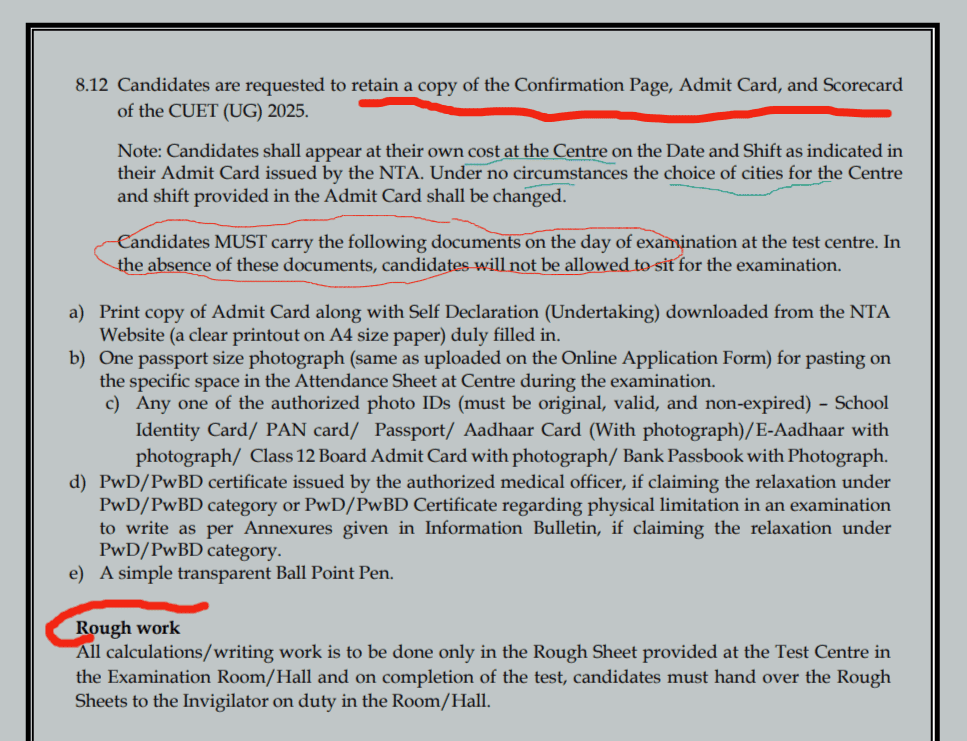
Admit Card – Carry the CUET UG 2025 admit card along with Self Declaration (Undertaking) downloaded from the NTA Website (a clear printout on A4 size paper) duly filled in.
A simple transparent Ball-point pen
Additional photograph (same as uploaded on the CUET UG 2025 application form) to be pasted on the attendance sheet in the Examination Room/ Hall.
Valid ID proof – An authorized photo ID (must be original, valid, and non-expired) – School Identity Card, PAN card, Passport, Aadhaar Card (with photograph)/E-Aadhaar with photograph, Class 12 Board Admit Card with photograph, or Bank Passbook with Photograph.
PwD certificate (if applicable) – If the candidate has claimed relaxation under the PwD/PwBD category, then they must also bring the relevant certificate issued by an authorized medical officer.
CUET UG 2025 exam guidelines for Diabetic Candidates
If the candidate is a diabetic, then they are also allowed to carry sugar tablets / fruits (like banana/apple/orange).
CUET UG 2025 Exam-day Instructions – List of Barred Items
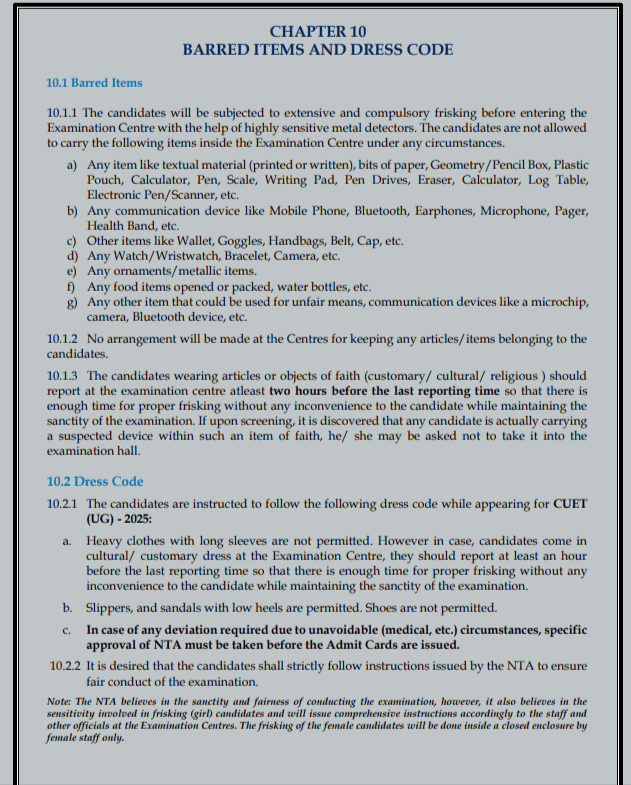
Extensive and compulsory frisking using highly sensitive metal detectors will be done before the candidate is allowed to enter the CUET 2025 exam centre.
If you are found carrying any of the following items inside the exam hall, you can be disqualified.
Any item like textual material (printed or written), bits of paper, Geometry/Pencil Box, Plastic
Any communication device like Mobile Phone, Bluetooth, Earphones, Microphone, Pager, Health Band, etc.
Other items like Wallet, Goggles, Handbags, Belt, Cap, etc.
Any Watch/Wristwatch, Bracelet, Camera, etc.
Any ornaments/metallic items.
Any food items opened or packed, water bottles, etc.
Any other item that could be used for unfair means, communication devices like a microchip, camera, Bluetooth device, etc.
CUET UG 2025 Exam-day Instructions – Dress Code
The NTA has postulated the following guidelines related to the CUET 2025 (UG) dress code.
Heavy clothes with long sleeves are not permitted. However, in case, candidates come in cultural/ customary dress at the Examination Centre, they should report at least an hour before the last reporting time so that there is enough time for proper frisking without an inconvenience to the candidate while maintaining the sanctity of the examination.
Slippers, and sandals with low heels are permitted. Shoes are not permitted.
In case of any deviation required due to unavoidable (medical, etc.) circumstances, specific approval of NTA must be taken before the admit cards are issued.
TG EAPCET Answer Key 2025 – Jawaharlal Nehru Technological University Hyderabad (JNTUH) has released the final TG EAPCET 2025 answer key along with the master question paper.
To download the final answer key and master question paper, log-in using your EAPCET Hall Ticket Number, Registration Number, and Date of birth. The answer key and question paper can be downloaded in pdf format.
The TG EAPCET 2025 answer key objection window is now closed. The window to submit objections against the provisional answer key for the Agriculture and Pharmacy (A & P) stream was open from May 4-6, and for the Engineering (E) stream from May 5-7. 2025
Earlier, The preliminary answer keys of TG EAPCET 2025 was released on: A & P stream – May 4; Engineering stream – May 5. The direct link to download the answer keys will be provided below. The response sheet and master question papers were also released along with the provisional key.
TG EAPCET 2025 was held on April 29-20 (Agriculture & Pharmacy) and May 2-5 (Engineering).
The answers keys have been released shift-wise for the Agriculture & Pharmacy (A&P) and Engineering (E) streams.
Using the answer keys, the candidate will be able to count correct attempts and then probable scores (refer to official TG EAPCET exam pattern for marking scheme), and thus their chances of admission.
You may consult TG EAPCET cut-off to check the institute-wise opening and closing ranks.
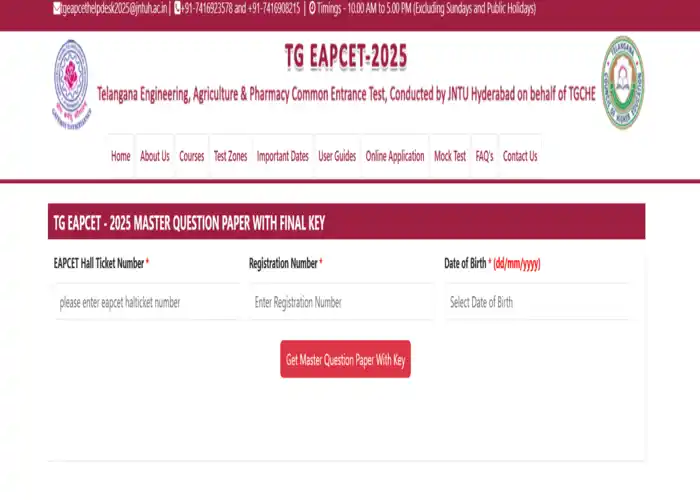
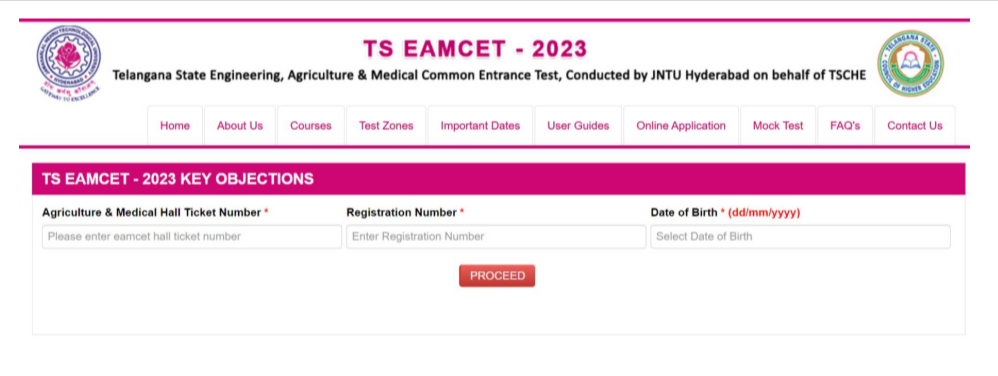
Log-in window to download TG EAPCET Answer Key & Master Question Paper
This is what the window to download the TG EAPCET 2025 master question paper and final key looks like:
How to download TG EAPCET Answer Key 2025
The answer key of TG EAPCET will be released on the official website in PDF format. The candidate needs to follow these steps to download the answer keys:
If the answer keys are OUT, the download portal will be activated
Enter the following details to log-in: 1) EAPCET Hall Ticket Number, 2) Registration Number, 3) Date of birth
Click on the answer key you want to download
The answer keys will open in downloadable PDF format
Download the answer keys.
This is how the TG EAPCET 2025 answer key and master question paper download window looks like:
How to Calculate Score Using TG EAPCET Answer Key 2025
Using the answer key, the candidate can calculate their expected score in the TG EAPCET 205 exam. To calculate your probable score, follow these steps:
First, calculate the number of correct attempts.
You need to then assign marks for each correct answer. Consult TG EAPCET 2025 exam pattern for the marking scheme.
Next, tally the marks to get the total or expected score in TG EAPCET 2025
The expected score will give you an idea about your chances of admission.
Note that in some cases, your expected score may be different from the actual TG EAPCET score.
This may happen if you wrongly tally the marks, or there are some modifications in the provisional answer key (like a question is dropped or a key has been modified).
The candidate is allowed to challenge the provisional TG EAPCET answer key 2025. The objection window will open almost immediately after the answer key has been released.
To raise an objection, the candidate must follow these steps:
Go to the TG EAPCET exam portal
If the objection window is open, click on the link
Log-in using your TG EAPCET Hall Ticket Number, Registration Number, and Date of Birth
Select the answer key or question number you want to object against
Describe your complaint, upload supporting documents, and also mention the reference book, page number, and edition
Note that objections must be submitted in the prescribed format only.
Pay the prescribed fee.
After checking that the complaint application is complete in all respects, submit it.
Note that objections are allowed only against the provisional answer key. Objections will not be entertained against the final answer key of TG EAPCET.
Sample TG EAPCET Answer Key Objection Window:
TG EAPCET Answer Key 2025 – Download Here
The answer keys for TG EAPCET 2025 will be available for download soon after the conclusion of the entrance exam. In the meantime, the candidate may download the previous years’ answer keys (along with the corresponding question papers).
NEET Exam Cut-off 2025 – The NTA will release the category-wise qualifying marks for NEET 2025 at the time of declaration of results. The NEET 2025 qualifying cut-off is the minimum score one needs to secure to be eligible for NEET counseling 2025.
The NEET 2025 cut-off (qualifying) can be checked after logging into the NEET 2025 result portal.
Candidates may note that the qualifying cut-off doesn’t guarantee admission to any institute, but is merely an eligibility for the next admission round (counseling).
The allotment of seats will be based on the NEET 2025 admission cut-off, which will be released at the time of NEET 2025 counseling. The admission cut-off will be institute-specific released for each round of counseling. Also, note that the NEET 2025 cut-off (admission) will be released separately by the MCC and State Counseling Authorities.
NEET UG Cut-off 2025 – Qualifying Marks vs Admission Cut-off
Particulars
NEET 2025 qualifying marks
NEET 2025 admission cut-off
What does it mean?
It is the minimum score a candidate needs to score to reach the counseling stage.
However, simply meeting the qualifying marks or cut-off is no guarantee of admission.
The admission cut-off is the minimum marks a candidate must secure to get admission.
This cut-off is institute-specific.
Further, the admission cut-off is released for each seat-allotment round. If a candidate fails to meet the cut-off in an earlier round, they may be considered in subsequent rounds (if available).
However, if the candidate fails to meet the cut-off for the last round of seat allotment, they are effectively out of the admission process.
Released by
National Testing Agency (NTA)
Medical Counselling Committee (MCC)
State Counseling Authorities
How to check?
The qualifying cut-off will be mentioned in the NEET 2025 scorecard.
So, log-in to the NEET 2025 result portal to check your qualification status.
The opening and closing ranks for each round of NEET 2025 counseling will be published on the respective counseling portal.
Category-specific?
Yes
Yes
Considered for admission purposes?
No
The qualifying cut-off is merely used to screen candidates for the counseling round.
Yes
Institute-specific
No
Yes
The admission cut-off will be released for each of the NEET 2025 participating colleges.
The NTA will release the qualifying cut-off for NEET 2025 along with the results. Log-in to the result portal to check the category-wise cut-off marks.
Category
Cut-off Percentile
Expected Cut-off Mark
Qualifying Marks
General, EWS
50
150
To be notified
SC, ST, OBC
40
120
To be notified
EWS-PWD
45
140
To be notified
PwD – SC, ST, OBC
40
120
To be notified
NEET 2024 Cutoff
The qualifying cut-off marks for NEET 2024 exam are given in the table below.
Category
Cut off Percentile
Cut off Score
UR/EWS
50
720-162
SC, ST, OBC
40
161-127
UR/EWS-PwD
45
161-144
OBC-PwD, SC-PwD, ST-PwD
40
143-127
Previous years’ NEET Qualifying Cutoff
The previous years’ category-wise qualifying cut-off of NEET exam is given in the table below.
Category
2023 Cutoff
2022 Cutoff
2021 Cutoff
2020 Cutoff
2019 Cutoff
UR
720-137
715-117
720-138
720-147
701-134
OBC, SC, ST
136-107
116-93
137-108
146-113
133-107
PwD (General/UR)
136-121
116-105
137-122
146-129
133-120
OBC-PwD, SC-PwD, ST-PwD
120-107
104-93
121-108
128-113
119-107
NEET Cut-off 2025 – Opening and Closing Ranks
The admission cut-off for NEET will be released at the time of seat allotment. Here we bring you previous year’s cut-off for your reference.
This year’s cut-off will be updated here as and when it is released.
The cut-off of Assam CEE 2025 will be released on the DTE Assam portal – cee.dtecounselling.in. The cut-off will be released for all the seat allotment rounds and is the closing rank for that round.
Assam CEE Cut-Off2025 – The Directorate of Technical Education (DTE), Assam, will release the cut-off during Assam CEE 2025 counseling. Note that the counseling will be conducted in multiple rounds.
The cut-off will be released for each Assam CEE 2025 seat-allotment round.
The Assam CEE 2025 cut-off will indicate the minimum marks or rank a candidate needs to secure to get admission in a seat allotment round.
The cut-off will be released in downloadable pdf format. It will contain the category-wise closing rank for admission to various design courses. The cut-offs will be released for all the participating colleges.
CLAT 2025 Result Update – The Consortium of NLUs declared the results of CLAT 2025 on May 17, 2025. This follows the directive of the Supreme Court of India passed on May 7, ordering the NLU Consortium to release revise CLAT 2025 (UG) results (which were originally declared on December 7). Earlier, on April 30, the apex court had stayed the Delhi High Court’s decision, which had directed the consortium to revise the results.
However, the exam has since been marred by controversy with petitions being filed in various courts across the country alleging the improper conduct, errors in the CLAT 2025 answer key, and a faulty evaluation process.
The Supreme Court of India on May 7, ordered the NLU Consortium to revise the CLAT 2025 (UG) results (which were originally declared on December 7). Earlier, on April 30, the apex court had stayed the Delhi High Court’s decision, which had directed the consortium to revise the results.
The Delhi High Court after hearing a slew of petitions filed by candidates challenging the CLAT 2025 (UG) results has asked the consortium to revise the results. The verdict to revise the results was pronounced on April 23, 2025.
Petitions have also been filed challenging the CLAT 2025 (PG) results. Hearing for the CLAT PG case will commence on May 2.
In this article, we bring you live updates of the court proceedings and the latest status of the CLAT 2025 exam, especially CLAT 2025 results, since there is a growing consensus among the student community that the results should be revised.
In fact, a single-judge bench of the Delhi High Court, on December 22, had advised the NLU Consortium to revise the results, after which it (the consortium) approached the Supreme Court. The apex court has since then transferred the case to the Delhi High Court, which is now hearing all petitions.
Here we bring you date-wise updates on the legal proceeding involving the CLAT 2025 exam and results. The events are presented in a chronological order so that you can understand how things have unfolded.
May 15 – Revised CLAT 2025 Results Declared
The Consortium of NLUs on May 17, 2025, declared the revised results of the CLAT 2025 exam. The results were released online at consortiumofnlus.ac.in.
The CLAT 2025 counseling registration process also commenced on May 17 (4 pm). The last date to register is May 21 (5 pm). Candidates who have qualified in the exam must register before the last date.
May 7 – SC directs NLU Consortium to release revised CLAT 2025 (UG) result
The Supreme Court of India directs the NLU Consortium to revise the CLAT 2025 (UG) results. The apex court passed the judgement after it found multiple errors in the CLAT 2025 question paper. The court also asked the consortium to award marks for some of the incorrect questions, while a few questions have been asked to dropped.
Further, the apex court stroked down a few other judgements passed by the Delhi High Court on CLAT 2025 results.
April 30 – SC stays Delhi HC’s Judgement
The Supreme Court stays the judgment of the Delhi High Court, which directed the consortium to release revised CLAT 2025 results. The next hearing was scheduled for May 7.
April 23 – High Court Order NLU Consortium to released revised result in 4 weeks
The Delhi High Court has pronounced its verdict on the results of Common Law Admission Test (CLAT) 2025 for admission to undergraduate law courses in National Law Universities (NLUs).
The bench of Chief Justice Devendra Kumar Upadhyaya and Justice Tushar Rao Gedela directed the NLU Consortium to revise the marksheets and release a revised result in 4 weeks.
The Chief Justice said, “- “We direct the NLU Consortium to revise the marksheet and republish and renotify final selected candidates in 4 weeks.”
April 9 – High Court reserves verdict
The Delhi High Court reserved its verdict on petitions challenging the CLAT 2025 (UG) results.
The Division Bench, comprising Chief Justice Devendra Kumar Upadhyaya and Justice Tushar Rao Gedela, was hearing the case.
As reported by Bar and Bench on X (formerly Twitter), the Bench confirmed that “the Court has reserved its verdict on the UG Batch matters.”
Several CLAT UG candidates had petitioned the court, alleging discrepancies in the CLAT 2025 question paper. Their concerns ranged from ambiguously-framed questions and out-of-syllabus content to an insufficient objection window provided by the consortium. Some of the petitioners appeared in person, while others were represented by their legal counsel.
The following issues were bright before the notice of the court
Petitioners claimed the CLAT 2025 question paper included a number of poorly structured, ambiguous, or deviated from the official CLAT syllabus released by the consortium.
A few of the petitioners alleged the objection window given to candidates was insufficient to properly vet and challenge the answer key/ question paper. Note that the CLAT 2025 objection window against the draft answer key was open from December 2 (4 pm) to December 3, 2024 (4 pm).
Some alleged procedural lapses, such as being interrupted during the exam for underlining on the question paper, raising concerns over fairness and transparency in the evaluation process.
In response, Senior Advocate Rajshekhar Rao, representing the consortium, defended the integrity of the examination process, emphasizing that subject matter experts had set and reviewed the paper. He urged judicial restraint in academic matters, arguing that courts should avoid interfering in expert-driven evaluations.
Court’s Observations
Throughout the hearings, the Bench acknowledged concerns over repeated issues with question-setting, warning of their potential impact on students. Justice Gedela remarked, “The court’s role is not to rewrite the exam but to ensure fairness.” Chief Justice Upadhyaya also suggested that the Consortium should consider improving the quality of paper setting, given the recurrence of similar disputes in past years.
Upcoming CLAT PG Hearings
Although the verdict on CLAT UG petitions has been reserved, the Court announced that hearings for postgraduate (PG) CLAT 2025-related petitions will begin on April 21. These petitions involve similar concerns about answer key discrepancies and evaluation standards but will be addressed separately.
Potential Implications
With the verdict pending, CLAT UG 2025 candidates must await the court’s final decision, which could impact rankings, admissions, and counselling schedules. If the court orders a revision or re-evaluation, the entire CLAT admission process may face further delays. For now, the CLAT UG result process remains on hold until the High Court delivers its judgment.
April 7 – HC asks consortium to appoint more qualified paper setters in future
Hearing the petitions, the Delhi High Court observed that the Consortium of National Law Universities (CNLU) must appoint more qualified and capable paper setters in the future.
This remark was made during the forenoon session as the court reviewed objections raised against certain questions in the CLAT UG 2025 examination.
The remark was prompted after Senior Advocate Rajshekhar Rao, representing the Consortium, informed the court that subject matter experts had differing opinions on the validity of a particular logical reasoning question.
Rao acknowledged that a question involving a scenario about homeless individuals had been “wrongly formulated.” He further explained that while multiple experts were consulted, two provided conflicting assessments regarding the question’s correctness. The court noted that such inconsistencies underscore the need for more rigorous vetting of question papers and improved academic oversight.
The division bench of the Delhi High Court was led by Chief Justice Devendra Kumar Upadhyaya and Justice Tushar Rao Gedela.
Objections from Petitioners
Petitioners have argued that certain CLAT UG 2025 questions were ambiguous, factually incorrect, or poorly structured, adversely affecting the candidates’ performance. In an earlier hearing, the court had already determined that at least one question should be removed from evaluation.
Separate Hearing for CLAT PG Petitions
Considering differences in the syllabus and the nature of objections, the court decided to take up petitions related to CLAT PG separately starting April 21.
March 3
The Delhi High Court deferred the hearing to April 7, 2025.
February 6
The Supreme Court on February 6 transferred all the petitions related to the CLAT 2025 result case to the Delhi High Court. This was done to avoid contradictory verdicts on the same issue if petitions are heard by various courts.
“List before Delhi High Court on March 3. Within 7 days of this order, the registrar of each High Court should send the papers (of the concerned case pending before them) to Delhi High Court,” the SC said in its statement.
The next hearing will be listed before the Delhi High Court on March 3, 2025.
January 15
The Supreme Court showed its intent to transfer petitions challenging the CLAT 2025 results to the Punjab and Haryana High Court.
A bench led by Chief Justice of India Sanjiv Khanna and Justice PV Sanjay Kumar issued a notice in response to transfer petitions filed by the consortium that request the court to consolidate all pending petitions and move them either to the Supreme Court or a single High Court for streamlined proceedings.
At present, multiple petitions related to the CLAT 2025 results are being heard in the High Courts of Delhi, Karnataka, Jharkhand, Rajasthan, Bombay, Madhya Pradesh, and Punjab & Haryana.
Discussion on transferring the case to a High Court
During the hearing, CJI Khanna expressed his intent to transfer the cases to a specific High Court instead of retaining them in the Supreme Court, citing past instances where similar matters had been redirected.
Solicitor General Tushar Mehta proposed Karnataka High Court as a suitable option. However, CJI Khanna pointed out that the first petition had originated in the Punjab and Haryana High Court, highlighting its efficient case disposal rate.
Delhi High Court comes up for consideration
Representatives of some students requested the Supreme Court to transfer the petitions to the Delhi High Court, citing its prior ruling that found two CLAT-UG 2025 answers incorrect. One lawyer passionately urged the bench to consider Delhi High Court, to which CJI Khanna responded, “Law students should not fold their hands.”
Supreme Court’s Order
The bench subsequently declared: “All writ petitions pending across various High Courts should be handled by a single High Court to ensure expedited resolution. Issue notice returnable in the week beginning February 3, 2025. Notices will be served to counsels representing petitioners in different High Courts. The bench is inclined to transfer the matters to the Punjab and Haryana High Court.”
January 7
The Delhi High Court continued deliberations on the CLAT 2025 results case. The court finally adjourned the case till January 30.
The CNLU has, meanwhile, approached the Supreme Court, contending the High Court’s directive to revise the CLAT 2025 results.
No update on when Counseling will start
This legal tussle has delayed the CLAT 2025 counselling process, leaving candidates uncertain about the final admission timeline. The fresh counselling schedule will probably only be declared once the court case is settled.
December 24
The Division Bench of the Delhi High Court refused to stop the order issued by a single-judge bench, which directed the Consortium of National Law Universities (CNLU) to revise the CLAT 2025 results.
Consortium decides to approach the SC
Reacting to the decision of the Delhi High Court, the consortium released the following statement, “The single bench of the Hon’ble Delhi High Court had directed us to revisit the Merit List published on December 7, 2024. While we filed an appeal before the division bench, the order was not overturned. We are now approaching the Supreme Court for appropriate relief at the earliest available date, considering the ongoing vacation.”
GIven the gravity of the situation, the Consortium also sought to assure candidates, “We understand that this delay may affect the counselling timeline. However, we remain committed to maintaining transparency and fairness in the admission process. As a result, the first admission list for NLUs will not be released on December 26 as originally planned. The revised schedule will be announced following our appeal to the Supreme Court and the expected relief.”
This update raised concerns among candidates awaiting their admission results, as the final counselling timeline now will depend on proceedings in the Supreme Court.
CLAT 2025 Counseling Postponed
The consortium issued an important update regarding the CLAT 2025 exam, notifying the postponement of the CLAT 2025 counselling process. Consequently, the first merit list, which was scheduled to be released on December 26, 2024, has been indefinitely postponed.
The Consortium of National Law Universities (NLU Consortium) appealed the Delhi High Court’s recent ruling directing a revision of the CLAT 2025 results due to errors in the question paper and answer key. The appeal, titled Consortium of National Law Universities vs Aditya Singh (Minor), was filed after Justice Jyoti Singh partially ruled in favor of a 17-year-old CLAT candidate who had raised concerns about discrepancies in the exam.
Delhi High Court’s Initial Ruling
On December 20, 2024, Justice Singh found errors in two of the five questions flagged by the petitioner and stated that such mistakes could not be ignored. Consequently, the court ordered the CLAT 2025 results to be revised to reflect correct markings for these two questions, impacting all candidates who sat for the exam.
NLU Consortium’s Appeal
The Consortium challenged the court’s ruling, arguing that the single-judge bench went beyond its jurisdiction by acting as an expert in academic matters. It maintained that the CLAT 2025 answer key had undergone thorough review by subject specialists and asserts that courts should not override academic committee decisions. The Consortium further emphasized the established legal position that judicial intervention should be limited in cases involving competitive exams and expert evaluations.
Candidate’s Counter-Appeal
Meanwhile, the original petitioner appealed the decision, contending that the court addressed only two of the five disputed questions. The candidate insisted that the errors exist in three additional questions and urged the court to revise the answer key further.
Upcoming Hearing
The Division Bench of the Delhi High Court adjourned the hearing till the next day
December 22
The Delhi High Court ruled that the CLAT 2025 results must be revised as there are inconsistencies in the official answer key.
The initial results, released on December 7, 2024, sparked concerns among candidates regarding errors in the Set A answer key, which impacted their scores and rankings.
After reviewing the complaints, the court ordered modifications to two answers in the final answer key.
Discrepancies in the CLAT 2025 Answer Key
Candidates who took the CLAT 2025 exam with Set A pointed out inconsistencies in the answer key, highlighting incorrectly marked responses and unclear solutions.
The affected candidates felt that the errors led to unfair evaluation. They also emphasized that despite them bringing these concerns to the notice of the Consortium of National Law Universities (CNLU), their concerns were overlooked.
As a result, a group of affected candidates filed a petition in the Delhi High Court, urging the court to intervene and ensure a fair reassessment.
Delhi High Court’s Verdict
After carefully examining the case, the Delhi High Court ruled in favor of the petitioners and directed the Consortium of NLUs to correct the answer key and adjust the results accordingly. The court emphasized that such discrepancies had placed many candidates at a disadvantage and should not be ignored in the interest of fairness.
Additionally, the court ordered the Consortium to re-evaluate the affected candidates’ scores based on the revised answer key and release the updated results within a specified timeframe. This ruling has brought hope to students whose rankings and scores may improve following the correction.