CUET Question Paper 2026 – NTA will release the CUET (UG) 2026 question papers soon after the conclusion of the exam.
The CUET 2026 exam is scheduled to be held from May 11-31, 2026.
The direct link to download the question papers will provided below. The question papers will be released alongside the recorded responses and CUET (UG) 2026 answer key.
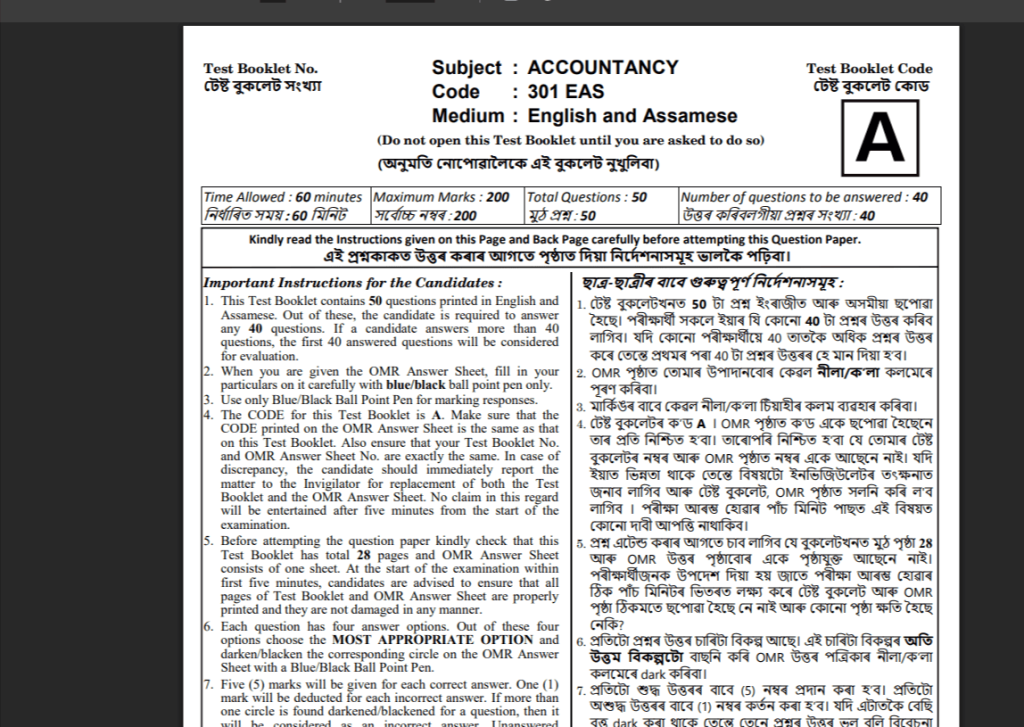
The official CUET question papers for the previous editions of the exam can be downloaded at https://nta.ac.in/Downloads.
To download CUET question papers, select the exam year, the name of the exam (in this case CUET UG), and paper. On submitting the details, the corresponding CUET question paper will open in downloadable pdf format. Download and save the CUET question paper to your computer system, or take a printout.
Candidates appearing in the CUET 2026 exam are recommended to solve previous years’ CUET question and sample papers as exam preparation routine. By solving the previous years’ papers you will get insights into the question papers structure, including question type, difficulty level, topics covered. Meanwhile, by solving sample papers, you can improve your problem-solving and time-management skills.
Latest Updates:
CUET (UG) 2026 Application From (Open) – Apply Here
You must solve previous years’ CUET question papers for the following reasons:
Familiarity with Exam Pattern – Previous year’s CUET UG question papers will provide insight into the structure of the exam, including the types of questions (MCQs, short answers, essays), time allocation, and difficulty level. This will help reduce exam anxiety. Further, you can use the insights to better align your exam strategy with the requirements of the exam.
Identifies Important Topics – By analyzing the past papers, you can identify recurring topics and prioritize high-weightage areas. This will allow you to focus on key concepts rather than wasting time on less relevant material.
Improves Time Management – Practicing with time constraints will help you develop speed and accuracy. You will learn to allocate time wisely, ensuring you complete the paper within the given duration without rushing at the last minute.
Enhances Problem-Solving Skills – Repeated exposure to different questions sharpens critical thinking and problem-solving abilities. Students learn various approaches to tackle questions, improving their ability to handle unfamiliar problems in the actual exam.
Self-Assessment & Weakness Identification – By solving past years CUET question papers, you can evaluate your preparation level. Further, you can identify weak areas and work on them before the exam, ensuring a more balanced understanding of all subjects.
Boosts Confidence – With regular practice, you will become accustomed to the exam format and can gain confidence. Also, solving questions beforehand during practice will reduce stress and increase performance efficiency.
Do I also need to solve sample papers for CUET 2026
Unlike previous years question papers, the sample papers will have an unlimited number of questions.
Also, it is very unlikely that the exact same question will be repeated in the CUET exam. The examiners will frame the questions differently each year, even though the same concepts may be required to solve these problems. So, if you are strong in the fundamentals and know the concepts inside-out, you will be able to solve any type of problems.
Sample papers will allow you to test your understanding and problem-solving skills. Further, time-management skills can also be developed by solving sample papers.
CUET Sample Papers – FAQs
How many sample papers should I solve for CUET UG 2026?
There is no specific number as such. However, it is recommended that you solve as many sample papers as possible. If you are able to completely solve, say 6-7, sample papers containing different types of problems, you are doing pretty well in your preparation.
When should I start solving CUET sample papers?
You can solve sample papers for the CUET exam from the very beginning, like after completing a few topics. FInd the related questions in the sample papers and solve them. As you move ahead in your exam preparation, you will be able to solve more questions in the sample paper.
Can I also take mock tests with the sample papers?
Mock tests are meant to be taken closer to the exam, as the express intent of these tests is to help the candidate get accustomed with the features of the exam. This is meant to ensure you don’t get distracted or surprised on exam day.
CUET Exam Pattern 2026 – Candidates appearing in the CUET 2026 (UG) exam must consult the official pattern to prepare for the exam.
The detailed exam pattern is outlined in the CUET(UG)-2026 Information Bulletin.
The CUET UG 2026 exam pattern will provide insights into the types of questions asked, exam mode, subjects, language, marking scheme, no. of questions, etc. As per the official pattern, the CUET 2026 (UG) exam will be conducted in a computer-based test (CBT) mode and will be available in 13 languages. The exam will be likely conducted from May 11-31, 2026.
The candidate can appear in a maximum of five (05) subjects including languages and General Aptitude Test irrespective of the subjects opted in class XII. The duration of each test paper is 60 minutes.
Keep reading to learn the full details about the CUET UG 2026 exam pattern.
Latest Updates:
CUET (UG) 2026 Application From (Open) – Apply Here
The detailed exam pattern of CUET UG 2026 is given in the table below.
Particulars
Description
Mode of the exam
Computer Based Test (CBT) mode
Total Questions
50 questions for each test paper. All Question are compulsory
Duration
Duration for each test paper is 60 minutes.
Note: Compensatory time for PwBD candidates of 20 minutes for each hour
Total subjects
37
(13 Indian languages + 23 domain-specific subjects + 01 General Aptitude Test).
Medium
13 Indian languages: Assamese, Bengali, English, Gujarati, Hindi, Kannada, Malayalam, Marathi, Punjabi, Odia, Tamil, Telugu, and Urdu.
Syllabus
Language Subjects: Language to be tested through Reading Comprehension (based on different types of passages–Factual, Literary, and Narrative), Literary Aptitude and Vocabulary
Domain Subjects: As per NCERT syllabus
General Aptitude Test: General Knowledge, Current Affairs, General Mental Ability, Numerical Ability, Quantitative Reasoning (Simple application of basic mathematical concepts arithmetic/algebra geometry/mensuration/statistics), Logical and Analytical Reasoning
Choice of Test Paper
Candidates can select a maximum of five (05) subjects including languages and General Aptitude Test irrespective of the subjects opted in class XII
Shift
CUET (UG) 2026 will be conducted in multiple shifts depending on the number of Candidates and Subject choices. (Compensatory time for PwBD Candidates of 20 minutes for each hour)
Question Type
Objective type Multiple Choice Questions (MCQs)
Marking Scheme
Correct Answer: 05 marks (Five)
There will be negative marking for each incorrect answer of 01 (one) mark
For all the remaining languages including Foreign Languages (i.e. “(Arabic, Bodo, Chinese, Dogri, French, German, Italian, Japanese, Kashmiri, Konkani, Maithili, Manipuri , Nepali, Persian, Russian,” Santhali, Sindhi, Spanish, Tibetan and Sanskrit).
For domain-specific subject/paper on Entrepreneurship, Teaching Aptitude, Fashion Studies, Tourism, Legal Studies and Engineering Graphics.
Please note:
Total Subjects: 37 i. Languages -13 ii. Domain-specific subjects-23 iii. General Aptitude Test-01
A candidate may choose any subject/language as desired by the applicable University/Organization.
When preparing for the CUET (UG) 2026 exam, it is recommended that the candidate solve previous years’ question papers along with sample papers.
While previous years’ papers will help the candidate get an insight into the exam, like the types of questions asked, scope of questions asked, weightage, how questions are framed, whether any specific trend is being followed, if questions are repeated, etc.
Meanwhile, CUET (UG) sample papers are great practice materials that can help you assess your progress, problem-solving ability, as well as evaluated your understanding of various concepts and ability to effective use them for problem-solving.
It is recommended that you solve as many sample papers you can.
CUET Participating Universities 2026 – The list of CUET (UG) 2026 participating colleges has been updated on the NTA exam portal – cuet.nta.nic.in.
Go to the NTA portal, and then click on “Universities.”
The following FIVE types of universities will participate in CUET (UG) 2026 – Central University, State University, Deemed University, Private University, and Other Government Institutions.
To check the list of academic programs offered by the participating institutes, the candidate needs to click on the specific institute.
For instance, to check courses offered by Delhi University, go to NTA exam portal (cuet.nta.nic.in), click on Universities, then select the institute type (Central University in this case), and then on Delhi University.
The courses offered by DU will be displayed in downloadable pdf format. The pdf will also contain the eligibility criteria and admission process for each of these courses.
The candidate can check the detailed list of courses offered by CUET (UG) 2026 participating colleges by following any of these Routes:
Route 1:
To check the eligibility criteria for your chosen program, all you need to do is click on the institute link given above. The name of the courses, along with the corresponding eligibility criteria and admission process, will be displayed in downloadable pdf format.
Refer to the image below to check CUET (UG) participating institute courses and eligibility criteria:
Route 2:
The other option the candidate has to check courses offered by CUET (UG) 2025 participating institutes is given below:
Select the Type of University – State, Central, Private, etc
Finally, click on the name of the university
A pdf will open showcasing the courses offered by the institute along with the eligibility criteria.
CUET Participating Universities – Eligibility Criteria for Admission
The candidate can now easily check the eligibility criteria of a CUET (UG) 2025 participating institute.
Route 1:
To check the eligibility criteria for your chosen institute, simply click on the corresponding link given above. The courses offered by the institute along with the related eligibility criteria will be displayed in downloadable pdf format.
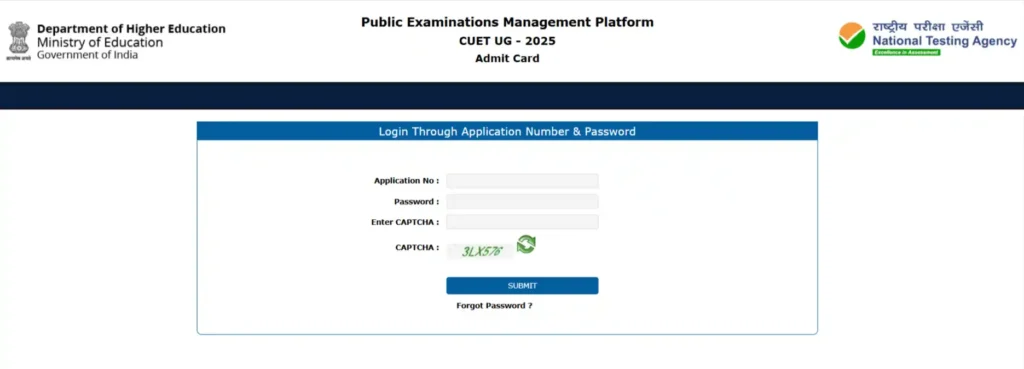
CUET Admit Card 2026 – NTA will release the CUET (UG) 2026 admit card four days before the exam date. The link to download the admit card will be provided here.
To download the admit card, log-in using your application number and password.
The CUET (UG) 2026 Advance City Intimation Slip will be released a few days before the exam. The city slip is intended to inform the candidate about the exam city they have been allocated.
Also, while the CUET (UG) admit card is required for appearing in the CUET (UG) 2026 exam, the city slip will not be accepted as an entry pass. This means, if candidates bring the city slip, and not the admit card, they won’t be allowed to enter the CUET (UG) 2026 exam center.
On the day of the exam, the candidate had to bring a valid photo ID proof along with the admit card.
Latest Updates:
CUET (UG) 2026 Application From (Open) – Apply Here
NTA will release the admit card for CUET (UG) exam around four days before the exam date.
In what mode will the admit card be released?
The admit card will be released online.
Hard copies will not be sent to the candidate.
Admit Card Download Portal
The candidate can download the admit card from the NTA – CUET (UG) portal – Click Here
examinationservices.nic.innta.ac.in
Credentials required to download the admit card
The candidate will need the following details for download the admit card:
Application number Date of birth
Details included in the admit card
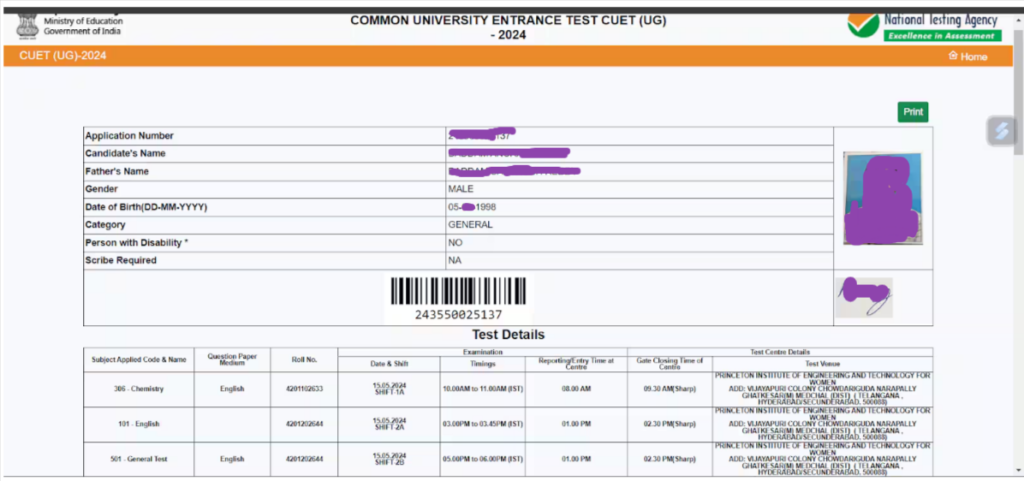
Application number, Candidate’s name, Father’s name, Gender, Date of birth, Category, PwD status, Scribe Required (Yes/No), Signature, Photograph
It will also contain Test Details: Subjects opted with codes, language of test, Roll Number, Exam timings, Reporting & Gate Closing Time, Exam Venue details.
Further, the admit card will contain exam-day guidelines.
Documents required for taking CUET (UG) 2026 exam
The candidate will need the following documents:
CUET admit card 2026 A valid photo ID proof.
What is Advance city intimation slip?
The advance city intimation slip is a document that contains information about the exam city that has been allocated to the candidate.
The city slip is released before the admit card.
However, the city slip is not required on exam day.
When will the CUET (UG) city intimation slip be released?
No official date given.
But it is expected that the city slip will be released soon.
CUET UG Admit Card 2026 – Dates
Particulars
Dates
Application submission date
START date: January 03, 2026
Last date to submit application: January 30, 2026
The application fee will be accepted till January 31, 2026
Window to edit the application form
February 2-4, 2026
Announcement of the City of Examination
To be notified
Downloading Admit Cards from the NTA website
Is released 4 days prior to the exam date.
CUET UG 2026 Exam
Between May 11-31, 2026
The admit card dates will be given in the CUET (UG) 2026 information bulletin.
How to download CUET UG Admit Card 2026
To download the CUET admit card 2026, the candidate must follow the steps given below:
After downloading the admit card, make sure that it contains the Photo,Signature and Barcode.
If any one is missing from Photo,Signature and Barcode then kindly re-download because without Photo,Signature and Barcode your admit card is invalid.
Details included in the CUET (UG) Admit Card 2026
The CUET 2026 admit card will carry the following information:
Application number
Candidate’s name
Father’s name
Gender
Date of birth
Category
PwD status
Scribe Required (Yes/No)
Signature
Photograph
Test Details: Subjects opted their Codes, Question paper medium, Roll Numbers, Exam timings, Reporting/ Entry Time, Gate Closing Time, and Exam Venue details.
Sample CUET (UG) Admit Card
A sample admit card for the CUET (UG) exam is given below for the reference of the candidate.
Difficulty in downloading CUET (UG) 2026 Admit Card
If the candidate faces any difficulty in downloading the CUET 2026 admit card, they need to contact CUET (UG) 2026 exam officials at the following address:
NTA Help Desk
011-40759000 cuet-ug@nta.ac.in
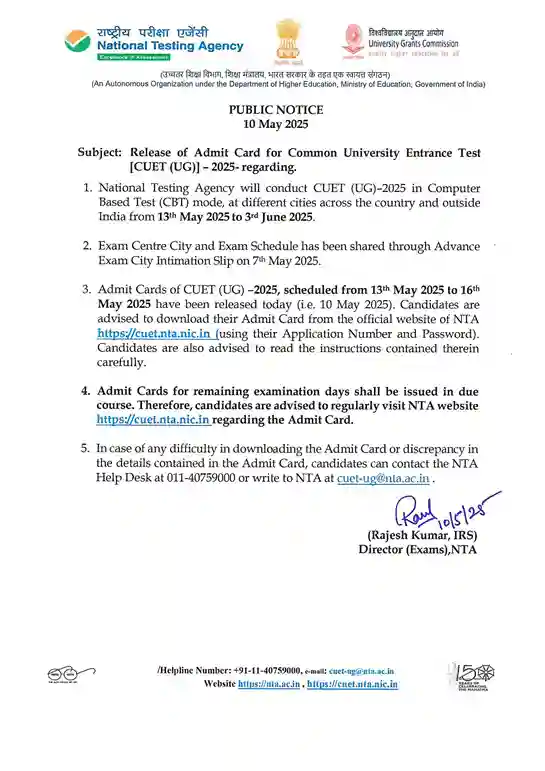
The official CUET (UG) admit card notification is given below:
CUET (UG) Advance City Intimation Slip
NTA will release the city intimation slip a few days before the exam date. The direct link to download the city slip will be provided here.
The city slip will be released before the CUET 2026 admit card.
CUET City Slip vs CUET Admit Card 2026: Key Difference
Please note that the city slip is not the same as the admit card. The city intimation slip is intended to inform candidates about the exam centre location so that they can plan their travel in advance.
The admit card, on the other hand, is released closer to the exam date and includes essential details such as the exam centre’s full address, reporting time, and other instructions.
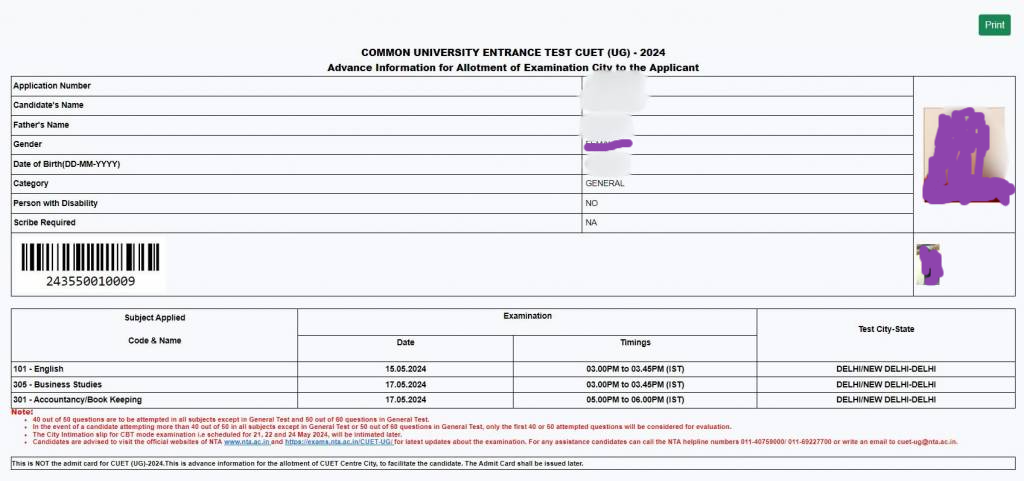
Sample CUET (UG) Advance City Intimation Slip
A sample city intimation slip for the CUET (UG) exam is given below.
How to download CUET (UG) 2026 Advance City Intimation Slip
The candidate needs to follow these steps to download the CUET (UG) city intimation slip:
Go to the CUET 2026 exam porta
If the city slip is OUT, the download link will be activated
Click on it; you will be redirected to a log-in window
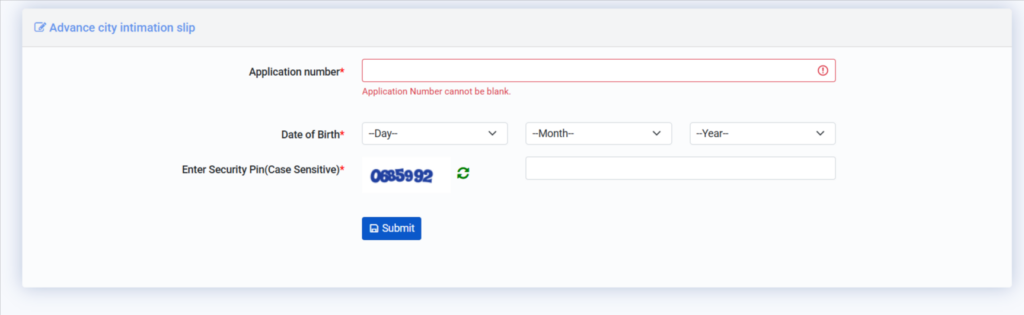
Enter your – 1) application number and 2) date of birth
On log-in, you can download the CUET 2026 advance city intimation slip
Download and take a printout of the city slip.
CUET (UG) City Slip Download Window
This is what the CUET (UG) advance city intimation slip download window looks like:
The CUET 2026 (UG) exam will be conducted in 306 cities across India, and 15 cities abroad.
The candidate has to select their choice of exam city when filling out the form. You are allowed to select a maximum of FOUR cities in the order of priority.
The name of the CUET (UG) 2026 exam center allotted to the candidate will be mentioned on the admit card.
CUET Exam Center 2026 – NTA has notified the list of CUET (UG) 2026 exam centers through the Information Bulletin.
In the brochure, you can find the information related to the exam centers in the “List of Examination Cities for CUET (UG) – 2026” section. You can also download the CUET information bulletin and list of exam centers in PDF format below.
The CUET (UG) 2026 exam will be held in 300 cities (up from 285 cities in the previous edition) across India; additionally, there will be 15 test locations abroad.
The candidate can select a maximum of FOUR exam cities when filling out the CUET 2026 application form. The name and address of the exam center allocated to the candidate was notified through the CUET (UG) 2026 Advance City Intimation Slip.
Additionally, the CUET (UG) 2026 admit card will provide details about the name and address of the allotted exam center, reporting time, gate closing time, etc.
The CUET 2026 (UG) exam will be conducted from May 11-31, 2026.
Latest Updates:
To download List of CUET (UG) 2026 Exam Cities – Click Here
CUET (UG) 2026 Application From (Open) – Apply Here
The candidate must select their choice of exam center when filling out the CUET (UG) 2026 application form.
How many exam centers can I select?
The candidate can’t select a specific exam center. Instead, the candidate is allowed to select an exam city.
You can provide up to a maximum of 04 cities as options.
How can I check the details of the exam city allocated to me?
The candidate will be notified about the exam city they have been allocated through the Advance City Intimation Slip, which is released before the admit card.
Further, the admit card will contain details of the exam city as well as the name and address of the exam city allocated to the candidate.
CUET exam center reporting time
The CUET (UG) exam center reporting time starts 2 hours before the exam starts.
Gate closing time
The candidates must reach the exam centre at least half an hour (30 minutes) before the commencement of the exam.
After that, no entry will be allowed inside the exam venue.
Note: The updated exam guidelines for CUET (UG) 2025 will be provided here as and when it is released.
List of CUET (UG) Exam Centers 2026
The CUET 2026 exam will be conducted in 306 cities across India (in the previous edition, the exam was held in 285 cities). 21 new cities have been added for CUET (UG) 2026 exam.
Additionally, CUET (UG) 2025 exam will be held in 15 destinations abroad (the same as in the last edition).
Note that each of these exam cities may have one or more exam centers. The name and address of the exam center allocated to the candidate will be mentioned on the CUET (UG) 2026 admit card.
CUET UG 2026 – NTA is currently conducting CUET 2026 registrations from January 3-30, 2026 (11.50 pm). The application fee will be accepted till January 31, 2026 (11.50 pm).
Candidates who meet the prescribed eligibility criteria may fill out the CUET 2026 application form following the link given below.
NTA will conduct CUET 2025 exam (UG) from May 11 to 31. The exam will be conducted in a Computer-Based Test (CBT) mode with the duration for each test paper being 60 minutes. The exam will be conducted in 13 languages and in 285 cities across India, and 15 cities outside India.
NTA will conduct the CUET 2026 (UG) exam from May 11-31, 2026. The application form of CUET (UG) 2026 is currently open. Refer to the important dates of CUET 2026 to keep updated about upcoming events.
Particulars
Description
Start of application form
January 3, 2026
Last date to submit applications forms
January 30, 2026 (up to 11.50 pm)
Last date of successful transaction of fee through Credit, Debit Card, Net-Banking, or UPI
The application form for CUET UG 2025 is is currently open online at cuet.nta.nic.in.
The application is open from January 3-30, 2026 (11.50 pm). The last date of successful transaction of fee through Credit/Debit Card/Net-Banking/UPI is January 31, 2026 (up to 11.50 PM).
Corrections in the particulars of the application form is allowed from February 2-4, 2026 (11.50 pm).
Candidates who met the prescribed eligibility criteria had to apply before the last date.
CUET UG Application Fee
NTA has made no changes to the CUET (UG) 2026 application fee.
The application fee for CUET UG has to be paid online using net-banking/debit/credit card/UPI/Wallet.
Candidates can choose up to a maximum of five (05) subjects including languages and General Aptitude Test. The fee is calculated based on the number of subjects chosen by the candidate.
The following fee structure is applicable for CUET (UG) – 2026:
Category
CUET (UG) – 2025 Application Fee
Up to 03 Subjects
For each Additional Subject
General (UR)
₹ 1000/-
₹ 400/- (each)
OBC(NCL) / EWS
₹ 900/
₹ 375/- (each)
SC/ST/PwD/PwBD/ Third gender
₹ 800/-
₹ 350/- (each)
Centres outside India
₹ 4500/-
₹ 1800/- (each)
CUET UG Exam Pattern 2026
NTA conducted the CUET 2026 exam in a computer-based test (CBT) mode. The exam pattern of CUET UG 2026 is given below.
Particulars
Description
Mode of the exam
Computer Based Test (CBT) mode
Total Questions
50 questions for each test paper. All Question are compulsory
Duration
Duration for each test paper would be 60 minutes.
Total subjects
37 (13 Indian languages + 23 domain-specific subjects + 01 General Aptitude Test).
Choice of Test Paper
Candidates can select a maximum of five (05) subjects including languages and General Aptitude Test irrespective of the subjects opted in class XII
Shift
CUET (UG) 2025 will be conducted in multiple shiftsdepending on the number of candidates and their combinations.
(Compensatory time for PwBD Candidates of 20 minutes for each hour)
Question Type
Objective type Multiple Choice Questions (MCQs)
Option of language for Question Paper s
CUET (UG)- 2026 will be conducted in 13 Indian languages:
Candidates appearing in the CUET exam must consult the official syllabus released by the NTA for exam preparation.
The CUET syllabus will include the section-wise topics.
The candidate, thus, by consulting the syllabus will be able to prepare for topics from which questions will be asked in the entrance exam. Note that the syllabus must be used in tandem with the CUET UG exam pattern.
Also, it is recommended that the candidate starts their preparation early to be able to complete the syllabus on time.
CUET Syllabus 2026 (UG) – Highlights
Sections
CUET UG 2026 – Section-wise Syllabus
Language Subjects
Language to be tested through Reading Comprehension (based on different types of passages–Factual, Literary, and Narrative), Literary Aptitude and Vocabulary
Domain Subjects
As per NCERT syllabus
General Aptitude Test
General Knowledge, Current Affairs, General Mental Ability, Numerical Ability, Quantitative Reasoning (Simple application of basic mathematical concepts arithmetic/algebra geometry/mensuration/statistics), Logical and Analytical Reasoning
To download the official CUET 2026 syllabus (pdf) – Click Here
NTA released the final answer key of CUET (UG) 2025 on July 1, 2025. The answer key is released online at cuet.nta.nic.in. You don’t need any log-in credentials to download the answer key. Simply click on the answer key you need to download.
The final answer key of CUET (UG) 2025 has been prepared after considering feedback given by candidates against the provisional key. The provisional answer key of CUET 2025 was released on June 17, 2025. The recorded responses and question papers of CUET (UG) 2025 were released with the answer key.
The candidate can use the CUET answer key to calculate probable scores and thus evaluate their chances of admission.
CUET (UG) Exam Recorded Responses 2025
NTA released the recorded responses of CUET 2025 alongside the answer key. The candidate can download the recorded responses and answer key online at cuet.nta.nic.in.
The CUET (UG) 2025 recorded responses and answer key can be used by the candidate to calculate the number of correct attempts. Next, use the CUET (UG) 2025 marking scheme to calculate the probable score.
This score will give the candidate a fair idea about their chances of admission to various institutes.
Download their scorecard by logging into the result portal using their application number and password. The scorecard includes details like sectional and overall score, qualifying status, and merit ranks.
Note that there is no provision for a recheck of CUET (UG) 2025 results.
CUET UG Exam 2025 – Result Statistics
Parameters
CUET (UG) — 2024
CUET (UG) — 2025
No. of unique candidates registered
13,47,820
13,54,699
No. of unique candidates appeared
11,13,610
10,71,735
No. of subject test administered (registered)
57,71,668
58,18,608
No. of subject Test administered (appeared)
46,21,670
44,75,444
Male (Unique candidates)
7,17,248
7,06,760
Female (Unique candidates)
6,30,565
6,47,934
Transgender (Unique candidates)
7
5
PwD (Unique candidates)
4,461
4,354
General (Unique candidates)
5,43,996
6,08,705
SC (Unique candidates)
1,44,851
1,44,289
ST (Unique candidates)
88,097
84,461
OBC (Unique candidates)
4,82,552
4,44,227
EWS (Unique candidates)
88,324
73,017
No. of mediuins (languages)
13
13
No. of cities where exam was conducted
379 (26 outside India)
300 (15 outside India)
No. of universities
283
239
No. of question papers administered
99
322
CUET Exam Counseling 2025
The role of the NTA will end with the declaration of CUET (UG) 2025 results.
The counseling process for CUET 2025 will be conducted by the respective Central Universities (CUs) and participating Universities. The candidate will have to fill in the counseling registration form, upload their scorecards, and participate in choice filling as part of CUET (UG) 2025 counseling.
The participating institutes will consider factors like CUET (UG) 2025 score, available seats, category of the candidate, and options selected to make seat allotments.
Candidates who are allotted seats will have to pay the seat acceptance fee, verify their documents, and report to the allotted institute to complete admission formalities.
How difficult is the CUET (UG) 2025 Exam?
The difficulty level of the CUET (UG) exam is considered to be easy to moderate.
But that being said, the answer to this question may depend on different factors:
The score or merit rank you want to achieve
The college you want to get admission to
Your category.
Here is why,
CUET (UG) exam is attempted by around 14 lakh candidates. So, you need to secure a good enough rank to get into one of the top institutes.
Take for example, if you want to get admission to a central university, say Delhi University, the competition is going to be immense. So, unless you have a very good rank, you have practically no chance of admission.
However, if you are seeking admission to a low-ranked institute, you have a chance to get admission even with a low score. What this means is the difficulty level of CUET (UG) is also directly proportional to your goals. If you are seeking admission to a top institute, you need to prepare thinking the competition is fierce. On the other hand, if you are happy with getting admission to any institute, well then, the CUET (UG) exam is easy.
The admit card cum hall ticket is released four days before the exam date. NTA issued the CUET intimation slip on May 7.
The CUET UG 2025 city intimation slip is meant to notify candidates about the exam city they have been allocated. However, the city slip is not an alternative to the admit card.
To get entry inside the CUET UG 2025 exam hall, the candidate must produce the admit card.
How to download CUET UG Admit Card 2025
To download the CUET 2025 admit card, the candidate must follow the steps given below:
If the admit card is released, the download link will be activate
Click on the “CUET 2025 admit card download” link
You will be redirected to a log-in window
Enter application ID and password (or date of birth)
On successful log-in, you can download the admit card
Download and take a printout of the admit card.
CUET (UG) Exam 2025 – List of Central Universities
The CUET (UG) 2025 participating institutes include Central Universities, State Government Universities, Autonomous Institutions, Private Universities, Deemed Universities, etc.
The list of CUET (UG) central Universities is given below.
S. No.
Name of CUET (UG) 2025 Central Universities
1
Aligarh Muslim University
2
Assam University
3
Babasaheb Bhimrao Ambedkar University
4
Banaras Hindu University
5
Central University of Andhra Pradesh
6
Central University of South Bihar
7
Central University of Gujarat
8
Central University of Haryana
9
Central University of Himachal Pradesh
10
Central University of Jammu
11
Central University of Jharkhand
12
Central University of Karnataka
13
Central University of Kashmir
14
Central University of Kerala
15
Central University of Odisha
16
Central University of Punjab
17
Central University of Rajasthan
18
Central University of Tamil Nadu
19
Dr. Harisingh Gaur Vishwa Vidyalaya
20
Guru Ghasidas Vishwavidyalaya
21
Hemvati Nandan Bahuguna Garhwal University
22
Indira Gandhi National Tribal University
23
Jamia Millia Islamia
24
Jawaharlal Nehru University
25
Mahatma Gandhi Antarrashtriya Hindi Vishwavidyalaya
26
Manipur University
27
Maulana Azad National Urdu University
28
Mizoram University
29
Nagaland University
30
North Eastern Hill University
31
Pondicherry University
32
Rajiv Gandhi University
33
Sikkim University
34
Tezpur University
35
The English and Foreign Languages University
36
Tripura University
37
University of Allahabad
38
University of Delhi
39
University of Hyderabad
40
Visva Bharati University
41
Mahatma Gandhi Central University
42
Central Sanskrit University, Delhi
43
Shri Lal Bahadur Shastri National Sanskrit University
CUET Application Form 2026(UG) – NTA released the application form of CUET (UG) 2026 on January 3, 2026. The last date to fill out the form is January 30, 2026 (11.50 pm). However, application fee will be accepted till January 31, 2026 (up to 11.50 PM). In the previous edition, the application was open from March 1-22, 2025.
The CUET application form can be filled online at cuet.nta.nic.in. You can also apply following the registration link given below.
Candidates who meet CUET (UG) 2026 eligibility criteria may apply before the last date. As part of the application process, the candidate needs to get registered, fill in the form, upload documents, select CUET (UG) exam center, and pay the application fee.
The CUET (UG) 2026 application fee is INR 1000 (for up to 03 subjects).
The candidate will also be given an opportunity to edit some of the particulars in the application form. The CUET (UG) 2026 application correction facility will open soon after the application closes.
The CUET application form is available in online mode only.
CUET (UG) application fee
The application fee depends on the number of papers chosen by the candidate:
Application Fees (General Category): Up to 03 Subjects: INR 1000 For each Additional Subject: INR 400
For centers outside India: Up to 03 Subjects: INR 4500 For each Additional Subject: INR 1800
Selection of subjects
Candidates may choose up to a maximum of five (05) subjects including languages and General Aptitude Test.
NTA Helpdesk
Email ID – cuet-ug@nta.ac.in Phone number: 011- 40759000 / 011-69227700
How to fill out CUET (UG) Application Form 2026
The application form for CUET (UG) must be filled out “Online” at cuet.nta.nic.in. Applications submitted in any other mode will not be accepted.
The step-wise process to fill out CUET application form 2026 (UG) program is given below:
Register Online – Go to the CUET (UG) 2026 exam portal and click on the registration link. Enter details like name, email ID, mobile number, etc. Also, select and confirm a password for the account, choose a security question and enter an answer. On successful registration, an application number will be generated.
Log-in to fill the form – Use the system-generated application number and password to log-in to the application portal. Fill in personal, academic, and contact details. Also, select the program, test paper, and CUET (UG) 2026 exam center.
Upload documents – The candidate has to next upload documents as per the given specification.
Pay the application – The candidate has to next pay the application fee to complete the application process. Note that the application fee will be based on the category and exam paper opted by the candidate.
Download, save and print a copy of the Confirmation Page of the CUET application form for future reference.
The application fee of CUET 2026 will be calculated based on the number of subjects chosen by the candidate. The candidates can choose a maximum of five (05) subjects including languages and General Aptitude Test when filling out the application form.
The following fee structure is applicable for CUET Application Form (UG) – 2026:
Category
Up to 03 Subjects
For each Additional Subject
General (UR)
INR 1000
INR 400
OBC)- (NCL) / EWS/
INR 900
INR 375
SC/ST/PwD/PwBD/ Third gender
INR 800
INR 350
Centres outside India
INR 4500
INR 1800
CUET Application Form 2026 – Documents Required & Format
The candidate must upload the following documents when filling out the CUET application form.
Document
Size
Format
Photograph
The recent photograph should be either in colour or black and white with 80% face (without mask) visible including ears against a white background.
The photograph should be clearly visible and named as ‘ _Photo’
10 kb to 200 kb
JPG/JPEG
Signature
The scanned signature should be clearly legible and named as <‘first two characters of candidate name’> _Signature’
10 kb to 50 kb
JPG/JPEG
PwD/PwBD Certificate
The certificate should be named as ‘< firsttwo characters of candidate name>_PwDCertificate’
50 kb to 300kb
PDF
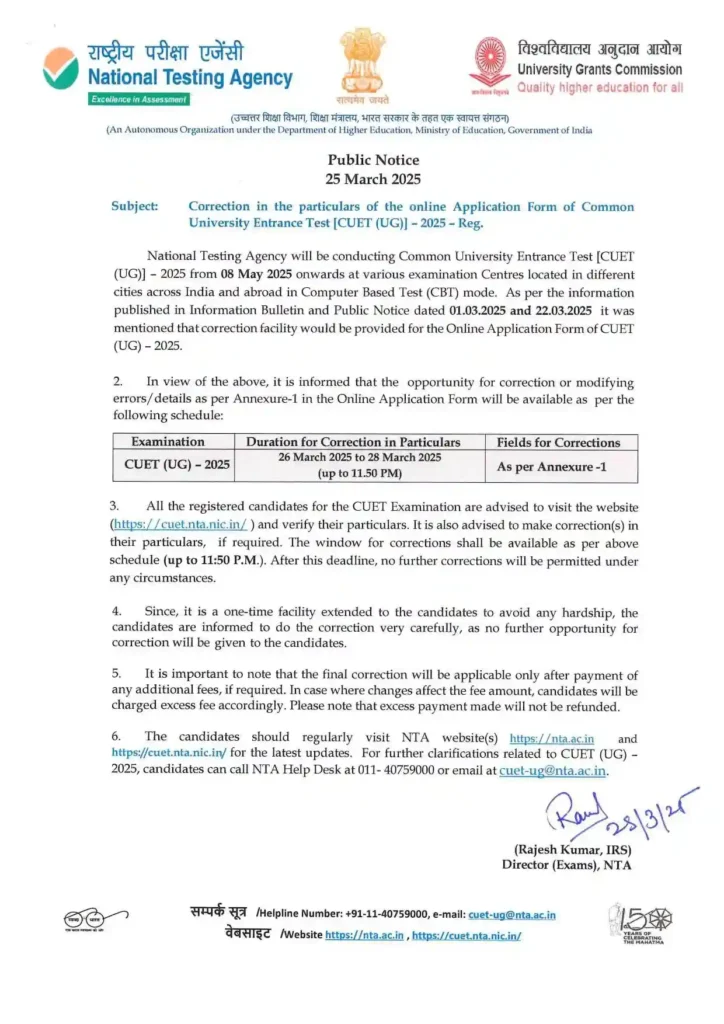
Corrections in particulars of the CUET (UG) 2026 application form
NTA will also allow candidates the option to edit particulars in the CUET 2026 application form. The correction window will be available from 02-04 February 2026 (up to 11.50 PM).
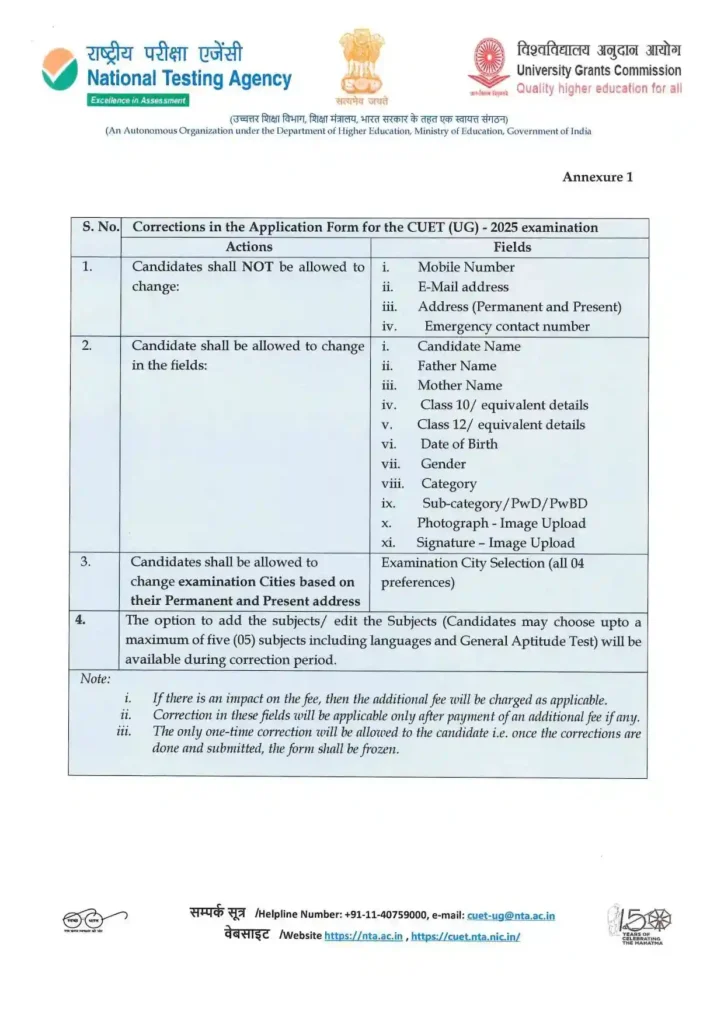
The following details can be edited during the CUET (UG) 2026 correction window:
S.No
Actions
Fields
1
The candidate is NOT allowed to change
Mobile NumberE-mail addressAddress (Permanent and Present)Emergency contact number
2
The candidate is ALLOWED to change the following fields
Candidates will be ALLOWED to change the exam city based on their present and permanent address
Examination city selection (all 04 preferences)
4
The option to add the subjects/ edit the subjects (Candidate may choose up to a maximum of five (05) subjects including languages and General Aptitude Test).
NOTE:
If category is changed, any impact on the fee (or additional fee) must be paid by the applicant
Correction in the above particulars will be applicable only if any additional fee (if applicable) has been paid
Here are officials guidelines for making corrections to the CUET application form.
CUET Admit Card 2026
The admit card of CUET 2026 exam will be released four days before the exam date. Candidates who successfully register for the exam must download the admit card online from the CUET exam portal.
Use your application number and password to log-in.
Exam officials will also release the city intimation slip before the admit card. The city slip will contain the name of the exam city allocated to the candidate. However, the candidate will only need to the admit card on exam day; the city slip is not required.
NCERT has launched a four-day online AI-based learning program for mathematics, aimed at improving conceptual understanding and classroom teaching practices using technology. The initiative is being conducted by the National Council of Educational Research and Training and is being held from January 12 to January 15, 2026.
The program is designed for students, teachers and educators across the country and focuses on integrating Artificial Intelligence tools into mathematics learning. According to NCERT, the objective is to move beyond rote learning and help learners identify conceptual gaps, common errors and effective problem-solving strategies with the support of AI-enabled tools.
Each session of the program is being held online for one hour daily, from 10:00 am to 11:00 am. The sessions are being streamed live through NCERT’s official digital platforms, including its YouTube channel and PM eVidya broadcast channels. Participation in the programme is free of cost, and no prior registration has been announced, allowing learners and teachers to join the sessions directly.
The four-day programme is structured to address different aspects of mathematics learning. Sessions focus on identifying learning difficulties using AI-based diagnostic tools, designing assessments that test conceptual clarity, using visual and digital aids to explain complex topics, and adopting personalised learning approaches to cater to diverse learner needs.
NCERT has stated that the initiative is part of its broader effort to integrate digital technology into school education and support teachers in adopting innovative teaching methodologies. By demonstrating practical applications of AI in mathematics education, the programme aims to make learning more engaging, inclusive and effective for students at the school level.
The program is open to all interested participants, including school students, teachers and education professionals, and reflects NCERT’s continued emphasis on technology-enabled learning aligned with contemporary educational needs.
The Common Management Admission Test (CMAT) 2026 will be conducted by the NTA on January 25, 2026, in computer-based test (CBT) mode across more than 120 cities nationwide.
Candidates who have registered for the exam can expect the city intimation slip — the advance notification of the exam city allotted to them — to be released soon on the official NTA-CMAT portal (exams.nta.ac.in/CMAT). The admit card for CMAT 2026 — containing full exam-day information including exact test center address, reporting time and shift details — is also expected to be issued in the third week of January 2026 ahead of the exam. These updates are crucial for candidates to plan travel and logistics well before the January exam date.
Latest Updates:
NTA CMAT 2026 City Intimation Slip (OUT Soon) – Exam Portal
How to Download the City Intimation Slip
Once the city intimation slip is released, candidates can download it by:
Visiting the official NTA-CMAT website – Click Here
Logging in with their CMAT application number and password.
Clicking on the ‘City Intimation Slip’ link to view and download the PDF.
Make sure to use the correct login credentials and download the slip as soon as it is available, as it helps with timely travel planning.
Information Included in the CMAT 2026 City Intimation Slip
The CMAT city intimation slip typically provides:
Candidate’s name and application number
Allotted exam city
Exam date
Basic instructions
It does not include the exact test centre address, reporting time, shift or room number — these details will be part of the admit card released later.
When Will the Admit Card Be Released?
While NTA has not yet publicly confirmed the admit card date, it is likely that the CMAT 2026 admit card will be released about 4–7 days before the exam — around late January 2026, likely in the third week of January. Once published, candidates will be able to download the admit card using their application number and date of birth/password from the same official portal.
Difference Between CMAT 2026 City Slip and Admit Card
It’s important for candidates to understand the distinction:
City Intimation Slip: Informs you of the exam city allocated — useful for planning travel and accommodation ahead of time.
Admit Card: The official hall ticket required for entry into the exam centre, containing detailed exam centre address, date, session/shift, reporting time, photograph, signature and exam-day instructions.
The city slip is a preliminary document; the admit card is mandatory and will be checked on exam day.
Other Important Information
The CMAT 2026 exam will be held in CBT mode and is a national-level entrance test widely accepted by AICTE-approved management colleges for admission into MBA/PGDM programs across India. Over 1,000+ institutes use CMAT scores for admission, making timely access to the city slip and admit card essential for candidates’ planning and preparation. While the city slip helps in early logistics planning, the admit card remains the document required to sit in the exam.
The CBSE Board Admit Card 2026 for Class 10 and Class 12 is expected to be released shortly, ahead of the commencement of the annual board examinations. As per the latest updates available on CBSE’s official platforms and leading education portals such as Careers360 and Shiksha, the admit cards are likely to be issued in the last week of January or the first week of February 2026. Once released, the admit cards will be accessible through the official CBSE website (cbse.gov.in) and the Pariksha Sangam portal.
The CBSE Class 10 and 12 board examinations for 2026 are scheduled to begin from February 17, 2026, and the admit card will serve as a mandatory document for entry into the examination centre on all exam days. Regular students will receive their admit cards through their respective schools, while private candidates will be able to download them directly online using their application credentials. Students are advised to keep track of official announcements, as CBSE does not issue individual alerts for admit card releases.
Latest Updates:
CBSE Board Admit Card 2026 for Class 10 and Class 12 – Visit Exam Portal
How to Download CBSE Board Admit Card 2026
Once the admit card link is activated, schools will be able to download the hall tickets for regular students by logging into the CBSE portal using their institutional credentials. After downloading, schools will verify the details and distribute the signed admit cards to students. Regular candidates should note that they will not be allowed to download the admit card on their own.
Private candidates, on the other hand, will be required to visit the official CBSE website and access the admit card download link. By entering details such as their application number, name, and date of birth, candidates will be able to view and download their admit cards. It is recommended that students print multiple copies of the admit card and keep them safely until the completion of the examination process.
The step-wise process to download the CBSE 2026 admit card is given below:
Visit the official CBSE website: cbse.gov.in or the Pariksha Sangam portal.
Look for the link labeled “CBSE Admit Card 2026 – Class 10 / Class 12” once it is activated.
Enter credentials like application number, name, and parent’s name as prompted.
On log-in, the admit card will be displayed on the screen.
Download and take a print of the admit card.
Regular students should contact their school authorities to obtain the printed hall ticket once schools download them.
Details mentioned on the CBSE Admit Card
The CBSE Board admit card 2026 will contain all essential information related to the examination and the candidate’s identity.
This includes the student’s name, roll number, photograph, signature, and date of birth, along with details such as class, stream (for Class 12), subject names and codes, examination dates, and the complete address of the exam centre.
The admit card will also mention reporting time, exam duration, and important instructions that candidates must follow during the examination.
Students are strongly advised to check all the information printed on the admit card carefully as soon as they receive it.
What to do in case of errors on CBSE 2026 admit card
If any discrepancy is found in the admit card – such as spelling mistakes in the name, incorrect subjects, or errors in exam centre details – immediately inform their school authorities.
Schools will then coordinate with CBSE to get the necessary corrections made before the examinations begin.
Private candidates should contact CBSE through the official help channels mentioned on the website. Candidates should not attempt to appear for the examination with incorrect details, as this may lead to complications at the exam centre.
CBSE 2026 Exam-Day Guidelines Candidates Must Follow
On the day of the examination, report to the exam centre well before the scheduled start time mentioned on the admit card.
Entry gates generally close before the commencement of the exam, and latecomers are not permitted to enter under any circumstances.
Carrying the printed CBSE admit card is compulsory, and candidates must also bring a valid photo identity proof if instructed by the school or centre authorities.
Students are permitted to carry only permitted stationery items such as pens, pencils, and transparent water bottles.
Electronic devices including mobile phones, smartwatches, calculators, or any other prohibited items are strictly banned inside the examination hall. CBSE conducts frisking and verification at centres, and violation of rules can lead to disqualification.
What next after CBSE 2026 board exams are over
After the conclusion of the CBSE Class 10 and 12 board examinations, the answer sheets will undergo centralized evaluation. CBSE does not usually release subject-wise answer keys for board exams, as evaluation is conducted internally. Once the assessment process is completed, the board will declare the results on its official websites.
As per current timelines, CBSE Class 10 results are expected in April 2026, while Class 12 results are likely to be announced by May 2026. Students will be able to check their results online using their roll number and other required credentials.
Key takeaway for students
The CBSE Board admit card 2026 is a crucial document and must be carried on every exam day. Students should ensure timely collection or download of the admit card, verify all details carefully, follow exam-day instructions strictly, and stay updated through official CBSE notifications to avoid last-minute issues.