The Indian Institutes of Management is conducting the CAT 2025 exam today (November 30) in three slots. The 1st slot started at 8.30 am. The exam is conducted in more than 170 cities and 375 test centers. The name and address of the exam center is mentioned on the CAT 2025 admit card.
Candidates must report to their allotted CAT 2025 exam centers at least 90 minutes before exam start time. Note that entry will be STOPPED 15 before exam commences.
So, it is incumbent on the candidate to be punctual. Or else entry may be denied, and even if entry is allowed, late arrival can mean anxiety and stress, which is not a good recipe for success.
The scores of the CAT 2025 exam will be used to shortlist candidates for admission to the MBA/PGDM courses offered by participating colleges.
CAT 2025 Exam Slots, Reporting Time & Last Entry
Event
Session 1
Session 2
Session 3
CAT 2025 Test Time
8.30 – 10.30 am
12.30 – 2.30 pm (Afternoon Slot)
4.30 – 6.30 pm (Evening Slot)
Reporting/ Entry Time at Center
7:00 AM
11:00 AM
3:00 PM
Gate Closing Time
8.15 am
12.15 am
4.15 am
CAT 2025 exam analysis
Educharcha.in will bring a detailed analysis of CAT 2025 after the exam concludes. The analysis will cover the following aspects:
Overall and sectional difficulty level
Difficulty level compared to previous editions
Inputs from candidates who appeared in the exam, how did they perform, types of questions asked
The expected cut-off
Whether there were any technical or other issues during the exam.
CAT Answer Key 2025
The provisional answer key of CAT 2025 will be released around the 1st week of December 2025. The answer key will contain the official keys to all the questions asked in the entrance exam.
The candidate can use these keys to calculate probable CAT scores.
There will also be an option to challenge the provisional key. The final key will be released after considering feedback/ comments of candidates.
NTA will close the JEE Main 2026 application (Session 1) form at 9 pm, November 27, 2025. Candidates who haven’t applied yet are urged to do so before the deadline. In a notification released on November 20, the NTA had notified that there will be no further extension of date.
The application form is open online at jeemain.nta.nic.in.
Candidates who meet the prescribed JEE Main eligibility criteria can apply for their chosen program. To apply for the exam, you need to get registered, fill in personal, academic, and contact details, upload documents, and pay the application fee.
You must also select FOUR exam cities in the order of priority. The name and address of the JEE Main 2026 exam center allotted will be mentioned on the admit card. The JEE Main 2026 admit card will be released 3 days prior to the exam date.
JEE Main 2026 (Session 1) exam will be held between January 21-30, 2026. Also, note that fresh registration will be opened for Session 2. Candidates who already applied for Session 1 don’t need to register again, but must pay the applicable application fee and complete basic formalities like selection or editing of the exam center (if applicable), etc.
JEE Main 2026 Application Form Dates
Events
Dates
Application Form START Date
October 31, 2025
Last date for submission of JEE Main 2026 application form
November 27, 2025 (9 pm) Application Fee Payment Deadline: November 27, 2025 (11.50 pm)
Correction in particulars of the application form
December 1-2 (Up to 11.50 pm)
Issue of admit cards
3 days prior to the exam date
JEE Main 2026 (Session 1) Exam Date
Between January 21-30, 2026
Correction in Particulars of JEE Main Application Form 2026
Using the correction facility, you can edit some particulars in the application form, including exam center, academic details, DOB, category, etc. However, a few particulars like mobile no., mail ID, etc., can’t be edited.
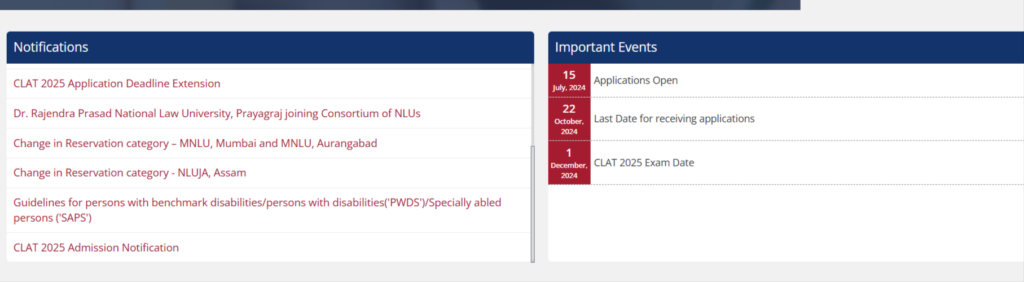
CLAT 2026 exam will be conducted on December 7. Being one of the most competitive law entrance exams in the country, if you want to ace it, you need to be at the top of your game. Here we bring you some reliable tips on how to prepare for the CLAT 2026 exam.
How to Prepare for CLAT 2026 – The Consortium of National Law Universities (NLUs) will conduct the CLAT 2026 exam on December 7, 2025. The application form of CLAT 2026 is now closed.
Given the difficulty and competition level of the CLAT exam, it is recommended that you START your preparation early. With enough time at your disposal, you can plan and execute better, and don’t have to rush through.
As part of the CLAT 2026 exam preparation strategy, you must follow a study time table, complete the CLAT 2026 syllabus, take notes, and solve CLAT 2026 sample papers, In the last few days leading up to the exam, the focus should be more on revision and taking mocks.
Here we bring you tips to prepare for the CLAT exam. Keep reading.
Before delving into how to prepare for CLAT, the candidate first needs to be familiar with the CLAT 2026 exam pattern.
This is because the exam pattern will provide insights into the types of questions asked, sections, test duration, marking scheme, weightage, etc. Without these inputs, it will be very difficult to make any progress in CLAT exam preparation 2025.
CLAT Exam Pattern 2026 – Highlight
Exam mode – Pen-paper-based test
Exam duration – 120 minutes
Total questions – 120 questions
Total marks – 120 marks
Marking Scheme – +1 will be awarded for a correct answer; –0.25 for every incorrect attempt.
CLAT Exam Pattern 2026 – Subject-wise No. of Questions and Weightage
Subject
Number of Questions
Weightage
English Language
22-26 questions
20%
Current Affairs, including General Knowledge
28-32 questions
25%
Legal Reasoning
28-32 questions
25%
Logical Reasoning
22-26 questions
20%
Quantitative Techniques
10-14 questions
10%
CLAT Syllabus 2026
Questions in the CLAT 2026 exam will be asked from the official syllabus released by the CLAT Consortium.
The CLAT 2026 exam syllabus will include the section-wise topics that candidates need to prepare for the entrance exam.
It is important to highlight here that the CLAT exam is designed to evaluate whether you have the mental aptitude, analytical skills, and critical thinking abilities required for a successful career in the legal profession.
For instance, good communication skills will allow you to strongly and eloquently elucidate your ideas, while being succinct and persuasive at the same time.
Also note that legal knowledge is not a prerequisite to appear and do well in the CLAT 2026.
Sections
Topics
English
Comprehension passages from news articles, non-fiction literature, etc.
Grammar Word meanings Summarize passages, Compare and contrast Draw inferences
Quantitative Techniques
Derive, infer, and manipulate numerical information set out a given passage Ratios and proportions, basic algebra, mensuration and statistical estimation.
Current Affairs Including General Knowledge
Contemporary events of significance from India and the world; Arts and culture; International affairs; and Historical events of continuing significance. Questions will be based on given passages of up to 450 words each. The passages will be derived from news, journalistic sources and other non-fiction writing.
Logical Reasoning
Logical and Analytical reasoning skills
Legal Reasoning
Identify and infer the rules and principles set out in the passage; Apply such rules and principles to various fact situations; and
Understand how changes to the rules or principles may alter their application to various fact situations.
Questions will be based on passages of around 450 words each. The passages may relate to fact situations or scenarios involving legal matters, public policy questions or moral philosophical enquiries. You don’t require any prior knowledge of law to attempt the questions in this section.
Here are a few tips that you can follow to master CLAT 2026 syllabus and ace the law entrance exam.
Don’t join a coaching institute just for the sake of it – If you really want to really crack CLAT 2026, better not to join a coaching institute. This is especially true if you are an average student. Truth be told, the coaching institute will focus most of their attention on the top students in a batch so that they crack CLAT, bring some fame for the institute and they can market it for more students.
What you need to do instead is make a study plan. Also, start in advance, like give yourself around SIX months.
If you are dedicated and follow the remaining tips here, you are sure to get a good score in CLAT and get admission to your dream institute.
START your preparation early – One major mistake many candidates make is to keep postponing their exam preparation. But it is not at all recommended.
If you are an average student, you will need enough time to prepare.
I will recommend you give yourself at least six months preparation time. This way you will have enough bandwidth to cover the CLAT syllabus 2026, solve mock tests and sample papers.
Get familiar with the exam pattern and syllabus – The exam pattern will tell you how you need to prepare for the exam. Meanwhile, the syllabus has the topics that you need to prepare for.
You can divide the topics into various categories depending on their difficulty level. Pay close attention to the ones that carry more weightage or are difficult.
Make a time table and follow it rigorously – If you make a study timetable, you need to stick to it. If you don’t, there is no point having one in the first place!
Success comes with discipline and determination.
So, you need to get your life in order, if it is not already, and follow a certain routine. Yes, it can get boring at times, but guess what it is when you chug along even when things are not looking all rosy that you are priming yourself for success.
Read newspapers regularly – Go through the editorials, opinion pieces, and other important segments of the newspaper.
Also, when you are reading, make it a point to note the words, phrases, and idioms that are being used. Like the context, presentation, etc.
Once you are done reading the topic, try to derive inferences, understand the concept and how to be persuasive and persistent.
Solve sample papers – There is no better tool to check your progress than by solving CLAT sample papers. For instance, if you are able to solve an entire sample paper within the given time, it is an indication that you are on track.
Solve as many sample papers as you can.
It is important that the sample papers don’t have the same and repetitive questions, but include a diverse set of questions covering the entirety of the CLAT 2026 syllabus.
You can start solving sample papers very early in your exam preparation. Along with sample papers, also solve previous years’ CLAT question papers to check the types of questions asked, difficulty level, marking scheme, and to understand how questions are framed.
Take mock tests – These tests are taken closer to the exam to give the final touches to one’s preparation.
Mocks will help to orient your body clock with exam timings if you take them at the same time of the day. Further, you will learn the navigation process and how to attempt the paper.
This will help you keep a cool head on the day of the CLAT 2025 exam.
Can I prepare for CLAT 2026 in one month?
If you are an average student, you are going to face an uphill battle to crack the exam with barely one month to prepare.
The point is the CLAT syllabus is quite vast and needs some time.
That being said, if you put an all out effort and luck is with you, who knows, you might just manage to do the impossible!
Don’t change your study plan too much in the last few days.
In these last few days leading up to the CLAT 2026 exam, it is important for the candidate to stick to their original study timetable and not make too many changes.
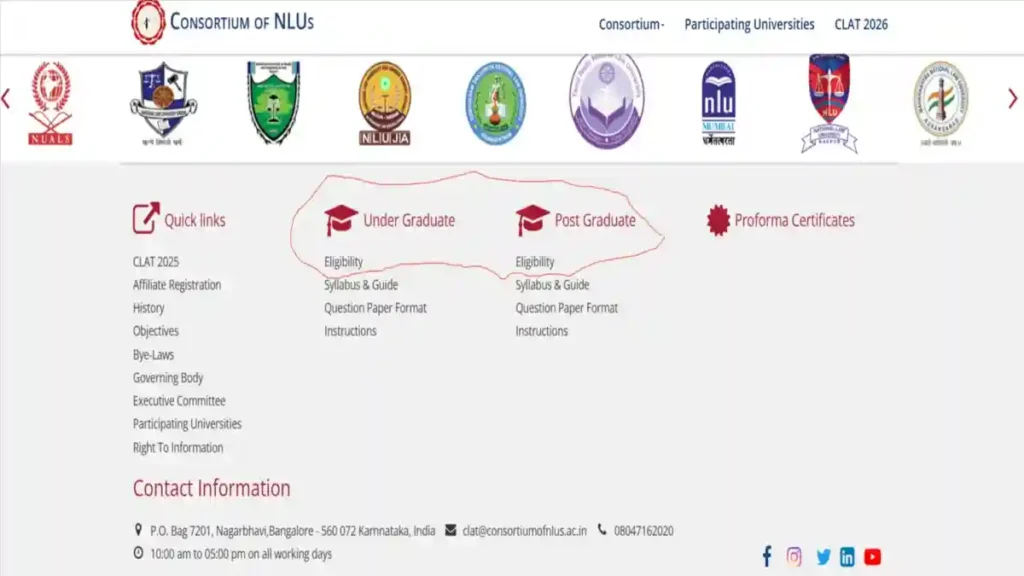
CLAT Syllabus 2026 – The Consortium of NLUs has released the CLAT 2026 syllabus on its exam portal – consortiumofnlus.ac.in. The syllabus are available for both the UG and PG courses. To download the syllabus for your chosen program, click on the program, and then on “Syllabus and Guide”. The detailed syllabus is also given below.
The CLAT 2026 question paper has five sections; i.e. English Language, Legal Reasoning, Current Affairs including GK, Logical Reasoning and Quantitative Techniques. The syllabus of CLAT 2026 will includes the topics for each of these subjects. Moreover, the syllabus will also throw insights into the type and nature of questions asked, source material, etc.
The CLAT 2026 exam will be conducted on December 7, 2025.
The CLAT 2026 exam syllabus for the UG program is given below.
Subject
CLAT UG 2026 Exam Syllabus
English Language
This section will include passages of about 450 words each. The passages will be derived from contemporary or historically significant fiction and non-fiction writing, and would be of 10+2 standard that students can read in about 5-7 minutes.
Each passage will be followed by a series of questions that will require you to demonstrate your comprehension and language skills, including your abilities to:
Read and comprehend the main point discussed in the passage, as well as any arguments and viewpoints discussed or set out in the passage; Draw inferences and conclusions based on the passage; Summarise the passage; Compare and contrast the different arguments or viewpoints set out in the passage; and Understand the meaning of various words and phrases in the context that they are used in the passage.
Current Affairs Including GK
In this section, you will be provided passages of up to 450 words each. The passages will be derived from news, journalistic sources and other non-fiction writing. The questions may include an examination of legal information or knowledge discussed in or related to the passage, but would not require any additional knowledge of the law beyond the passage.
Each passage will be followed by a series of questions that will require you to demonstrate your awareness of various aspects of current affairs and general knowledge, including:
Contemporary events of significance from India and the world; Arts and culture; International affairs; and Historical events of continuing significance.
Legal Reasoning
In this section, you will be expected to read passages of around 450 words each. The passages may relate to fact situations or scenarios involving legal matters, public policy questions or moral philosophical enquiries. You will not require any prior knowledge of law to attempt the questions in this section. You will benefit from a general awareness of contemporary legal and moral issues to better apply general principles or propositions to the given fact scenarios.
Each passage would be followed by a series of questions that will require you to:
Identify and infer the rules and principles set out in the passage; Apply such rules and principles to various fact situations; and Understand how changes to the rules or principles may alter their application to various fact situations.
Logical Reasoning
The Logical Reasoning section of the UG-CLAT 2026 will include a series of short passages of about 450 words each. Each passage will be followed by one or more questions that will require you to:
Recognize an argument, its premises and conclusions; Read and identify the arguments set out in the passage; Critically analyze patterns of reasoning, and assess how conclusions may depend on particular premises or evidence, and how conclusions may be strengthened or weakened as a consequence of an alteration in premises or supporting facts; Infer what follows from the passage and apply these inferences to new situations; Draw relationships and analogies, identify contradictions and equivalence, and assess the effectiveness of arguments.
Quantitative Techniques
The Quantitative Techniques section of the UG-CLAT 2026 will include short sets of facts or propositions, or other textual representations of numerical information, followed by a series of questions. You will be required to derive information from the passages or questions, and apply mathematical operations on such information.
The questions will require you to:
Derive, infer, and manipulate numerical information set out in such passages; and Apply various 10th standard mathematical operations on such information, including from areas such as ratios and proportions, basic algebra, mensuration and statistical estimation.
CLAT PG 2026 Exam Syllabus
The detailed syllabus of CLAT 2026 for the PG program is explained below.
Subject
CLAT PG 2026 Exam Syllabus
Objective Section
In this section of the PG-CLAT 2025, you will be provided extracts from primary legal materials such as important court decisions in various fields of law, statutes or regulations. Each passage will be followed by a series of questions that will require you to demonstrate the:
Ability to read and comprehend the issues discussed in the passage, as well as any arguments and viewpoints discussed or set out in the passage; Awareness of the issues discussed in the passage, as well as of legal issues and facts related to and arising out of the passage and the judgment or statute from which it is extracted; Summarise the passage; and Ability to apply your knowledge of the fields of law discussed in the passage.
Mandatory subjects of the undergraduate program
Constitutional Law, Jurisprudence, Administrative Law, Law of Contract, Torts, Family Law, Criminal Law, Property Law, Company Law, Public International Law, Tax Law, Environmental Law, and Labour & Industrial Law.
How to Use CLAT Syllabus 2026 for Exam Preparation
The candidate is recommended to refer to the syllabus of CLAT 2026 for making their exam preparation plan. Here is how.
Go through the syllabus and segregate into easy, moderate, and difficult. This way you will get a fair idea as to how much time it will require to complete the CLAT 20y syllabus. Also, you will be in a better place to decide how to approach the syllabus.
The syllabus will also tell you the nature of questions asked in the CLAT 2025 exam. For instance, a majority of the questions in the CLAT 2026 exam will be passage-based.
The syllabus also tells the candidate that to succeed in the exam, the candidate must do more that simple rot learning. For instance, the to perform well in the Legal Reasoning section, the candidate must have a general awareness of contemporary legal and moral issues to better apply general principles or propositions to the given fact scenarios.
The CLAT 2026 question paper will also require the candidate to Recognize an argument, its premises and conclusions; Read and identify the arguments set out in the passage;
CLAT Exam Pattern 2026
Candidates are urged to consult the CLAT 2026 exam pattern in tandem with the syllabus to prepare for the law entrance exam.
Particulars
Description
Mode
Pen-and-paper exam
Exam duration
Two hours
Test language
English
Type of questions
Multiple-Choice Questions (MCQs)
Total questions
120 MCQs
Maximum marks
120 marks
Marking scheme
+1 for correct answer -0.25 for incorrect answer
Official preparation material for CLAT 2026
According to the CLAT exam portal – “the consortium plans to publish various preparatory materials for the UG-CLAT, including”
Instructional materials and exercises for each of the subjects that the UG-CLAT comprises.
“The Consortium will also provide candidates who have successfully completed their application to the UG-CLAT access to a learning platform where you may access the preparatory materials described above, as well as your scores on various exercises and model question papers. The Consortium shall also organise online sessions for such candidates, in which subject experts shall provide guidance on how best to prepare for each of the sections of the UG-CLAT, and how candidates may approach the questions in each section.
In addition, you should develop your capacity to read and understand bodies of text, ensure you stay abreast of news and current affairs by regularly reading quality newspapers and periodicals, and improve your speed of answering questions on quantitative techniques by practicing with materials such as 10th standard mathematics textbooks.”
CLAT Exam Pattern 2026 – The Consortium released the exam pattern of CLAT 2026 along with the exam notification on July 20, 2025. It contains insights into the types of questions asked, marking scheme, sections & section-wise questions, weightage, test duration, etc.
The CLAT 2026 examwill be administered in pen-and-paper mode and include 120 MCQs that candidates have to attempt in 120 minutes. Questions will be asked from five sections; i.e. English Language, Current Affairs including GK, Legal Reasoning, Logical Reasoning and Quantitative Techniques.
Note that while the exam pattern will instruct how to prepare for the exam, the CLAT 2026 syllabus will guide as to which topics to prepare from. Keep reading to learn the full details about the CLAT 2026 exam pattern.
A snapshot of the CLAT PG 2026 exam pattern is given below.
Particulars
Description
Mode
Pen-and-paper exam
Exam duration
Two hours
Test language
English
Type of questions
Multiple-Choice Questions (MCQs)
Exam subjects
Constitutional Law
Other areas of law such as Jurisprudence, Administrative Law, Law of Contract, Torts, Family Law, Criminal Law, Property Law, Company Law, Public International Law, Tax Law, Environmental Law, and Labour & Industrial Law
Total questions
120 MCQs
Maximum marks
120 marks
Marking scheme
+1 for correct answer -0.25 for incorrect answer
CLAT UG Exam Pattern 2026 – Key Highlights
Here is a closer look at the CLAT UG 2026 exam pattern and question paper.
Passage-based questions: All four subjects (excluding the Quantitative Technique section) will include passage-based questions. The English, Current Affairs, and Logical Reasoning sections will include 450-word passages. The Logical Reasoning section will have short passages of about 350 words. Each passage will be followed by a series of questions.
Quantitative Techniques section: This section will include short sets of facts, propositions, graphs, pictorial representation, etc. The candidate will have to derive answers from such passages, representations, etc.
How many questions will be asked? – A total of 120 multiple-choice questions will be asked
Marking scheme: Each question is worth 1 mark; 0.25 marks will be deducted for an incorrect answer.
Difficulty level of questions: The difficulty level of CLAT 2026 will be of Class 12. Questions asked in Quantitative Techniques are of Class 10 difficulty level.
Skills evaluated: The CLAT UG question paper will test the comprehension and reasoning skills of candidates. This means to do well in the exam, the candidate must do more than just try to memorise the theories.
CLAT UG Exam Pattern 2026 – Section-wise No. of Questions Asked
Sections
MCQs per section
Maximum Marks
Approximate Weightage (in %)
English Language
22-26
22-26
20%
Current Affairs including GK
28-32
28-32
25%
Legal Reasoning
28-32
28-32
25%
Logical Reasoning
22-26
22-26
20%
Quantitative Techniques
10-14
10-14
10%
Is CLAT 2026 be an open-book exam?
CLAT 2026 will not be an open-book exam.
Note: For you knowledge, the All India Bar Examination (AIBE) was conducted as an open-book exam till AIBE 16. However, since then only Bare Acts without short notes are allowed. Books, notebooks, or any textual material are not allowed inside the AIBE exam hall.
In contrast, the candidate is not allowed to carry bare acts, short notes, books, notebooks, and any written material inside the CLAT 2026 exam center.
CLAT Syllabus 2026
Candidates preparing for the CLAT 2026 exam must also refer to the CLAT 2026 syllabus to prepare for the exam. While the exam pattern will tell you how to study, the syllabus will outlined what to study.
For instance, the CLAT syllabus will include the section-wise topics, from which questions will be asked in the exam. Additionally, the syllabus will also state the skills that are being evaluated. This will help you get a better insights into the exam.
To complete the syllabus on time, it is recommended to have a study time table. You can also segregate the syllabus in segments – easy, moderate, difficult. This will help you pay special attention to the difficult and high weightage topics.
CLAT Application Form 2026 – The Consortium of NLUs has closed the CLAT 2026 application correction window. The correction window was open from November 7-9, 2025.
Using the correction window, you could edit particulars in the CLAT application form, including name, date of birth, program of STUDY, exam center, etc. (explained in detail below). CLAT 2026 application form 2026 is now closed.
The application form was open from August 1- November 7. The application fee was accepted till November 9 (11.59 pm). Note that applications will only be considered if one meets CLAT 2026 eligibility criteria.
Exam officials will verify information entered by the candidate during CLAT 2026 counseling, and if any anomaly is found, the candidate will be disqualified. To register for CLAT 2026 exam, fill in personal, academic, and contact details, upload documents, select THREEexam centers for CLAT 2026, upload documents, and pay the application fee.
CLAT 2026 application fee is INR 4,000 (INR 3,500 for reserved category candidates). Further, with an additional payment of INR 500, you can get the previous years CLAT question papers from the consortium. Keep reading to learn the full details about the CLAT 2026 application form.
The application form for CLAT 2026 was open online at https://consortiumofnlus.ac.in. Before proceeding to register for the exam, ensure that you meet the prescribed eligibility criteria and have the prescribed documents ready.
Stepwise process to fill CLAT 2026 application form
Get registered – In the registration form that opens, enter your name, mobile number, and email ID. Also, select and confirm a password for the applicant account.
Fill in the form – The candidate needs to log-in to the applicant account and fill in other details like program of STUDY, personal, academic, and contact details.
Select EXAM centers – The candidate has to select THREE exam cities in the order of priority.
Upload documents – The candidate has to next upload photograph, signature, domicile documents, etc., in the prescribed specification.
Pay the application fee – FINALLY, the candidate has to pay the category-specific application fee to complete the application process.
CLAT Application Form 2026 – Category-wise Registration Fee
The application fee of CLAT 2026 for various categories is shown in the table below. The application fee is non-refundable.
Category
CLAT 2026 Application Fee (in INR)
Open
4,000
SC/ST/BPL/PwD
3,500
Mode of payment – The application fee has to be paid online using credit card, debit card, and net banking.
The mandatory documents along with the prescribed specification for filling out the CLAT 2026 application form is given below.
Document
Image Size (maximum)
Format
Photograph
500 KB
jpg/jpeg
Signature
100 KB
jpg/jpeg
State domicile certificate
2 MB
PDF
CLAT Exam Centers 2026
You can select your choice of exam center for CLAT 2026 when registering for the exam. You are allowed to selectthree exam centers in the order of priority.
The name and address of the exam center allocated to you will be mentioned on the CLAT admit card 2026. On the day of the exam, report to the exam center with the admit card and a valid photo ID proof.
The exam center reporting time, exam date and timings, and exam-day guidelines will be mentioned on the CLAT admit card.
List of CLAT 2026 Exam Centers
CLAT Test Cities 2026
Agartala
Agra
Allahabad
Amravati
Amritsar
Asansol
Aurangabad
Bareilly
Barrackpore
Bengaluru
Bhopal
Bhubaneswar
Bilaspur
Calicut
Chandigarh
Chennai
Chittor/Tirupathy
Coimbatore
Cuttack
Dehradun
Diu
Durg
Ernakulam
Faridabad
Gandhinagar
Gangtok
Ghaziabad
Gorakhpur
Greater Noida
Gurugram
Guwahati
Gwalior
Haldwani
Hisar
Hoogly
Hubli
Hyderabad
Imphal
Indore
Jabalpur
Jaipur
Jalandhar
Jammu
Jamshedpur
Jhansi
Jodhpur
Kanpur
Kharagpur
Kolkata
Kota
Kottayam
Kurnool
Kurukshetra
Lucknow
Madurai
Malda
Mangalore
Meerut
Mohali
Mumbai
Muzaffarpur
Mysore
Nagpur
Navi Mumbai
New Delhi
Patiala
Patna
Puducherry
Pune
Raipur
Rajkot
Rajahmundry
Ranchi
Salem
Shillong
Shimla
Siliguri
Silvassa
Sonepat
Srinagar
Surat
Thane
Thiruvananthapuram
Tirunelveli
Trichy
Vadodara
Varanasi
Vijayawada
Visakhapatnam
CLAT Registration Statistics
The exam statistics for the CLAT exam, including the number of registered and appeared candidates, are given in the table below.
The eligibility criteria of CLAT 2026 exam are outlined in the consortium portal – consortiumofnlus.ac.in.
Go to the portal and scroll down. You will see the program-wise eligibility criteria. Click on the eligibility criteria you want to check (UG or PG).
Ensure you meet CLAT 2026 eligibility criteria when filling the form
Before proceeding to fill out the application form, make sure that you meet the prescribed eligibility criteria for your chosen program. It is because all particulars entered by the candidate will be verified at the time of CLAT counseling.
If any anomaly is found, the candidate can be disqualified.
CLAT Application Correction Window 2026
The Consortium of NLUs will open the CLAT Application Correction Window 2026 soon after the application form closes. The correction link will be provided here or the candidate can visit the CLAT 2026 exam portal at consortiumofnlus.ac.in
To make corrections in the CLAT application 2026 application form, follow these steps:
Go to the CLAT 2026 exam portal
Next, log-in to the registration portal using your mobile number and password
Click on the “Edit Application” button
Go to ‘Category and Seat Reservation’ for NLU preferences, as well as, Personal details tab for OBC category status, whether Non-Creamy Layer or Creamy Layer
Make the required changes.
Save the changes and submit the application form.
Editable Details in CLAT 2026 Application Correction Window
The candidate can edit the following details during the CLAT 2026 correction window.
Category
Particulars that can be edited
Personal and contact details
Candidate’s Name Date of Birth Gender Mobile Number Email Address Father’s and Mother’s Name Category Reservation Category Status (e.g., PwD, OBC Non-Creamy Layer)
National Law University Delhi (NLU Delhi) has released the admit cards for AILET 2026 on November 26, 2025. The admit card can be downloaded online at nationallawuniversitydelhi.in. Use your user name/ email ID and password to download the admit card.
The AILET 2026 exam will be held on Sunday, 14 December 2025, from 02:00 PM to 04:00 PM, for both undergraduate and postgraduate programs.
The deadline to download the admit card is December 14 (1:30 PM). However, it is recommended that candidates don’t wait until the dying hours to download the hall ticket.
It is because there can be a technical snag or server issues, which may make it difficult to download the admit card. Further, if there are any errors in the admit card, the candidate will get very little time to address them.
The admit card will carry details like the name and address of the allotted AILET 2026 exam center, roll number, date and time of the exam, reporting time, gate closing time, etc.
Log in to your AILET 2025 application account with your registered credentials: 1) User Name/ Email ID and 2) Password
On successful log-in, the admit card will open on screen
Save the admit card as a PDF and take a colour printout. It’s advisable to keep an extra print for backup.
Verify all details — name, roll number, exam date/time, exam centre address, and photo — are correct. If you spot errors, contact NLU Delhi immediately via their helpline.
AIBE (XX) 2025 Exam-day Instructions and Checklist: The Bar Council of India (BCI) has released the list of AIBE (XX) 2025 exam guidelines on November 24, 2025.
The AIBE (XX) 2025 exam will be held on November 30, 2025 (1 pm – 4 pm). Entry inside the AIBE 2025 exam center will start at 11.30 am.
On the exam day, you must bring the AIBE (XX) 2025 admit card and a valid photo ID proof. Without these documents, entry will not be allowed. The AIBE admit card contains important exam-day instructions that all candidates must strictly follow. For example, entry inside the AIBE 2025 exam center will NOT be allowed after 1:15 pm.
Arrive at least an hour before the exam begins to allow sufficient time for registration, security checks, and locating your assigned seat in the exam hall. The danger of arriving late is not only that you may have less time to attempt the exam or even be denied entry altogether, but also that, if you are allowed in, the resulting stress and anxiety can play spoilsport. You are allowed to carry Bare Acts (without notes and comments) inside the exam center.
Here we bring you a detailed AIBE exam-day guide to help you stay prepared, confident, and fully compliant with all instructions. Keep reading.
The BCI released the AIBE (XX) 2025 admit card on November 15, 2025. You can download the admit card following the link given above.
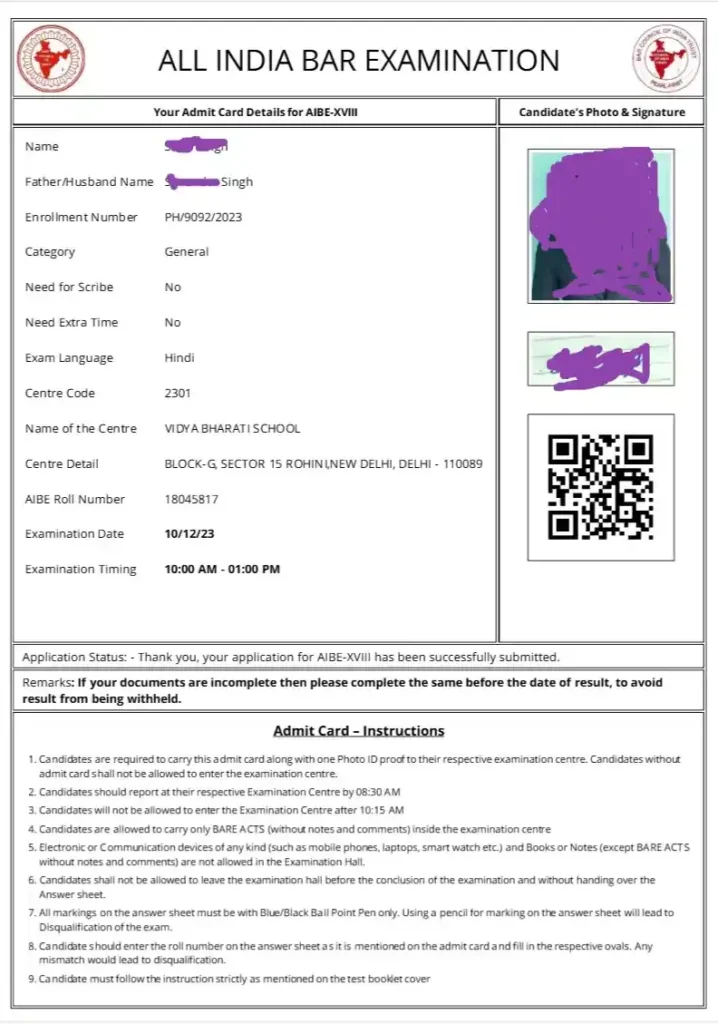
The admit card contains important exam-related information like reporting time, exam date and timings, roll number, name and address of the allotted AIBE (XX) 2025 exam center, and exam-day instructions.
The exam instructions include information on the list of barred and allowed items, how to mark the AIBE (XX) 2025 answer booklet, special provisions (say for specially abled students), etc.
A sample admit card with the list of AIBE exam-day instructions is shown below.
AIBE (XX) 2025 Exam-day Schedule – Reporting Time, Last Entry
The candidate must note the following exam-day events along with their corresponding schedules and timings.
Particular
Timing
AIBE (XX) 2025 Exam Timing
1 pm – 4 pm
Note: Candidates with 40% or more disability are eligible for an extra 20 minutes to complete the exam. To avail this facility, the candidate must submit a disability certificate to the invigilator.
Entry STARTS
11.30 am
Last entry inside exam center
1.15 pm However, it is recommended that candidates arrive much earlier than that to allow time for frisking, registration, and finding their seats.
Exit (from exam center)
4.30 pm (onward)
AIBE 2025 Exam-day Instructions
Before you head to the exam center, take a moment to go through these key AIBE (20) 2025 instructions. These steps will guide you through reporting, what to carry, what to avoid, and how to navigate the exam hall with confidence.
Reporting time – Entry inside the exam center will START at 11.30 am
Last entry – No entry inside the exam center after 1.15 pm
Exam Timings – 1 pm – 4 pm
Documents: Carry the following documents – 1) AIBE 2025 admit card, and 2) a valid photo ID proof
Are Bare Acts allowed? – You are allowed to carry BARE ACTS (without notes and comments) inside the exam center. However, bare acts with comments or notes are not allowed.
Barred items – Electronic or communication devices of any kind (mobile phones, laptops, smart watches, etc.), bags, handbags, and Book and Notes (except Bare Acts without notes and comments) are not allowed inside the exam hall.
Exit – 4.30 pm (onward). But note that you are not allowed to leave the exam hall without handing over the AIBE (XX) 2025 answer sheet.
Submit the answer seat before leaving – You must submit the answer sheet to the invigilator at the end of the exam.
Marking Answers on the Answer Sheet – Use a Blue/ Black Ball Point Pen only to mark your answers on the answer sheet. Using a pencil or any other material will lead to disqualification.
Make sure that you properly enter your roll number in the given space on the answer sheet. Any mismatch while filling the ovals could lead to cancellation.
Enter the Question Booklet Set Code and Roll Number and all other necessary information correctly on the OMR answer sheet. Any errors or omissions could lead to disqualification.
Extra Time for Candidates with Disability – Candidates with 40% or more disability will be given 20 extra minutes to complete the paper. To avail extra time, you must submit a certified copy of the disability certificate to the invigilator.
Eligibility Criteria – The candidature of a candidate will be provisional subject to meeting the prescribed AIBE (XX) 2025 eligibility criteria. If a candidate is found to be ineligible, his or her candidature will be cancelled.
Cheating/ Adopting Unfair Means – Candidates found indulging in cheating or resorting to any type of unfair means will be disqualified.
Preserve the Admit Card – Make sure that you don’t throw away the AIBE (XX) admit card once the exam is over. It is because the printout of the admit card used for appearing in the exam may be required when receiving the Certificate of Practice (CoP) and also for future reference.
Dress code for AIBE (XX) 2025 Exam
On the day of the AIBE 2025 exam, the candidate is recommended to wear comfortable and decent clothing.
There is no strict or official dress code that BCI postulates.
However, wearing fancy, revealing, or a lot of jewellery, are not usually recommended as it may invite unwanted attention and frisking. Also, if you wear religious attire, make sure it doesn’t cover your identity; also, reach the exam center a bit earlier.
The dress code for the AIBE 20 (XX) 2025 exam is designed to ensure the comfort and security of all candidates. Here are the key guidelines regarding what to wear and what to avoid:
Category
Permitted / Recommended
To be avoided
Clothing
Plain formal or semi-formal attire such as shirts & trousers, skirts or dresses for women; light sweater/jacket allowed if needed.
Flashy designs, heavy patterns, slogans, oversized accessories.
Footwear
Closed-toe shoes like formal shoes, flats or sneakers.
Minimal jewellery, no large accessories; religious headgear allowed (if it does not obstruct security/checks).
Smartwatches, mobile phones, calculators, headphones, large watches, caps/hats (unless for religion/medical reasons)
Particulars for Women
Comfortable simple tops, trousers or plain dress; flats recommended.
Extravagant jewellery, heavy earrings, high heels.
Particulars for Men
Formal/semi-formal shirts and trousers, optional light jacket.
T-shirts with bold prints, loud patterns, unnecessary layers.
Key points & tips to follow:
A proper dress code will ensure fairness, prevent distractions, and support the security/verification process.
Non-compliance may lead to denial of entry or disqualification (in extreme cases).
Arrive early at the exam centre to allow for frisking and document checks; comfortable attire will help avoid last-minute stress.
Final advice: Adopt plain, professional dressing on exam day – avoid any element that might raise a security concern or distract other candidates. A well-chosen outfit will help you focus fully on the paper rather than on avoidable formalities.
How to Prepare for AIBE XX (20) 2025 Exam – BCI will conduct the AIBE (XX) 2025 exam on November 30, 2025. If you are preparing for the AIBE 2025 exam, make sure that you go the whole hog.
It is because, if you don’t manage to qualify the AIBE 2025 exam, you will have to wait for the next edition of the exam.
Take note, many students fail to qualify the AIBE exam by 1 or 2 marks. So, there should be no room for any complacent. That is why we bring you ten tips to prepare for the AIBE 2025 exam.
If you follow these tips and put in enough effort, nothing can stop you from qualifying the AIBE exam.
So, keep reading to learn about AIBE (XX) 2025 exam preparation tips.
The BCI will conduct the AIBE (XIX) 2025 exam on November 30, 2025. The admit card of the AIBE 2025 exam was released on November 15, 2025. The AIBE XIX results will be declared around March 2026.
Candidates who qualify the AIBE exam will be issued the Certificate of Practice (CoP), which is required to practice in a court of law.
Top 10 Tips to Prepare for AIBE Exam 2025
Here are Ten Tips To Prepare for the AIBE 2025 Exam. Go through each of these tips and get a headstart.
Tip 1 – Familiarize yourself with the AIBE 2025 Exam Pattern
The first thing the candidate needs to do before deep diving into AIBE 2025 exam preparation is get acquainted with the official AIBE 2025 exam pattern.
Particulars
Description
Exam duration
3 hours (1 pm to 4 pm)
Exam mode
Offline mode
Number of Questions
100
Topic/ Subject
The AIBE question paper will include questions from 19 sections.
The number of questions that will be asked from each section is given in the table below.
Total marks
100 marks
Type of questions
Multiple-choice questions (MCQs)
Marking Scheme
1 mark for a correct attempt. There is no negative marking.
Skills tested
1. The exam assesses basic level knowledge of a member
2. It also lays down a minimum benchmark for entering into practice of law3. Assesses a candidate’s analytical skills.
Language options
Candidates can appear in the bar exam in English and 22 vernacular languages.
Difficulty level
Easy to moderate
The AIBE exam tests the basic skills one will require as a lawyer.
The exam syllabus is based on 3-year and 5-year LLB programs.
Tip 2 – Find out what is in the AIBE (20) Exam Syllabus 2025
The syllabus will tell you what to read and what to avoid. For instance, you must prepare for all the topics included in the syllabus. If you have time, you may also read topics not included in the official AIBE syllabus 2025.
But don’t expect any questions to be asked from topics that are not included in the syllabus. Yes, in such rare instances, a question may be asked from topics outside of the syllabus, but it is better not to invest much on such topics for exam preparation.
AIBE 2025 Syllabus & Section-wise No. of Questions Asked
Sl.No
AIBE Topic/ Subject
Number of Questions
1
Constitutional Law
10
2
I. P. C. (Indian Penal Code) & (New)Bharatiya Nyaya Sanhita
8
3
Cr. P. C. (Criminal Procedure Code) & (New)Bharatiya Nagarik Suraksha Sanhita
10
4
C.P.C. (Code of Civil Procedure)
10
5
Evidence Act & (New) Bharatiya SakshyaAdhiniyam
8
6
Alternate Dispute Redressal Including Arbitration Act
4
7
Family Law
8
8
Public Interest Litigation (PIL)
4
9
Administration Law
3
10
Professional Ethics and Cases of Professional Misconduct under BCI Rules
4
11
Company Law
2
12
Environmental Law
2
13
Cyber Law
2
14
Labour and Industrial Law
4
15
Law of Tort, including Motor Vehicle Act and Consumer Protection Law
5
16
Law Related to Taxation
4
17
Law of Contract, Specific Relief, Property Laws, Negotiable Instrument Act
8
18
Land Acquisition Act
2
19
Intellectual Property Laws
2
Total
100
Tip 3 – Gather Study Materials
The study material for AIBE (20) 2025 exam preparation needs to be top notch. Instead, if the study material is poor, the output, likewise, will also be poor.
The Constitution of India Bare Act with short notes
Universal’s
Sure Success AIBE & JCJ
DV Rao
Human Rights
HO Agarwal
Public International Law
VK Ahuja
Law Exam Times
PK Pandey
All India Bar Examination Guide
Shambhu Prasad Choudhary
Central Law Agency All India Bar Examination (AIBE) Guide
SM Ranjan and PK Jain
AIBE Solved papers (buy the latest edition)
Lovedeep Bangia
AIBE – Previous years solved papers
Thakral Law Publications
Tip 4 – Create a STUDY Plan
Here is a plan that you can follow.
Divide the subjects into easy, moderate, difficult, etc. Allocate time based on the weightage/ difficulty of each subject.
Daily Targets: Set daily or weekly goals to cover topics systematically.
Revision: Regularly revise important topics and sections.
Mock Tests: Practice AIBE 2025 mock tests to improve speed and accuracy.
Tip 5 – Focus on Key Areas
Here are a few topics that may be your focus area:
Constitutional Law: Fundamental Rights, DPSP, and landmark judgments.
CrPC & IPC: Focus on sections related to bail, arrest, and offenses.
CPC: Understand the stages of civil suits and important orders.
Evidence Act: Study types of evidence, burden of proof, and witness examination.
Professional Ethics: Pay special attention to this section as it’s mandatory to pass.
Tip 6 – Practice Answering MCQs
The AIBE question paper will include multiple-choice questions (MCQs). So, it is paramount that you know how to answer these questions. One way to improve your speed and accuracy is by solving previous years’ papers. Also, add a few sample papers in between.
It is recommended to solve as many AIBE sample papers as possible.
You can find sample paper banks online or you can buy them from coaching institutes. But make sure that the questions banks are good enough and not some cheap practice material that serves no purpose.
Importantly, focus on understanding the application of laws rather than rote learning.
Tip 7 – AIBE is no longer an open-book exam. So, be prepared!
AIBE was conducted as an open-book exam until 2021. However, since then the candidate is no longer allowed to carry books inside the exam hall.
However, bare acts without notes are allowed as per the revised AIBE exam pattern.
So, you must be prepared for the current dynamics of the exam.
Tip 8 – Stay Updated
At the bare minimum, you need to be updated about the following things:
Landmark Judgments: Be aware of recent Supreme Court and High Court judgments.
Legal News: Follow legal developments and amendments.
Tip 9 – Improve Accuracy and Time Management
Now, how exactly do you do that?
To improve accuracy, you need to solve as many sample papers as possible. Evaluate your performance, the areas where you are lacking, making mistakes, or are getting stuck.
Next, find solutions to these problems.
To improve time-management, you can use a timer when solving the paper. This way you can record how much time you are taking to complete a question, the paper, etc. If you are not able to complete within the allotted time, you need to quicken up.
When attempting the AIBE 2025 question paper, make sure that you allocate time to each question. Don’t spend too much time on difficult questions; move on and return later.
Tip 10 – Exam Day
Finally, we bring you the AIBE 2025 exam-day tips.
Carry your admit card, ID proof, and study materials.
Stay calm and focused during the exam.
Read questions carefully and avoid guesswork.
Additional Tips for AIBE (XX) 2025 Exam Preparation
Here are a few more tips that will help you go full throttle on your exam preparation:
Stay in the present – It is important that you focus on the task at hand rather that fussing over what happened or would happen. It is only the present that you have any control over. So, it is your effort that you put in now that will decide your prospects in the AIBE 2025 exam.
Take proper breaks during study – Make sure that you take small breaks in-between your studies. It will keep you refreshed and provide your brain that much needed rest. Just like a car needs to be given rest after ever few hours, you body, which is also a very sophisticated machine, needs timely rest. With the required amount of rest, your body will rebound for the next battle.
Don’t go on a prolonged holiday – If you take extended breaks, it will really break all the tempo and can derail your preparation. If you do take any break, make sure it don’t spill over to like 2-3 days. If it is unavoidable, then it is nothing you can do about it. But otherwise, don’t take long breaks. A one-day trip in a month is ok.
If you get stuck, get help – The CAT exam syllabus is quite vast and also contains topics that can be very testing. If you come across topics that you feel are beyond you comprehension or might take a lot of time mastering, it is better to get external help. This will help you save time. Further, if you can complete your topics on time, with a little bit of external help, if needed, it will ensure you don’t panic and stay composed.
Stay healthy – This may look like a very ordinary tip, but rest assured if you don’t take good care of your health, it might not respond in the manner you want it to. The trick to simple good health is eating healthy food, getting sufficient sleep, doing some physical exercise, and staying hydrated.
NID Exam Pattern 2026 – NID has released the exam pattern of NID DAT 2026 for the B.Des and M.Des courses. The NID DAT 2026 exam will be conducted in TWO stages:
Stage 1 – DAT Prelims Stage 2 – DAT Mains.
The exam pattern will be available for both the stages and provide insights into the NID DAT 2026 question paper structure, like types of questions asked, topics covered, marking scheme, no. of questions, weightage, etc. DAT Prelims will be a paper-and-pencil/pen test that will be conducted at the same time on the same day across all NID DAT 2026 test centers. The questions may involve test and visuals. The test duration will be mentioned on the NID DAT 2026 admit card.
DAT Prelims will be held on December 21, 2025. The scores of NID DAT 2026 (Prelims) will be used to shortlist candidates for DAT Mains. DAT Mains 2026 will be conducted once DAT Prelims are declared.
The DAT Mains will include a Studio Test (+ Personal Interview for the M.Des program). The candidate must also consult the NID DAT 2026 exam syllabus to prepare for the exam.
DAT Prelims is the first stage of the two-stage NID admission process.
The DAT prelims question paper structure for the B.Des and M.Des courses is outlined in the respective NID DAT 2026 admission handbooks.
DAT Prelims Exam Pattern for B.Des
The key features of the DAT Prelims exam for the B.Des program are described below.
Test Duration – 3 hours. DAT Prelims exam will be held from 10 am – 1 pm
Sections – The question paper has TWO sections – Part I & Part II
Mode – The prelims exam will be held as a paper-and-pencil/pen test
Question Type – Both textual and visual question may be asked
Language – The DAT Prelims question paper will be set in English
Negative marking – There is no negative marking
DAT Prelims Exam Pattern for M.Des program
Particulars
Description
Sections
The DAT Prelims paper has TWO sections.
Common Design Aptitude Test Discipline Specific Test
The DAT Prelims paper will evaluate the Design Aptitude of the candidate.
Mode of the exam
Paper-and-pencil/pen test
Total Questions
100
Types of questions asked
Text- and visual-based questions may be asked
Medium of the paper
The question paper will be set in English language ONLY.
Maximum number of Disciplines
M.Des applicants are allowed to appear in a maximum of TWO disciplines.
Note: Candidates applying to only one discipline have to appear in the DAT Prelims exam comprising the test paper for one discipline only. However, candidates applying in two disciplines must appear in two test papers, one for each discipline.
DAT Prelims Exam Pattern – Sections, Type and No. of Questions
The National Institute of Design will conduct DAT Prelims as a paper-and-pencil/pen test at the same time on the same day across all NID DAT 2025 test centers.
The DAT Prelims question paper will be set in English language only.
Sections, number of questions, and type of questions asked in DAT Prelims exam are compiled below based on analysis of previous years’ NID DAT papers.
DAT Prelims Exam Pattern (B.Des) – Sections, Type & No. of Questions
The DAT Prelims question paper structure for the B.Des program is given below.
NID DAT Prelims BDes Exam Pattern
Section
Question Type
No. of Questions
Part I
Objective type questions
22
Part II
Subjective type questions
4
Total No. of Questions
26
Marking Scheme for NID DAT Prelims
The tentative marking scheme for DAT Prelims based on analysis of previous years’ papers is given in the table below.
Type of Question
No. of Questions
Marks for Each Question
Objective type questions
Questions 1 to 14
1 mark
Questions 15 to 22
2 marks
Subjective type questions
Question No. 23
15 marks
Question No. 24
20 marks
Question No. 25
15 marks
Question No. 26
20 marks
Total Marks
100 marks
NID DAT 2026 Exam Pattern – Mains
Candidates who qualify DAT Prelims have to next appear in DAT Mains. The qualifying status will be mentioned in the NID DAT (Prelims) 2025 scorecard.
The DAT Mains exam includes the following components:
B.Des – Studio Test
M.Des – Studio Test + Personal Interview
As given above, M.Des candidates are required to appear in an interview in addition to the Studio Test as part of DAT Mains.
Candidates will be shortlisted for DAT Mains based on their performance in DAT Prelims.
The DAT Mains exam pattern for B.Des and M.Des courses is given below.
DAT Mains 2026 Exam pattern
The DAT Mains exam pattern for the B.Des and M.Des programs is given in the table below.
NID DAT Mains Exam Pattern Highlights
Mode
Offline
Test Duration
3 hours
Total marks
100
Language of question paper
English
Type of questions
Multiple formats (Drawing/ Sketching/ Model Making)
NID DAT Studio Test Dates 2026
The National Institute of Design has released the schedule for the NID DAT 2025 Studio Test for the B.Des and M.Des courses.
NID DAT 2026 (Mains) Dates – B.Des
Event
Dates
B.Des DAT Prelims result
4 pm, April 7, 2026
B.Des DAT Mains exam date
April to May 2026
Declaration of results
May 2026
NID DAT 2026 (Mains) Dates – M.Des
Event
Dates
M.Des DAT Prelims result
4 pm, Feb 17, 2026
M.Des DAT Mains exam date
March to April 2026
Declaration of results
May 2026
NID DAT 2026 – Test Components and Weightage
The test components and weightage of the NID Design Aptitude Test (DAT) is given below for the B.Des and M.Des courses.
The candidate must refer to the syllabus when preparing for any entrance exam. But since the National Institute of Design doesn’t release any official syllabus of NID DAT exam, it is recommended that candidates refer to the previous years’ question papers to understand the types of questions asked, how they are framed, the difficulty level, etc.
The previous years’ papers will also help the candidate understand what the examiners are trying to evaluate.
Important topics that candidates need to prepare for the NID DAT 2026 written exams (Stage 1) include clay modeling, wire molding, story illustration, model making, doodling, material manipulation, etc.