When preparing for an exam like JEE Main, one needs a lot of preparation. We are not limiting the word “preparation” to simply reading the textbooks and solving a few problems.
Here the word preparation encompasses a much wider idea, starting with planning and ending with execution.
Planning starts when you draw out the exam preparation plan, decide where to get the JEE Main study material from, narrowing down on resources to be used, etc.
Here we intend to discuss the resources you will need to prepare for the JEE Main entrance exam.
You can download previous years JEE Main questions papers online. By solving the sample papers you will get to know the types of questions asked, marking scheme, topic-wise weightage, specific questions asked.
To practice for the JEE Main exam, you need to focus more on sample papers.
JEE Main Mock Test
The candidate can take official mock tests for JEE Main 2025 exam at the NTA portal – nta.ac.in/Quiz
To take the mock tests, follow these steps:
Click on the mock test link
A log-in window will open
You will have to SELECT the 1) exam, and 2) paper
The log-in credentials will be entered by default
Click on the “Login” button to proceed
Next, read the instructions for the mock test – How to navigate, answer a question, the status of a question, etc.
Once you are done reading the instructions, accept the terms and conditions, and THEN proceed to START the mock test.
But unfortunately, it doesn’t have any exam preparation material.
So, if you are looking for online, or more precisely, youtube study material, here are some guide as to how to go about it:
There are many youtube channels that explain various JEE Main concepts
But the problem is how to choose between them and verify what they are teaching is authentic or not?
To address this problem, first check the subscriber count of the channel. If the subscriber base is large, chances are the channel is a genuine one. Next, check who is the person or agent running the channel. Also, check the age of the channel. If the channel is in existence for a few years, and has been publishing content on a regular basis, such content more or less is user certified. Finally, check the comments. Typically, exam content should invite a lot of comments. Read the comments and see what the viewers are saying. Are they finding fault in his content or his presentation, or are they praising the channel. If all appears good, and you also like the content, you can consult such channels for preparation.
FREE online Tools – There are platforms like SWAYAM, NTA Abhyas, etc., that you can use to take mock tests, get access to online study material, video tutorials, etc.
JoSAA 2025 – The Joint Seat Allocation Authority (JoSAA) released JoSAA 2025 seat allotment for Round VI on July 16, 2025. The direct link to check the seat-allotment status is provided below. Login to the seat allotment portal using your JEE (Main) 2025 Application Number and password.
Candidates who were allotted seats had to report online (submit willingness, upload documents, fee payment) by July 20, 2025 (5 pm). The seat allocation for NIT+ system only will be announced by July 22, 2025.
The JoSAA Counseling 2025 registration/ choice filling was open from June 3-12, 2025. As part of JoSAA 2025 counseling registration, candidates had to participate in choice filing. Candidates are not required to pay any counseling registration and choice-filling fee. Instead, the candidate must pay a processing fee of INR 5000 to confirm a seat that they have been allotted.
JoSAA counseling is conducted for admissions to UG engineering courses offered by the IITs, NITs, IIITs, and other GFTIs. JEE Main 2025 scores are considered for admission to NITs, IIEST, IIITs, and other GFTIs. Meanwhile, admission or seat allotment to the IITs will be based on JEE Advanced 2025 scores.
The JoSAA 2025 counseling process is conducted in multiple rounds. If there are vacant seats left after completion of the JoSAA, such seats will be filled through CSAB counseling 2025.
JEE Main 2025 exam was conducted conducted in TWO sessions – January and April.
JoSAA (Joint Seat Allocation Authority) counseling is an online, centralized seat allotment process for admissions to IITs, NITs, IIEST, IIITs, and other GFTIs.
JoSAA counseling is meant to reduce the number of vacant seats in engineering colleges. It has also made the seat allotment process simpler, transparent, and streamlined.
Candidates who have qualified JEE (Main) or JEE (Advanced) can register for JoSAA.
The JoSAA seat allotment is based on merit rank of the candidate (in JEE Main or JEE Advanced) and academic option (courses + colleges) selected.
The Joint Seat Allocation Authority (JoSAA) has revised the JoSAA 2025 seat-acceptance fee.
The seat-acceptance fee for SC, ST, and PwD category has been reduced to INR 15,000 (from INR 17, 500). Meanwhile, the fee for remaining categories have been reduced to INR 30,000 (from INR 35,000).
The key points related to the JoSAA counseling are given in the table below.
Particulars
Description
Name of the Counseling Process
JoSAA Counseling
Conducting Body
Joint Seat Allocation Authority (JoSAA)
Participating Colleges
IITs – 23 NITs – 32 IIITs – 26 Other GFTIs – 47
Total Participating Institutes = 128
To check official JoSAA 2025 Participating Institutes – Click Here
Mode of counseling
Online
Who can participate?
JEE Advanced and JEE Main qualified candidates
Academic Courses Offered by Participating Colleges
Candidates can check the academic programs, along with the category-wise intake capacity known as seat matrix, on the online portal – https://josaa.nic.in.
JoSAA Choice Filling
JoSAA counseling includes a choice-filling process, wherein the candidate had to choose and apply to a series of academic programs (combination of academic program and institute) in the order of preference.
Counseling Registration & Choice Filling Fee
Registration and Filling-in of choices on the online portal is FREE of cost, i.e. candidates are NOTrequired to pay any fee.
JoSAA Seat Acceptance Fee
INR 15,000 – SC, ST, PwD candidates
INR 30,000 – For all other candidates
Note: The fee includes Rs. 5,000 JoSAA processing charges. The seat acceptance fee, excluding JoSAA processing charges of INR 5000, will be adjusted against the admission fee.
The schedule for JoSAA 2025 has been revised. To download the revised JoSAA 2025 counseling scheduled – Click Here
JoSAA 2025 Counseling Registration Window
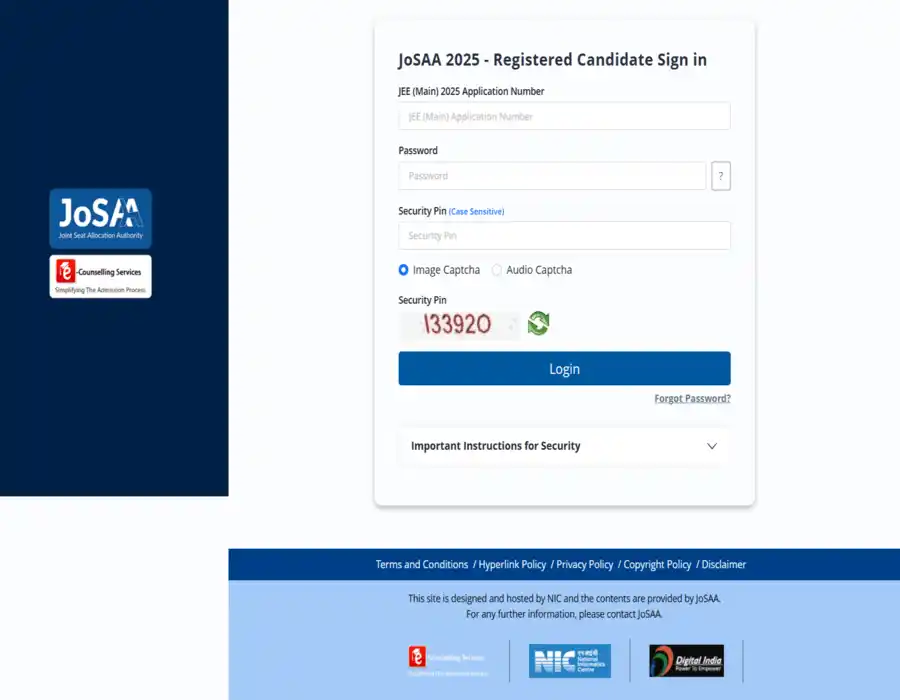
This is what the JoSAA counseling registration window looks like:
JoSAA Counseling Registration 2025
It is mandatory for candidates to register online at the official JoSAA 2025 portal to obtain seats to be allocated through JoSAA 2025 in any of these institutes – IITs, NITs, IIEST, IIITs (Triple-I-Ts) and Other-GFTIs.
Next, click on the “Online Registration and Choice Filling for JoSAA 2025” tab under the CANDIDATE ACTIVITY BOARD.
Sign up as a new user by entering your JEE (Main) 2025 Application Number or JEE (Advanced) 2025 login ID. A One Time Password (OTP) will be sent to the registered mobile number and email address of the candidate. Upon entering the OTP, the system will prompt the candidate to set a password.
Login to the JoSAA account – Login with the newly set password, and proceed to future steps such as registration, choice filling, choice freezing etc.
Choice Filling – Next, fill in choices on the online portal is FREE of cost, i.e. candidates are NOT required to pay any fee. Also, lock your choices, or else last filled choices will automatically get locked upon reaching the deadline.
Submit the form.
In the previous edition, candidates were given an 8-day window to fill-in their choices which included 2 mock seat allocations.
JoSAA Choice Filling 2025
Candidates need to mandatorily complete the JoSAA 2025 registration and choice-filling process to be considered for seat allotment.
For registration and filling-in of choices of academic programs in various Institutes, candidates must sign up as a new user in the JoSAA portal, where he/she needs to authenticate by entering the JEE (Main) 2025 Application Number or JEE (Advanced) 2025 login ID.
A One Time Password (OTP) will be sent to the registered mobile number and email address of the candidate.
Upon entering the OTP, the system will prompt the candidate to set a password. After this step, the candidate must login with the newly set password, and proceed to future steps such as registration, choice filling, choice freezing etc.
Filling-in of choices on the online portal is free of cost, i.e. candidates are NOT required to pay any fee.
A candidate may be eligible for seat allocation based on one, two, three or all four examinations, viz., JEE (Advanced) 2025, JEE (Main) 2025 B.E. / B.Tech. Paper, JEE (Main) 2025 B.Arch. Paper, and JEE (Main) 2025 B.Plan. Paper.
However, even for candidates who are eligible to participate in the Joint Seat Allocation based on any two, any three or all four of the above examinations, only ONE seat from among the choices filled-in is made available.
Hence, it is important for candidates to carefully prioritize the academic programs while filling-in the choices, while bearing in mind that only the choices filled in would be made available for seat allocation.
Candidates are given an 8-day window to fill-in their choices which includes 2 mock seat allocations.
JoSAA Counseling – How to Fill and Lock Choices
The stepwise process to choose and lock choices for JoSAA Counseling 2025 is given below.
Go to the JoSAA counseling portal
Complete the registration process
Next, log-in to the portal and fill in your preferred courses and colleges in the order of priority
Lock the choices; if you don’t lock your choices, then the last filled choices will automatically get locked once the choice filling window closes.
Basis of JoSAA Seat Allotment 2025
A seat to the highest possible choice of academic program will be allocated to the candidate considering the following factors:
Admission category opted by the candidate (SC, ST, OBC, etc.)
The position of the candidate in the respective rank list(s).
The order of preference of academic programs selected by the candidate.
The availability of seats in different seat categories / seat quotas for which the candidate is eligible.
Any other rules mentioned in JoSSA 2025 Business Rule document.
How to Check JoSAA 2025 Seat Allotment
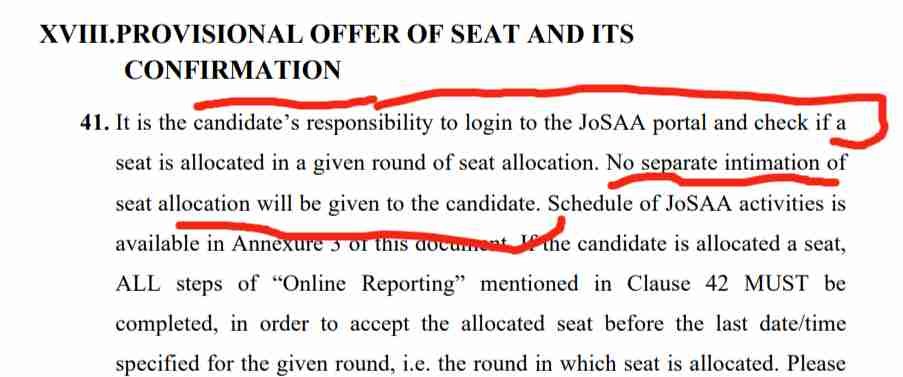
To check the seat-allotment status, the candidate needs to login to the JoSAA portal. No separate intimation of seat allocation will be given to the candidate.
Candidates who have been allotted seats will be issued the “Initial Seat Allotment Intimation Slip”
You need to download the “Initial Seat Allotment Intimation Slip” which will carry information regarding the Seat Allotment and steps to be followed for seat confirmation by the candidate.
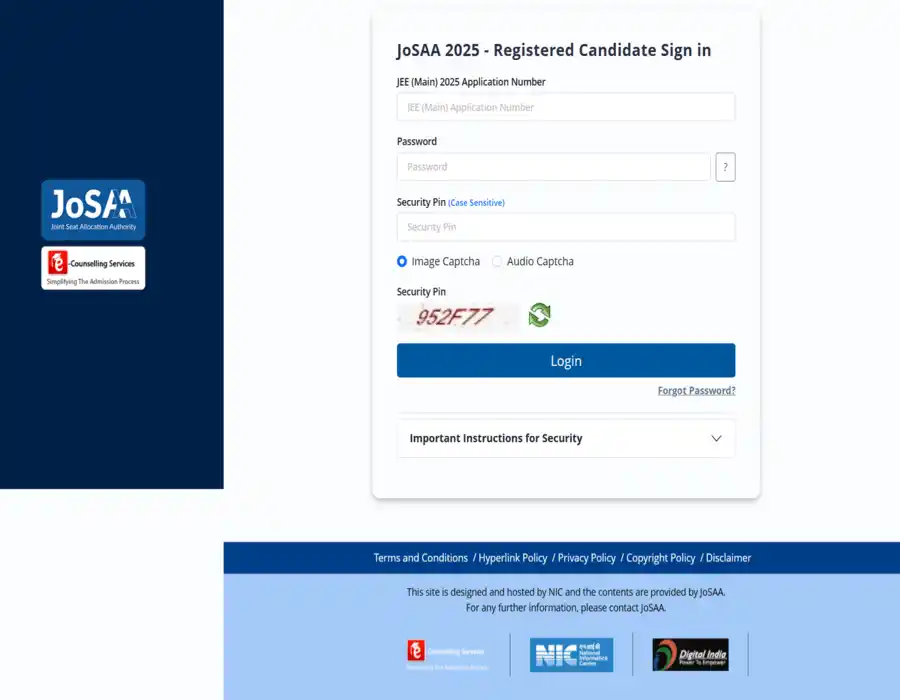
JoSAA 2025 Seat Allotment Log-in Window
Intimation about seat allotment has to be checked through JoSAA portal:
JoSAA Counseling Eligibility Criteria 2025
Candidates who satisfies one or more of the following criteria are eligible for participation in the joint seat allocation or JoSAA counseling 2025:
Parameter
Eligibility Criteria
Criterion (i)
Qualified in JEE (Advanced) 2024 for academic programs [excluding the preparatory courses] at IITs.
AND satisfies the “Performance in Class XII (or equivalent) examination*” criteria
Criterion (ii)
Qualified in JEE (Advanced) 2024 for preparatory courses at IITs
AND
satisfies the “Performance in Class XII (or equivalent) examination
Criterion (iii)
Secured a rank in JEE (Main) 2024 B.E./B.Tech. paper for B.E./B.Tech. programs at NITs, IIEST, IIITs and Other-GFTIs
AND
satisfies the “Performance in Class XII (or equivalent) examination
Criterion (iv)
Secured a rank in JEE (Main) 2024 B.Arch. Paper for B.Arch. programs at NITs, IIEST, IIITs and Other-GFTIs. AND
satisfies the “Performance in Class XII (or equivalent) examination
Criterion (v)
Secured a rank in JEE (Main) 2024 B.Plan. Paper for B.Plan. program at NITs, IIEST, IIITs and Other-GFTIs.
AND
satisfies the “Performance in Class XII (or equivalent) examination
JoSAA Counseling Eligibility Criteria 2025 – Qualifying Exam Requirement
Depending on the institute-type selected by you, the qualifying exam required may vary (refer to the table below).
Eligibility Criteria
Qualifying Examination
Admitting Institutes
JEE (Advanced) 2025
IITs
JEE (Main) 2025 B.E. / B. Tech. Paper
NITs, IIEST, IIITs (Triple-I-Ts) JEE (Main) 2024 B.Arch. / B. Plan. Paper and Other-GFTIs
JEE (Main) 2025 B.Arch. / B. Plan. Paper
JoSAA 2025 Seat Matrix and Intake Capacity
The category-wise intake for each academic program will be updated on the JoSAA 2025 online portal.
The Joint Seat Allocation Authority (JoSAA) 2025 will oversee and coordinate the centralized seat allocation process for admissions to 127 premier technical institutes for the academic year 2025-26. Admission to all the academic programs offered by these Institutes will be made through a single platform.
These participating institutes include:
23 Indian Institutes of Technology (IITs)
31 National Institutes of Technology (NITs)
IIEST Shibpur
26 Indian Institutes of Information Technology (IIITs), and
47 Other Government-Funded Technical Institutes (Other-GFTIs).
JoSAA Counseling 2025 – Seat Matrix
Category
Seats
Open
24800
Open-PwD
1217
Gen-EWS
5944
Gen-EWS-PwD
279
SC
8864
SC-PwD
462
ST
4972
ST-PwD
220
OBC-NCL
15314
OBC-NCL-PwD
781
Total Seats (includes Female Supernumerary)
62,853
Seat Capacity: 59543 Female Supernumerary: 3310
In the previous session, a total of 59,937 seats were available across all participating institutes.
The Joint Seat Allocation Authority is conducting two mock seat allotments as part of the JoSAA 2025 counseling process.
Round I Mock Seat Allotment – June 9 (2 pm)
Round II Mock Seat Allotment – June 11 (12.30 pm)
The mock seat allotment for Round I was based on the choices filled- in by candidates as on June 8, 2025, (8 pm). Meanwhile, seat allotment for Round II was based on on the choices filled- in by candidates as on June 10, 2025, (5 pm).
The candidate can use the results of the mock seat allotment to edit their choices. Note that choice filling for JoSAA 2025 counseling was open till June 12, 2025.
JoSAA Counseling 2025 – How to Check Mock Seat Allotment
JoSAA released the mock seat allotment of JoSAA 2025 counseling on June 11, 2025. The check the mock seat allotment status, follow these steps.
Go to JoSAA 2025 counseling portal
Click on “View Mock Seat Allocation-2 based on the choices filled- in by candidates as on June 10, 2025, 17:00 IST”
You will be redirected to a log-in window
Enter your JEE (Main) 2025 Application Number, Password, and the security pin
On successful log-in, you can check the JoSAA 2025 mock seat allotment status.
JoSAA Cut-off 2025
The cut-off of JoSAA 2025 is now available for the first FOUR rounds of seat allotment.
Candidates will be considered for admission to participating institutes only if they meet the the JoSAA cut-off.
Considering JoSAA counseling is conducted in multiple rounds, if a candidates doesn’t meet the cut-off for a specific round, they may be considered in subsequent rounds (if available). However, if the candidate fails to meet the cut-off for the last round of seat allotment, they are effectively out of the JoSAA admission process.
The Staff Selection Commission (SSC) Selection Post Phase 13 exam gets more mired in controversy as the police lathicharged teachers and students protesting the various anomalies in the conduct of the exam.
The SSC exams are amongst the most competitive entrance exams in the country with more than 2 million aspirants. The exams are conducted to recruit candidates for various Group B (non-gazetted) and Group C (non-technical) posts in government organizations, including ministries. Popular exams conducted by the SSC include SSC CGL, SSC MTS, SSC CHSL, etc.
What are students protesting about?
Allotment of wrong exam centers – Many students claim they have been allotted SSC exam centers they have not opted for when filling out the SSC application form. For instance, one visually impaired student from J&K claimed that he was allotted an exam center in Delhi. In another case, a student from Delhi found himself allotted an exam center in Andaman Nicobar.
Last minute cancellations of exams – Many students after travelling far from their homes found on the exam-day, and much to their chagrin, that the exam has been cancelled indefinitely.
Errored ridden question paper – Then there are also allegations that there were mistakes in how questions were framed. Some students even claim that parts of the questions were missing in some question papers.
Same questions from previous year repeated – Another allegation is that questions from previous years’ SSC exam were repeated word-for-word.
Technical glitches – Then in many cases students found the computer system to be unresponsive, or the mouse won’t work. With little help around, it is an open question whether such glitches were deliberate or pure negligence.
Unhelpful exam officials – When students approached exam officials with their grudges, there was little to no help. On the contrary, as in some cases bouncers were used to intimidate students into silence.
Blacklisted vendors – Another major allegation is enlisting blacklisted vendors to conduct the SSC exam.
Exam body say no blacklisted vendors used
Responding to criticisms, the exam conducting body has made a clarification stating that no blacklisted agency was given the task of conducting the SSC exam.
SSC Chairman S Gopalakrishnan also defended the conduct of the examinations and centre allocation process.
“This is the first time we have changed agencies, and hence some students faced issues. Some had to travel far because larger centres are not available in every city, while some cities only have smaller centres. We will resolve this in future exams. Secondly, in two locations, the exam was cancelled due to a security lapse. However, we re-conducted the test at those locations on the same day,” he explained.
The SSC Selection Post Phase 13 recruitment exam has got mired in a major controversy over the conduct of the exam and allotment of exam centers. Protests have erupted all across the country, with “Delhi Chalo” cry becoming a rallying point as students demand accountability and reform in the examination process.
The SSC Selection exam was slated to conclude on August 1; it started on July 24, 2025.
Students alleged that there were a number of issues faced by candidates during the exam, like computer crash, unresponsive systems, biometric verification failure, allotment of incorrect and far-flung exam centers, etc.
Many candidates claim that they came to know about the cancellation of exams after travelling as far as 500 kms from their homes. Then there are instances where candidates were allotted exam centers where the ground floor has been used as a cattle-shed.
But the most outrageous claim is the use of bouncers at exam halls to ensure students aren’t able to raise their voice against such mismanagement. In fact, if the use of bouncers is true, it will mark an outrageous affront to the education and examination system in the county.
It is important that the central government takes immediate cognizance of the situation and tries to find a working and permanent solution.
Teachers get into the Act
The emerging situation has also alarmed the teaching community who have now joined the cause of the students demanding answers and reforms to the existing system.
There are claims of blacklisted agencies being given the task of administering the exam.
Teachers were also concerned that the there were so many technical glitches during the exam, that admit cards were not released even two days before the exam, and then making students travel to far-flung regions, only to cancel the exams at the last minute.
There are broadly FOUR types of education boards in India that regulate, determine examination standards, and conduct board exams. These are 1) national boards (like CBSE and NIOS), 2) private national boards, like CISCE, 3) State boards, like UP Board, and 4) international national boards.
The education boards typically conduct Class 10 (secondary) and Class 12 (higher secondary) exams.
The CBSE is the most popular national education board in the country, with more than 29,000 schools affiliated to it.
On the other hand, NIOS is extremely popular among students who can’t afford regular classes. There are currently around 2.7 million students enrolled in NIOS affiliated schools. NIOS allows makes available a number of courses/programs of study through open and distance learning (ODL) mode.
Table of Contents
Types of Education Boards in India
There are FOUR types of School Education Boards in India:
National Boards
Private National Boards
State Boards
International National Boards
Here we discuss each board in detail. So, keep reading!
National Education Boards in India
There are two categories of national boards in India.
The full form of CBSE is the Central Board of Secondary Education. It is a national-level board that is managed and controlled by the Union Government. Both public and private schools are affiliated to the CBSE.
The CBSE currently conducts the CBSE Class 10 and CBSE Class 12 exams across the country and abroad.
There is no upper age limit for admission. However, the minimum age for enrolment is 14 years for the Secondary course and 15 years for the Senior Secondary.
Enrollment
NIOS is the largest Open Schooling system in the world with cumulative enrolment of 23.56 lakhs (during last 5 years)
Admission Numbers
More than 5.92 lakh learners were admitted during 2023-24 in various courses of NIOS
Regional Centers
20
Study Centres (AIs/AVIs)
11000
Mode of education
NIOS imparts education through Open and Distance Learning (ODL) mode using a mix of self-instructional print material, audio and video program supported by Personal Contact Program (PCP)
3530 This include 26 AI in U.A.E, Nepal, Kuwait, Qatar, Muscat and Kingdom of Bahrain
Vocational (AVIs)
1379
Open Basic Education (OBE) (AAs)
1313
The Study Centres are known as Accredited Institutions (AIs) for Academic Courses, Accredited Vocational Institutions (AVIs) for Vocational Education Courses and Accredited Agencies (AAs) for Open Basic Education (OBE) courses.
Student Enrollment
Enrollment Type
Total Percentage
Secondary
46%
Senior Secondary
49%
Vocational
5%
Cumulative Enrolment
2.71 million
Courses Offered
Open Basic Education (OBE) (A level, B level, C level equivalent to Class III, V, VIII respectively of formal Education) courses are offered through Accredited Agencies (AAs).
Secondary – leading to Secondary School Certificate.
Sr. Secondary – leading to Senior Secondary School Certificate.
Open Vocational Education.
Life Enrichment Programmes.
Study Material
Printed Self Instructional study materials supported by Audio- Video programmes. A half yearly Magazine “Open Learning” is also provided to the learners.
School Boards under the Department of Higher Education, GoI
Maharshi Sandipani Rashtriya Veda Sanskrit Shiksha Board, Ujjain
CISCE has been mentioned in Delhi School Education Act 1973 as a body conducting Public Examination in NCT of Delhi. For functioning out of NCT of Delhi, CISCE has taken / has to take approval / NOC from the concerned State/UT Government for functioning in their jurisdiction.
The Council for the Indian School Certificate Examinations (CISCE) is a non-governmental, privately owned national-level education board in India responsible for administering the Indian Certificate of Secondary Education (ICSE) examination for Class X and the Indian School Certificate (ISC) for Class XII.
The CISCE has more than 2750 affiliated schools spread across every State and Union Territory in India and in five countries overseas.
English is the language of instruction in CISCE affiliated schools.
The CISCE conducts the following THREE examinations:
ICSE – The Indian Certificate of Secondary Education (ICSE –Class X)
ISC – The Indian School Certificate (ISC – ClassXII)
CVE – The Certificate of Vocational Education (CVE – Year 12)
Note that the subject choices and syllabus prescribed for the exams are varied and are aimed at nurturing the unique abilities and gifts of the student.
International Boards
International and foreign boards are permitted by the appropriate authority to function in India, unless deemed ineligible based on existing laws, rules, norms, or directives of the appropriate government at any subsequent date. The qualifications granted by these boards must have been recognized as equivalent by the authority designated by the Ministry of Education, Government of India, for this specific purpose.
International Baccalaureate (IB)
Cambridge International Examinations (CIE)
French Baccalaureate (FB)
Canadian Board
State Education Boards
Besides the three National Education Boards in India, most states have their own boards. Some of the state boards are listed here:
NIFT City Intimation Slip 2026 – NTA will release the NIFT 2026 city intimation slip around the last week of January 2026. The direct link to download the city intimation will be given below.
Use your application number and date of birth to download the slip.
The city intimation slip is primarily meant to notify candidates the NIFT 2026 exam city they have been allocated. However, it will also contain details like exam date, city, state, application number, name of the applied program, etc.
If the candidate is allocated a city outside of the options they have selected, they must apply for a correction.
Importantly, the intimation slip is not the admit card. Candidates will not be allowed to sit in the NIFT 2026 exam if they don’t bring the admit card. The NIFT 2026 admit card will be released around the 1st week of February 2026. Note that the admit card is typically released after the city slip.
Keep reading to learn the full details of the NIFT City Intimation Slip 2026.
Table of Contents
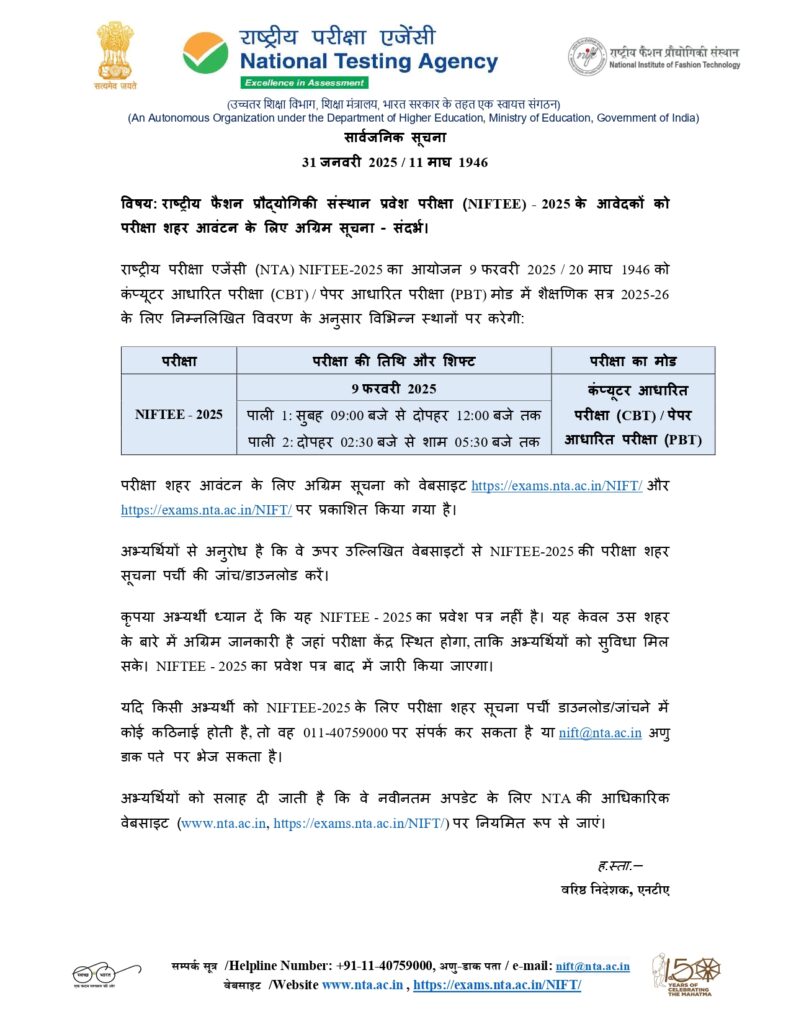
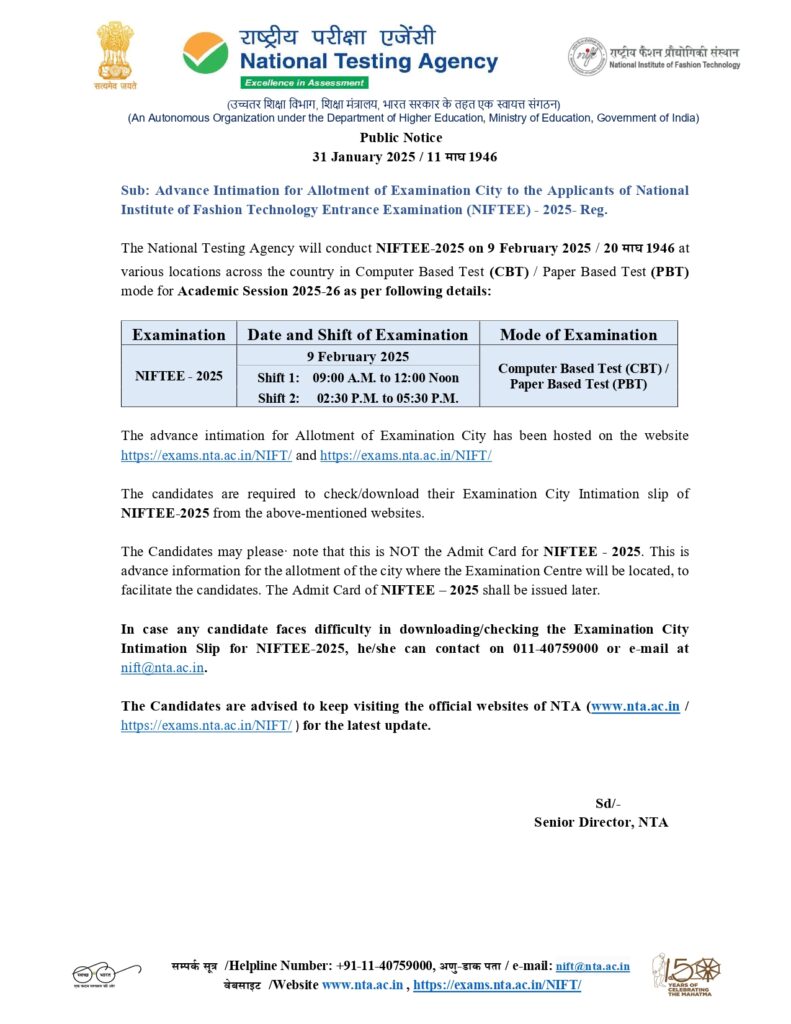
Public Notice for City Intimation for NIFT Entrance Examination
This is the public notice about the release of NIFT 2025 city intimation slip.
When will the NIFT 2026 exam be conducted?
NTA will likely conduct the NIFT 2026 exam in the 2nd week of February 2026.
The exam will be administered in 81 cities. The name of the NIFT 2026 exam center allocated to the candidate will be mentioned on the admit card.
On the day of the exam, the candidate must bring the NIFT 2026 admit card and a valid photo ID proof.
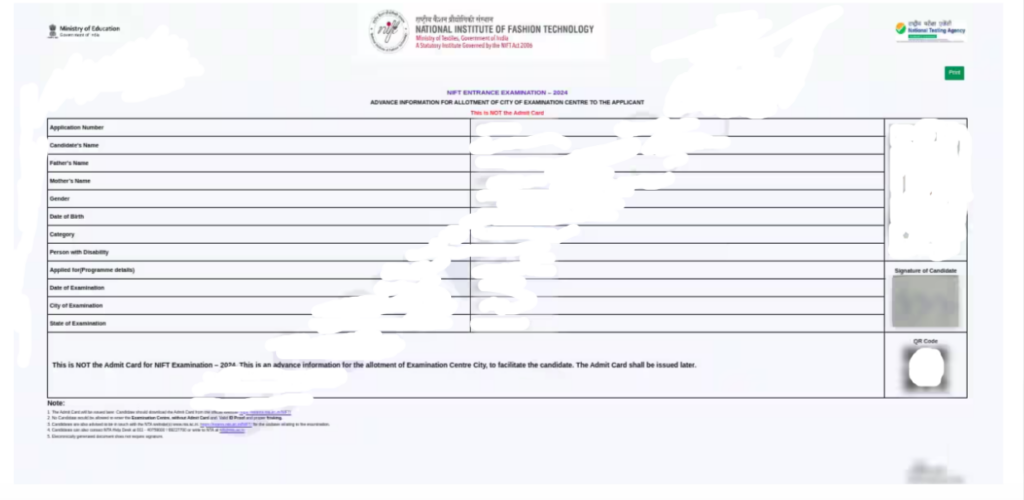
Details included in the NIFT 2026 City Intimation Slip
The city intimation slip will be released a few days before the release of the NIFT 2026 admit card. The city slip will contain the following information.
The name of the candidate
Application Number
Father’s name
Mother’s name
Gender
Date of Birth
Category
PwD status
The name of the program applied for admission to (B.Des, M.Des, etc.)
Date of Examination
City of Examination
State of Examination
PHOTOGRAPH
Signature
QR Code
Sample NIFT City Intimation Slip
A sample intimation slip for the NIFT exam is given below for reference.
NIFT Admit Card vs NIFT City Intimation Slip
The basic differences between the NIFT 2026 admit card and the city intimation slip are explained in detail below.
Particulars
NIFT Admit Card 2026
NIFT City Intimation Slip
Purpose
It is a mandatory document for appearing in the NIFT 2026 exam.
The intimation slip is not required nor will be accepted as an entry pass.
The intimation slip is merely intended to inform the candidate about the exam city they have been allocated.
Details mentioned
In addition to the name of the exam city and exam date, the admit card will also contain the following information:
NIFT 2026 Roll number Exam center reporting time Exam Timings Photograph Personal details like name, gender, DOB, etc. Application number Program applied for admission Exam-day guidelines
The city intimation slip will contain the following information.
Exam CITY Exam State Photograph Application number Program applied for admission Personal details like name, gender, DOB, etc.
The intimation slip will not contain the NIFT 2026 roll number. It will also not contain any exam-day guidelines.
Required on exam day
Yes, you need to carry a printout of the admit card with you.Without the admit card, you won’t be allowed to take the exam.
No.The intimation slip is merely meant to inform you about the exam city you have been allocated. It has no use beyond that.
Required post exam
Yes, the admit card (stamped and duly signed at the exam centre) will be required even after the exam is over. So, make sure that you don’t lose it.
The city intimation slip is not required post-exam.
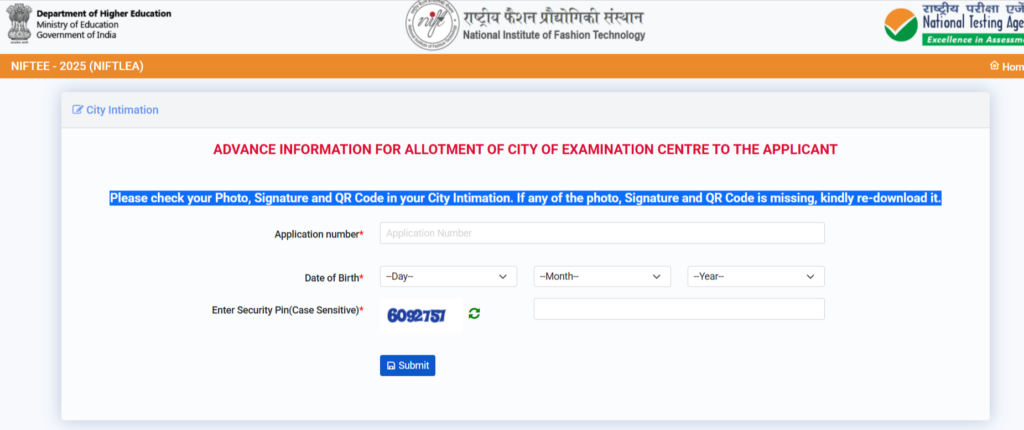
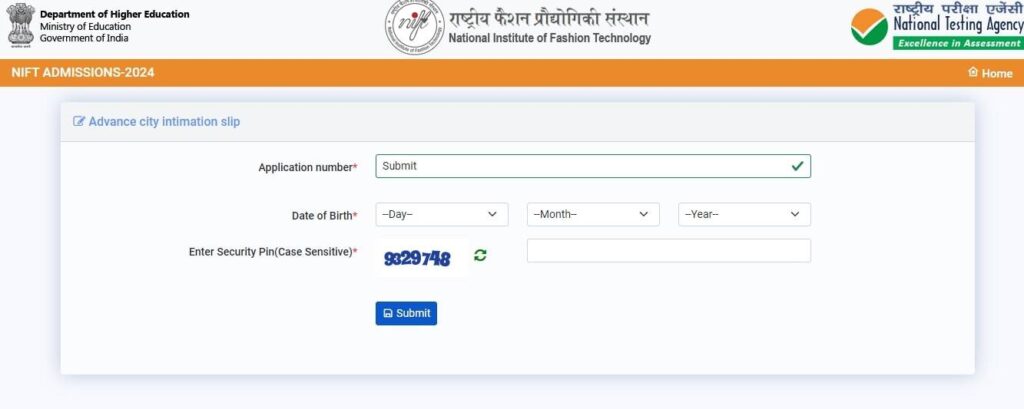
NIFT City Intimation Slip 2026 Log-in Window
This is what the NIFT 2026 intimation slip log-in window looks like:
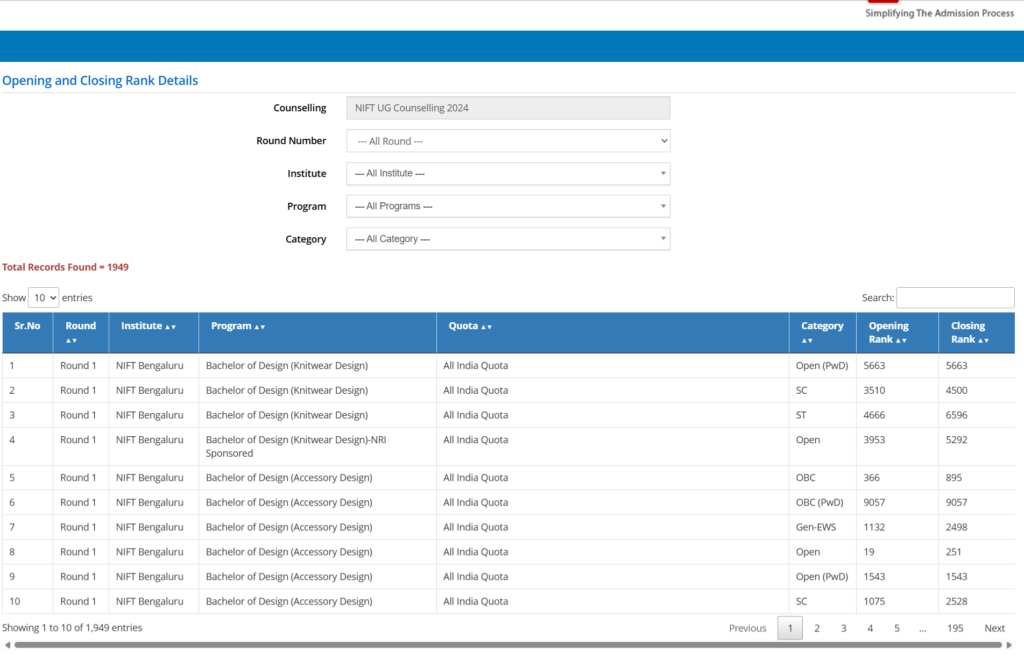
NIFT Cut-off 2025 – The National Institute of Fashion Technology (NIFT) has released the institute-wise NIFT 2025 cut-off for Round 1 and 2. The cut-offs have been released online at nift.admissions.nic.in.
To download the NIF cut-off, go to nift.admissions.nic.in, and click on eServices section under the Menu, and then click on OR-CR.
OR-CR stands for Opening Rank and Closing Rank.
The direct link to download the cut-offs will also be provided here. The cut-offs will be available for all the rounds of seat allotment. Candidates who meet the cut-off for a round will be considered for admission in that round.
Keep reading to learn more about NIFT 2025 cut-off, including previous years’ cut-off details, factors that determine cut-off, and much more.
Here are a few ready reckoners about the NIFT cut-off that you must beware of. So, read on.
The cutoff will be released during the counseling and seat allotment process. The cut-offs will be released online at nift.ac.in/admission. The link to download the institute-wise cut-offs will be provided here.
The cut-offs will be released in the form of opening and closing ranks (OR-CR)
Also, the cut-off will be released for each round of seat allotment and will be category-specific.
Candidates who meet the cut-off for a seat allotment round will be eligible for admission in that round.
Candidates who don’t meet the cut-off in an earlier round will be considered for admission in subsequent rounds provided they meet the relevant cut-off.
If the candidate fails to meet the cut-off for the last round of allotment, then they are effectively out of the admission process.
To prepare the cut-off, factors like total number of applicants, NIFT 2025 merit rank of applicants, admission category, seat intake, etc., will be considered. If any of these factors change, the cut-off would also change.
Note that all of the above factors are variable. So, if we change any of these factors, the cut-off will also change.
For instance, if the number of applicants go up, the cut-off would also increase likewise.
What is a good score in NIFT?
Candidates appearing in NIFT exam frequently wonder – what is a good NIFT score?
A score that will get them admission to their dream institute.
Here are answers to that question:
The cut-off or good score will depend on the institute you are targeting.
If you plan to get admission to a top NIFT, say NIFT Bangalore, you need to have a very good score.
On the other hand, a not-so-good ranking may suffice to get admission to one of the lower-ranked NIFTs
Again, your category will also determine the score. For instance, if you belong to the Open category, you will need a much higher score. On the other hand, those from SC and ST categories are in with a chance even with a low NIFT score.
So, when talking of a good score in NIFT, we will have to consider all these factors.
The table below can be used as a reference to understand what is a good score in NIFT.
Program
NIFT Common Merit Rank (CMR) – Range
Shortlisted Candidates
Bachelor of Design (B.Des)
51-317
80
319-619
90
620-825
90
828-1098
90
1104-1328
80
1331-1605
90
1612-1874
90
1882-2127
90
2128-2440
80
2443-2741
90
2747-3132
90
3133-3628
90
3629-4100
80
4110-4714
90
4715-5543
90
5448-6739
90
6744-8150
100
8161-9875
100
9883-11605
100
11658-14378
86
B.F.Tech- Apparel Production
11-275
40
276-929
89
M.F.Tech
88-100
3
Master of Design (M.Des)
24-525
91
Master of Fashion Management (MFM)
24-352
80
353-814
90
816-1310
81
NIFT 2025 Cutoff – Opening and Closing ranks
The National Institute of Fashion Technology (NIFT) will release the NIFT cut-off 2025 for the participating colleges at the time of NIFT 2025 counseling and seat allotment.
In the meantime, candidates can go through the previous years’ NIFT cut-off.
NIFT Counselling 2025 – The National Institute of Fashion Technology (NIFT) will declare NIFTEE 2025 seat allotment for Round III on July 28, 2025. Candidates who are allotted seats need to submit willingness and pay the admission fee by July 29, 2025 (12 midnight).
The choice filling & modifications for Round III was allowed from July 24-25, 2025. Document verification was allowed till 8 pm, July 23, 2025. Corrections in application form was allowed till 5 pm (July 23).
During choice filling, candidates must enter choices in the order of priority. NIFT 2025 seat allotment will be based on factors like NIFT 2025 merit rank and choices opted. The NIFT counseling 2025 registration fee is INR 9,300. Candidates were shortlisted for counseling based on NIFTEE 2025 results.
The online registration for NIFT 2025 counseling was open from June 24- July 1, 2025.
NIFT 2025 seat allotment has FOUR regular and one SPOT round.
NIFT 2025 seat acceptance fee is INR 1,83, 200. If the fee is not paid within the given deadline, the allotment will be cancelled and allotted to the candidate next in the order of merit.
Document Verification (who have made thecorrections)
12/07/2025 to 12/07/2025 (8:00 PM)
Choice Filling/Modifications
14/07/2025 to 16/07/2025 (12:00 Midnight)
Seat Allotment
18-07-2025
Willingness Submission and Admission Fee Payment
18/07/2025 to 21/07/2025 (12:00 Midnight)
Withdrawal
18/07/2025 to 21/07/2025 (12:00 Midnight)
Round 3
Correction in Application Form
23/07/2025 to 23/07/2025 (5:00 PM)
Document Verification (who have made thecorrections)
23/07/2025 to 23/07/2025 (8:00 PM)
Choice Filling/Modifications
24/07/2025 to 25/07/2025 (12:00 Midnight)
Seat Allotment
28-07-2025
Willingness Submission and Admission Fee Payment
28/07/2025 to 29/07/2025 (12:00 Midnight)
Withdrawal
28/07/2025 to 29/07/2025 (12:00 Midnight)
PHYSICAL REPORTING OF CANDIDATES: 30th July, 2025
Spot Round
Registration and Participation Fee Payment
01/08/2025 to 04/08/2025 (12:00 Midnight)
Document Verification of New Registered Candidates
01/08/2025 to 05/08/2025 (6:00 PM)
Choice Filling/Modifications and Locking
01/08/2025 to 06/08/2025 (12:00 Midnight)
Seat Allotment
08-08-2025
Admission Fee Payment
08/08/2025 to 10/08/2025 (12:00 Midnight)
Physical reporting at allotted institute
11th August, 2025
NIFT Counseling 2025 – Document Required To Participate
The candidate will need the following documents to participate in the NIFT 2025 counseling process.
Document Type
Description
Qualifying examination
12th class/ degree (marks Sheet and Certificate)
Note: PG candidates must upload mark sheets and certificates of the qualifying degree examination.
If the candidate has appeared in the final semester/ final year exam, then they must upload mark sheets of all previous semesters/years.
The candidate has appeared for the qualifying exam/compartment (of final year/semester) and the result is due.
The date sheet /admit card for the examination has to be brought.
Birth Certificate
10+2 mark sheet/certificate. Original and Photocopies.
Category Certificate
Candidates applying under reserved categories must produce documents as per the GOI format and issued by a competent authority
In the case of OBC-NCL and GEN-EWS categories, the certificate must be issued on or after April 1, 2021
Basis of funding of the tuition fee
Certificate of the parent’s income e.g. Income Tax Return, Salary Certificate, etc.
Medical Fitness certificate
To be signed by a Registered Medical Practitioner in the prescribed format in original.
Provisional Admission
Affidavit on non-judicial stamp paper of INR.10/- for seeking provisional admission only in case, the result of qualifying examination is yet to be declared (in the format at Annexure-I)
Size and format of documents to be uploaded
Documents should be in jpeg, jpg, or pdf format. Size = 100 kb – 500 KB
The National Institute of Fashion Technology will conduct centralized counseling for the 19 participating colleges of NIFT 2025.
The counseling and seat allotment process will be conducted online.
Step-wise NIFT counseling process 2025
Register – The candidate will have to get registered using their NIFT 2025 scorecard details. Also, pay the counseling registration fee of INR 9,300.
Fill in Choices – The candidate has to next fill in campus choices. The entries must be in the order of priority.
Upload documents – The candidate will have to next upload documents to complete the registration process.
SEAT Allotment – Based on choices entered by the candidate, seats available, and NIFT 2025 merit rank, allotment of seats will be made.
Seat Acceptance and Payment of Fees – To confirm their seats, the candidate will have to pay the NIFT 2025 seat acceptance fee. Note that if the candidate doesn’t make the payment within the given deadline, the allotment will be cancelled. Further, the seat that has been vacated as a result will be allocated to the candidate next in the order of merit. The seat-acceptance fee of INR 1,83,200 has to be paid online through the Admission Portal only.
Get documents and fee verified – Next, complete the document verification process.
Issue of Seat Allotment Letter – Once the process is complete, the candidate will be issued NIFT 2025 seat-allotment letter.
Log-in to the candidate portal using your NIFT 2025 roll number and password
On successful log-in, you can check the NIFT 2025 seat allotment result
Download the NIFT 2025 Provisional Seat Allotment Letter
To confirm the seat, you will have to submit willingness and pay the seat-acceptance fee online through the NIC portal. Candidates who are not allotted a seat in Round 1 or 2 will be automatically considered in subsequent rounds, if registered.
Newly registered candidates will pay the participation / registration fee of Rs. 5000 before choice filling.
Candidate who have already paid seat acceptance fee and not withdrawn in any previous rounds are exempted from the registration fee of Rs 5000.
Registration fee/Participation Fee of Rs. 5000/- is non-refundable.
NIFT Counseling 2025: Seat Withdrawal and Refund Policy
S.No
Particulars
Amount Refunded
1
If Seat /Admission not taken after registration
Full seat acceptance fee
2
Withdrawal requests after confirmation of seat requests received online on the portal until before the commencement of the last round of counselling. No physical request will be entertained
Full fee except for registration fee of INR. 9,300.
3
After the commencement of the last round of counselling
CBSE 12th Board Exams 2024 – The Central Board of Secondary Education (CBSE) conducted the supplementary exam of CBSE 12th Board exam on July 15. The supplementary date sheet has been released online at cbse.gov.in/cbsenew/cbse.html.
The exam was conducted in a pen-and-paper format.
The practical exams were conducted from July 10-15, 2025
CBSE 12th Board admit card 2025 for the supplementary exam will be before the exam. Students need to collect the admit card 2025 from the schools. If the candidate failed to showcase the admit card, he or she was not be allowed to write the exam.
Earlier, the results of the CBSE 12th board exams 2025 were declared on May 13, 2025. The results were released online at cbse.gov.in, cbse.nic.in. The exams were conducted from February 15 to April 2025.
Candidates appearing in the CBSE 2025 exam for class X and XII need to follow the update syllabus. The updated syllabus contains the chapters and topics from which questions will be asked in the exams. Students also need to refer to the CBSE 12th exam pattern 2025 to get familiar with the marking scheme, types of questions asked, test duration etc.
To prepare for the CBSE 2025 exam, solve CBSE 12th practice questions and CBSE Class 12 Sample Papers 2024-25 and previous years question papers. This will not only provide inputs like exam difficulty level, weightage, types of questions asked, but also help improve one’s problem solving ability.
Latest Updates:
To download the CBSE Board 12th Exam Supplementary Date Sheet – Click Here
The Central Board of Secondary Education conducts the CBSE Class 12 exams every year for students studying in Class 12.
Students who have passed their Class 11 exams from a recognized institute and have studied for a year in Class 12 are eligible to appear in the CBSE 10+2 board exams.
CBSE releases the CBSE 12th Syllabus and Exam Pattern on its official syllabus at the start of the session.
Central Board of Secondary Education Class 12th Examination
Conducting Body
Central Board of Secondary Education
Frequency of Conduct
Annually
Exam Level
Matriculate
Mode of Exam
Offline-based exam
Test Duration
3 hours
What’s new in CBSE Class 12 exam?
No percentage of marks, overall division, distinction or aggregate marks will be released with CBSE Result 2025
The CBSE will not release percentage of marks nor announce overall distinction, division or aggregate marks in the CBSE Class 10+2 results.
Answer sheets not to be made available for Accountancy paper
Commerce students appearing in the CBSE 2025 class XII exam may note that separate answer sheets with printed tables will not be released for the Accountancy paper.
Special CBSE Board 2025 exams for students participating in sports events, Olympiad
CBSE will conduct special exams for students participating in international olympiads and sports events (recognized by sports bodies SAI, BCCI, and HBCSE) and thereby unable to appear for regular CBSE 12th board exams.
However, no separate or special CBSE 2025 examination opportunity will be available for the compartment and practical exams. The Board has taken this decision to promote sports and other educational competitions among the youths.
Exam pattern modified
The CBSE Class 12 Board exam pattern has been revised. The paper will now include 40 percent objective-type questions and the weightage of short and long-answer-type questions will be reduced. The paper will now include a higher percentage of MCQs questions.
100% syllabus to be covered
Questions in the CBSE 2025 Class 12 exams will be based 100% on the official syllabus.
TJEE Syllabus 2026 – The Tripura Board of Joint Entrance Examination (TBJEE) will release the official syllabus of TJEE 2026.
The syllabus will be released online at tbjee.nic.in.
The TJEE 2026 syllabus will be released for all four subjects – Physics, Chemistry, Mathematics, and Biology. The syllabus for each subject is divided into 10 Modules.
The questions of the TJEE 2026 exam will be framed on the basis of the syllabus. So, it is important for the candidate to consult the official TJEE syllabus to prepare for the exam. Also, along with the syllabus refer to the TJEE 2026 exam pattern to get insights into the types of questions asked, marking scheme, test duration, etc.
TJEE is one of the most important engineering entrance exams in the state of Tripura. So, it is very competitive.
Meanwhile, the extent of the TJEE syllabus makes it also quite difficult.
To effectively prepare for the exam and complete the TJEE syllabus on time, it is important to start one’s exam preparation early.
The candidate can divide the syllabus into categories – easy, moderate, and difficult. This will allow the candidate to pay special attention to the difficult topics.
Also, there are some topics that will carry more weightage than others. These topics are to be specially prepared.
TJEE Exam Pattern 2026
The candidate must consult the TJEE 2026 exam pattern to understand the question paper structure, like the types of questions asked, marking scheme, subject combination, test duration, mode of the exam, etc.
The TJEE syllabus for each subject is divided into 10 Modules.
There will be 30 (Thirty) compulsory MCQs, taking 3 (Three) questions from each module for the subject Physics, Chemistry, Mathematics and Biology.
How to prepare for TJEE 2026
The candidate may follow the following tips to prepare for the TJEE exam.
Get familiar with the TJEE syllabus and pattern – This will help the candidate align their preparation with the requirements of the exam.
START early – If you start your preparation early, you will be able to complete the syllabus on time. Also, with enough time on hand, if there are some difficulties down the road, you will have the elbow room to get it fixed and keep your exam preparation on track.
Take notes during study – The candidate can this way jot down all the important points, which can be handy for quick revision. Also, if you make it a habit to take notes, it can help you stay focused and engaged when you are studying.
Do timely revision – Periodic and timely revision will keep you on top of your preparation. On the other hand, if you don’t revise a topic for too long, you may have to put in a lot of effort to learn the topic the second time around.
Solve sample papers – There is no better way to evaluate your progress than by solving TJEE sample papers. Further, the more sample papers you solve, the better you will get at time-management and problem-solving.
Take mock tests – You may take mocks closer to the exam, say a week or two before the exam, to align your body clock and fix last minute glitches.