The WBJEE 2026 application form is expected to be released soon on the official portal wbjeeb.nic.in; West Bengal Joint Entrance Examinations Board (WBJEEB) is yet to announce exact dates.
The window for registration is likely to open in January 2026, possibly in the third week of the month, though the official notification is still awaited. The WBJEE 2026 exam date has also not been declared yet, but based on trends, it is expected to be conducted in the fourth week of April 2026.
The exam will be conducted in offline, pen-and-paper mode across various test centres in West Bengal and select cities.
WBJEE is a state-level engineering entrance test held annually for admission to undergraduate courses in Engineering & Technology, Pharmacy and Architecture offered by universities, government and private institutes in West Bengal. It serves as the gateway to BTech, BPharm, and related programmes with seat allocations based on rank and counselling.
Latest Updates:
WBJEE 2026 application form OUT Soon
To visit WBJEE 2026 registration and exam portal – Click Here
How to Register for WBJEE 2026
Registration for WBJEE 2026 will be fully online. Once the official form is live at wbjeeb.nic.in/wbjee, candidates will need to:
Open the WBJEE 2026 application page on the official website.
Complete the New Registration by entering basic personal details and creating login credentials.
Log in with the generated application number and password.
Fill in academic, personal and contact information.
Choose your preferred exam centres from the options provided.
Upload scanned documents (photograph, signature).
Pay the application fee and submit the form.
No offline mode is available; only online submissions are accepted.
Documents Required to Register for WBJEE 2026
Candidates are advised to keep the following documents ready before beginning the application:
Class 10th and 12th mark sheets
Valid mobile number and email ID for communication and login alerts
Scanned passport-size photograph (as per specifications)
Scanned signature
Debit/credit card or net-banking credentials for fee payment
Exact file sizes and format instructions will be available in the official PDF when the form is released.
WBJEE 2026 Application Fee
The category-wise WBJEE 2026 application fee structure based on previous patterns is given below:
Category
Application Fee
General Male
₹500
General Female & Reserved Male (SC/ST/OBC-A/OBC-B/EWS/TFW)
₹400
All Female & Third Gender General
₹300
Third Gender Reserved
₹200
WBJEE 2026 Application Correction
The correction window will open after form submission, where candidates can edit certain details. Typically, this may include modification of category, income status, religion, Aadhaar number, and uploaded images.
Details like name, date of birth, or parents’ names usually cannot be changed once submitted, so it’s important to enter accurate information initially.
WBJEE 2026 Exam Centres
While the exact list of WBJEE 2026 exam centres is not yet published, WBJEE is historically conducted at dozens of centres across West Bengal and other cities, allowing candidates to choose three preferred locations during application. Centre allotment is based on availability and preferences entered in the form.
WBJEE 2026 Exam Pattern
WBJEE traditionally follows an offline, pen-and-paper format with multiple-choice questions (MCQs) divided into subjects such as Mathematics, Physics and Chemistry.
The exam typically runs in a single day but in two sessions, and questions have both single and multiple correct answers with negative marking applicable.
The full details on pattern and marking will be available in the official notification and syllabus booklet once released.
Why is WBJEE Conducted?
The WBJEE exam is the principal entrance test for admission into undergraduate engineering and allied programmes at universities and colleges in West Bengal, such as:
B.Tech in Engineering & Technology
B.Pharm in Pharmacy
Architecture related courses
It also plays a key role in seat allocation through state counselling after results, making it essential for applicants seeking quality technical education in the region.
The GATE 2026 admit card is expected to be released soon on the official website gate2026.iitg.ac.in, with the organising institute, IIT Guwahati, yet to confirm the revised date. The hall ticket release was originally scheduled for early January, so candidates are advised to keep checking the Graduate Aptitude Test in Engineering (GATE) portal for the official announcement.
Once released, candidates can download the admit card through the GOAPS login using their enrolment ID and password. The admit card is a mandatory document for entry to the examination hall and will contain details such as exam date, shift timing, test centre address and candidate information.
The GATE 2026 exam will be conducted on February 7, 8, 14 and 15, 2026, in TWO shifts each day – forenoon and afternoon. The exam will be held across hundreds of canters spread over multiple cities in India, with the exact exam center and reporting time mentioned on each candidate’s admit card.
After the link is activated, candidates can access their hall ticket by visiting the official GATE 2026 website and logging in to GOAPS. On successful login, the admit card will be available for download in PDF format.
The step-wise process to download the GATE admit card 2026 is given below.
Visit the official GATE 2026 portal: gate2026.iitg.ac.in
Click the “GATE 2026 Admit Card” link once it is active.
Log in using your Enrollment ID and password.
View and download the hall ticket PDF.
Save it and print a hard copy for exam day.
Make sure your login details are ready beforehand to avoid delays once the link is live.
Candidates are advised to save a copy and take a clear printout, as digital copies will not be accepted at the exam centre.
Details mentioned on the admit card
The GATE 2026 admit card will include essential information required on the exam day, including the candidate’s name, photograph and signature, enrolment ID, paper code, exam date and shift, and the complete address of the allotted test centre. It will also carry important instructions that candidates must follow on the day of the examination.
Candidates are advised to carefully verify all details printed on the hall ticket immediately after downloading it.
What to do in case of discrepancies in GATE admit card?
In case of any discrepancy – such as errors in personal details, paper code, exam date, shift or test centre – candidates must contact the concerned GATE zonal office immediately through the official communication channels provided on the website. Requests for correction should be raised well before the exam date, as candidates with incorrect details on the admit card may face issues during entry at the exam centre.
If you notice errors in your personal details, paper code, exam date/shift, or test centre address after downloading the admit card:
Immediately contact your GATE zonal office (details available on the official portal).
Request a correction well before your exam date.
Keep copies of your application confirmation and documents handy to support the correction request.
Discrepancies should be resolved before the exam day to avoid barring entry at the exam centre.
Exam-day guidelines candidates must follow
Exam Dates: February 7, 8, 14, and 15, 2026
Shifts:
Forenoon: 9:30 AM – 12:30 PM
Afternoon: 2:30 PM – 5:30 PM
According to the official instructions, candidates must report to the exam centre well in advance of the reporting time mentioned on the admit card. Entry to the test hall will close before the commencement of the examination, and late arrivals may not be permitted.
Candidates must carry:
A printed copy of the GATE 2026 admit card
A valid original photo ID proof issued by the government
Electronic gadgets such as mobile phones, smart watches, calculators and other prohibited items will not be allowed inside the examination hall. All candidates must strictly adhere to the instructions mentioned on the admit card and displayed at the test centre.
Other guidelines:
Arrive early — reach the test centre at least 1 hour before reporting time.
Pen/pencil – For scratch work on the scribble pad.
Do not carry prohibited items (electronic devices, calculators, mobile phones, smart watches) inside the test hall.
What happens after the GATE 2026 exam
After the conclusion of the examination, the GATE 2026 answer key is expected to be released a few days after the exam sessions. Candidates will be allowed to raise objections within the specified window. The GATE 2026 result is scheduled to be declared in March 2026, following which scorecards will be made available for download.
The GATE score will be used for MTech and PhD admissions as well as recruitment by PSUs, and will remain valid for three years from the date of result declaration.
NEET Application Form2026 is expected to START soon. The direct link to fill out the form will be given here.
The National Testing Agency (NTA) issued an advisory on January 5, 2026, asking aspirants to ensure that their Aadhaar card, UDID card, and category certificates are updated before applying online for NEET UG 2026. So, it is anticipated that the NEET 2026 registration form will be released shortly on the official website neet.nta.nic.in.
To register for NEET 2026, you need AADHAAR details. NTA has implemented Automated Permanent Academic Account Registry (APAAR) ID for NEET registration. This is done to ensure candidate details and personal information are correctly verified. However, note that APAAR ID is not mandatory for NEET 2026 registration. The NTA notification reads “It is clarified that APAAR ID is not mandatory for NEET UG registrations. Aspirants can continue to register for the exam using other available means, details of which shall be available in the information bulletin soon.” Candidates who meet the NEET 2026 eligibility criteria must apply before the last date.
Candidates will also be given a NEET 2026 application form correction window.
The correction window will open in March 2026. Using the option, you can make corrections to particulars in the application form.
The direct link to fill out the form will be provided here.
The candidate also has the option to visit the exam portal – neet.nta.nic.in
Application fee
General – INR 1700 Gen-EWS ad OBC-NCL – INR 1600 SC, ST, PwD, Third Gender – INR 1000
Documents required
The detailed list of required documents is given below.
Application Correction window
The candidate will also be given the option to edit the submitted application form.
How to fill NEET Application Form 2026
The NEET 2026 registration process is expected to commence sometime around the 1st week of Feb 2026.
The candidate has to fill out the NEET 2026 application form online at neet.nta.nic.in. The stepwise process to fill out the application form is given below.
Go to the NEET 2026 registration page
Online Registration: Click on the “New Registration” tab to start the registration process. You will have to enter your name, parents’ name, date of birth, gender, present and communication address, phone number, and email ID. The candidate will also have to select and confirm a password for the applicant account. On completion of the registration process, NEET 2026 application number will be generated.
Filling of the application form: Log-in to the newly created account to fill in the rest of the application form, including personal, academic, AAPAR ID, medium of the NEET 2026 exam, and additional details.
Uploading of documents: Scanned images of a photograph, a signature and other documents must be uploaded as per the given specification.
Payment of application fees: Check that the application form is complete in all respects before proceeding to pay the application fee. The exam fees can be paid online using Debit/Credit card/ Netbanking/ UPI.
Taking printout of the confirmation page: After submitting the completed application form, take a printout of the confirmation page.
NEET Application Form 2026 – Document Required, Format, and Size
The candidate will require the following documents to apply for NEET 2026. The specified size and format for these images are also given below.
Documents
Size
Format
Passport-size Photograph Note: The passport size photograph should be either in colour or black & white with 80% face (without mask) visible including ears against white background. Photograph should be named as ‘<first two characters of candidate name>_Photo’
10 kb to 200 kb
JPG/JPEG
Postcard Size Photo Note: Postcard (4×6) Size Photo with file name as <‘first two characters of candidate name’> _Postcardphoto’
10 kb to 200 kb
JPG/JPEG
Signature Note: Signature file should be named as <‘first two characters of candidate name’>
10 kb to 50 kb
JPG/JPEG
Thumb Impressions Note: Left and Right hands Fingers and Thumb impressions with file name as <‘first two characters of candidate name’> _Fingerprint’
10 kb to 200 kb
JPG/JPEG
Category Certificate (If Applicable)
Note: Scanned copy of Category Certificate (if applicable) should be named as <‘first two characters of candidate name’> _Category’
50 KB to 300 KB
PDF
Class 10 or Equivalent Certificate Note: Scanned copy of Class 10 or Equivalent Certificate should be named as <‘first two characters of candidate name’> _ClassXCertificate’
50 KB to 300 KB
PDF
Class 10 or Equivalent Marks-sheet
Note: Scanned copy of Class 10 or Equivalent Marks-sheet should be named as <‘first two characters of candidate name’> _ClassXMarksheet’
50 KB to 300 KB
PDF
Class 10 or Equivalent Marks are in CGPA
Note: If Class 10 or Equivalent Marks are in CGPA, then scanned copy of Conversion / Equivalent Certificate should be named as <‘first two characters of candidate name’> _ CGPAConversion’
50 KB to 300 KB
PDF
Identity Proof Note: Scanned copy of Identity Proof (for those candidates who will verify their identities through methods other than Aadhaar or Digilocker) should be named as <‘first two characters of name’>_<‘last 4 characters of Identity No’> ’
10 KB to 200 KB
JPG/JPEG
PwD/PwBD/UDID certificate Note: Scanned copy of PwD/PwBD/UDID certificate (if applicable) should be named as <‘first two characters of name’> _PwDCertificate’
50 kb to 300 kb
PDF
Address Proof (present and permanent) Note: Scanned copy of Address Proof (Present and Permanent) should be named as <‘first two characters of name’> _Addressproof’
50 KB to 300 KB
PDF
NRI / OCI/ Foreigner Certificate/ Documentary Proof (for candidates with nationality other than Indian) Note: Scanned copy of NRI / OCI/ Foreigner Certificate/ Documentary Proof (for candidates with nationality other than Indian) should be named as <‘first two characters of name’> _Citizenshipproof’
50 KB to 300 KB
PDF
What after NEET Application Form 2026 Closes?
Candidates who successfully register for the NEET 2026 exam will be issued the NEET Admit Card 2026 a few days before the exam. The admit card will be issued online at the NEET exam portal.
The candidate has to download the admit card using their application number and date of birth. The admit card will contain details like the name and address of the NEET 2026 exam center, exam date and timings, roll number, reporting time, and exam-day guidelines.
On the day of the NEET 2026 exam, the candidate must bring the admit card and a valid photo ID proof.
The NEET 2026 exam will be held around the 1st week of May 2026 (from 2 pm – 5 pm). The mode of the exam will be offline (pen-and-paper based).
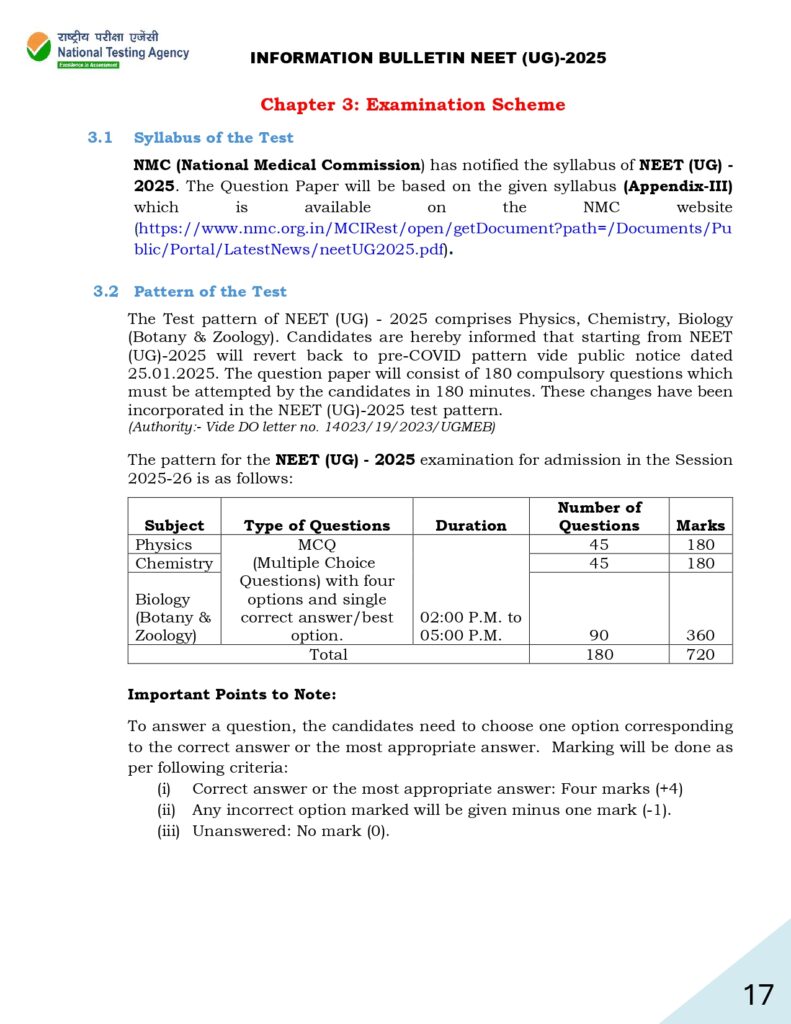
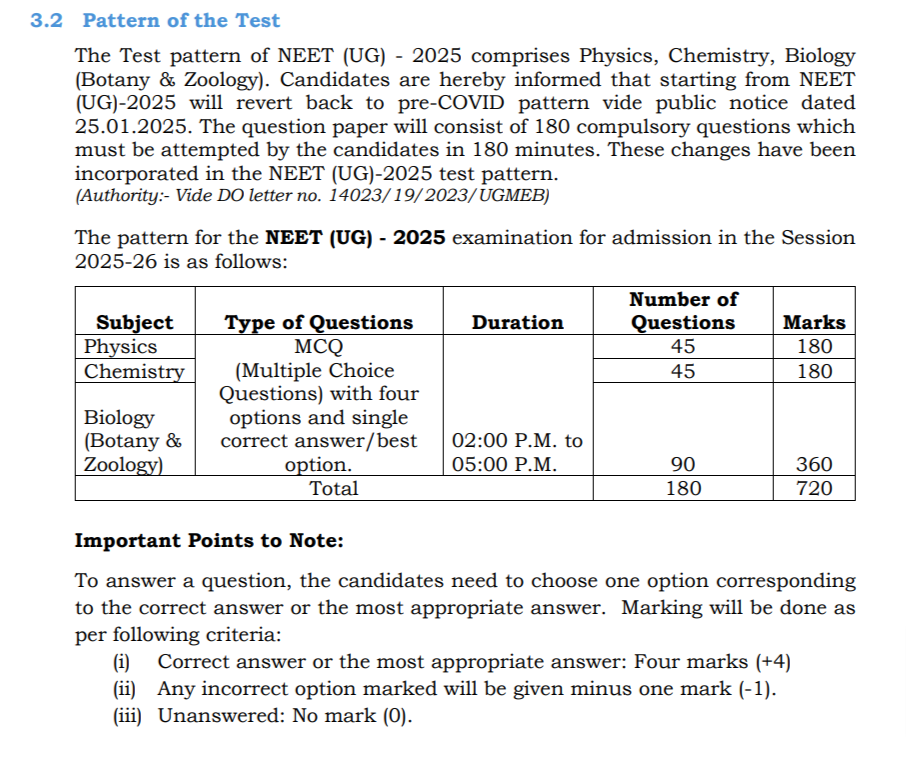
NEET Exam Pattern 2026 – In the previous edition, the NTA had revised the exam pattern of NEET. As per the revised format, the NEET (UG) 2026 exam will be conducted as per the pre-COVID pattern.
The NEET 2026 exam pattern will be outlined in the Information Bulletin.
The NEET 2026 question paper will have 180 compulsory questions which must be attempted in 180 minutes. In the old pattern, the NEET exam included 200 questions, out of which the candidate had to attempt only 180 questions.
Optional questions have been removed in the new pattern.
Go though the detailed NEET 2026 exam pattern to get insights into the NIFT 2026 question paper structure, including the mode and duration of the exam, types of questions asked, number of questions, marking scheme, etc.
NTA will conduct the NEET 2026 exam in an offline mode. The candidate will be provided with OMR sheets where they have to mark their answers using a ball-point pen. Questions will be asked from three subjects – Physics, Chemistry, and Biology. Also, refer to the NEET 2026 exam syllabus to prepare for the exam.
The section-wise number of questions and total marks as per the revised NEET 2026 exam pattern are given in the table below.
Section
Type of Question
Number of Questions
Total Marks
Physics
MCQ (Multiple Choice Questions) with four options and single correct answer/best option.
45
180
Chemistry
45
180
Biology
90
360
Total
180
720
NEET (UG) 2026 Revised Exam Pattern
This is the revised exam pattern as outlined in the NEET (UG) 2026 information bulletin
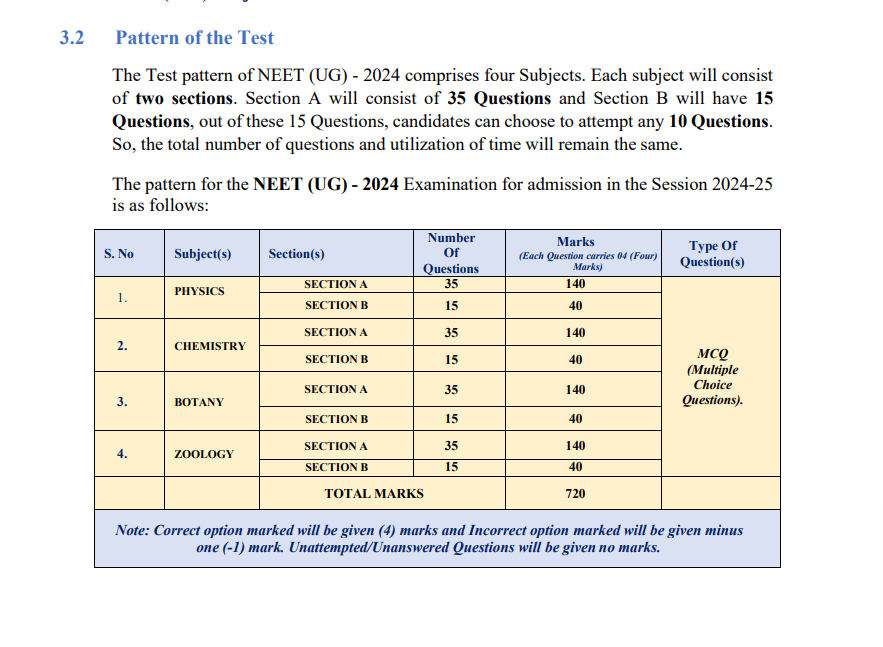
Old NEET Exam Pattern
The exam pattern followed in the previous edition of the NEET exam is given below for reference.
Section
Sections
Number of Questions
Total Marks
Physics
Physics Section A
35
140
Physics Section B
15
40
Total
45
180
Chemistry
Chemistry Section A
35
140
Chemistry Section B
15
40
Total
45
180
Biology
Botany Section A
35
140
Botany Section B
15
40
Zoology Section A
35
140
Zoology Section B
15
40
Total
90
360
Old NEET (UG) Exam Pattern
Test pattern of NEET (UG) 2026 – Section-wise Distribution of Questions
The NEET 2026 question paper is divided into FOUR subjects – Physics, Chemistry, Zoology, and Botany
Each subject will consist of two sections.
Section A will consist of 35 Questions
Section B will have 15 Questions; out of these 15 questions, candidates can choose to attempt any 10 Questions.
So, the total number of questions and utilization of time will remain the same.
Guidelines for attempting the NEET 2026 Question Paper
NTA has suggested a set of guidelines that candidates need to follow when marking their answers in the NEET 2065 – OMR sheet.
NEET (UG) – 2026 is a Pen & Paper-based Test. The candidate has to mark their answers on the specially designed 16 machine gradable OMR sheet using Ball Point Pen provided at the NEET 2026 exam centre.
Tampering with the OMR at any stage will lead to debarring of the candidature for 03 years.
Erasing or obliterating any information printed on the OMR Answer Sheet will be considered an unfair means.
Changing answers on the OMR sheet is not allowed
Any rough work must be done on the test booklet.
Make sure that you mark the test booklet code on the OMR sheet
Ensure that the NEET question paper code matches with that of the OMR sheet.
The following activities will also be considered unfair practices:
Taking away the answer sheet (Original OMR/Office Copy of OMR) out of the examination hall/room
Smuggling out of Question Paper or its part or smuggling out answersheet or part thereof
Providing incorrect information and/or overwriting of the Roll No./ Test Booklet No. / own Name of the Candidate / Father’s Name / Mother’s Name / own Signature, on the OMR Answer Sheet.
Making fake claims by manipulating the responses in the OMR sheet one tampering it in any way whatsoever, uploaded on the website for the challenge before or after the declaration of the result.
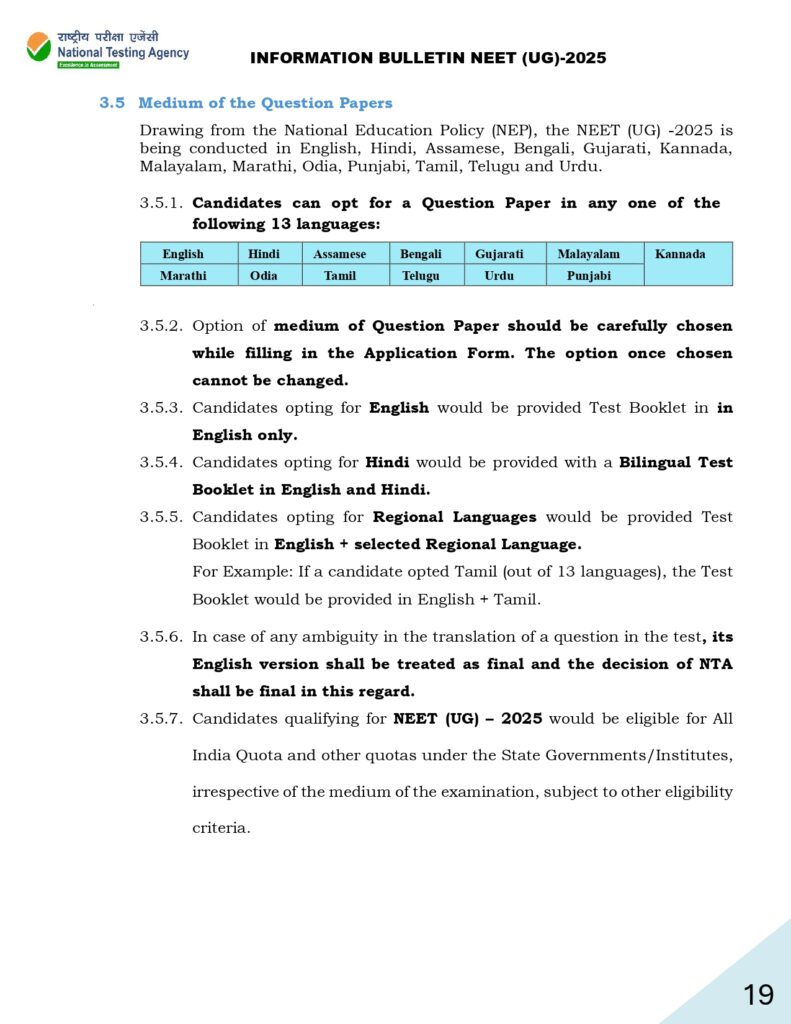
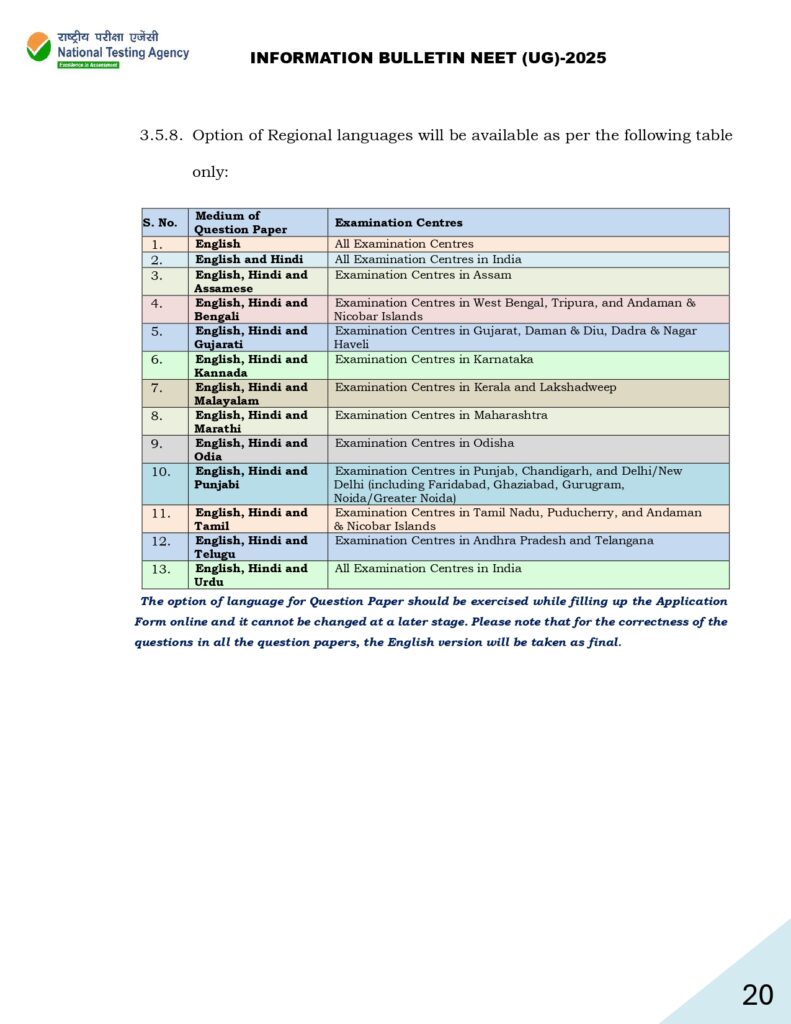
Language Options for Appearing in NEET 2026
The language options that are available for appearing in the NEET 2026 exam are given in the table below.
S.No
Medium of NEET 2026 Question Paper
Examination Centers
1
English
All Examination Centres
2
English and Hindi
All Examination Centres
3
English and Assamese
Examination Centres in Assam
4
English and Bengali
Examination Centres in West Bengal, Tripura, and Andaman & Nicobar Islands
Examination Centres in Punjab, Chandigarh, and Delhi/New Delhi (including Faridabad, Ghaziabad, Gurugram, Noida/Greater Noida)
11
English and Tamil
Examination Centres in Tamil Nadu, Puducherry, and Andaman & Nicobar Islands
12
English and Telugu
Examination Centres in Andhra Pradesh and Telangana
13
English and Urdu
All Examination Centres in India
Note: The option of language for Question Paper should be exercised while filling up the NEET 2026 application form and it cannot be changed at a later stage. Further, for the correctness of the questions in all the question papers, the English version will be taken as final.
NEET Exam Syllabus 2026 – The NEET 2026 syllabus has been released at neet.nta.nic.in; it was released on January 8, 2026. You can download the syllabus in PDF file following the link given below.
The NEET 2026 syllabus remains unchanged and is exactly the same as the syllabus released by the National Medical Commission (NMC) on December 22, 2025. So, you can also download the syllabus from the NMC website – nmc.org.in.
The NEET 2026 syllabus will be based on Class 11 and Class 12 syllabi with NCERT-based typically questions being asked in the exam.
The NEET 2026 question paper will be based on the given syllabus.
NEET 2026 exam has three sections – Physics, Chemistry, and Biology (Zoology and Botany). The syllabus includes the topics for each of these subjects. So, when preparing for the NEET 2026 exam, strictly follow the syllabus.
Role of NMC – The NMC is responsible for making /notifying any changes to the NEET UG syllabus or pattern; it last revised the NEET exam pattern in the previous edition (NEET 2025).
The syllabus will be uploaded in PDF format under the “What’s New” section
Click on the syllabus notification
The syllabus can be downloaded in PDF format.
NEET 2026 Exam Pattern will follow pre-COVID format
While no changes have been made to the NEET syllabus 2025, the NEET 2025 exam pattern was revised to the pre-COVID times, with the optional questions being removed and test duration restored to 3 hours (from 3 hours 20 minutes).
The question paper will have 180 compulsory questions. In the old pattern, the question paper had 200 questions. Out of these, the candidate had to attempt 180 questions.
Total Marks
720
Negative marking
Yes
Marking Scheme
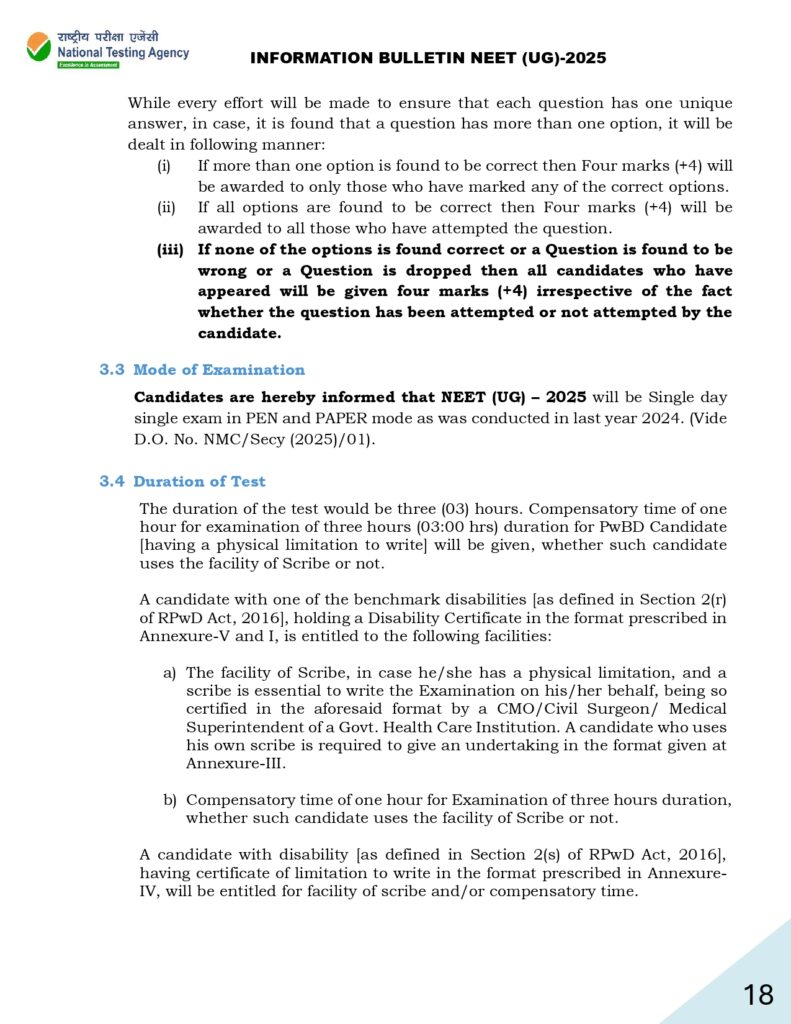
4 marks for a correct answer -1 marks for an incorrect answer 0 marks for unanswered questions
NEET Entrance Exam2026 – NTA has released the NEET UG 2026 syllabus on January 8, 2026, bringing clarity for aspirants preparing for the national-level exam. The syllabus remains unchanged and is based on the final curriculum approved by the National Medical Commission (NMC) on December 22, 2025. Candidates can download the official NEET 2026 syllabus PDF from the NTA website (download link also given here) to begin or streamline their preparation accordingly.
Earlier, on January 5, 2026, the NTA issued instructions advising candidates to update essential documents such as Aadhaar card, UDID card, and category certificates before filling out the NEET 2026 application form. The NEET UG 2026 application process is expected to commence soon with the release of the information bulletin on the official website, neet.nta.nic.in. Details regarding the registration schedule and exam date will be announced through the official notification. As per current expectations, the NEET UG 2026 examination is likely to be conducted on May 3, 2026. Eligible candidates must complete the application process within the stipulated timeline while adhering to the prescribed guidelines
NEET exam, in the previous edition, was held on on May 4, 2025 (2 pm to 5 pm). The exam was held from 2 pm – 5 pm (3 hours duration) in a pen-and-paper mode.
In the last edition, more than 22.76 lakh candidates registered for the exam. Scores of NEET 2025 will be used to fill MBBS, BDS, AYUS, BVSc and AH seats. There are around 1,09,170 and 27,868 MBBS and BDS seats available respectively.
The National Testing Agency is expected to conduct the NEET 2026 entrance exam in the 1st week of May 2026. The tentative schedule for exam events, including application start and last date, is given below.
Event
Tentative Date
Release of NEET 2025 exam notification
Feb 2026
NEET UG 2026 registration starts
1st week of Feb 2026
Last date for registration and fee payment
1st week of March 2026
NTA NEET application correction window
2nd week of March 2026
Announcement of the city of examination
April 2026
Issue of Advanced City Intimation Slip
April 2026
Release of admit card
Last week of April 2026
NEET 2026 exam date
1st week of May 2026 (2 pm – 5 pm)
Release of NEET 2026 answer key/ recorded responses
1st week of June 2026
Submission of Objections against the provisional key/ recorded responses
1st week of June 2026
Declaration of RESULTs
2nd week of June 2026
Commencement of NEET UG counselling
–
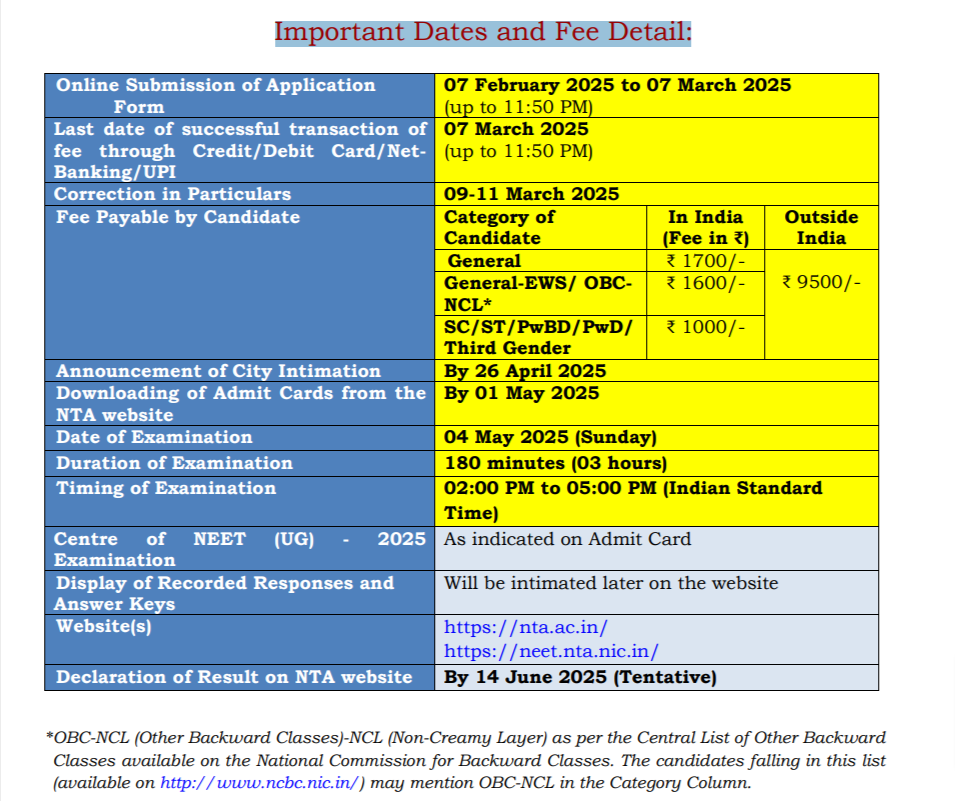
NEET Important Dates and Fee Detail
The previous years’ official exam schedule and fee details is given below for the reference of the candidate.
NEET Application Form 2026
The application form for NEET 2026 will open in online mode at neet.nta.nic.in. NTA issued an advisory on January 5 instructing candidates to get Aadhaar card, UDID card and category certificate updated before registering online for NEET UG 2026.
The release of the advisory is an indication that the NEET 2026 registration process will START soon.
Candidates who didn’t or couldn’t apply in this session may apply in the next academic session provided they meet the eligibility criteria.
The steps to fill out the NEET 2026 application form are as follows:
Online Registration: The candidate has to get registered by entering their phone number, email ID, and other details. On successful registration, NEET 2026 application number will be generated.
Filling of the application form: The candidate has to log-in to the newly created account to fill in the rest of the application form, including personal, academic and contact details.
Uploading of documents: Scanned images of photograph, signature and other documents have to be uploaded as per the given specification.
Payment of application fees: The exam fees have to be paid online using Debit/Credit card/ Netbanking/ UPI.
Taking printout of the confirmation page: After submitting the duly filled application form, take a printout of the confirmation page.
The eligibility criteria for NEET (UG) – 2026 is given in the table below.
Parameters
Description
Qualifying Exam
Candidates must have passed 10+2 or an equivalent with Physics, Chemistry, Biology/Biotechnology, and English as compulsory subjects. Candidates appearing in the qualifying exam in the admission year may also apply.
Marks in the qualifying exam
The candidate must have passed in Physics, Chemistry, Biology/Biotechnology, and English individually. The candidate also must obtain minimum aggregate marks in Physics, Chemistry, and Biology/Bio-technology. UR – 50%OBC/SC/ST – 40%PWD – 40%
Lower Age limit
Candidates must have attained the age of 17 years at the time of admission or will attain the same by December 31, 2025, or the last date of the year. Accordingly, the minimum date of birth of candidates should be December 31, 2008.
Upper Age Limit
No upper age limit prescribed.
Number of Attempts
There is no restrictions on the maximum of attempts
Nationality
Indian Nationals, NRIs, OCIs, PIOs & Foreign Nationals can apply for admission
The NEET 2026 question paper will have questions from THREE subjects – Physics, Chemistry and Biology. The NEET 2026 syllabus includes the topics for each subject, from which questions will be asked in the entrance exam – Physics, Chemistry, and Biology.
The NEET syllabus is similar to CBSE Class 11 and Class 12 syllabi. The candidate must refer to the syllabus when preparing for NEET exam.
Download NEET Syllabus PDF
Subject
Syllabus
NEET 2026 Syllabus PDF – Physics, Chemistry, Biology
The NEET 2026 exam will be conducted in an offline, pen-and-paper-based mode. The duration of the exam will be 200 minutes, during which the candidate will have to attempt 200 multiple-choice questions.
NEET Exam Pattern 2026
NEET 2026 exam pattern – Snapshot
Particulars
Description
Mode of exam
Pen and Paper-based. Answers have to be marked on OMR sheets using a black or blue ballpoint pen
The NEET (UG) – 2026 question paper will comprise four Subjects. Each subject will consist of two sections. Section A will consist of 35 questions Section B will have 15 questions, out of these 15 questions, candidates can choose to attempt any 10 questions So, the candidate has to attempt a TOTAL of 180 questions.
Marking scheme
+4 marks for each correct answer. One mark will be deducted for each wrong attempt.
Total marks
720 Marks
NEET Admit Card 2025
NTA released the admit cards for the NEET 2025 exam on April 30, 2025. Candidates who have registered for the exam can download the admit cards online at http://neet.nta.nic.in.
Log-in to the admit card portal using your application number and password.
On the day of the NEET 2025 exam, the candidate must bring the admit card and a valid photo ID proof.
The admit card will carry details like the roll number, date and time of the exam, allocated NEET (UG) 2025 exam center, reporting time, gate closing time, and exam-day guidelines.
The candidate must preserve the admit card until the admission process is over.
NEET Advance City Intimation Slip 2025
NTA released the city slip on April 23; the city slip is released before the release of the admit card. The purpose of the NEET 2025 city slip is to inform the candidate about the exam city they have been allocated.
It will, however, not contain the name of any specific exam center, nor will the city slip be accepted as an alternative for the admit card.
If the candidate bring the city slip, but not the admit card, to the exam center, they will not be allowed entry inside the NEET 2025 exam center.
NEET Exam Answer Key 2025
NTA released the final answer key of NEET 2025 on June 14, 2025. The answer key was released online at neet.nta.nic.in. The keys have been released for all the paper codes – 45, 46, 47, and 48. The candidate can download the answer key by simply clicking on the answer key link. No log-in is required.
NTA released the provisional answer key of NIFT 2025 on June 3, 2025. NTA also released the NEET 2025 OMR answer sheet along with the provisional answer key. Use it and the answer key to calculate probable scores and assess your chances of admission.
The candidate was also be given the option to submit objections against the provisional answer key from June 3-5, 2025.
The FINAL answer key of NEET 2025 will be released after considering feedback given by the candidate.
NEET Result 2025
NTA announced the results of NEET 2025 on June 14, 2025. The results were declared for all candidates who have appeared in the entrance exam.
The candidate can check their results by following the link updated above.
Log-in to the result portal using your application number, date of birth, and email ID or mobile number. The NEET 2025 result will include details like the qualifying status of the candidate, section-wise and total marks, and merit ranks.
Also, the merit rank of NEET 2025 will be used to shortlist candidates for the counseling and seat allotment process.
MCC conducts counselling for AIQ seats, while state counselling authorities or the Directorates of Medical Education for different states conduct NEET state counselling.
The Medical Counselling Committee (MCC) is currently conducting NEET 2025 counseling registration from July 21-31, 2025. Candidates who have qualified in the NEET 2025 exam are eligible to participate in the counseling process.
Step-wise NEET 2025 Counseling Process
Online registration and payment of counseling registration fee
Choice filling and locking
Publication of NEET 2025 seat allotment
Reporting to the allotted institute.
NEET 2025 Exam Analysis
Follow detailed NEET Exam Analysis Done by Leading Agencies
VITEEE Exam Pattern 2026 – Vellore Institute of Technology (VIT) has released the exam pattern for VITEEE 2026 on its admission portal – viteee.vit.ac.in (and also the information brochure).
As per official exam pattern, the VITEEE 2026 exam will be conducted in a computer-based mode and will be of 2 hours 30 minutes duration. The VITEEE 2026 question paper will include 125 multiple-choice questions. The subject combination (MPCEA or BPCEA) for VITEEE 2025 may vary depending on the program opted by the candidate.
Carefully go through the VITEEE exam pattern when preparing for the exam. Also, refer to the VITEEE exam syllabus, as it will have inputs on the subject-wise topics.
The exam pattern for VITEEE 2026 is discussed in detail below. Make sure that you prepare for the VITEEE 2026 exam in tune with the official exam pattern.
Exam pattern of VITEEE 2026
Particulars
Details
Examination Mode
Computer-Based Test
Duration
2 Hours 30 Minutes
Medium of Exam
English
Type of Questions
Multiple Choice Questions (MCQs)
Each question will have four choices and one correct answer.
A mock test will be available for applicants at vit.ac.in
Zero ‘0’ marks in the exam
Candidates who score ‘0’ in total marks will be declared as “Not Qualified” and will not be eligible to participate in the counseling process.
VITEEE 2026 Exam Pattern (MPCEA) – Subject-wise No. Of Questions
VITEEE 2026 (MPCEA) No. of Questions
Subject
No.of Questions
Mathematics
40
Physics
35
Chemistry
35
English
5
Aptitude
10
VITEEE 2026 Exam Pattern (BPCEA) – Subject-wise No. Of Questions
VITEEE 2026 (BPCEA) No. of Questions
Subject
No.of Questions
Biology
40
Physics
35
Chemistry
35
English
5
Aptitude
10
VITEEE Syllabus 2026
The syllabus for VITEEE is also available at viteee.vit.ac.in. Consult the syllabus based on the subject combination you have opted to appear in the VITEEE 2026 exam. The VITEEE 2026 exam has TWO streams – MPCEA and BPCEA.
The VITEEE syllabus will provide inputs into the topics for each subject that the candidate has to prepare for the exam. Note that questions in the exam will be asked only from the official syllabus. Also, it is paramount that you refer to the updated and latest syllabus only. This is because the current syllabus will include any new topics that have been added. Also, dropped topics will be excluded from the current VITEEE syllabus.
VITEEE Exam Pattern 2026 – Features of the Computer-based Test
Each computer node will be connected to a central server which delivers the encrypted test in real time through a secure and reliable connection.
Questions will be in English and will appear one by one randomly.
All questions are multiple choice questions (MCQ). Each question has a body and four responses labelled A, B, C and D. Only one of the four responses is correct. Candidate should select only one among four choices. Candidates can navigate freely back and forth, through the questions.
There is no negative marking for wrong answers.
The number of examination days will be determined based on the total number of applications received and the test centers will be given as chosen by the candidates in the application form.
VIT reserves the right to reschedule the exam for a candidate. The candidate will not be charged any additional entrance exam fee if the re-schedule is initiated by VIT. However, the candidate should make their own arrangements at their cost similar to the original schedule to take the test on the revised date
VITEEE Exam Pattern 2025 – Guidelines to be Followed at Exam Center
Barred items – Electronic devices like calculators, tables, side ruler, pager and cellular phones are not allowed in the exam hall
Documents to carry – The candidate must carry the e-admit card and a valid photo ID proof.
Biometric registration is a part of attendance and hall ticket verification process and can be carried out either before or during the exam or both.
Candidates who do not co-operate during the biometric registration process will not be allowed to take the exam. Biometric authentication will be carried out again for the shortlisted candidates during the admission.
Students will be monitored through CCTV cameras individually.
VITEEE Syllabus 2026 – Vellore Institute of Technology (VIT) will conduct the VITEEE 2026 exam from April 28 – May 3, 2026. Candidates appearing in the exam must consult the official VITEEE 2026 syllabus to prepare.
The VITEEE 2026 exam syllabus is outlined in the VITEEE admission portal – viteee.vit.ac.in. On the Homepage, click on “Admission Guidelines”, and then on SYLLABUS.
The direct link to download the subject-wise syllabus PDFs are also given below. The syllabus contains the topics from which questions will be framed in VITEEE 2026. Note that depending on the program opted by the candidate, they must appear in either MPCEA or BPCEA subject options. Also refer to the VITEEE 2026 exam pattern to prepare for the exam.
Keep reading to learn the full details about VITEEE 2026 exam syllabus.
The subject-wise syllabus for the VITEEE 2026 exam is given below. The syllabus is divided into units which contain the corresponding topics for each subject.
VITEEE 2026 Syllabus – Physics
VITEEE 2026 Syllabus – Physics
Unit
Topics
Mechanics and Properties of Matter
Law of conservation of linear momentum and its applications. Static and kinetic friction- laws of friction – rolling friction Work done by a constant force and a variable force; kinetic energy – work-energy theorem- power.
Conservative forces: conservation of mechanical energy (kinetic and potential energies)- non-conservative forces: motion in a vertical circle – elastic and inelastic collisions.
Elastic behaviour – Stress-strain relationship – Hooke’s law – Young’s modulus – bulk modulus- shear modulus of rigidity – Poisson’s ratio – elastic energy. Viscosity – Stokes’ law – terminalvelocity – streamline and turbulent flow – critical velocity. Bernoulli’s theorem and itsApplications.
Heat and Thermodynamics: Zeroeth law of thermodynamics- Temperature. First law of thermodynamics- Internal energy-Heat-Work-Isothermal and Adiabatic processes. Second law of thermodynamics- Reversible and Irreversible processes. Thermal expansion- Heat Capacity- Cp, Cv -latent heat, Qualitative idea of Blackbody radiation: Wein’s displacement law- Stefan’s law.
Electrostatics
Charges and their conservation; Coulomb’s law – superposition principle. Electric field – electric field due to a point charge, electric field lines; electric dipole, electric field intensity due to a dipole – behaviour of a dipole in a uniform electric field. Electric potential – potential difference- electric potential due to a point charge and dipole – equipotential surfaces – electrical potential energy of a system of two point charges.
Electric flux-Gauss’s law and its applications. Electrostatic induction-capacitor and capacitance – dielectrics- electric polarisation – parallel plate capacitor with and without dielectric – applications of capacitor – energy stored in a capacitor – Capacitors in series and in parallel – Van de Graaff generator.
Current Electricity & Magnetic Effects of Electric Current
Electric Current – drift velocity and mobility and their relation with electric current. Ohm’s law, electrical resistance – V-I characteristics – electrical resistivity and conductivity-classification of materials in terms of conductivity – Carbon resistors – colour code for carbon resistors – combination of resistors – series and parallel – temperature dependence of resistance – internal resistance of a cell – potential difference and emf of a cell – combinations of cells in series and in parallel.
Kirchoff’s law – Wheatstone’s Bridge and its application – Metrebridge – special case of Wheatstone bridge – Potentiometer principle – comparing the emf of two cells.
Magnetic effect of electric current – Concept of magnetic field – Oersted’s experiment – BiotSavart law- Magnetic field due to a current carrying straight wire and circular coil – Tangentgalvanometer – Bar magnet as an equivalent solenoid – magnetic field lines.
Ampere’s circuital law and its application. Force on a moving charge in uniform magnetic field and electric field – cyclotron – Force on current carrying conductor in a uniform magnetic field –Forces between two parallel current carrying conductors – definition of ampere.
Torque experienced by a current loop in a uniform magnetic field – moving coil galvanometer – conversion to ammeter and voltmeter – current loop as a magnetic dipole – Magnetic dipolemoment of a revolving electron.
Electromagnetic Induction and Alternating Current
Electromagnetic induction – Faraday’s law – induced emf and current – Lenz’s law. Self induction – Mutual induction – self inductance of a long solenoid – mutual inductance of two long solenoids. Methods of inducing emf – (i) by changing magnetic induction (ii) by changing area enclosed by the coil and (iii) by changing the orientation of the coil.
AC generator – (Single phase, three phase). Eddy current – applications – transformer -Alternating current – AC circuit with resistance – AC circuit with inductor – AC circuit withcapacitor – LCR series circuit – Resonance and Q – factor – power in AC circuits
Optics
Reflection of light, spherical mirrors, mirror formula. Refraction of light, total internal reflection and its applications, refraction at spherical surfaces, lenses, thin lens formula, lens maker’s formula. Magnification, power of a lens, Resolving power, combination of thin lenses in contact, combination of a lens and a mirror. Refraction and dispersion of light through a prism.
Wavefront and Huygens’s principle – Reflection, total internal reflection and refraction of plane wave at a plane surface using wavefronts. Interference – Young’s double slit experiment and expression for fringe width – coherent source – Formation of colours in thin films – Newton’s rings. Diffraction – differences between interference and diffraction of light. Polarisation of light waves – polarisation by reflection – Brewster’s law – doublerefraction – nicol prism – uses of plane polarised light.
Dual Nature of Radiation, Atomic & Nuclear Physics
Displacement current – Electromagnetic waves and their characteristics – Transverse nature of electromagnetic waves – Electromagnetic spectrum – Photoelectric effect – Light wavesand photons – particle nature of light – photocells and their applications.
Atomic structure – discovery of the electron – specific charge (Thomson’s method) and charge of the electron (Millikan’s oil drop method) – alpha scattering – Rutherford’s atom model.
Nuclear properties – nuclear radii, masses, binding energy, density, charge – isotopes, isobars and isotones – nuclear mass defect – binding energy – stability of nuclei
Nature of nuclear forces – Radioactivity – alpha, beta and gamma radiations and their properties – Radioactive decay law – half life – mean life – artificial radioactivity – radio isotopes – effects and uses. Radio carbon dating. Nuclear fission – chain reaction – atom bomb – nuclear reactor – nuclear fusion.
Semiconductor Devices and their Applications
Semiconductor basics – energy bands in solids: difference between metals, insulators and semiconductors – semiconductor doping – Intrinsic and Extrinsic semiconductors. Formation of P-N Junction – Barrier potential and depletion layer-P-N Junction diode – Forward and reverse bias characteristics – diode as a rectifier – Zener diode- LED. Junction transistors – characteristics – transistor as a switch – transistor as an amplifier – transistor as an oscillator.
Logic gates – NOT, OR, AND, EXOR using discrete components – NAND and NOR gates as universal gates – De Morgan’s theorem – Laws and theorems of Boolean algebra.
Bohr’s atomic model- Sommerfeld’s extension of atomic structure; Electronic configuration and Quantum numbers; Shapes of s,p,d,f orbitals – Pauli’s exclusion principle – Hund’s Rule of maximum multiplicity- Aufbau principle. Emission spectrum, absorption spectrum, line spectra and band spectra; Hydrogen spectrum – Lyman, Balmer, Paschen, Brackett and Pfund series; de Broglie’s theory; Heisenberg’s uncertainty principle – wave nature of electron – Schrodinger wave equation (No derivation). Eigen values and eigen functions. Hybridization of atomic orbitals involving s,p,d orbitals.
p,d and f – Block Elements
p-block elements – Phosphorous compounds; PCl3, PCl5 – Oxides. Hydrogen halides, Inter halogen compounds. Xenon fluoride compounds. General Characteristics of d – block elements – Electronic Configuration – Oxidation states of first-row transition elements and their colours. Occurrence and principles of extraction: Copper, Silver, Gold and Zinc. Preparation, properties of CuSO4, AgNO3 and K2Cr2O7.
Lanthanides – Introduction, electronic configuration, general characteristics, oxidation state – lanthanide contraction, uses, brief comparison of Lanthanides and Actinides.
Coordination Chemistry and Solid State Chemistry
Introduction – Terminology in coordination chemistry – IUPAC nomenclature of mononuclear coordination compounds. Isomerism, Geometrical isomerism in 4-coordinate, 6-coordinate complexes. Theories on coordination compounds – Werner’s theory (brief), Valence Bond theory. Uses of coordination compounds. Bioinorganic compounds (Haemoglobin and chlorophyll).
Lattice – unit cell, systems, types of crystals, packing in solids; Ionic crystals – Imperfections in solids – point defects. X-Ray diffraction – Electrical Property, Amorphous solids (elementary ideas only).
Thermodynamics, Chemical Equilibrium and Chemical Kinetics
I and II law of thermodynamics – spontaneous and non-spontaneous processes, entropy, Gibb’s free energy – Free energy change and chemical equilibrium – the significance of entropy. Law of mass action – Le Chatlier’s principle, applications of chemical equilibrium. Rate expression, order and molecularity of reactions, zero order, first order and pseudo-first-order reaction – half-life period. Determination of rate constant and order of reaction.Temperature dependence of rate constant – Arrhenius equation, activation energy.
Electrochemistry
Theory of electrical conductance; metallic and electrolytic conductance. Faraday’s laws – theory of strong electrolytes – Specific resistance, specific conductance, equivalent and molar conductance – Variation of conductance with dilution – Kohlrausch’s Law – Ionic product of water, pH and pOH – buffer solutions – use of pH values. Cells – Electrodes and electrode potentials – construction of cell and EMF values, Fuel cells, Corrosion and its prevention.
Read more
Digestion and absorption, breathing and respiration, body fluids and circulation, excretory system, endocrine system, nervous system, skeletal and muscular systems. Locomotion and movement, growth, ageing and death. Hormones – types of hormones, functions and disorders.
Adjoint, inverse – properties, computation of inverses, solution of a system of linear equations by matrix inversion method. The rank of a matrix – elementary transformation on a matrix, consistency of a system of linear equations, Cramer’s rule, non-homogeneous equations, homogeneous linear system and rank method. Solution of linear programming problems (LPP) in two variables.
Trigonometry and Complex Numbers
Definition, range, domain, principal value branch, graphs of inverse trigonometric functions and their elementary properties. Complex number system – conjugate, properties, ordered pair representation. Modulus – properties, geometrical representation, polar form, principal value, conjugate, sum, difference, product, quotient, vector interpretation, solutions of polynomial equations, De Moivre’s theorem and its applications. Roots of a complex number – nth roots, cube roots, fourth roots.
Analytical Geometry of two dimensions
Definition of a conic – general equation of a conic, classification with respect to the general equation of a conic, classification of conics with respect to eccentricity. Equations of conic sections (parabola, ellipse and hyperbola) in standard forms and general forms- Directrix, Focus and Latus-rectum – a parametric form of conics and chords. – Tangents and normals – Cartesian form and parametric form- equation of chord of contact of tangents from a point (x1,y1) to all the above-mentioned curves. Asymptotes, Rectangular hyperbola – Standard equation of a rectangular hyperbola.
Vector Algebra
Scalar Product – the angle between two vectors, properties of scalar product, and applications of the dot product. Vector product, right-handed and left-handed systems, properties of vector product, applications of cross product. Product of three vectors – Scalar triple product, properties of scalar triple product, vector triple product, vector product of four vectors, scalar product of four vectors.
Analytical Geometry of Three Dimensions
Direction cosines – direction ratios – equation of a straight line passing through a given point and parallel to a given line, passing through two given points, the angle between two lines. Planes – equation of a plane, passing through a given point and perpendicular to a line, given the distance from the origin and unit normal, passing through a given point and parallel to two given lines, passing through two given points and parallel to a given line, passing through three given non-collinear points, passing through the line of intersection of two given planes, the distance between a point and a plane, the plane which contains two given lines (co-planar lines), angle between a line and a plane. Skew lines – the shortest distance between two lines, condition for two lines to intersect, point of intersection, collinearity of three points. 2 Sphere – equation of the sphere whose centre and radius are given, equation of a sphere when the extremities of the diameter are given.
Differential Calculus
Limits, continuity and differentiability of functions – Derivative is a rate of change, velocity, acceleration, and related rates, and derivative as a measure of slope, tangent, normal and angle between curves. Mean value theorem – Rolle’s Theorem, Lagrange Mean Value Theorem, Taylor’s and Maclaurin’s series, L’ Hospital’s Rule, stationary points, increasing, decreasing, maxima, minima, concavity, convexity and points of inflexion. Errors and approximations – absolute, relative, percentage errors – curve tracing, partial derivatives, Euler’s theorem.
Integral Calculus and its Applications
Simple definite integrals – fundamental theorems of calculus, properties of definite integrals. Reduction formulae – reduction formulae for x dx n sin and x dx n cos, Bernoulli’s formula. Area of bounded regions, length of the curve.
Differential Equations
Differential equations – formation of differential equations, order and degree, solving differential equations (1st order), variables separable, homogeneous and linear equations. Second-order linear differential equations – second-order linear differential equations with constant coefficients, finding the particular integral if f(x) = emx, sin mx, cos mx, x, x2.
Probability Distributions
Probability – Axioms – Addition law – Conditional probability – Multiplicative law – Baye’s Theorem – Random variable – probability density function, distribution function, mathematical expectation, variance Theoretical distributions – discrete distributions, Binomial, Poisson distributions- Continuous distributions, Normal distribution.
Discrete Mathematics
Functions – Relations – Basics of counting. Mathematical logic – logical statements, connectives, truth tables, logical equivalence, tautology, a contradiction. Groups-binary operations, semi-groups, monoids, groups, order of a group, order of an element, properties of groups
Need for classification; three domains of life. Linnaean, Whittaker, Bentham and Hooker systems of classification. Salient features of non-chordates up to phyla levels and chordates up to class levels.
Cell and Molecular Biology
Cell theory. Prokaryotic cell and it’s ultrastructure. Eukaryotic cell- cell wall, cell membrane, cytoskeleton, nucleus, chloroplast, mitochondria, endoplasmic reticulum, Golgi bodies, ribosomes, lysosomes, vacuoles and centrosomes. Cell cycle and division – amitosis, mitosis and meiosis. Search for genetic material; structure of DNA and RNA; replication, transcription, genetic code, translation, splicing, gene expression and regulation (lac operon) and DNA repair.
Reproduction
Asexual reproduction – binary fission, sporulation, budding, gemmule formation and fragmentation. Vegetative propagation in plants, sexual reproduction in flowering plants and structure of flowers. Pollination, fertilization, development of seeds and fruits, seed dispersal, apomixis, parthenocarpy and polyembryony. Human reproductive system. Gametogenesis, menstrual cycle, fertilization, implantation, embryo development up to blastocyst formation, pregnancy, parturition and lactation. Assisted reproductive technologies.
Genetics and evolution
Chromosomes – structure and types, linkage and crossing over, recombination of chromosomes, mutation and chromosomal aberrations. Mendelian inheritance, chromosomal theory of inheritance, deviation from Mendelian ratio (incomplete dominance, co-dominance, multiple allelism, pleiotrophy), sex-linked inheritance and sex determination in humans. Darwinism, neo-Darwinism, Hardy and Weinberg’s principle and factors affecting the equilibrium: selection, mutation, migration and random genetic drift.
Human health and diseases
Pathogens, parasites causing human diseases (malaria, dengue, chikungunya, filariasis, ascariasis, typhoid, pneumonia, common cold, amoebiasis, ringworm) and their control. Basic concepts of immunology, vaccines, antibiotics, cancer, HIV and AIDS. Adolescence, drug and alcohol abuse.
Biochemistry
Structure and function of carbohydrates, lipids and proteins. Enzymes – types, properties and enzyme action. Metabolism – glycolysis, Kreb’s cycle and pentose phosphate pathway.
Plant physiology
Movement of water, food, nutrients, gases and minerals. Passive diffusion, facilitated diffusion, and active transport. Imbibition, osmosis, apoplast and symplast transport and guttation. Transpiration, photosynthesis (light and dark reactions) and electron transport chain. 2 Hormones and growth regulators, photoperiodism and vernalization. Nitrogen cycle and biological nitrogen fixation.
Human physiology
Digestion and absorption, breathing and respiration, body fluids and circulation, excretory system, endocrine system, nervous system, skeletal and muscular systems. Locomotion and movement, growth, ageing and death. Hormones – types of hormones, functions and disorders.
Biotechnology and its applications
Recombinant DNA technology, applications in health, agriculture and industries; genetically modified organisms; Human insulin, vaccine and antibiotic production. Stem cell technology and gene therapy. Apiculture and animal husbandry. Plant breeding, tissue culture, single cell protein, fortification, Bt crops and transgenic animals. Microbes in food processing, sewage treatment, waste management and energy generation. Biocontrol agents and biofertilizers. Biosafety issues, biopiracy and patents.
Biodiversity, ecology and environment
Ecosystems: components, types, pyramids, nutrient cycles (carbon and phosphorous), ecological succession and energy flow in an ecosystem; Biodiversity – concepts, patterns, importance, conservation, hot spots, endangered organisms, extinction, Red data book, botanical gardens, national parks, sanctuaries, museums, biosphere reserves and Ramsar sites. Environmental issues: pollution and its control. Population attributes – growth, birth and death rate and age distribution.
Tabular Chart, Pie Chart, Bar Chart, Line Graph, Mixed Charts
Data Sufficiency
All topics combined
Syllogism
2 statements and 2 conclusions, 3 statements and 2 conclusion, 2 statements and 4 conclusions, 3 statements and 4 conclusions, 3 statement and 3 conclusions
–
Number series, Coding, and Decoding – Number series, Letter to Letter Coding, Letter to Number Coding, Mixed coding
–
Clocks, Calendars, and DirecƟons – Mirror image of the clock, Angle based questions, Gain or loss per day, finding days/dates, finding odd days, Occurrence of same calendar year, Directions faced with respect to the starting point, Distance between two points
Multiple Choice Questions to test the comprehension of a short passage or line of poems, English grammar, and pronunciation.
Please note that the passages, lines of poems, dialogues, grammar, and pronunciation items are chosen to suit the level of higher secondary or equivalent education.
VITEEE Application Form 2026 – Vellore Institute of Technology (VIT) is currently accepting the applications for VITEEE 2026 from October 24 till March 31, 2026. The application is open online at the VIT exam portal – viteee.vit.ac.in.
The direct link to apply is provided below.
The VITEEE 2025 application fee is INR 1350. For test centers abroad, the fee to be paid is the equivalent of USD 90 in INR.
As part of the application process, get registered, fill in personal, academic, and personal information, upload documents, SELECT a VITEEE 2026 exam center, and pay the application fee. Candidates who duly complete the application process will be issued VITEEE 2026 admit cards. VITEEE application is for admission to the B.Tech program offered at various VIT campuses.
The VITEEE 2026 exam will be conducted from April 28 – May 3, 2026.
To complete the VITEEE 2026 application process, the candidate will need the following documents.
Document
Format
Size
Signature
Instructions: Candidates need to draw a rectangular box of size 6 cm (width) x 2 cm (height) on an A4 white paper. Sign with a dark blue or black pen within the box.
.jpeg
5 kb – 150 kb
Photograph
Instructions: The photograph must be in color and taken in a studio against a light background. Only white/off-white backgrounds are preferred.
The photograph must show the full-frontal view without tilting the face, both ears visible, open eyes with neutral expression. The photograph shouldn’t be too dark or too bright but have optimum exposure. The photograph should have only one face.
Dimension: Width (300 to 400 pixels) x height (400 to 550 pixels)
.jpeg
20 kb – 300 kb
VITEEE 2026 Application Fee
The application fee for VITEEE 2026 with the mode of payment is given in the table below. Note that the application fee is non-refundable.
Particulars
Description
VITEEE application fee 2025
INR 1350
Mode of payment
Net Banking, Credit Card, Debit Card, and Paytm
What after submission of VITEEE 2026 application form – Slot Booking
Candidates who successfully complete the registration process will given the option to book slots for the VITEEE 2026 exam. The VITEEE exam will be conducted on multiple-days and slots. So, it is mandatory for the candidate to book an exam slot.
Admit cards will be generated only after the completion of the slot booking process.
VITEEE 2026 test slots will be allocated on a first-come, first-served basis. So, to get your preferred test slot, complete the slot-booking process at the earliest.
VITEEE Exam Center 2026
The candidate must select their choice of exam city when filling out the VITEEE 2026 application form. The VITEEE 2026 exam will be conducted in 122 cities across India.
The name and address of the VITEEE 2026 exam center allocated to the candidate will be mentioned on the admit card. The admit card will also contain the exam center reporting time, exam date and timings, and exam-day guidelines.
On the day of the exam, the candidate must bring the following documents:
VITEEE 2026 admit card
Photo ID proof
VITEEE 2026 Application Form Correction
If we go by previous years’ trends, it is unlikely that candidates will be given the option to edit or make corrections to the VITEEE 2026 application form. So, you must take the utmost caution to ensure that there are no mistakes when filling out the application form.
Fill in your academic credentials, email ID, name, phone number, date of birth, and other details correctly.
If you enter incorrect information, there is a chance you may be disqualified. Further, if you enter misleading or counterfeit information, criminal charges may also be levied.
What if VITEEE application form 2026 correction window is opened?
In the scenario, VIT officials do offer candidates an edit the application form, the same will be updated here, along with details like what fields can be edited and what fields can’t be edited.
VITEEE Exam 2026 – Vellore Institute of Technology (VIT) will conduct VITEEE 2026 exam from April 28 – May 3, 2026. The exam will be administered in a computer-based mode and include 125 MCQs. Each question will carry 1 mark; there is no negative marking.
The exam will be held in 122 cities across India, on multiple days and slots. You can select the test date and exam venue when filling out theform. The name of the allotted VITEEE 2026 exam center will be mentioned on the VITEEE 2026 admit card. Test slots booking process will start soon after the application closes. Slots will be allocated on a first-come, first-served basis.
VITEEE 2026 application form 2026 is currently OPEN online at viteee.vit.ac.in from October 24 to March 31, 2026. The application fee is INR 1350. You can apply following the link given below.
Keep reading to learn the full details about the VITEEE 2026 exam.
Vellore Institute of Technology Engineering Entrance Examination (VITEEE)
Conducting body
Vellore Institute of Technology (VIT)
Exam Level
Undergraduate
Exam Frequency
Annual
Number of attempts
The candidate can appear only once for VITEEE
Mode of Exam
Computer-Based Test
Total Registrations
More than 2 lakhs (approx)
Course offered through the exam
BTech
Application Fees
INR 1,350
STATUS of application (OPEN)
October 24 to March 31, 2026
Exam DATE
April 28 – May 3, 2026
The exam will be conducted on multiple dates and slots. Test slots will be allotted on a first-come, first-served basis. The slot booking process will open soon after the closure of the application.
Exam Duration
2 Hour 30 Minutes
Number of Sections
The VITEEE 2026 question paper will have FIVE sections:
1. Mathematics/Biology 2. Physics 3. Chemistry 4. Aptitude 5. English
Total Questions
125
Marking Scheme
1 mark for each correct answer. No negative marking
The event schedule for the VITEEE 2026 exam is given below. The application form for the exam is currently open.
Events
Dates
START of application form
October 24, 2025
Last date to submit applications
March 31, 2026
Slot Booking
April 2026
Issue of VITEEE 2026 admit cards
Actual e-Admit card will be made available 2 days ahead of the booked schedule.
VITEEE 2026 exam date
April 28 – May 3, 2026
Declaration of Results
2nd week of May 2026
Counseling
2nd week of May 2026
VITEEE 2026 Application Form
The application form of VITEEE 2026 is open from October 24 to May 3, 2025. The application has been released online at viteee.vit.ac.in.
Candidates who meet the program-wise eligibility criteria may apply for VITEEE 2026 following the steps given below.
How to fill VITEEE application form
Go to the VITEEE 2026 admission portal – Click Here
You will see the registration window on the right
Click on the “Sign Up” tab
Get registered by entering name, DOB, gender, email ID, and mobile number. On successful registration, a candidate account will be created
Log in to the account. Fill in personal, academic, and personal details.
Upload documents
Finally, pay the application fee to complete the VITEEE 2026 application process.
The candidate needs to download and save the filled-in VITEEE application form for reference and further correspondence.
However, there is no need to send the hard copy of the filled-in application to VIT.
VITEEE 2026 Application Form – Document Checklist
Document
Format
Size
Signature
Instructions: Candidates need to draw a rectangular box of size 6 cm (width) x 2 cm (height) on an A4 white paper. Sign with a dark blue or black pen within the box.
.jpeg
5 kb – 150 kb
Photograph
Instructions: The photograph must be in color and taken in a studio against a light background.
Only white/off-white background is preferred. The photograph must show the full-frontal view without tilting the face, both ears visible, open eyes with neutral expression.
The photograph shouldn’t be too dark or too bright but have optimum exposure. The photograph should have only one face.
Dimension: Width (300 to 400 pixels) x height (400 to 550 pixels)
.jpeg
20 kb – 300 kb
VITEEE 2026 Application Fee
The application fee for the VITEEE 2026 exam is non-refundable.
Particulars
Description
VITEEE application fee 2026
INR 1350
Mode of payment
Net Banking, Credit Card, Debit Card, and Paytm
VITEEE 2026 application correction window
VIT will also allow candidates the opportunity to edit the submitted application form.
The VITEEE 2026 application correction dates will be announced later.
VITEEE Eligibility Criteria 2026
The candidate must meet the following conditions to be considered for admission to the B.Tech course through VITEEE 2026.
Parameter
VITEEE 2026 Eligibility Criteria
Nationality
The applicant must be a Resident / Non-Resident Indian National / OCI / PIO Holder.
Age Limit
Candidates must be born on or after July 1, 2003.
The date of birth as recorded in the High School / SSC / X Certificate will be considered authentic.
Qualifying Examination
The candidate must have completed or shall be appearing in a 10+2 or equivalent exam in 2026.
Minimum marks in Qualifying Exam
Applicants should be qualified for admission to collegiate education.
Must have scored a minimum aggregate of 60% marks (reserved category candidates need 50%) in Physics (P), Chemistry (C), and Mathematics (M) / Biology (B) (PCM/PCB) in the qualifying examination (+2/Intermediate).
Subject Eligibility
PCMB/PCM applicants who have attempted Mathematics, Physics, Chemistry, English and Aptitude (MPCEA) in VITEEE 2026 are eligible for all B.Tech. Programs.
PCMB/PCB applicants who have attempted Biology, Physics, Chemistry, English and Aptitude (BPCEA) in VITEEE 2026 & PCB applicants who have attempted Mathematics, Physics, Chemistry, English and Aptitude (MPCEA) in VITEEE 2026 are eligible only for the following programs :
B.Tech. Biotechnology (VIT, Vellore) B.Tech. Computer Science and Engineering (Bioinformatics), (VIT – Vellore) B.Tech. Electronics and Communication Engineering (Biomedical Engineering), (VIT – Vellore) B.Tech. Health Sciences and Technology (VIT – Vellore) B.Tech. Bioengineering (VIT – Bhopal) B.Tech. Computer Science and Engineering (Health Informatics), (VIT – Bhopal)
VITEEE Exam Admit Card 2026
VIT will release the VITEEE 2026 admit card 2 days before the exam date. The direct link to download the admit card will be provided here.
Before the candidate can download the VITEEE admit card, they needed to book slots for the exam. The admit card will be generated only after the slot booking process is complete.
To book slots, log in to the slot-booking portal using your application number and password. You can use the same credentials to download the admit card.
VITEEE Exam Center 2026
The candidate can select their choice of VITEEE 2026 exam city when filling out the application form.
To download the syllabus, go to the VITEEE exam portal – viteee.vit.ac.in. Next, click on “Admission Guidelines.” You will see the “Syllabus” tab on the left hand panel. Click on it. The subject-wise VITEEE 2026 syllabus will be displayed.
Download the syllabus for your stream – MPCEA or BPCEA.
Make sure that you refer to the VITEEE 2026 syllabus to prepare for the exam. Also, to be able to complete the syllabus on time, start your exam preparation early.
VITEEE 2026 Programs Offered
The Vellore Institute of Technology (VIT) offers B.Tech courses at its FOUR campuses.
Vellore Institute of Technology (VIT) will declare the VITEEE results around the 1st week of May 2026. The direct link to check the results of VITEEE 2026 will be provided here.
To check VITEEE 2026 results, log in to the result portal using your application number and password. The scorecard of VITEEE 2026 will include details like sectional and overall score, merit ranks, and the qualifying status of the candidate.
How to check VITEEE 2026 results
Go to the VITEEE 2026 exam portal
Click on the result link (will be activated once results are declared)
In the log-in window that opens, enter your application number and password
On successful log-in, the scorecard will be displayed on the screen.
VITEEE Counseling 2026
The counseling process for VITEEE 2026 will be conducted from the 2nd week of May 2026 (onward). The counseling will be conducted online. Candidates who are ranked up to 1 Lakh are eligible for counseling at all the four campuses – VIT Vellore, VIT Chennai, VIT AP, and VIT Bhopal.
Candidates who score ‘0’ in total will be declared as ‘Not qualified’ and will not be eligible to participate in the VITEEE 2026 counselling process.
As part of the counseling process, the candidate needs to pay a counseling fee of INR 5,900 and participate in choice filling. The allotment of seats will be based on VITEEE 2026 merit rank.